49 works in this view — arrow keys or swipe to move between them.
Dance in Art
Courtly Couple — Plate 52
Gregorio Lambranzi
- Medium:
- Copper-plate engraving
- Dance:
- Notation/Choreography
- Era:
- 1700s (Enlightenment/Minuet Era)
- Collection:
- Nuova e curiosa scuola de' balli theatrali (1716)
- Source:
- Library of Congress
- Rights:
- Public domain — free to use, share and adapt.
- Recorded as:
- Public Domain
Lambranzi's manual is the only comprehensive visual record of Baroque theatrical dance that survives; no video, no film, no notation system of the period captures movement as directly as these engravings. This single plate reveals the silhouette, posture, distance, and formal vocabulary that defined courtly dance at the court of Louis XIV's successors, a style that shaped European social and theatrical practice for decades. For anyone studying the history of ballet, courtly dance, or the culture of Baroque Europe, this is irreplaceable evidence.
What you are looking at
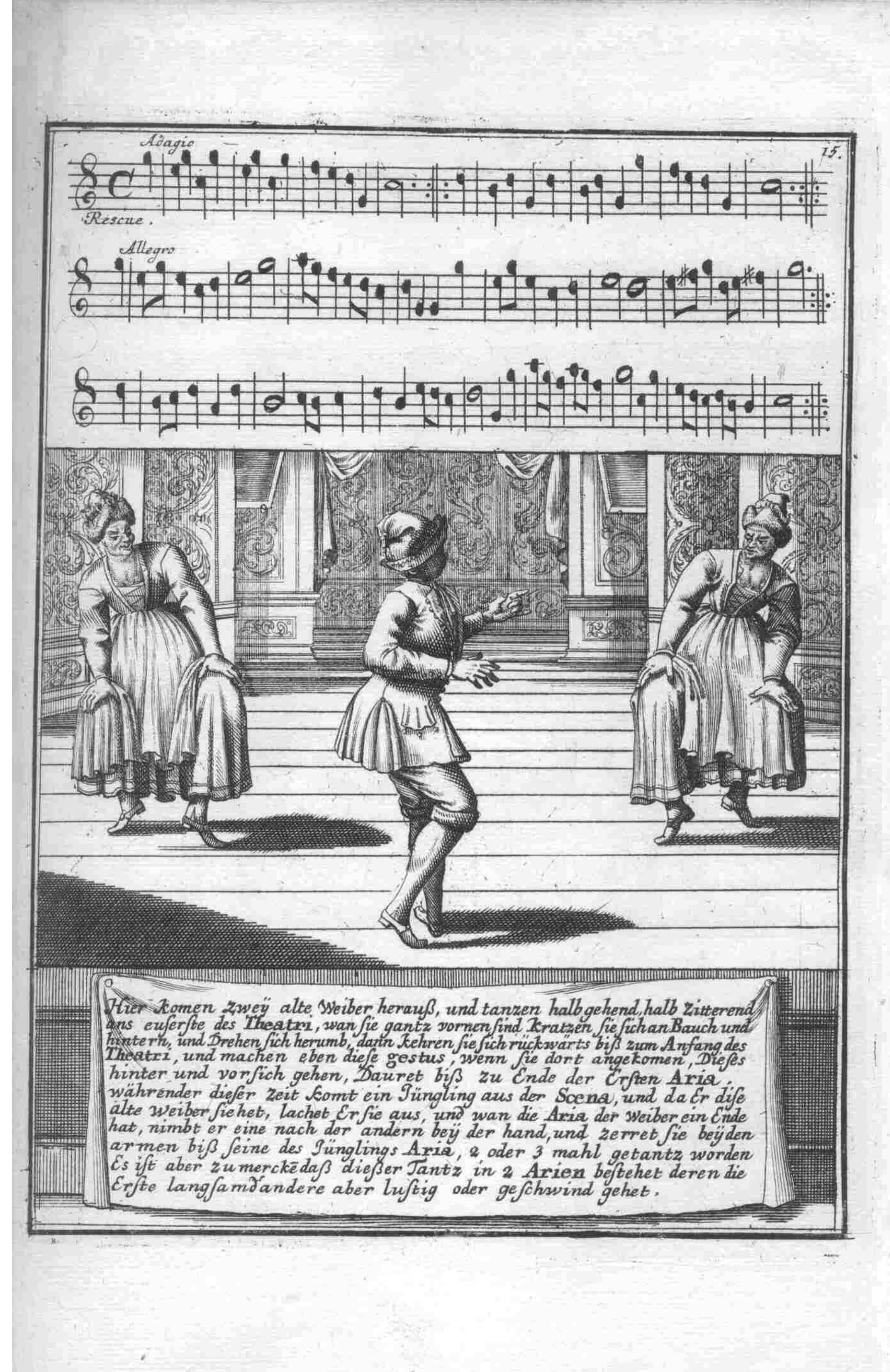
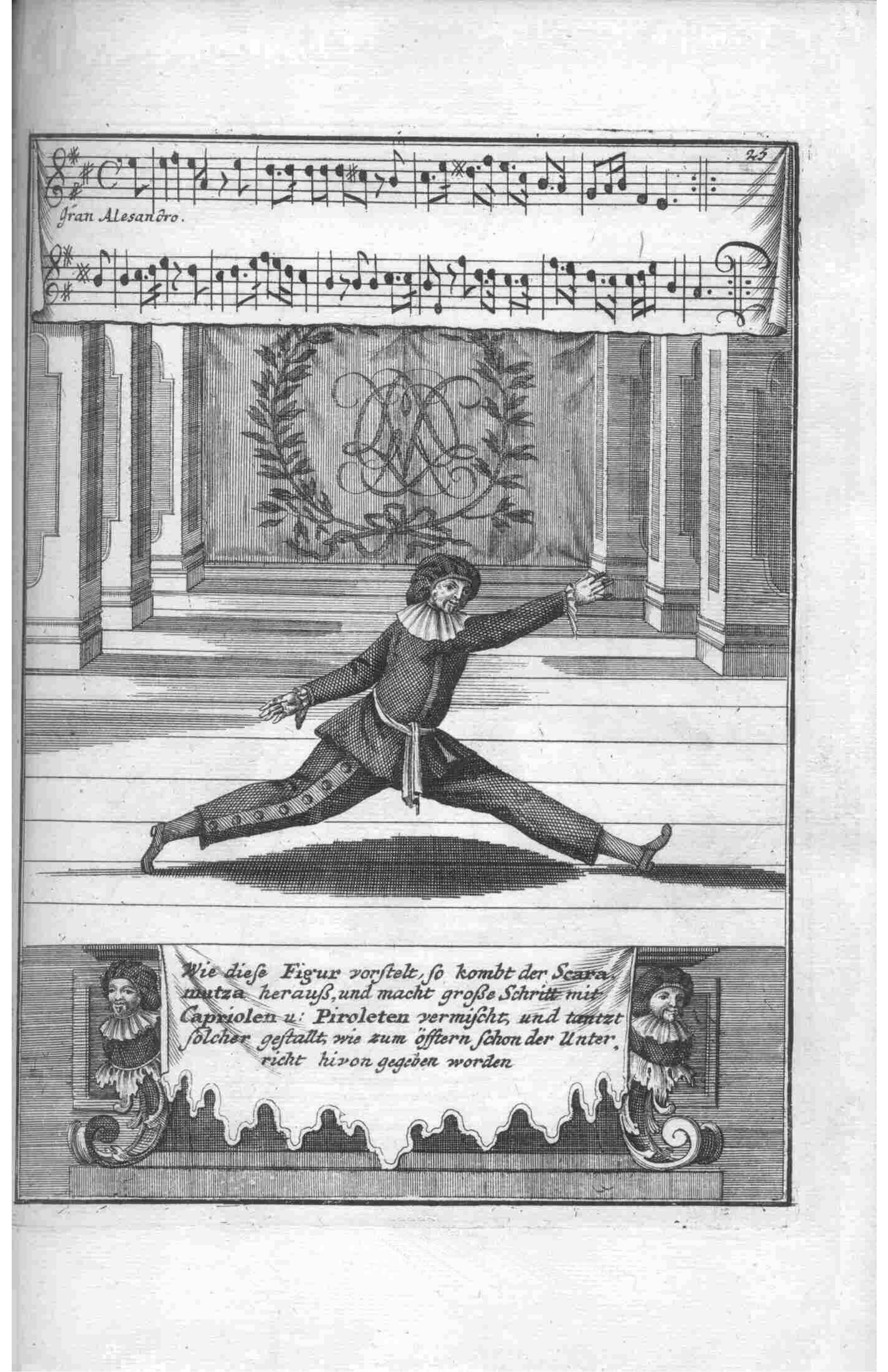
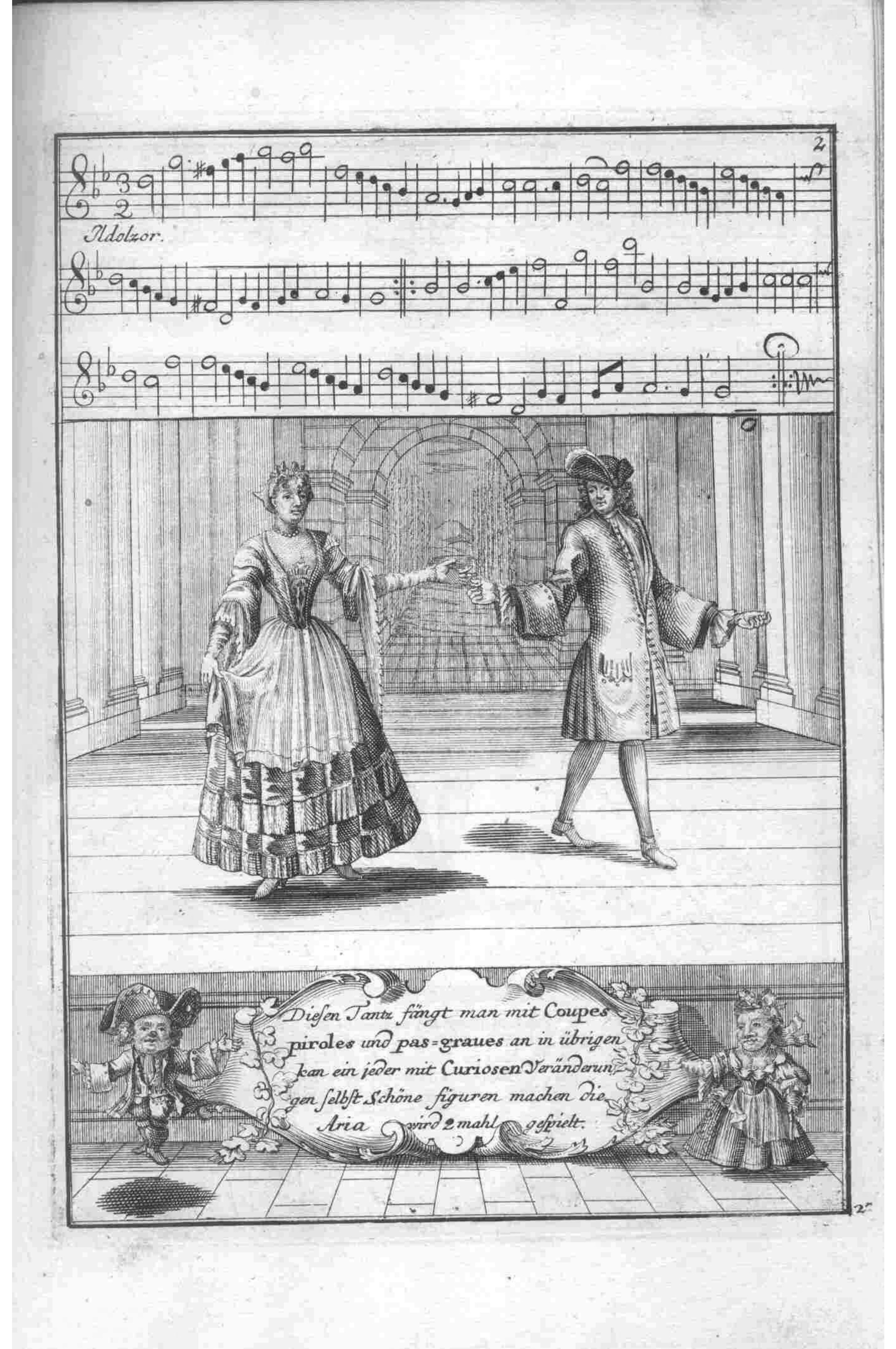
A formal Baroque theatrical scene on a shallow paved stage set with fluted pilasters and a vaulted archway in the background. A young woman in an elaborate layered gown of white silk with a dark decorative hem stands on the left, her posture formal and composed, while a young man in a fitted coat and breeches stands to the right, gesturing toward her with an extended arm in an attitude of courtship or formal address. The woman's dress features the characteristic silhouette of early eighteenth-century court fashion: a tight bodice, full skirt gathered at the sides, and what appears to be heavy silk or damask underskirts. The man wears a coat with buttons and cuffs, his leg extended in a relaxed but elegant line. The stage setting emphasizes the theatrical artificiality of the scene—this is not a ballroom but a representation of courtly behavior for an audience learning dance through observation.
The dancing
Both figures maintain an upright, formal posture characteristic of court dance. The woman stands with her weight centered and hands held before her, her gaze directed toward the man; the man's extended arm and open frame suggest he is offering invitation or making a formal presentation. Neither figure shows weight transfer or the dynamic turnout associated with later ballet technique. The distance between them—perhaps three feet—is neither touching nor closed; this suggests a structured approach rather than a partnered hold. Their body alignment is frontal and open to the viewer, a presentational stance rather than an inward-focused partnership.
The dance depicted
This image represents theatrical dance instruction from Lambranzi's manual, the most comprehensive European record of courtly and stage dance technique in the early 1700s. The formal dress, staged setting, and studied postures indicate a minuet or similar slow courtly dance of the Baroque period. The distance between the partners and the woman's composed stance support this: the minuet was characterized by restrained movement, careful footwork, and the illusion of effortless grace. Lambranzi's plates were the primary means by which dancers across Europe learned choreography from written notation and engraved figures; this plate would have been studied in dance studios from London to Venice.
How it was made
This is a copper-plate engraving, a medium that allowed fine linear detail and required the artist to work in reverse on a polished copper surface before printing. Engraving was the highest-status reproductive medium of the period and was used exclusively for prestige publications aimed at educated readers and nobility. The clear, precise lines allowed dance notation (shown at the top of the plate) and costume detail to be read with precision across multiple impressions, making it ideal for instructional use. The technique's cost and technical difficulty meant that only the most important dance manuals received engraved plates; this signals that Lambranzi's *Scuola* was a major investment and a work intended for serious students and patrons.
About this work
Plate 52 from Gregorio Lambranzi's *Nuova e curiosa scuola de' balli theatrali* (Nuremberg, 1716) is a copper-plate engraving that documents Baroque courtly dance through the simultaneous presentation of musical notation, costumed figures, and a detailed stage setting. It is one of the most important visual records of how early eighteenth-century dancers moved, dressed, and presented themselves on stage. The work sits at the intersection of dance instruction, theatrical practice, and courtly social behavior, showing how formalized, reproducible movement could be disseminated across Europe through print. For historians of Baroque dance, this is a primary source of both technique and cultural meaning; for artists and printmakers, it exemplifies the engraver's role in documenting performance before photography.
How to look at it
Look at the distance between the two figures and the formal opening of their frames: this is not partnership dancing as we think of it, but rather a structured social exchange in which the man offers and the woman receives. Notice the fabric and silhouette of the woman's gown—the heavy, gathered skirts would move only with weight shift and careful control of the hips, not with quick footwork. The engraver has chosen to show both figures in profile or three-quarter view, which was the convention for dance documentation: it allows the viewer to see the line of the body and the position of the feet. The musical notation above the figures tells us the tempo and meter; the stage setting below anchors this as theatrical, not social, dancing.
The artist
Gregorio Lambranzi was a choreographer and dance master active in Nuremberg in the early eighteenth century. Little is known of his personal life, but his *Nuova e curiosa scuola de' balli theatrali* (1716) established him as one of the most systematic and ambitious documenters of dance in the early modern period. The manual, printed in two volumes with 110 engraved plates, presents dances arranged by type and difficulty, each with musical notation and multiple figures showing position and attitude. Lambranzi's approach combined the Italian tradition of court dance with theatrical spectacle; his manual was reprinted and translated for over a century, testifying to its practical value and influence. It represents a moment when dance was beginning to be recorded systematically in print, a precursor to the more formal notation systems (like Beauchamp-Feuillet notation) that followed.
The period
In 1716, European court dance was at an inflection point. The absolute monarchy of Louis XIV (who died in 1715) had established dance as essential courtly behavior, and the minuet and other court dances were spreading rapidly through the nobility and merchant classes across Europe. At the same time, theatrical dance was developing as a distinct practice, separate from social dancing; this is what Lambranzi documents—choreographed, staged movement for an audience, not for participation. In visual art, engraving as an instructional medium was at its peak; photography did not yet exist, and detailed engravings were the closest equivalent to modern instructional video. Lambranzi's manual appeared at the moment when dance was becoming both a codified art form and an object of systematic study.
Where it lives
This is a plate from *Nuova e curiosa scuola de' balli theatrali*, a two-volume choreographic manual first published in Nuremberg in 1716. The work is held in numerous libraries and archives across Europe and North America; this particular plate is from the Library of Congress. The manual was reprinted in facsimile in the twentieth century and remains in print, making it one of the most accessible primary sources for Baroque dance.
Dance in this work
Questions about this work
How do we know what Baroque dance actually looked like?
Lambranzi's *Scuola* is our best visual source. Dance notation systems like Beauchamp-Feuillet existed but are difficult to read; written descriptions are vague. Lambranzi's engravings show actual costumed figures in dance positions, allowing us to see posture, frame, and spatial relationships. The musical notation above each plate tells us the tempo and structure. When combined with written sources and the few surviving dance scores, Lambranzi's plates let us reconstruct how dancers moved with reasonable confidence.
Is this a social dance or a theatrical dance?
It is a theatrical dance—a choreographed, staged scene meant to be watched, not participated in. The stage setting with its architecture, the formal costumes, and the notation all indicate this. However, the movement vocabulary is drawn from court dance, which was social in origin. Lambranzi's genius was to document how courtly movement could be lifted onto a stage and made into spectacle, a transition that was crucial to the development of ballet.
What is the movement in this moment?
We cannot know for certain without the notation, but the postures suggest a formal approach: the man is likely preparing to offer his hand or to move into a turn; the woman is poised in a moment of readiness. Both are 'in frame'—that is, posed in the positions prescribed by the minuet or similar courtly dance. The distance between them (about a short stride) is typical for Baroque partnering, which did not involve a closed ballroom hold.
How was Lambranzi's book used?
Dance masters and serious students of dance would study the plates and the notation together, learning steps and sequences by reading and observing. The book was expensive and prestigious, likely owned by court dance masters, professional choreographers, and wealthy amateurs. It was reprinted multiple times and translated into French and English, suggesting it was a standard reference for anyone teaching or learning courtly and theatrical dance across Europe.
More Notation/Choreography artwork