49 works in this view — arrow keys or swipe to move between them.
Dance in Art
Solo Dancer — Plate 53
Gregorio Lambranzi
- Medium:
- Copper-plate engraving
- Dance:
- Notation/Choreography
- Era:
- 1700s (Enlightenment/Minuet Era)
- Collection:
- Nuova e curiosa scuola de' balli theatrali (1716)
- Source:
- Library of Congress
- Rights:
- Public domain — free to use, share and adapt.
- Recorded as:
- Public Domain
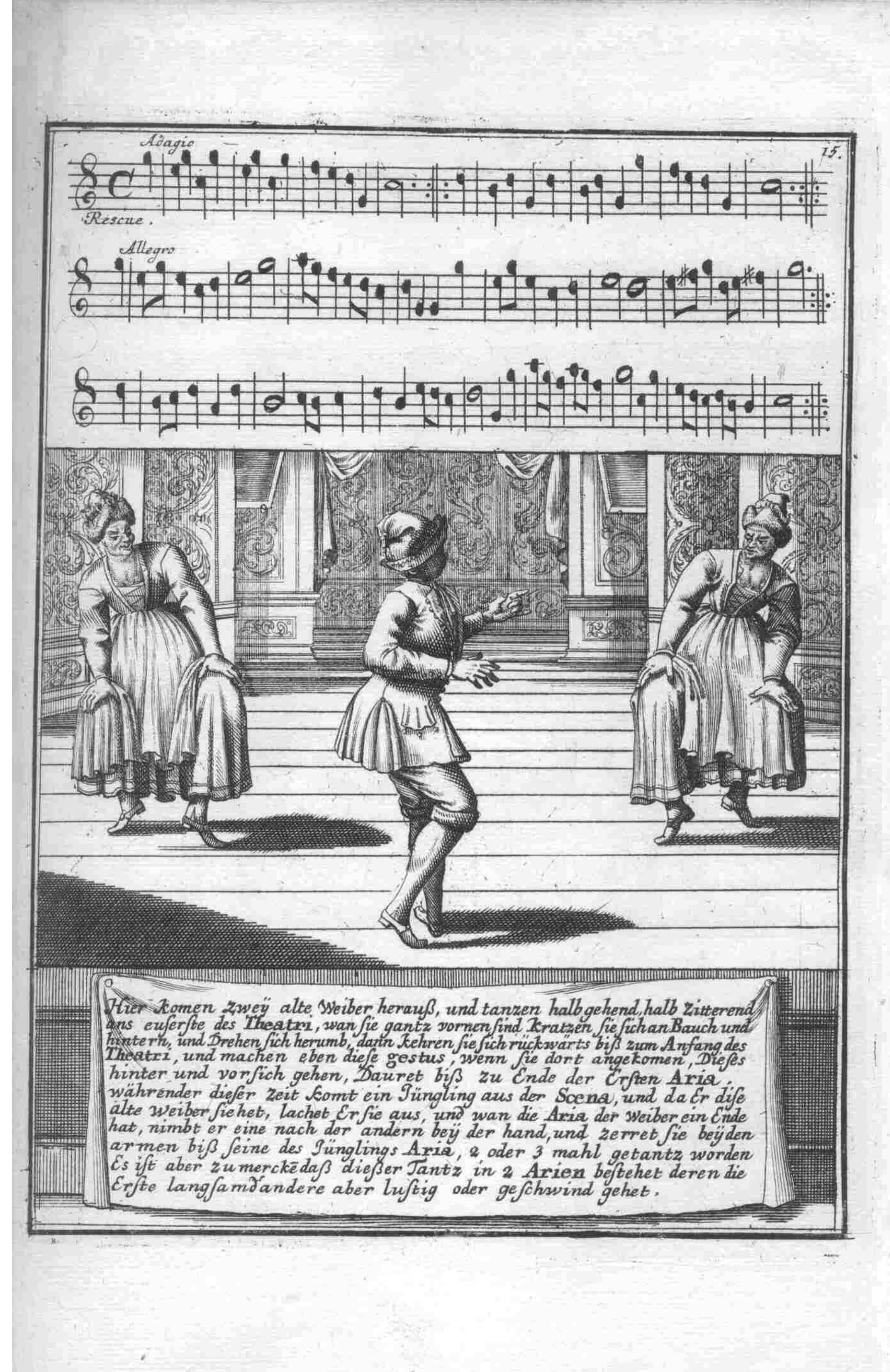
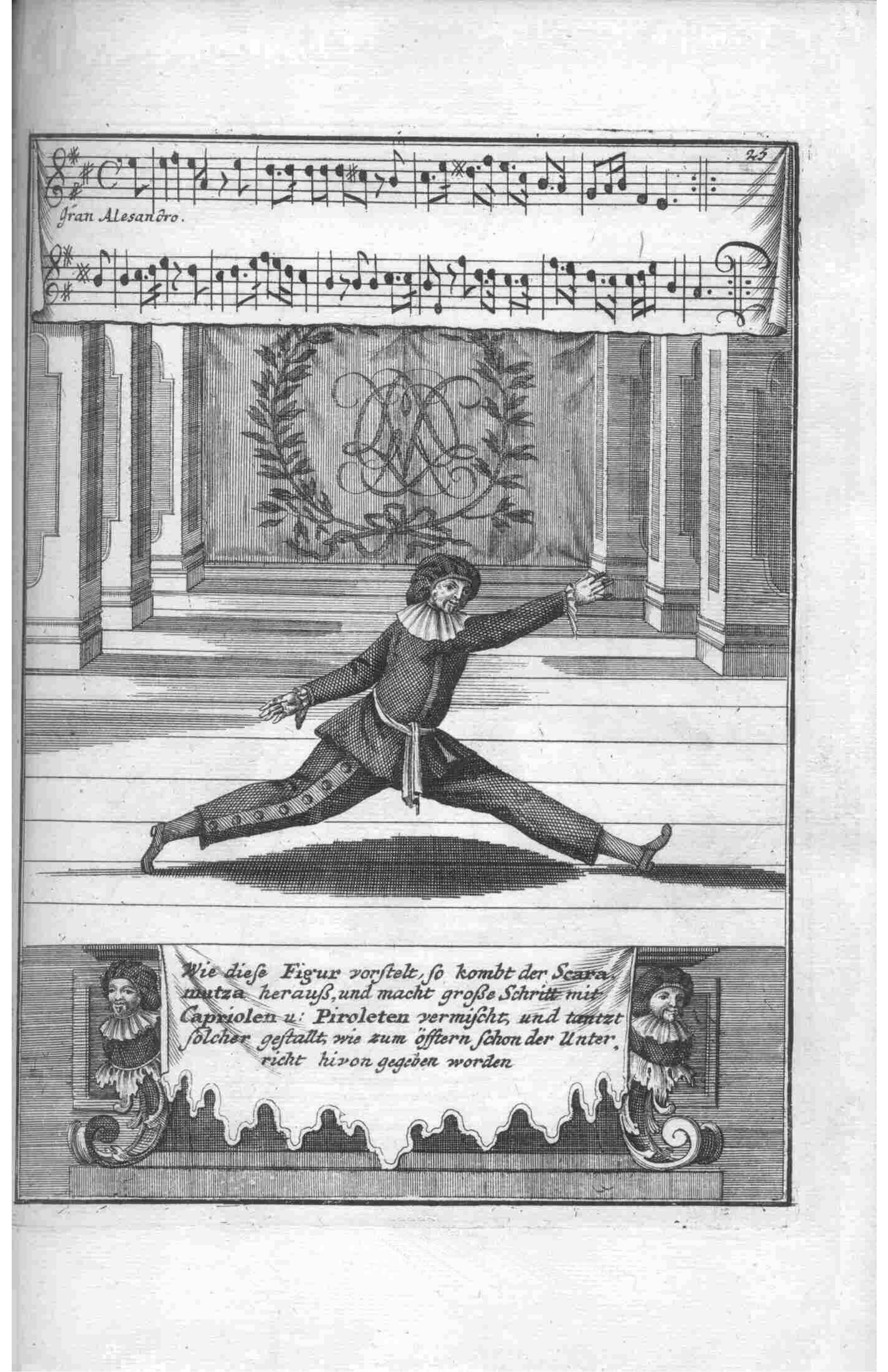
Lambranzi's manual is one of the earliest and most detailed printed records of how early 18th-century theatrical dancers actually moved and dressed. Historians of baroque dance, choreographers reconstructing period works, and artists interested in dance imagery as a historical source all rely on these engravings as evidence of technique, costume, and stage practice. The pairing of notated music with precise visual documentation makes this an unusually rich record of how choreography, music, and performance were coordinated in the period.
What you are looking at
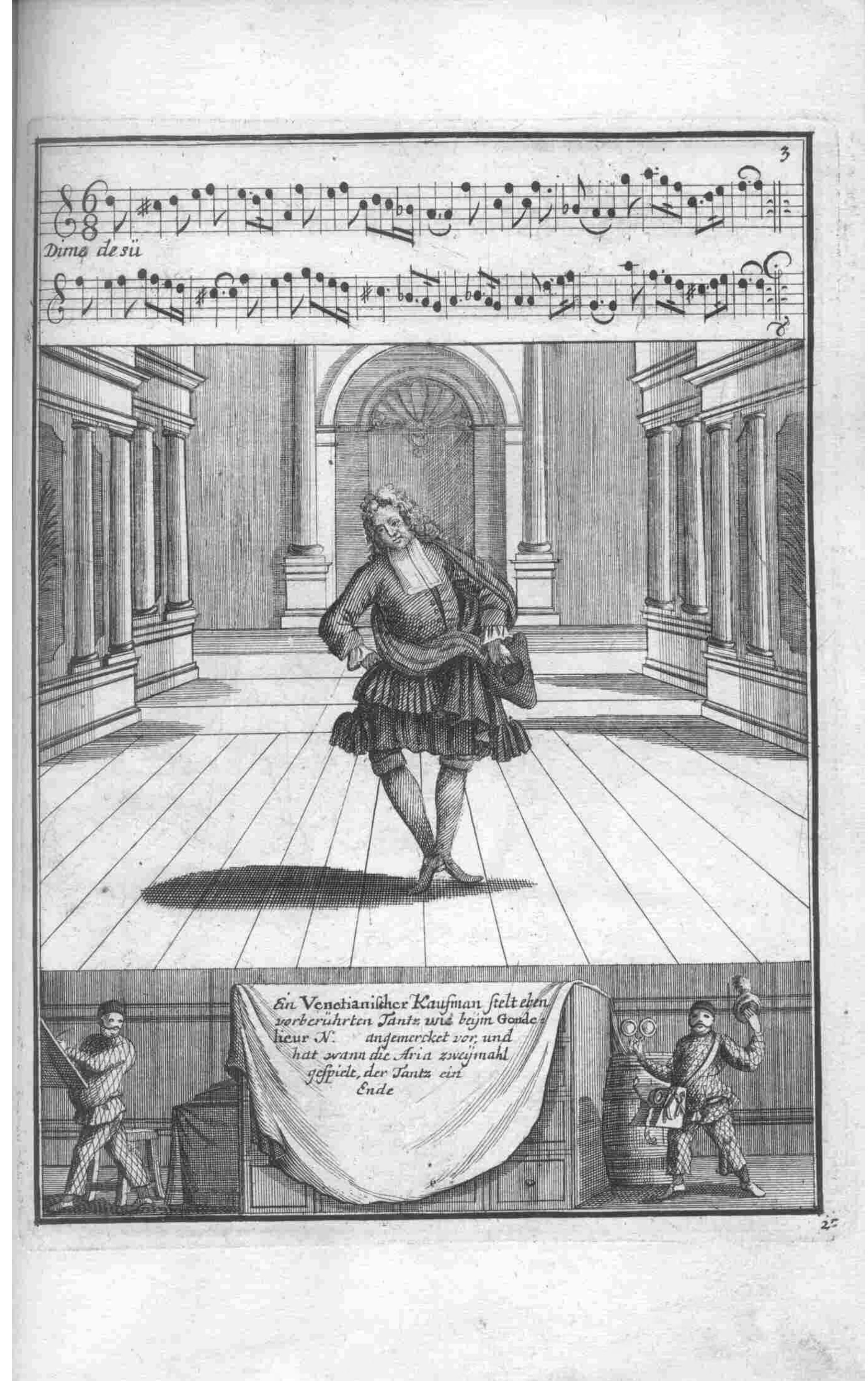
A solo male dancer occupies the center of a classical interior stage, framed by paired Corinthian columns on either side and a barrel-vaulted apse with a lunette window behind him. The stage floor is rendered in strict linear perspective, receding sharply toward the back wall. The dancer wears aristocratic costume: a plumed hat, ornate jacket with patterned embroidery, knee breeches, stockings, and heeled shoes. His posture is upright and formal, with one arm extended and the other held at his side in a controlled position. The setting is austere and architectural rather than theatrical—no curtains, no scenery—emphasizing the dancer's body as the sole focus of attention. Above the engraving, two staves of musical notation with the instruction "Dima de su" indicate the accompanying music. Below, a German verse in a decorative cartouche provides context or caption for the performance.
The dancing
The dancer stands in a balanced, frontal position with weight evenly distributed and legs extended in a controlled line. His right arm is raised and extended forward at approximately shoulder height; his left hangs at his side with the hand gesturing. The posture suggests either a transitional moment between steps or a held pose meant to display the body's alignment and the elegance of his costume. There is no visible partner or ensemble—this is a solo male performer. The formality of the stance and the symmetrical framing suggest this is not a moment of vigorous motion but rather a pose chosen to demonstrate courtly carriage and the precise positioning valued in the period.
The dance depicted
This is a theatrical dance from the early 18th-century courtly tradition, most likely a minuet or a related baroque solo form intended for professional theatrical performance rather than social dancing. The architectural stage setting and formal notation suggest this comes from a master's teaching manual, documenting a specific choreographed solo with its corresponding music. The costume—plumed hat, embroidered coat, heeled shoes—identifies this as a performer of rank and training in the courtly dance tradition. The upright posture, controlled arm placement, and balanced weight distribution are consistent with baroque dance technique as taught and notated during this period.
How it was made
This is a copper-plate engraving, a medium that allowed for precise linear detail and wide circulation. The fine parallel lines (hatching) create volume and shade in the figure and architecture; the perspective construction demonstrates the engraver's command of spatial recession. Engravings of this type were more durable and reproducible than etchings, making them ideal for a teaching manual or dance instruction book that would be consulted repeatedly and shared among practitioners across multiple copies. The technique's clarity and detail allowed the engraver to render both the fine architecture of the stage and the nuances of the dancer's dress and carriage.
About this work
This is one plate from Gregorio Lambranzi's *Nuova e curiosa scuola de' balli theatrali*, a foundational illustrated dance manual published in Nuremberg in 1716. Each plate pairs a musical notation (indicating the choreography's temporal structure) with an engraved image of a costumed dancer performing in a formal architectural setting. The work is a primary document of early 18th-century theatrical dance practice and was influential across Europe; it survives in multiple editions and copies, attesting to its value as a teaching and reference tool.
The manual bridges notation and visual representation: the music staff tells one kind of truth about the dance's structure, while the engraved image shows the body's position, the performer's costume, and the spatial logic of the stage. Together, they constitute a form of choreographic documentation that combines gesture, music, and setting into a coherent pedagogical record.
How to look at it
Observe the dancer's stillness and symmetry: he is not caught mid-leap or in a fluid transition, but posed in a balanced, frontal stance that allows the viewer—and the student—to read the precise placement of every limb. The architectural framing, with its matched columns and recession, serves to stabilize and dignify the figure; he is presented not as a figure in motion but as a geometric form in space. Look at how the heeled shoes, the angle of the arm, and the set of the shoulders all contribute to a single, unified statement of carriage and control. This is a teaching image: it shows not the excitement of performance but the standards of correctness the student is meant to internalize.
The artist
Gregorio Lambranzi was an Italian dancing master and choreographer active in the early 18th century. His *Nuova e curiosa scuola de' balli theatrali* (New and Curious School of Theatrical Dances), published in Nuremberg in 1716, is his principal surviving work. The manual documents theatrical dances—solo and ensemble pieces—with paired musical notation and engravings, establishing a systematic method for recording and teaching choreography. The work draws on both Italian and French courtly dance traditions and served as a teaching text across northern Europe.
The period
The early 18th century was a period of transition in European dance. The baroque dance tradition, centered on the French court and codified in Louis XIV's Académie Royale de Danse, was at its height; yet new forms of theatrical dance, distinct from courtly social dancing, were beginning to develop. Dance manuals and notation systems were proliferating—Feuillet's notation system, published in the 1690s, had established a method for recording dance in print. Lambranzi's manual arrived in this context of systematization and documentation, offering a synthesis of courtly technique and theatrical presentation. In the visual arts, the precise linear perspective and careful architectural framing seen here reflect baroque aesthetics and the period's interest in geometric precision and ordered space.
Where it lives
This plate comes from the *Nuova e curiosa scuola de' balli theatrali*, a two-volume illustrated dance manual first published in Nuremberg in 1716 and later reprinted in other editions. The work is held in the Library of Congress and other major collections, reflecting its historical importance as a foundational document of dance pedagogy and performance practice.
Dance in this work
Questions about this work
Is this a real person or a generic demonstration figure?
The engraving is a teaching image, not a portrait of a specific performer. The dancer represents an idealized figure demonstrating a choreographed step or position from a named dance with its corresponding music. The costume and carriage are typical of a trained theatrical dancer of the period, not a likeness.
What is the music notation at the top for?
The notated music indicates the temporal and harmonic structure of the choreographed dance. In early 18th-century practice, dance was coordinated with music; the notation allows teachers and dancers to understand the relationship between the step sequence and the music's phrasing. The text "Dima de su" may indicate the dance's title or character.
Why is the stage so bare and architectural?
The austere architectural setting isolates the dancer's body as the primary subject, making it easier for a student to observe and copy the position of the limbs, the carriage, and the alignment. It also reflects the formality of courtly dance tradition, where the body itself is the primary decoration and expression. The perspectival recession creates spatial depth and grounds the figure in a coherent stage space.
What kind of dance is this?
Without being able to read the German text beneath the image clearly, the specific name of this dance cannot be determined with certainty. However, the costume, posture, and formal architectural setting are consistent with the minuet or a related theatrical baroque solo form. Lambranzi's manual includes many such dances, each with its own character and music.
More Notation/Choreography artwork