49 works in this view — arrow keys or swipe to move between them.
Dance in Art
Courtly Couple — Plate 54
Gregorio Lambranzi
- Medium:
- Copper-plate engraving
- Dance:
- Notation/Choreography
- Era:
- 1700s (Enlightenment/Minuet Era)
- Collection:
- Nuova e curiosa scuola de' balli theatrali (1716)
- Source:
- Library of Congress
- Rights:
- Public domain — free to use, share and adapt.
- Recorded as:
- Public Domain
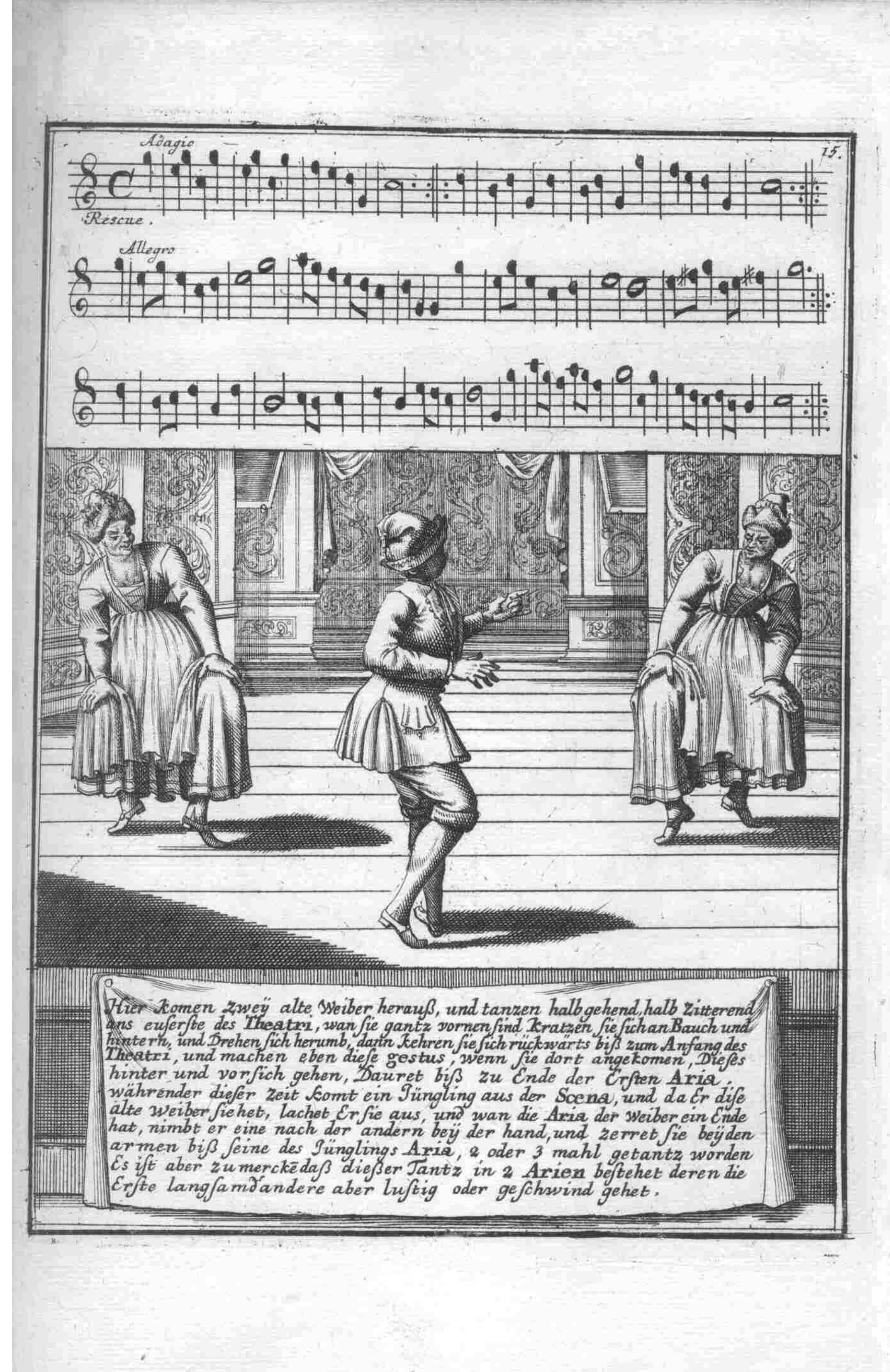
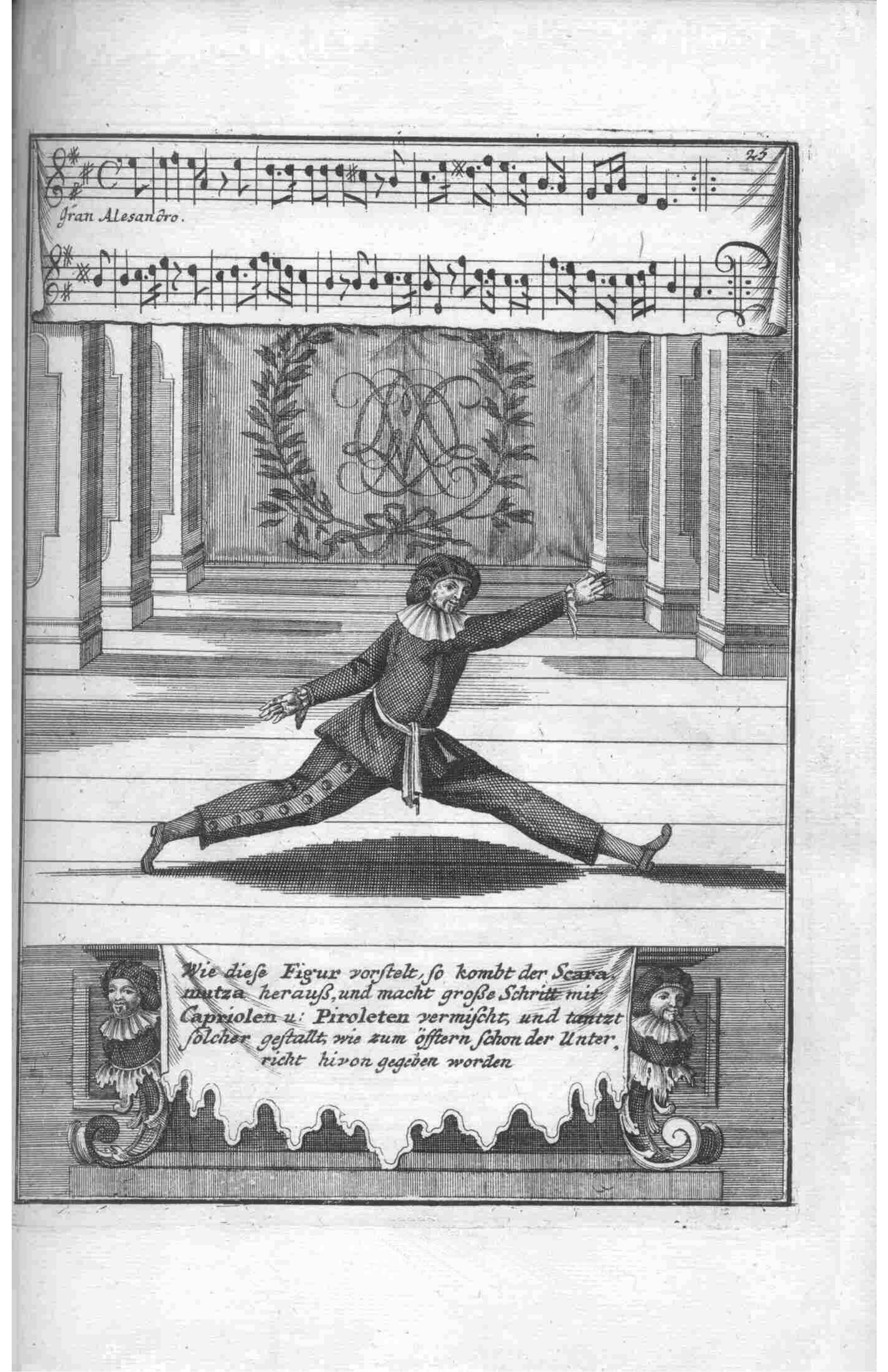
Lambranzi's treatise is one of the few surviving sources that documents actual baroque choreography through both notation and visual representation. For dancers and historians, this plate provides rare evidence of how the minuet—perhaps the most important social and theatrical dance of the era—was actually performed, including the formal frame, spacing, and courtly deportment that defined it. The engraving also illustrates how dance was transmitted through print culture, turning ephemeral performance into a teachable, shareable, and collectible object.
What you are looking at
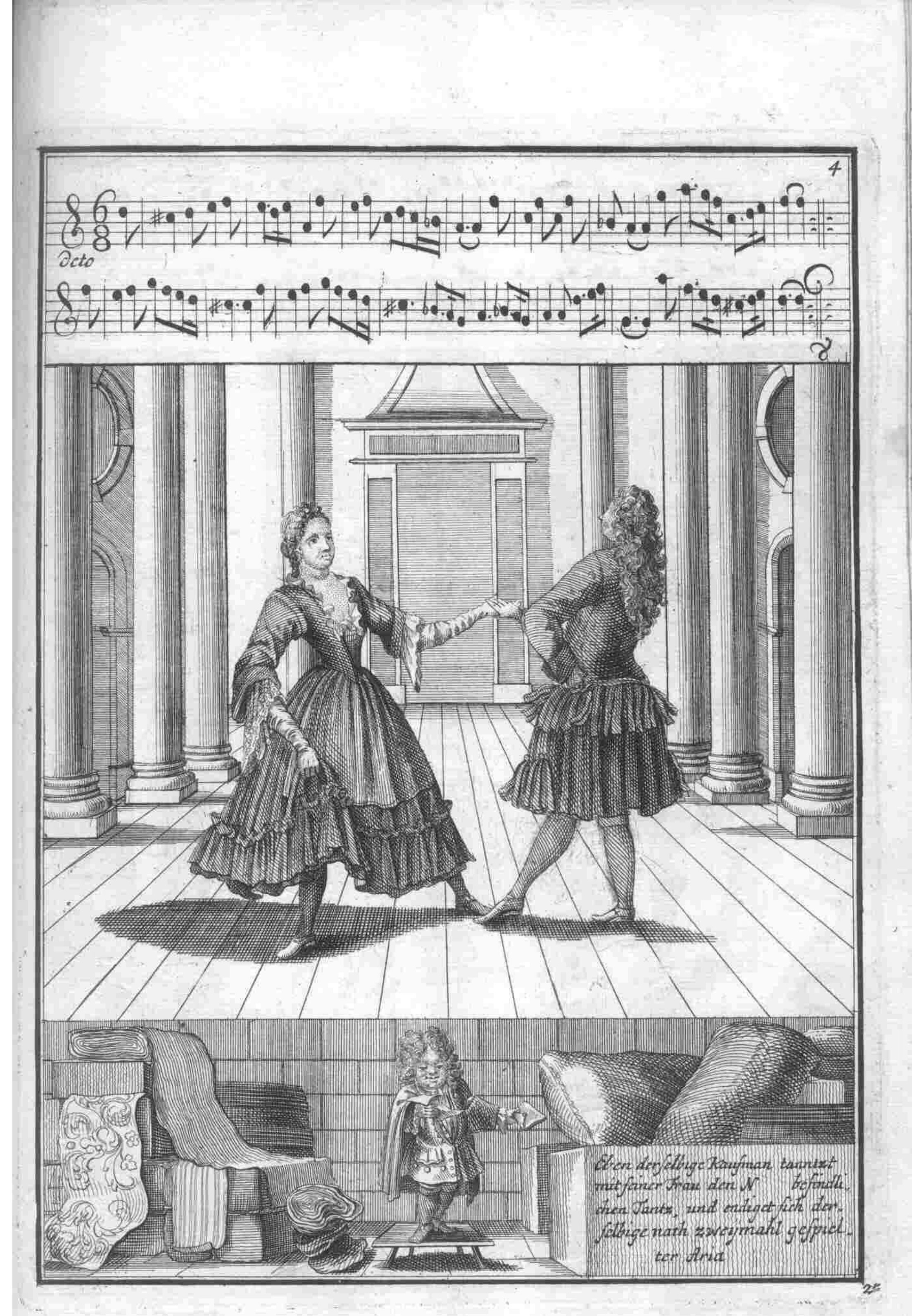
A man and woman in elaborate 18th-century courtly dress face each other in a columned hall, their bodies angled in a formal dancing posture. The woman wears a heavily flounced skirt with multiple tiers of pleating and a fitted bodice; the man wears a coat with full skirts and breeches. The architectural setting is severe—tall fluted columns frame the couple against a receding floor with a distant doorway, suggesting a palace or grand house interior. The engraving's fine hatching creates shadow and depth, emphasizing the theatrical nature of the space. A small vignette below shows a child and domestic items, possibly indicating the dance's theatrical context or a scene from a performance narrative.
The dancing
Both dancers stand upright with bodies slightly rotated toward each other in a formal, courtly frame. The woman's right arm extends toward the man's hand; his left arm mirrors hers. Their upper bodies maintain the stiffness characteristic of court dance, with heads held high and weight centered. The posture suggests the beginning or a moment within a formal couple dance—neither in active traveling movement nor in a tight embrace, but in the poised, controlled positioning typical of minuet or similar baroque court dances.
The dance depicted
This is almost certainly a minuet or a similar courtly couple dance of the baroque era. The formal facing position, the arm extension, and the upright carriage are hallmarks of the minuet, which dominated European court dance in the 18th century. Lambranzi's treatise documents theatrical versions of court and social dances with musical notation, so this couple likely represents professional or trained dancers performing a stylized minuet for an audience rather than a social dancing couple. The notation at the top of the plate confirms the dance was accompanied by composed music.
How it was made
This is a copper-plate engraving, a medium that allowed precise line work and fine tonal gradation through hatching—visible here in the columned architecture and the folds of the dancers' costumes. Engraving was the standard method for reproducing dance instruction books in this period; the technique's clarity and durability made it ideal for repeated impressions sold to subscribers and institutions. Lambranzi's use of engraving, combined with music notation and architectural framing, elevated dance notation from technical diagram to a form of visual theater—each plate was designed to be studied, performed from, and appreciated as a complete artistic statement.
About this work
This is Plate 54 from Gregorio Lambranzi's *Nuova e curiosa scuola de' balli theatrali* (Nuremberg, 1716), one of the most influential and comprehensive dance manuals of the early 18th century. The work documents theatrical dances—many of them stylized versions of courtly and social forms—pairing each dance with its musical notation, choreographic direction, and engraved illustration of the dancers in costume and setting. Lambranzi's treatise bridges the worlds of court, theater, and social dance, and his engravings are among the finest surviving visual records of how baroque dances were actually performed.
This particular plate depicts what appears to be a minuet or formal courtly couple dance, shown at the moment of greeting or opening salutation. The precision of the engraving and the architectural grandeur of the setting emphasize that this is a theatrical performance, not a casual social dancing scene. The work belongs in a dance collection because it is both a historical record of choreography and a work of visual art that shaped how dance was conceived, taught, and remembered in the 18th century and beyond.
How to look at it
Notice the formal geometry of the composition: the couple is centered and symmetrical, the columns frame and stabilize the space, and the floor recedes toward a distant threshold. This architectural precision was intentional—it emphasizes the control and artifice of the dance, distinguishing it from casual movement. Watch the arm position, which is neither fully extended nor relaxed but held in the formal line characteristic of court dance. The moment chosen is one of greeting or opening, not traveling—the dancers are poised and presented rather than captured mid-motion. This static, presentational quality is typical of how baroque dance was visualized in prints: the goal was to show the *posture and frame* of the dance rather than its traveling and turning sequences.
The artist
Gregorio Lambranzi was a dancing master and choreographer active in early 18th-century Germany. His *Nuova e curiosa scuola de' balli theatrali* (New and Curious School of Theatrical Dances), published in Nuremberg in 1716, is recognized as one of the most comprehensive and artistically ambitious dance manuals of its time. The treatise documents both courtly and theatrical dances, many of them with dramatic scenarios, and pairs each with musical notation and detailed engravings. Lambranzi's work was influential across Europe and remained in use for dance instruction well into the 19th century. The quality of the engravings and the specificity of the choreographic descriptions suggest that Lambranzi collaborated closely with skilled engravers and that he was invested in creating a work that would serve both as a practical teaching tool and as a prestigious art object for wealthy subscribers.
The period
In the early 18th century, the minuet had become the dominant social and theatrical dance form across European courts and aristocratic society. Dance manuals and treatises had become increasingly popular and sophisticated, reflecting growing interest in codifying and transmitting dance knowledge through print. Lambranzi's work appeared at a moment when dance was being elevated as a subject worthy of serious artistic and intellectual attention—the engraved plates themselves are miniature works of art, showing the influence of theatrical design and architectural print culture. The inclusion of musical notation with each dance reflects the period's understanding of dance as inseparable from music and composition.
Where it lives
This plate comes from Gregorio Lambranzi's *Nuova e curiosa scuola de' balli theatrali*, first published in Nuremberg in 1716. The work is held at the Library of Congress and is one of the most important surviving dance manuals of the baroque era. The treatise was published as a prestige object for aristocratic and merchant-class subscribers and was subsequently reprinted and translated, making it one of the few dance instruction books of this period to achieve wide circulation.
Dance in this work
Questions about this work
How do we know what this dance is?
The formal couple frame, upright carriage, and facing position are diagnostic of the minuet, which dominated court and theatrical dance in the 18th century. Lambranzi's treatise documents dances by name and with musical notation, so later scholarship has been able to identify which pieces correspond to which dance types. The architectural framing and the presence of a musician's notation confirm this is a formal, codified dance rather than a social improvisation.
Who was Gregorio Lambranzi?
Lambranzi was a dancing master and choreographer based in Nuremberg in the early 18th century. His *Nuova e curiosa scuola de' balli theatrali* is one of the most comprehensive surviving dance manuals from the baroque era. The treatise combines musical notation, choreographic description, and high-quality engravings to document both courtly and theatrical dances. His work was influential across Europe and is valued today as one of the primary sources for understanding how baroque dances were actually performed.
What is an engraving and why does it matter?
An engraving is a print made by incising lines into a metal plate, inking the plate, and pressing paper onto it. Engraving allowed for precise detail and fine gradations of tone through hatching, making it ideal for technical and instructional illustrations. For dance, engraving meant that choreography and movement could be reproduced reliably and distributed to multiple subscribers, teachers, and performers—turning ephemeral, localized dance practices into a shared, portable, and collectible body of knowledge.
Was this a real minuet or a made-up theatrical one?
Both. Lambranzi documents theatrical versions of dances, many of them with dramatic scenarios or character elements. However, they are all based on actual courtly and social dance forms that were performed and recognized. The distinction between 'real' and 'theatrical' was not always sharp in this period—professionals and courtiers would stylize, elaborate, and dramatize the same basic forms. This plate shows a theatrical presentation of a minuet, which means it is heightened and framed for performance, but the underlying dance vocabulary is authentic to its time.
More Notation/Choreography artwork