49 works in this view — arrow keys or swipe to move between them.
Dance in Art
Solo Dancer — Plate 55
Gregorio Lambranzi
- Medium:
- Copper-plate engraving
- Dance:
- Notation/Choreography
- Era:
- 1700s (Enlightenment/Minuet Era)
- Collection:
- Nuova e curiosa scuola de' balli theatrali (1716)
- Source:
- Library of Congress
- Rights:
- Public domain — free to use, share and adapt.
- Recorded as:
- Public Domain
This is one of the earliest European works to systematize theatrical dance in printed form, treating movement with the seriousness previously reserved for music or rhetoric. For dancers and historians, it reveals what the trained body was expected to do and look like in the early 1700s—the posture, the costume, the musicality, the control—and it shows how dance knowledge was transmitted in the pre-Labanotation era. The very existence of this manual argues that dance was no longer an improvised or court-amateur practice but a professional art with techniques that could be taught, recorded, and preserved.
What you are looking at
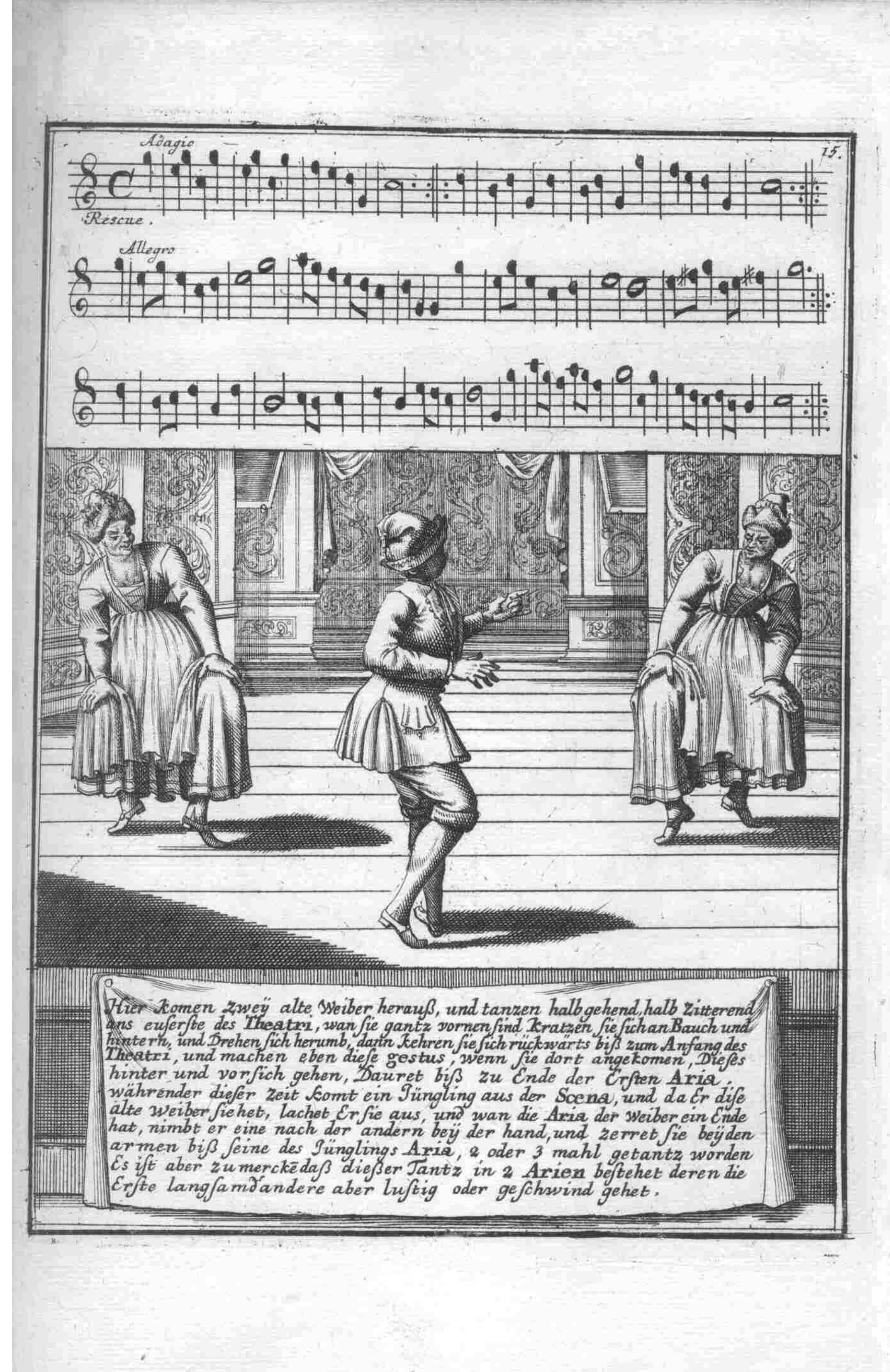
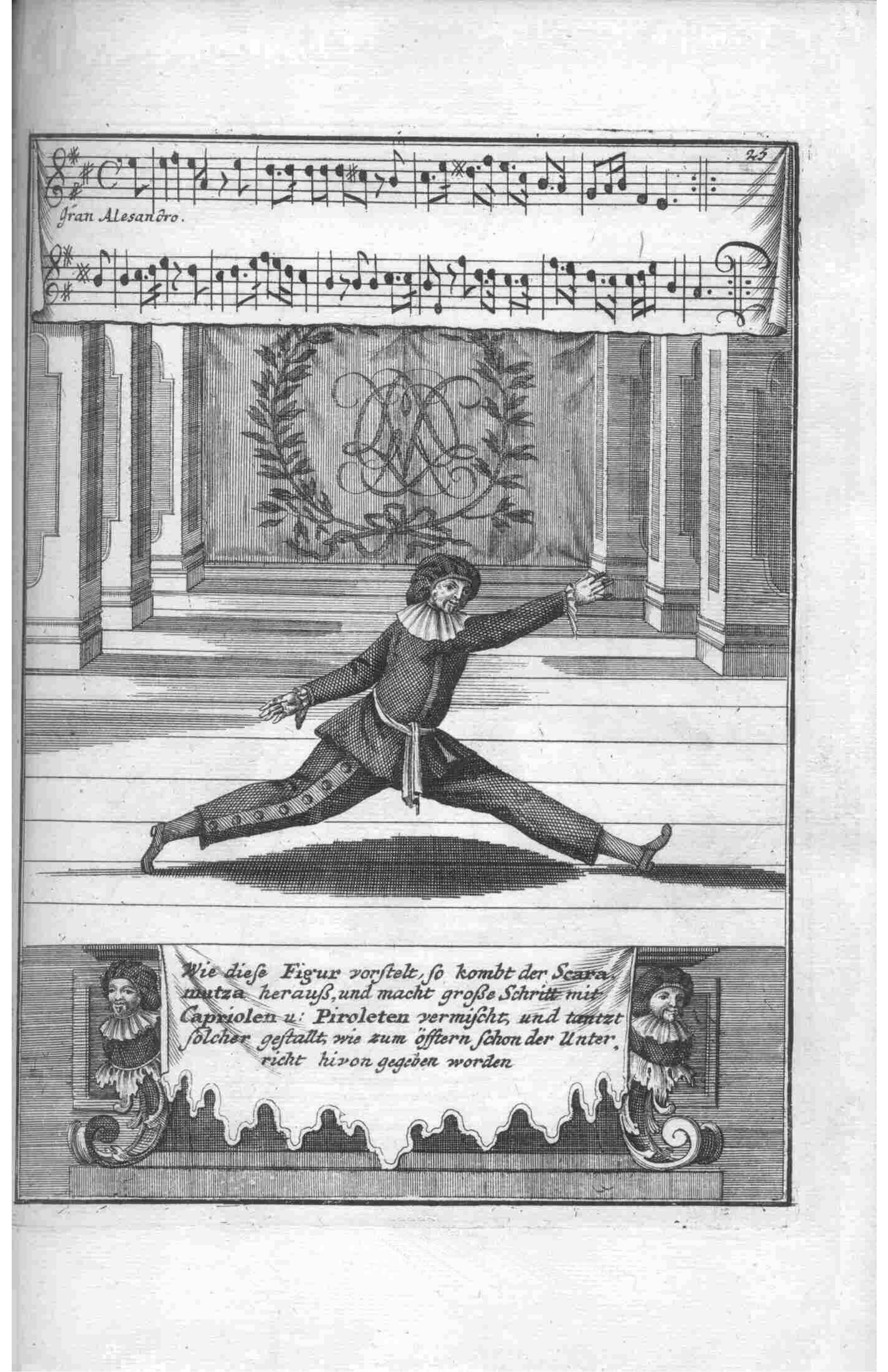
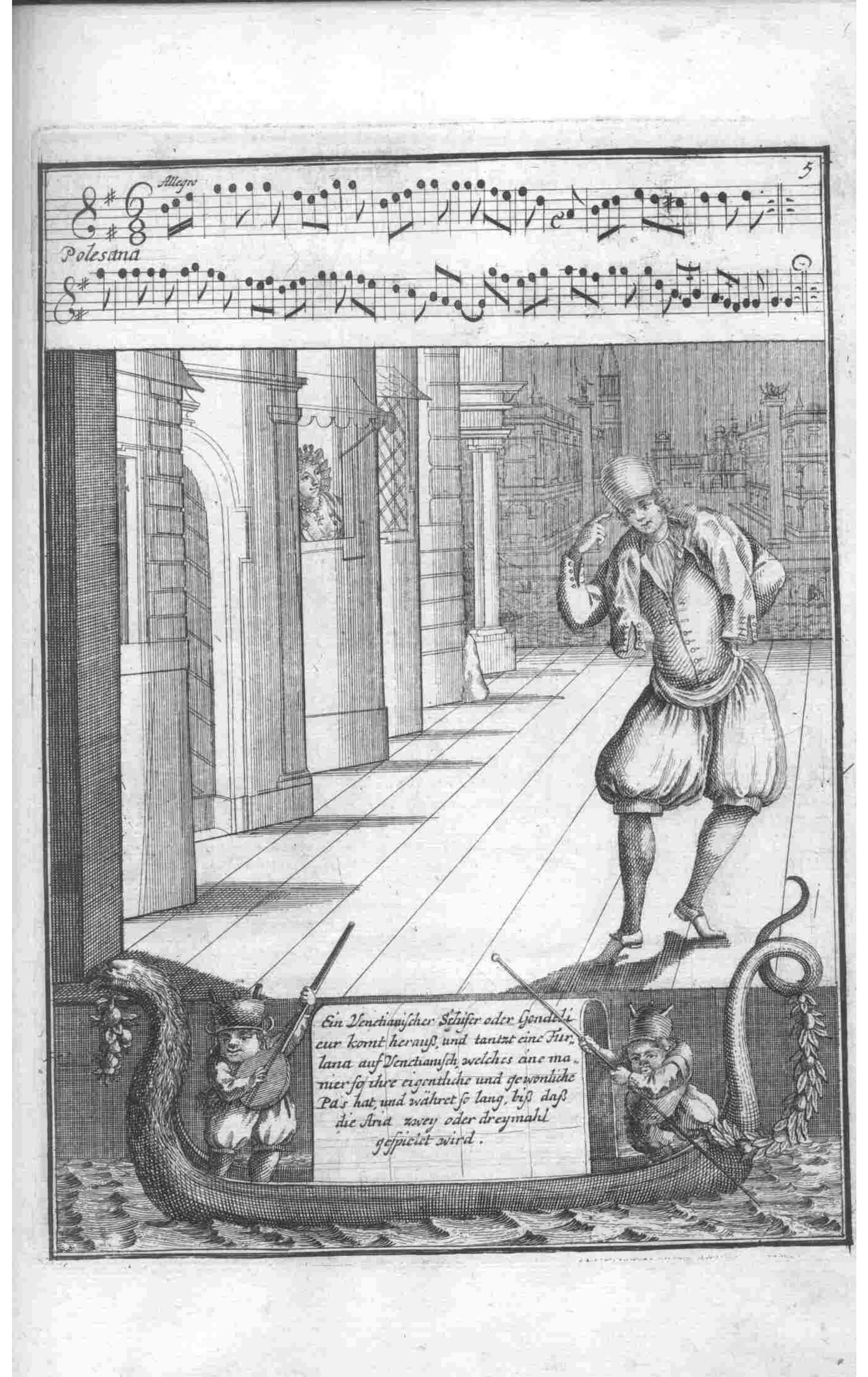
A solo male dancer stands center-stage in a columned interior, mid-movement with arms raised and bent, captured in a moment of theatrical performance. He wears early 18th-century costume: a fitted jacket, breeches, and stockings, with a close-fitting cap on his head. The stage setting is rendered in perspective with classical columns receding into shadow, creating depth and formality. At the top of the engraving, two systems of musical notation in treble clef are inscribed—labeled "Allegro" and "Polesana"—each containing figured bass and melodic line. Below the stage scene sits a decorative cartouche with German text, framed by allegorical figures (a bearded male and a winged putto) carved or depicted in relief, suggesting this is both a practical instruction and a work of art.
The dancing
The dancer's posture is upright and controlled, with knees slightly bent in a preparatory or landing position. His arms are raised to shoulder height, elbows bent, hands turned outward with wrists articulated—a pose suggesting either a preparation for or recovery from a jump or turning movement. The body shows no tension or strain; the weight appears centered and balanced. The costume is fitted but not constraining, and the tightness of the hose makes the line of the leg clearly visible, which is essential for reading the footwork.
The dance depicted
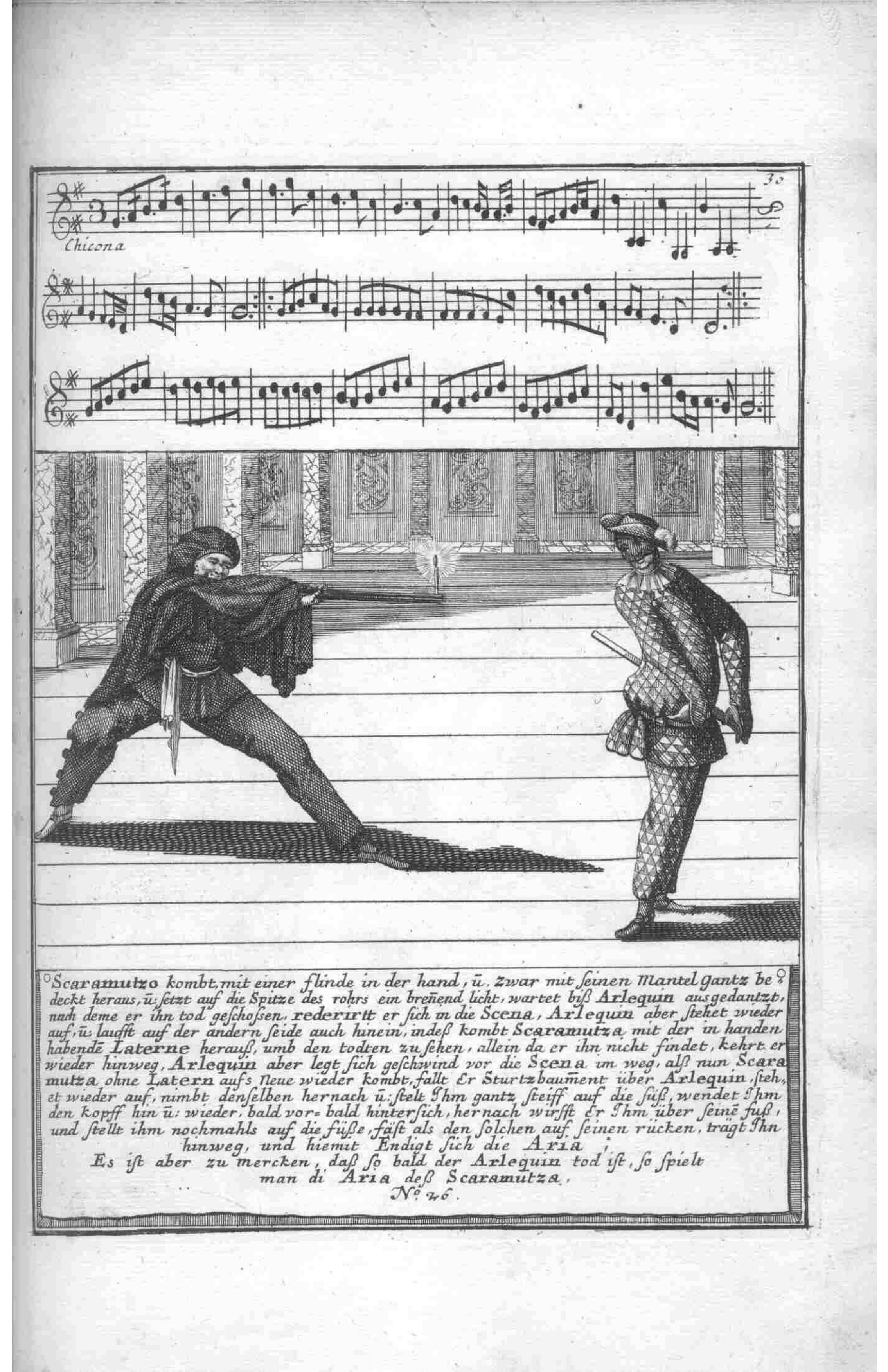
This is a page from Lambranzi's *Nuova e curiosa scuola de' balli theatrali*, the foundational choreographic manual of the early 18th-century Baroque theater dance. The notated music paired with the figure suggests this is a solo from a theatrical ballet or dance suite, likely a *ballo*, *balletto*, or *danza* of the type performed at Italian and German court theaters. The pose—elevated, formalized, self-contained—and the simple theatrical setting indicate this is a display of technique rather than a social or courtship dance. The figure shows a dancer of trained capability, executing what would have been a standard vocabulary of the period: the carriage of the upper body, the turnout implied by the leg position, and the articulation of the arms all indicate Baroque theatrical dance conventions.
How it was made
This is a copper-plate engraving, a technique that allowed for fine detail, precise line work, and reproducibility—critical for a dance instruction manual intended for circulation among theaters and dance masters across Europe. The engraver has rendered the human figure with anatomical observation while maintaining the idealized formality appropriate to its instructional purpose. The combination of music notation and figure on the same plate was a deliberate choice: it bound the visual and sonic elements of dance inseparably, allowing a master or student to read step and music together. Engraving was labor-intensive and expensive, indicating that Lambranzi's work was aimed at serious practitioners and institutional collections, not casual consumers.
About this work
This plate exemplifies the convergence of dance, music notation, and visual representation in early 18th-century theatrical dance pedagogy. Lambranzi's manual was among the first systematic attempts to record and codify the movements and styles of professional stage dancers, making it a primary source for understanding both the technique and the aesthetic values of Baroque dance. The pairing of musical score with figure was revolutionary: it asserted that dance was a learned, notatable art form worthy of the same documentation as music or architecture. The solo male dancer shown here is not an individual performer but a model—an exemplar of correct deportment and technique for other dancers to study and imitate. The work was printed in Nuremberg and circulated widely, influencing dance practice in German and Central European courts and theaters for decades. It bridges the world of the dancing master's notebook and the engraver's shop, representing a moment when theatrical dance began to assert itself as a discipline with its own literature and theory.
How to look at it
Attend to the moment the engraver chose to freeze: this is not the moment of maximum elevation or extension, but a moment of control and readiness—the breath between movements. Notice the alignment of the body: shoulder, hip, and heel are related in a way that suggests formal training. The arms are not relaxed or purely decorative; they are positioned with intention and articulation, implying that arm movement was as much a part of the technique as footwork. Look at the costume: fitted enough to reveal the shape and line of the body, but not so tight as to impede movement. This was a practical as well as aesthetic choice. Finally, observe the musical notation at the top: it is not a transcription of the figure's movement into musical time, but rather the music to which the figure was danced, indicating that music and movement were coordinated but not metrically identical.
The artist
Gregorio Lambranzi (c. 1659–c. 1725) was a dance master and choreographer active in Nuremberg and northern Europe during the late Baroque. Little is documented about his own life beyond his career as a professional dance instructor and his authorship of *Nuova e curiosa scuola de' balli theatrali* (New and Curious School of Theatrical Dances), published in Nuremberg in 1716. The manual, illustrated by engraver Johann Georg Puschkin, represents Lambranzi's effort to codify and preserve the dance vocabulary he had mastered and taught. The work became one of the most influential choreographic texts of its era, widely consulted by dance masters and copied in manuscript. Lambranzi's approach was practical and systematic: each plate presents a single figure, a named step or movement sequence, and the music that accompanied it, treating dance as a teachable discipline.
The period
The early 18th century saw the professionalization and formalization of theatrical dance across Europe. The transition from court spectacle to commercial theater was accelerating, and with it came a need to standardize and record dance vocabularies that had previously been transmitted orally by master to apprentice. Louis XIV's establishment of the Académie Royale de Danse in 1661 had already begun this process in France; Lambranzi's manual was part of a broader movement to systematize and document dance. Music notation was already mature and standardized; dance notation was far behind. The *basse danse*, *pavane*, and *galliard* of the Renaissance had given way to more elaborate theatrical choreographies. By the early 1700s, dancers and choreographers were experimenting with higher jumps, faster footwork, and more complex spatial patterns—all of which required better methods of recording and transmission. Lambranzi's decision to pair each figure with its musical score reflects the inseparability of dance and music in performance, and the need to preserve both together.
Where it lives
This plate is from *Nuova e curiosa scuola de' balli theatrali*, published by the printer Johann Christoph Lochner in Nuremberg in 1716. The original edition contained 52 engraved plates, each pairing a musical score with a costumed dancer. The work was reissued and translated multiple times and in multiple editions, attesting to its popularity and utility among dance professionals. The copy here is held at the Library of Congress.
Dance in this work
Questions about this work
How do we know this dancer's training level?
The posture, the precision of the arm placement, and the clarity of the body line all signal professional training. The dancer is not a courtier or amateur; he is a model for instruction. The very fact that he was deemed worthy of engraving and inclusion in a manual meant for circulation indicates that his technique was exemplary. In the early 18th century, such detailed movement notation in print was rare and reserved for dancers of recognized skill.
What does the music notation tell us?
The presence of music paired with each figure was Lambranzi's innovation. The notation shows the tempo (Allegro, Polesana) and the melody and bass line the dancer performed to. This reveals that theater dancers were performing to composed music, not improvising to musicians' cues, and that the choreography was synchronized to specific musical measures. The combination of score and figure on a single plate made it possible to learn movement in relation to music.
Was this solo from an actual ballet?
Possibly, but more likely it is a generic model or exercise—a *ballo* or *balletto* representing a standard type of theatrical movement that could be inserted into various performances. Lambranzi's manual was a teaching tool for dance masters to use with their students and performers, not a collection of complete works. These plates represent vocabulary, technique, and style—the building blocks of theater dance.
Why is he wearing a cap?
Head coverings were standard male costume for theatrical dancing in this period, both indoors and in courtly settings. The cap was part of the formal theatrical ensemble and would have been removed only in specific dramatic moments. It also kept the dancer's hair in place and presented a clean, formalized line from head to foot.
More Notation/Choreography artwork