49 works in this view — arrow keys or swipe to move between them.
Dance in Art
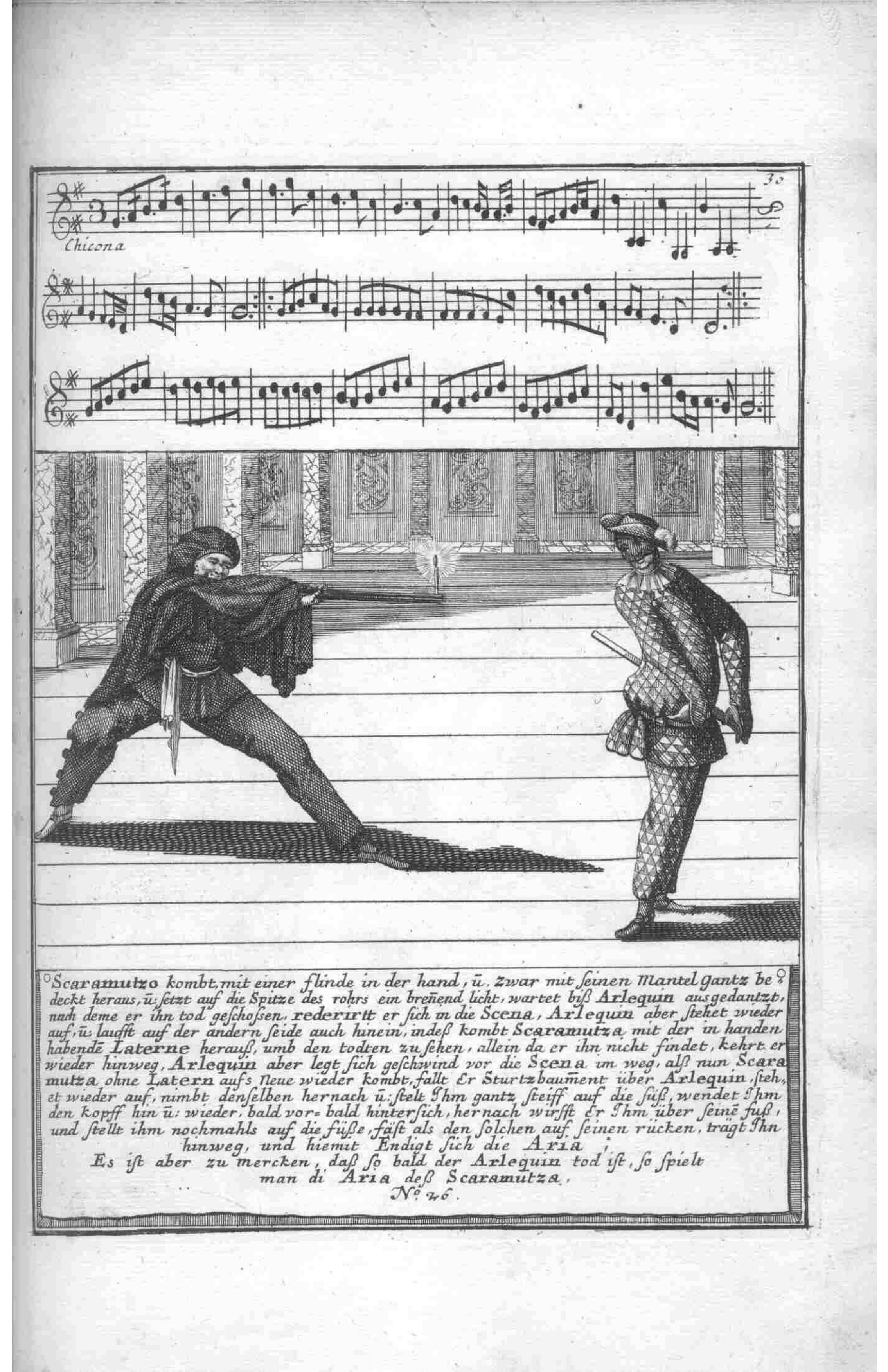
Combat/Duel — Plate 56
Gregorio Lambranzi
- Medium:
- Copper-plate engraving
- Dance:
- Notation/Choreography
- Era:
- 1700s (Enlightenment/Minuet Era)
- Collection:
- Nuova e curiosa scuola de' balli theatrali (1716)
- Source:
- Library of Congress
- Rights:
- Public domain — free to use, share and adapt.
- Recorded as:
- Public Domain
Lambranzi's manual is one of the only surviving visual records of how early 18th-century theatrical dance actually looked—not how it was theorised, but how the body was positioned, dressed, and set in space. The pairing of music and figure made it possible to teach and reproduce dances across distance and time, which transformed dance from an ephemeral court accomplishment into a transmissible art form. This plate in particular documents a genre—the combat dance—that is now extinct but was central to the theatrical vocabulary of the era.
What you are looking at
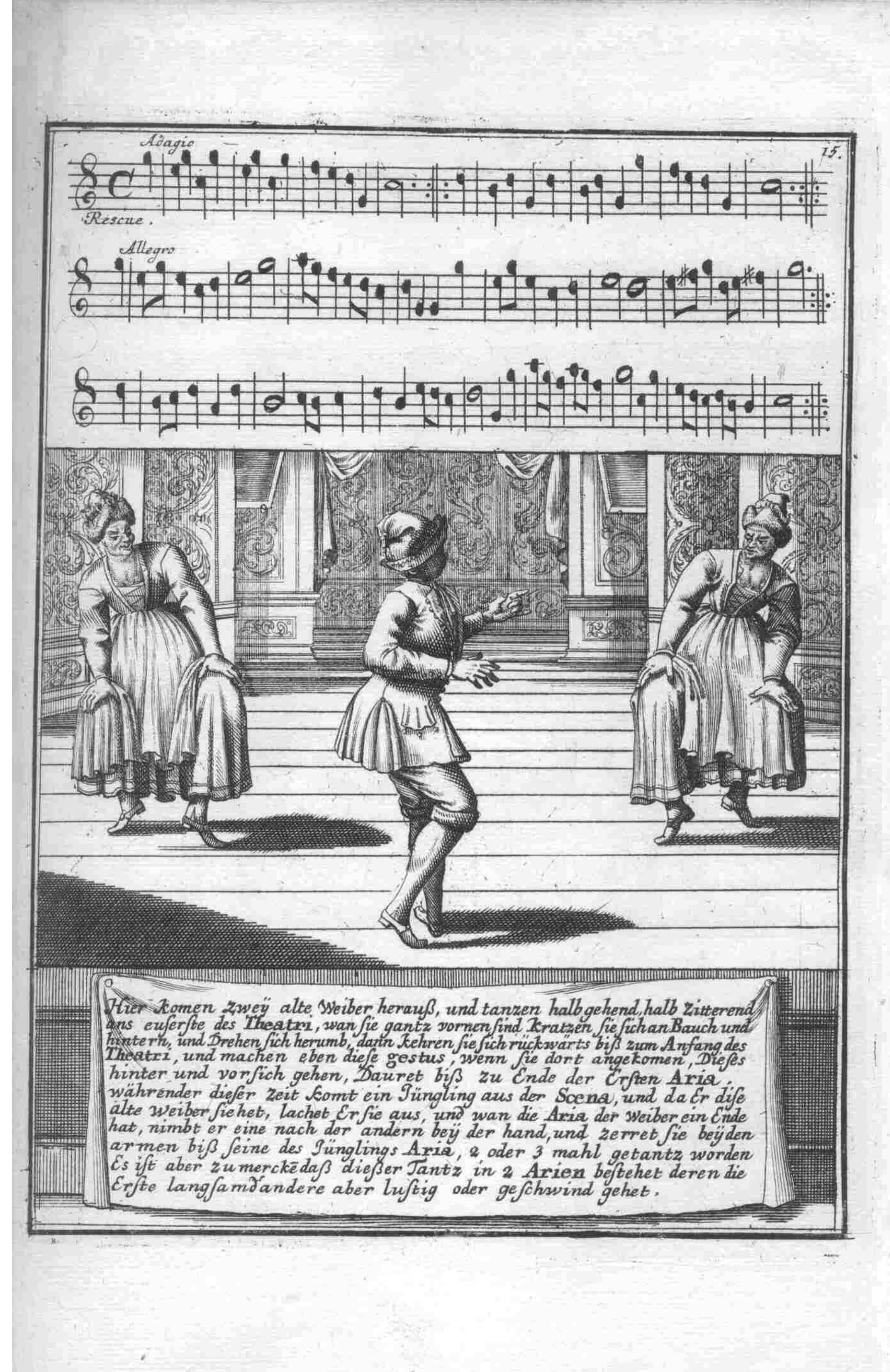
Two figures in elaborate theatrical costume face each other across the stage in a martial stance. The figure on the left, wearing a feathered plumed hat, stands with weight planted and hands positioned assertively at the sides of a long skirt with deep folds. The figure on the right, also plumed and hatted, leans forward in a charged posture, one arm extended and the other bent, as if advancing or parrying. Both wear the full-skirted, corseted dress of early 18th-century court fashion, though rendered here as theatrical costume. They are framed by a stage architecture of columns and draped curtains receding into shadow. The composition captures a moment of dramatic tension—neither figure moves toward the other, but both are poised as if one might. Above the scene, three systems of musical notation in treble clef provide the score for this choreographed encounter. Below, a panel of German verse in italic script runs beneath allegorical putti, establishing the didactic intent of the plate.
The dancing
Both dancers carry their weight low and centered, with the characteristic upright spine and forward-facing orientation of the minuet tradition. The leftward dancer's arms frame the body vertically; the rightward dancer's asymmetrical arm position—one up, one lower—suggests an active moment within a sequence, not a static pose. The postures suggest walking or traveling steps rather than stationary positions, with the bent knees and angled torso of the advancing figure hinting at a chassé or other forward movement. Neither figure touches the other, which is consistent with the formal distance maintained in courtly dance.
The dance depicted
This is a choreographed duel or combat dance—a theatrical form that emerged in the early 18th century, blending martial stance and gestural drama with the formal technique of the minuet. Such pieces were performed on stage as part of elaborate court spectacles and were taught to courtiers and actors as demonstrations of control, decorum, and dramatic expression. The image shows two equally matched opponents, which suggests a stylised representation of combat rather than an actual fight; the careful dress, the stage setting, and the notated music all confirm this as a rehearsed theatrical work. The German title 'Combat/Duel' and the accompanying score indicate that this was one of a suite of dances to be learned and performed, each with its own character and music.
How it was made
This is a copper-plate engraving, a technique that allowed fine lines, precise detail, and serial reproduction. The engraver has used parallel hatching and cross-hatching to build shadow and volume, particularly in the drapery and the theatrical setting. Engraving was the primary method for publishing dance instruction and choreographic notation in the 17th and 18th centuries, because it preserved the clarity of the musical staff and the figure's outline at a size readable in a bound book. This technique made instruction portable and repeatable, turning choreography into a publishable commodity for the first time.
About this work
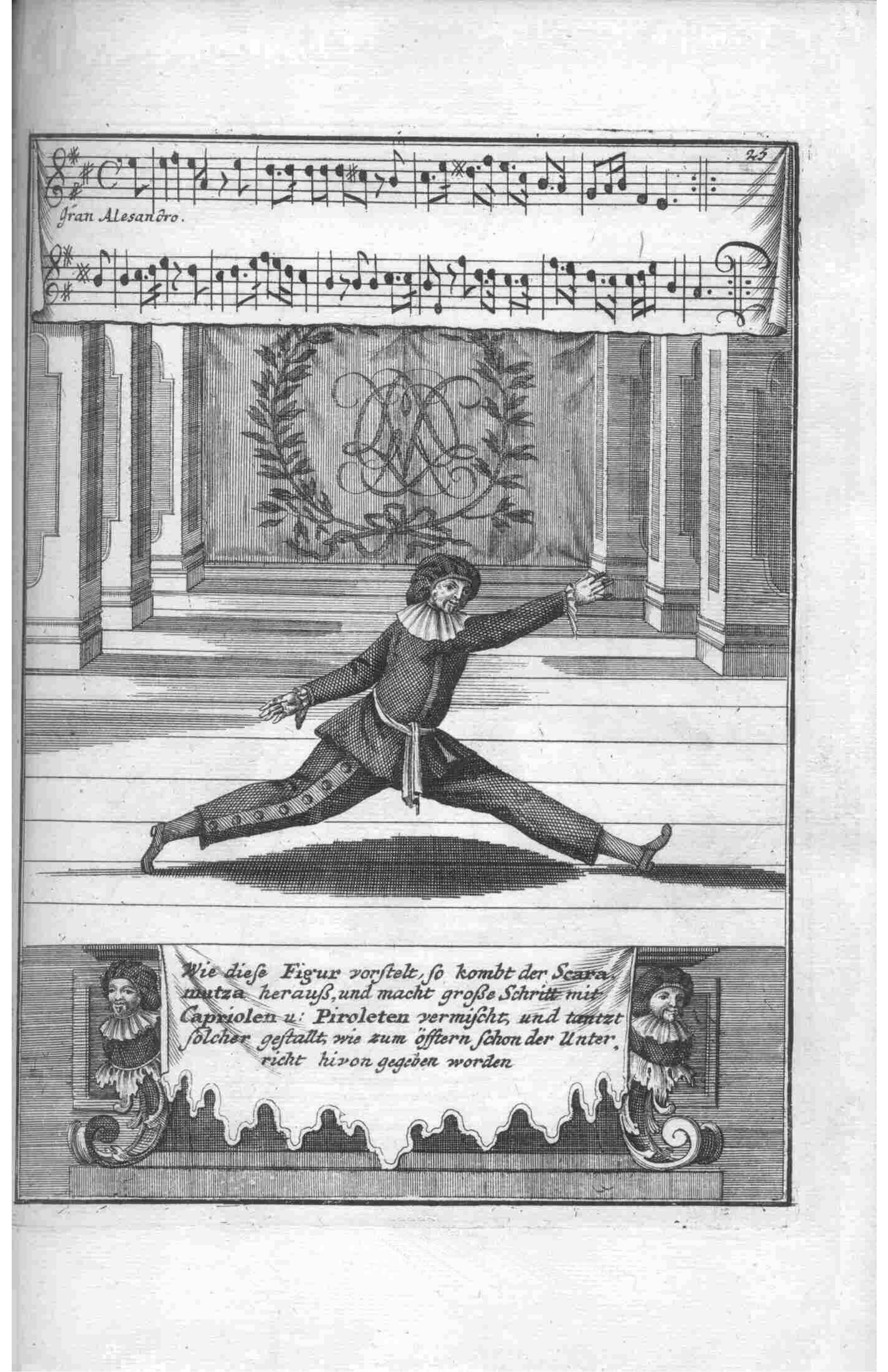
This plate is one of 52 engraved dance instructions from Gregorio Lambranzi's *Nuova e curiosa scuola de' balli theatrali* (*New and Curious School of Theatrical Dances*), published in Nuremberg in 1716. Each plate pairs a notated music score with a costumed figure (or here, two figures) in a specific dance pose or sequence, creating a visual and musical record of how the dances were to be executed. The work was the most comprehensive and influential choreographic manual of its era, circulating across Europe and serving as a definitive guide to theatrical dance practice in the decades following the death of Louis XIV. Its engravings represent the intersection of notation, costume practice, and theatrical staging at a pivotal moment when dance was beginning to be formally documented and taught outside the court.
How to look at it
Look first at the positioning of the feet and knees, which show the characteristic turnout and bent-knee carriage of minuet technique. Then trace the line of the spine and head—both dancers maintain the upright, dignified alignment that was essential to courtly dancing. Notice the asymmetry in the rightward figure's arm position, which breaks the symmetry of a static pose and suggests a moment within a sequence. The stage setting is stylised but informative: the columns and curtains frame the action as theatrical rather than ballroom, and the relatively narrow stage suggests that these dances were performed in a proscenium space, not in the round. The musical notation above is not ornamental: it is the key to understanding how the movement was timed and phrased, and a trained musician of the period could have used it to reconstruct the choreography.
The artist
Gregorio Lambranzi was an Italian dancing master and choreographer active in the late 17th and early 18th centuries. He spent much of his career in Nuremberg, where he served as ballet master and court composer. His *Nuova e curiosa scuola* was compiled late in life as a summary and record of a lifetime of choreographic practice. The work was translated into French in 1716 and circulated widely; it became the standard reference for European theatrical dance technique and remained in use for over a century. Lambranzi was one of the last major figures to document dance in the pre-Beaumont notation era, making his manual an invaluable record of the transition from improvised court dancing to choreographed theatrical spectacle.
The period
In the early 18th century, theatrical dance was undergoing rapid formalisation. The minuet, which had emerged in France in the 1650s, had become the standard courtly dance and the basis for all theatrical choreography. Elaborate spectacles combining music, dance, and costume were central to court life and public entertainment, particularly in the German courts. The rise of professional dance masters and the codification of technique reflected a broader Enlightenment impulse to document, systematise, and teach knowledge that had previously been transmitted orally. Lambranzi's manual was part of this movement, but it also marked the end of an era: within a generation, the rigid formalism of the minuet would begin to loosen, and new forms of theatrical dance—including ballet d'action and the beginnings of Romantic ballet—would emerge.
Where it lives
This plate comes from the 1716 Nuremberg edition of Lambranzi's *Nuova e curiosa scuola de' balli theatrali*, held at the Library of Congress. The work was published in two volumes with German text; a French edition followed the same year. The plates were engraved by an unidentified hand or hands working from Lambranzi's designs or descriptions. The Library of Congress holding is one of the few complete copies of this edition surviving in North America.
Dance in this work
Questions about this work
Is this a ballet?
Not in the modern sense. It is a theatrical dance from the early 18th century, performed in court spectacles and on public stages. It uses the formal technique of the minuet—the dominant courtly dance form of the era—but in a dramatised, choreographed sequence. Ballet as we now know it did not exist yet; this was the immediate predecessor, part of a transition from court dancing to staged theatrical spectacle.
How would this have been learned and performed?
A dancer or actor would study the engraved figure, matching their body position to the illustrated pose, and a musician would play or sing the notated melody. Lambranzi's manual was used as a teaching text: you would learn each figure sequentially and practise until you could perform the sequence in time with the music. The dances were then performed on stage, often as part of a larger spectacle, court entertainment, or public theatrical production.
What is a 'combat dance'?
A choreographed mock fight performed in costume, using the formal technique of courtly dance rather than realistic fighting. These dances were popular in 17th- and 18th-century court spectacles and theatrical entertainments. They allowed for dramatic storytelling and visual spectacle while maintaining the decorum and formal control of courtly movement. This plate shows the moment of confrontation, frozen in a pose of readiness and tension.
Why is the music engraved on the same plate as the figure?
Because in the early 18th century, dance and music were inseparable. You could not execute the choreography without hearing the music; the rhythm, phrasing, and character of the dance came from the score. By engraving them together, Lambranzi made it possible to learn the complete work—music and movement as a unified whole—from a single page.
More Notation/Choreography artwork