49 works in this view — arrow keys or swipe to move between them.
Dance in Art
Caroso Nobiltà — Dance Plate (plate 18)
Fabritio Caroso da Sermoneta
- Medium:
- Woodcut
- Dance:
- Notation/Choreography
- Era:
- Pre-1700 (Renaissance/Baroque)
- Collection:
- Nobiltà di Dame (1600)
- Source:
- Library of Congress
- Rights:
- Public domain — free to use, share and adapt.
- Recorded as:
- Public Domain
For dancers and historians, this image is invaluable because it documents not a spectacular moment but the foundational grammar of Renaissance court dance—the reverence that opened every dance. Caroso's plates are among the only visual records we have of how this world-defining dance vocabulary actually looked, and they remain the gold standard for historical reconstruction of Renaissance bassadanza. The work also exemplifies how dance was taught, transmitted, and understood as a marker of noble status and courtly civilization.
What you are looking at
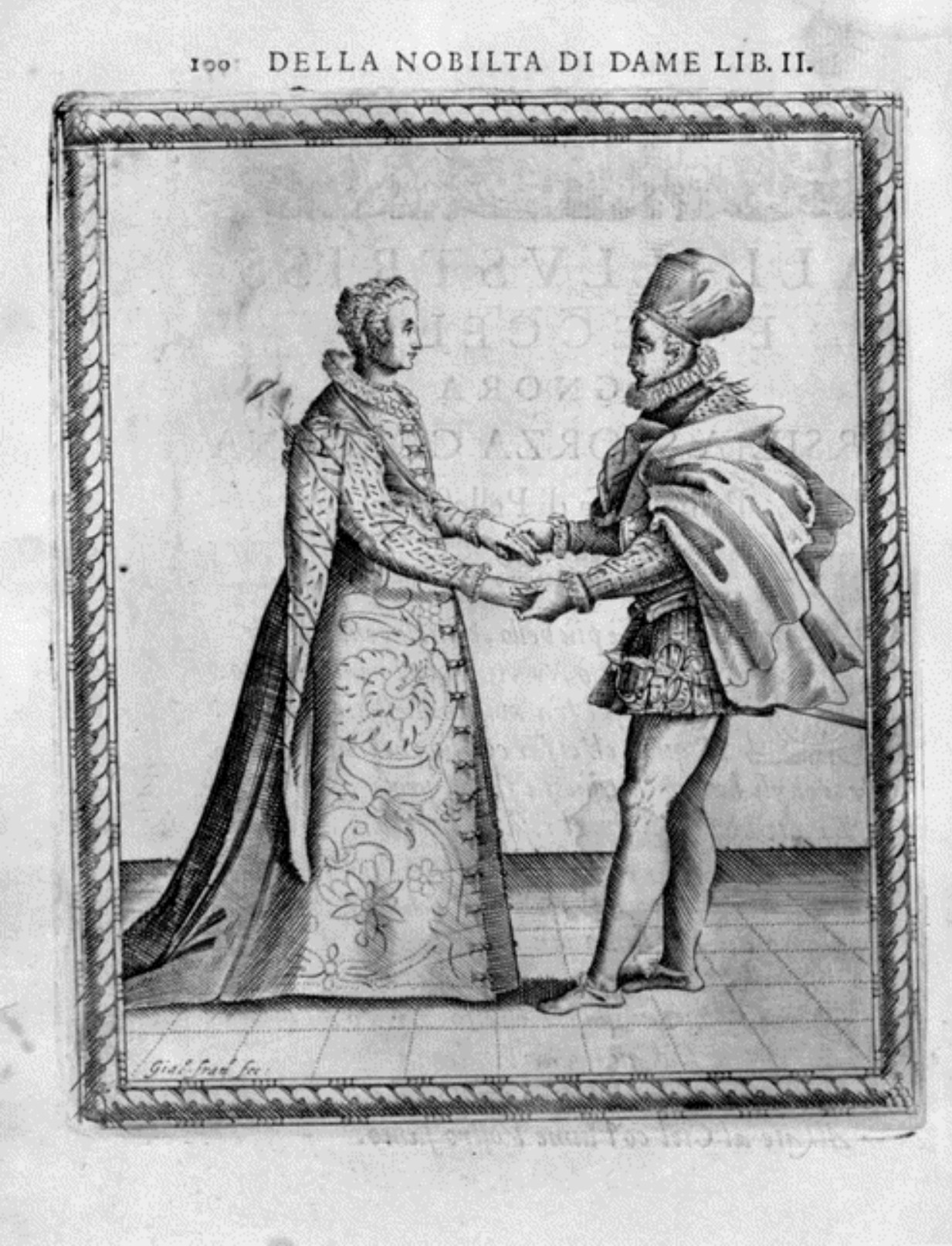
A woodcut from Caroso's dance manual showing two figures in elaborate Renaissance Italian court dress, engaged in a formal dance greeting or opening salute. The figure on the left wears a richly patterned gown with long sleeves and a flowing train, her hair bound in a close-fitting cap; the figure on the right, in shorter doublet and hose with a large plumed hat, extends his hand toward hers in a gesture of courtly address. Both stand upright on a tiled floor against a plain background. The composition captures a moment of formal acknowledgment between partners—the precise instant at which their hands meet or are about to meet—rather than vigorous motion. The engraver has rendered fine detail in the textile patterning and the construction of the garments, which speak to the wealth and refinement expected of dancers in this milieu.
The dancing
Both figures stand in an upright, dignified posture with weight evenly distributed. The woman's body is frontal and stationary; the man's is turned slightly toward her, his right arm extended at roughly shoulder height with palm open in an offering or salutation gesture. Their hands are at or nearly at the point of contact. Neither figure shows weight transfer, spring, or the dynamic tension of active footwork; instead, the moment is one of formal courtesy and mutual acknowledgment. The spatial relationship between them is measured and controlled, consistent with the courtly decorum of Renaissance dance.
The dance depicted
This is a *bassadanza* (or bassa danza), the foundational noble dance of the Italian Renaissance, documented extensively in Caroso's treatises. The image captures the opening *riverenza* or *reverence*—the formal bow-and-curtsy salutation that preceded all court dances. Bassadanza was characterized by slow, processional movement with no jumping or hopping (unlike the *saltarello* or *galliard*), and was danced by couples or groups in geometric patterns across the floor. The paired figure shown here—male and female in formal dress—was the normative social unit, and the reverence was the obligatory opening that announced the dancers' respect for their partners and the occasion.
How it was made
Woodcut, a relief printing technique that allowed Caroso's dance sequences to be mass-produced and distributed across Europe. The woodblock method produced bold, high-contrast lines well-suited to illustrating the clean geometry of court dance positions. Because the work is a printed instructional manual rather than a unique artwork, it circulated widely among dance masters, noble households, and educated courtiers—making it both a practical teaching tool and a statement of cultural authority. The relative simplicity of the medium did not diminish its effectiveness; on the contrary, the clarity of line and composition made complex spatial and postural information legible to practitioners.
About this work
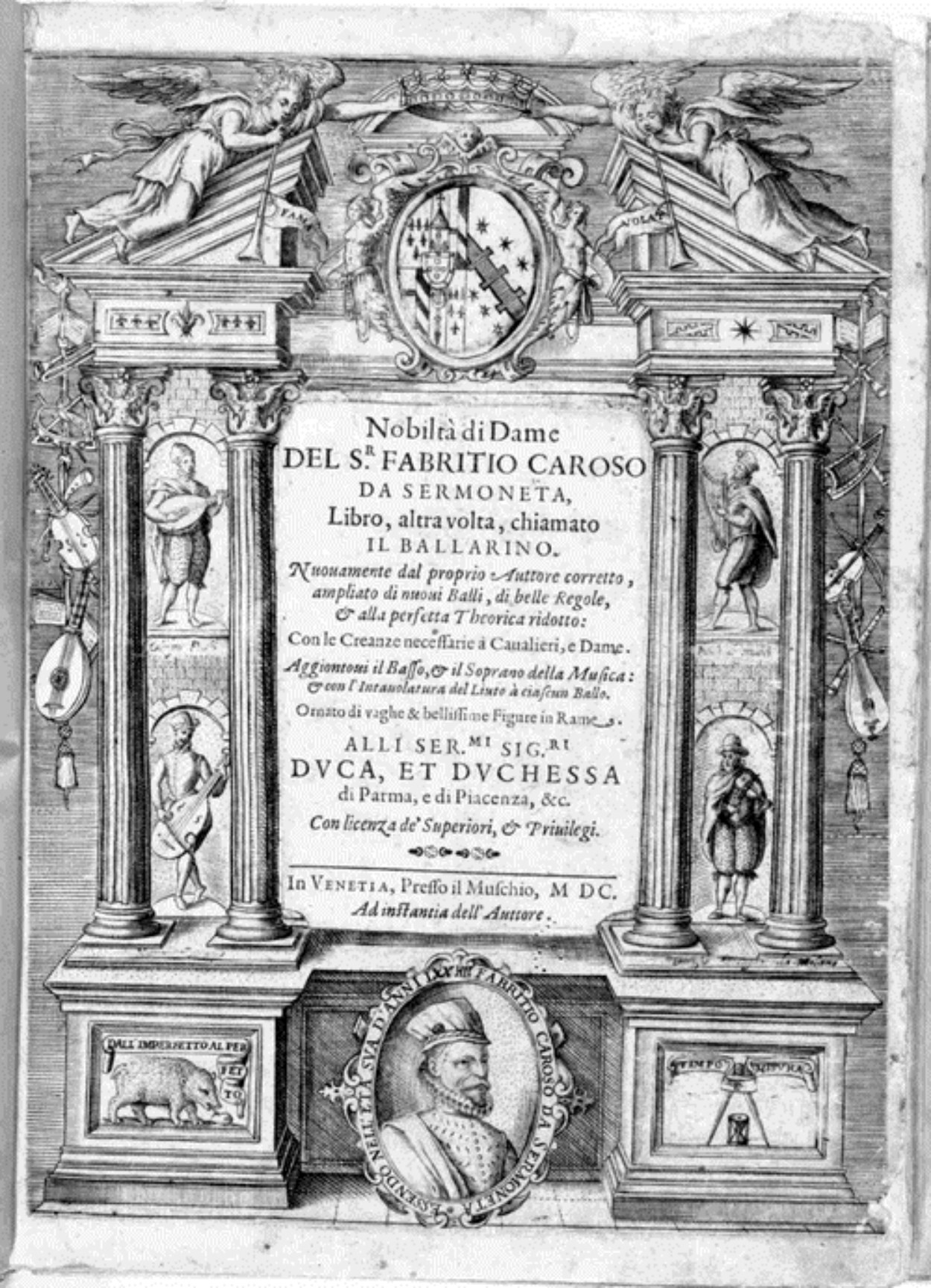
This is one of the instructional plates from Fabritio Caroso's *Nobiltà di Dame* (Venice, 1600), a comprehensive choreographic treatise documenting the dances and deportment of the Italian Renaissance nobility. Caroso revised and expanded his earlier *Il Ballarino* (1581) to reflect the fashions and dance practices of the turn of the century, and the *Nobiltà* became the most authoritative manual of its kind. This particular plate shows the opening reverence of a noble couple about to dance a bassadanza—the formal greeting that preceded all courtly dancing. As a woodcut from a printed manual, it exists at the intersection of dance instruction, artistic practice, and social ritual: it is simultaneously a technical diagram, a record of how Renaissance nobility were expected to move, and evidence of how dance knowledge was codified, preserved, and transmitted.
How to look at it
Notice the precision of the hand gesture—the moment at which courtship or partnership is formally acknowledged through touch. In Renaissance court dance, the reverence was not merely decorative but a social contract: the formal salutation that initiated a structured, rule-bound interaction. Observe too the stillness of the bodies and the absence of any suggestion of effort or emotion. The artist has chosen a moment of quiet formality rather than exuberance, which tells us that the ideal of court dancing prioritized control, geometry, and restraint over dynamism. The woodcut's linear clarity emphasizes the architecture of the pose—how the body should be composed—rather than the illusion of naturalistic movement.
The artist
Fabritio Caroso da Sermoneta (c. 1520–1600) was an Italian dance master active in Rome in the latter half of the 16th century. He was among the most celebrated choreographers of his time and served noble and papal households. His two major treatises—*Il Ballarino* (1581) and the revised *Nobiltà di Dame* (1600)—are the most detailed and influential dance manuals of the Renaissance, featuring hundreds of choreographed dances with notational descriptions, woodcut illustrations, and instructions in courtly deportment. Caroso's work defined the standard for courtly dance across Europe and established him as the authoritative voice on Renaissance dance technique and etiquette.
The period
In the late 16th and early 17th centuries, dance was a core component of noble education and courtly display across Italy and Europe. The Renaissance ideal of the complete courtier, articulated most famously by Baldassare Castiglione in *Il Cortegiano* (1528), placed accomplished dancing alongside music, conversation, and arms as essential markers of refinement and social standing. By 1600, when Caroso published the *Nobiltà*, the bassadanza—slow, measured, and processional—had been the dominant noble dance for over a century, though it was beginning to give way to faster, more athletic forms like the galliard. Caroso's manual thus captures a moment of transition: it preserves the older courtly vocabulary in print precisely as it was being displaced by newer fashions. The woodcut technique allowed choreographic knowledge to be disseminated as never before, transforming dance from an oral and embodied tradition into a codified, reproducible system.
Where it lives
This plate is drawn from the *Nobiltà di Dame*, published in Venice in 1600 and held in the Library of Congress. The *Nobiltà* is the surviving copy of Caroso's definitive late-career revision; earlier copies of the *Il Ballarino* (1581) and a second edition of that work (1584) also survive. As a page from an instructional manual, this woodcut was never a unique artwork but rather one of hundreds produced for circulation among dance masters and patrons.
Dance in this work
Questions about this work
What is a 'reverence' or 'riverenza'?
The reverence is the formal bow-and-curtsy greeting that opened every Renaissance court dance. It was a moment of mutual respect and acknowledgment between dancers, and its correct execution was essential to courtly etiquette. Caroso's manuals devote considerable attention to the precise geometry and deportment of the reverence, as it set the tone for the entire dance.
What is a bassadanza?
The bassadanza (or bassa danza) was the foundational noble dance of the Italian Renaissance, characterized by slow, gliding steps without jumping or hopping. It was danced in geometric patterns across the floor, often by couples, and conveyed dignity, restraint, and courtly refinement. It dominated noble dancing until the mid-16th century, when faster dances like the galliard became fashionable.
Who was Caroso and why does his work matter?
Fabritio Caroso (c. 1520–1600) was the most celebrated Italian dance master of the Renaissance. His treatises *Il Ballarino* (1581) and *Nobiltà di Dame* (1600) are the most detailed and authoritative records of Renaissance court dance we possess, featuring hundreds of choreographed dances with notational descriptions and woodcut illustrations. Without Caroso's manuals, our knowledge of how Renaissance nobility actually danced would be fragmentary.
How do we know this depicts dance and not just courtly greeting?
The hand gesture and proximity between the figures, combined with their formal dress and the context (this is explicitly a dance manual), mark this as the opening salute of a dance. In Renaissance court dancing, the reverence *was* a formal greeting, but it functioned as the choreographed opening to a structured dance sequence. The gesture is both social courtesy and technical dance vocabulary.
More Notation/Choreography artwork