49 works in this view — arrow keys or swipe to move between them.
Dance in Art
Courtly Couple — Plate 40
Gregorio Lambranzi
- Medium:
- Copper-plate engraving
- Dance:
- Notation/Choreography
- Era:
- 1700s (Enlightenment/Minuet Era)
- Collection:
- Nuova e curiosa scuola de' balli theatrali (1716)
- Source:
- Library of Congress
- Rights:
- Public domain — free to use, share and adapt.
- Recorded as:
- Public Domain
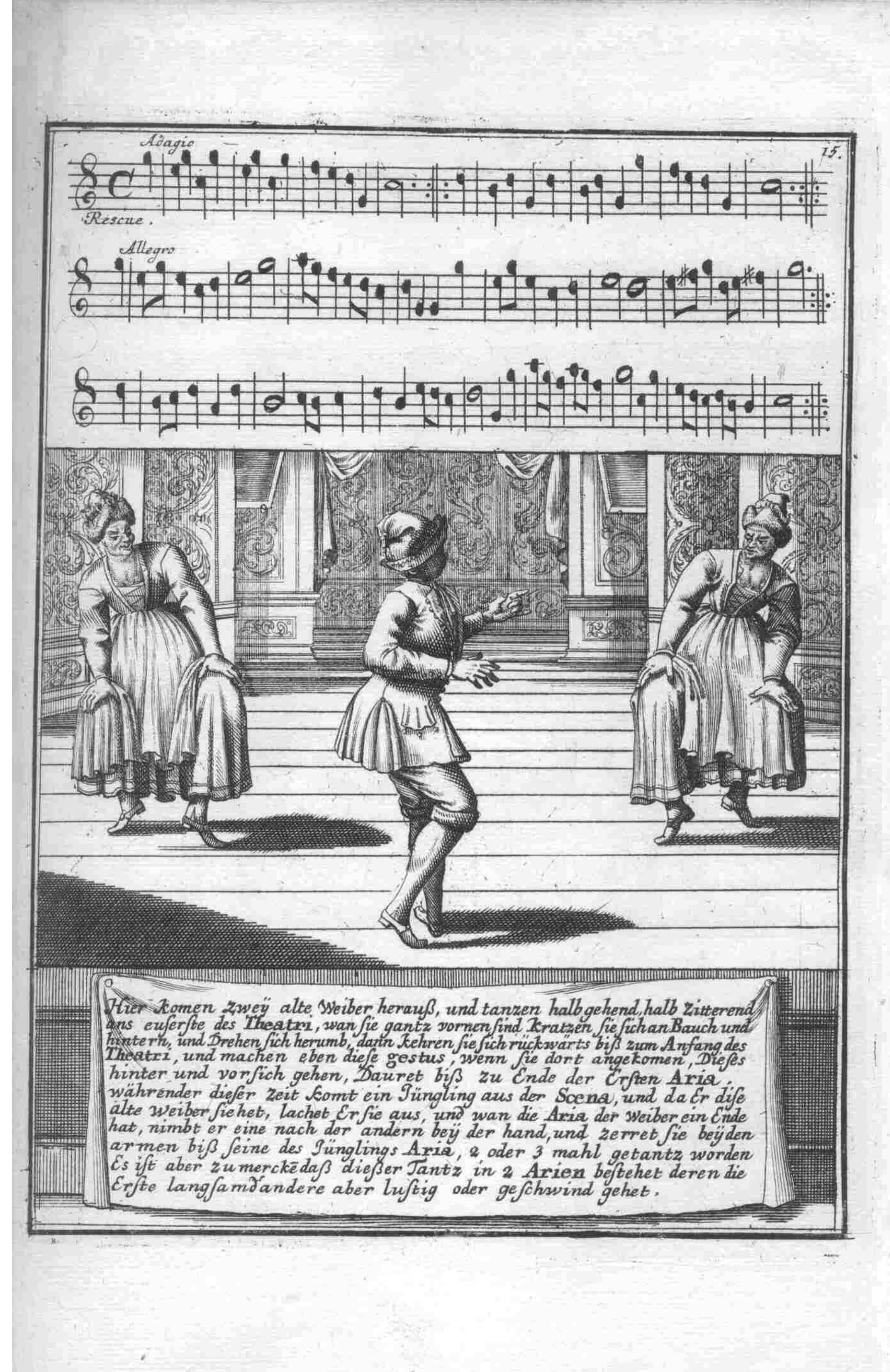
Lambranzi's *Scuola* is one of the few surviving visual records of theatrical dance before the codification of ballet technique in the 19th century, and it shows us dance as a medium of character and comedy, not just court elegance. This plate specifically documents how comic dances were structured, costumed, and notated for the professional stage—knowledge that would otherwise be lost to us. Dancers and historians of early modern theater depend on images like this one to understand what pre-classical theatrical movement actually looked like.
What you are looking at
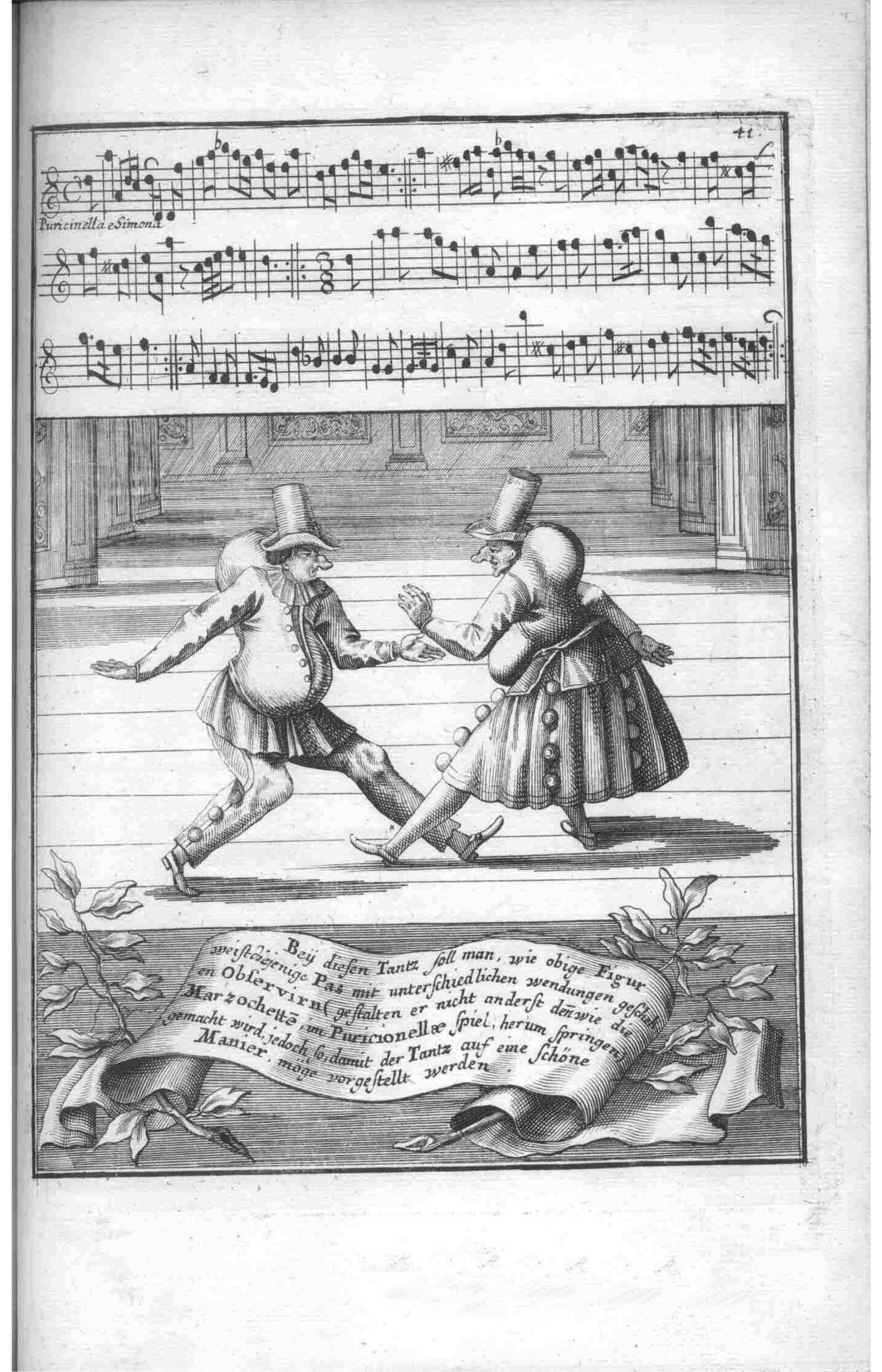
Two plump comedic figures dressed in theatrical costume dance face-to-face on a wooden stage set with draped curtains behind them. The figure on the left wears a dark coat with buttons and breeches, topped with an oversized cylindrical hat; the figure on the right wears a full skirt with buttons down the front and a matching tall hat. Both have exaggerated, rotund bodies rendered with heavy cross-hatching typical of the engraving technique. Their arms are raised and extended toward one another in an animated gesture of greeting or salutation, bodies leaning forward slightly in a playful, almost comic posture. The stage is framed by classical pilasters and decorated panels. Below the dancing figures, a scrolling banner contains German text in Gothic script. Above the scene, three staves of musical notation in Renaissance clefs show the choreography's accompanying melody.
The dancing
The two dancers face each other at close quarters with arms extended and raised, suggesting a hand-taking or hand-clapping gesture rather than a formal ballroom hold. Both figures are rendered with comedic proportions—bulbous bodies, thick legs—which exaggerates the liveliness of their movement. The weight appears forward and dynamic, the posture animated rather than restrained. The positioning suggests a reciprocal, symmetrical action: a moment of mutual greeting or exchange rather than a lead-and-follow structure.
The dance depicted
This plate illustrates theatrical dance from the early 18th century German stage, likely a theatrical intermezzo or comic dance (Tantz) of the sort performed between acts of spoken drama or opera. The two characters—their exaggerated proportions and costume silhouettes suggest stock theatrical types, possibly representing servants or common folk rather than courtiers—are engaged in what appears to be a greeting or flirtation dance, a social exchange rendered comedic through costume and character. The notation above provides the melody, essential for reconstructing the actual choreography. The paired format of music above and figure below was Lambranzi's signature method for teaching theatrical dance through the printed page.
How it was made
Copper-plate engraving, a technique that allowed fine detail, precise line, and mass production through printing. The dense cross-hatching creates shadow and volume; the regular grid of the musical staves above integrates notation and image on the same plate. Engraving's expense and labor meant this work was aimed at a literate, affluent audience—dance teachers, theater professionals, nobility interested in spectacle. The integration of music and figure on a single plate was innovative and permitted dancers and musicians to work from the same source, making this both a practical teaching tool and a document of theatrical fashion and movement.
About this work
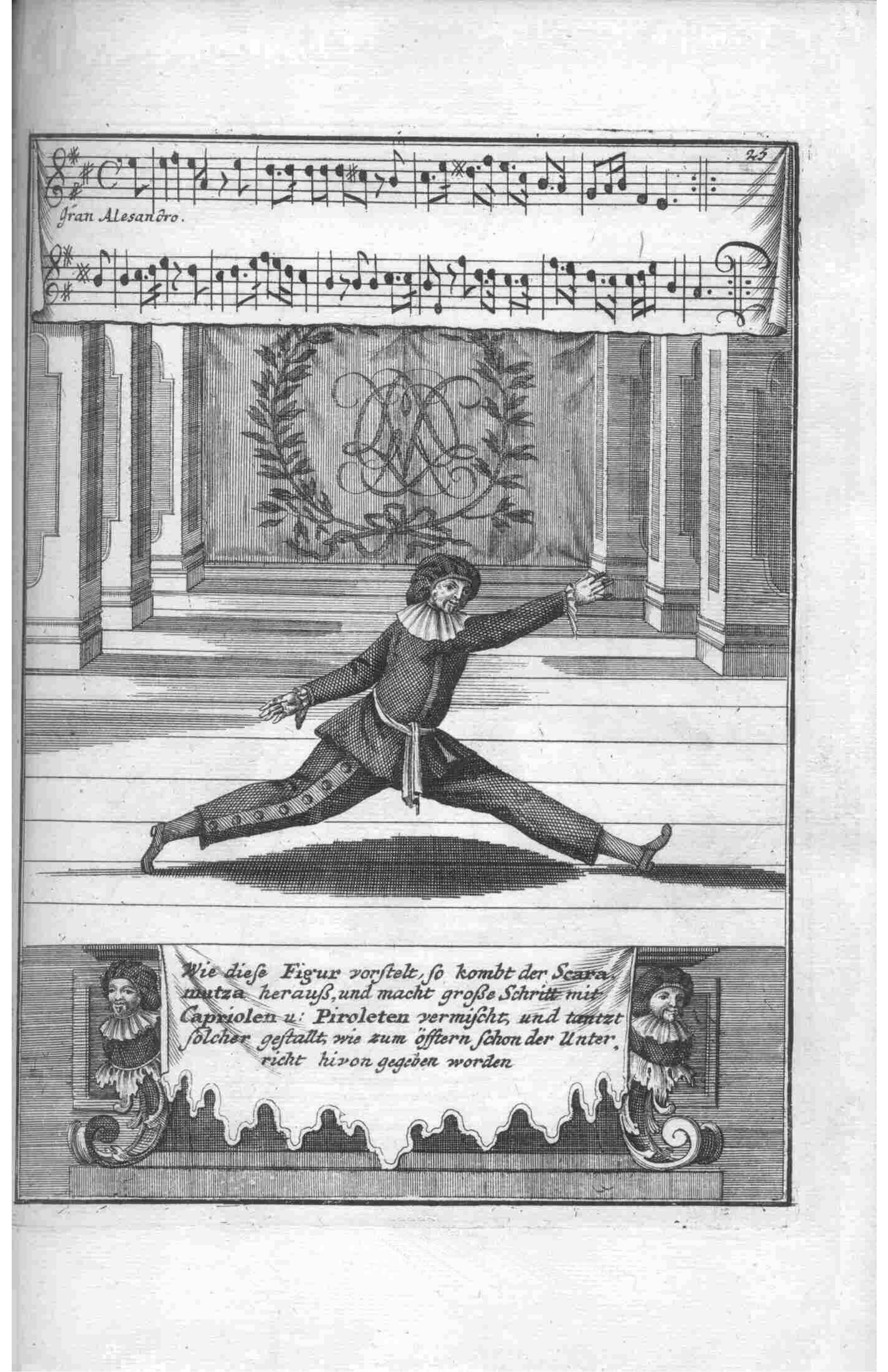
This is plate 40 from Gregorio Lambranzi's *Nuova e curiosa scuola de' balli theatrali* (*New and Curious School of Theatrical Dances*, Nuremberg, 1716), one of the era's most influential and visually rich dance manuals. Each plate pairs a piece of notated music with a costumed figure or figures shown in a moment of action on a small proscenium stage. Lambranzi's work documented the theatrical dance of the German Baroque stage—not courtly minuets or formal dances, but the livelier, character-driven dances of comedy and spectacle, designed for professional performers. This particular plate shows two comic characters engaged in a social dance, their exaggerated bodies and animated postures capturing the energy and humor of early 18th-century theatrical performance. The combination of notation and image made Lambranzi's manual a practical resource for choreographers and performers across Europe.
How to look at it
Attend to the moment Lambranzi chose to freeze: not a formal, geometric pose, but a moment of animated social exchange—the instant of greeting or flirtation. The exaggerated body proportions are not distortion but characterization; they tell us these are comic types, not idealized courtiers. The arm position—raised, open, extended toward the partner—shows reciprocal, mutual action, not the hierarchical lead-and-follow of ballroom dance. The musical notation above is not decorative; it is the choreography, and you can read the rhythm and phrasing of the movement from it. The stage setting, with its classical frame and draped backdrop, places this dance within the theater, not the ballroom—this is spectacle, not social dance.
The artist
Gregorio Lambranzi (c. 1665–1730) was an Italian dancer and choreographer active in the German-speaking territories in the late 17th and early 18th centuries. He held positions in Nuremberg and other courts, and his *Nuova e curiosa scuola de' balli theatrali*, published in Nuremberg in 1716 and reprinted in Augsburg in 1725, was the most comprehensive and visually ambitious dance manual of its time. The work was both practical—a teaching resource—and aspirational, presenting theatrical dance as a refined art worthy of printed documentation alongside music and architecture. Lambranzi's innovation was to unite choreographic notation, musical score, and engraved figures on a single plate, creating a model that influenced dance documentation for generations.
The period
In the early 18th century, theatrical dance in German-speaking lands was distinct from the courtly minuet and formal dances of France and Italy. The German stage featured comedic, character-driven dances performed by professional actors and dancers; these were livelier, less regulated, and often grotesque or satirical in character. At the same time, the codification of dance notation—Feuillet notation in France, Lambranzi's own adaptations in Germany—was making choreography reproducible and teachable through print. Lambranzi's work sits at the intersection of these currents: he documented theatrical, comic, character-based dance at a moment when dance was beginning to be theorized as a teachable, transmissible art. The early 18th century also saw the flourishing of engraving as a medium for technical and artistic instruction—parallel to the rise of the dance manual itself.
Where it lives
This plate is from the *Nuova e curiosa scuola de' balli theatrali*, a two-volume printed work in copper-plate engraving published in Nuremberg by Johann Jacob Wolrab in 1716. The work consists of 104 plates, each showing a costumed figure or group in a theatrical dance, paired with musical notation and often with a descriptive German caption. It is held in the Library of Congress and other major research libraries.
Dance in this work
Questions about this work
What is the music at the top?
The three staves of musical notation represent the melody and rhythm of the dance. The music and the choreography are synchronized; a musician reading this notation would play at the tempo and in the phrasing that the choreography requires. This integration of score and figure was Lambranzi's innovation and made his manual useful to both dancers and musicians.
Who would have danced this?
Professional theatrical dancers and actors on the German stage, likely in comedic roles. The exaggerated body proportions suggest character types—servants, rustics, or comic figures—rather than courtiers or nobility. These dances were performed in theaters during intermezzos or comic scenes, not in ballrooms or at court ceremonies.
Why does Lambranzi show the dancers in such exaggerated proportions?
The exaggeration reflects the character and social class of the dancers and the comedic intention of the dance. Theatrical dance of this period was not about geometric perfection or courtly refinement but about character, humor, and spectacle. The round bodies, the animated postures, the comic costume—these communicate the genre and tone of the performance.
How do we know this is a real dance and not Lambranzi's invention?
Lambranzi was documenting theatrical dance as it was performed on the German stage in his time. The work is didactic—designed to teach dancers and musicians how to perform these choreographies. While Lambranzi may have choreographed some of these dances himself, he was primarily recording and standardizing theatrical dance practices that already existed in performance.
More Notation/Choreography artwork