49 works in this view — arrow keys or swipe to move between them.
Dance in Art
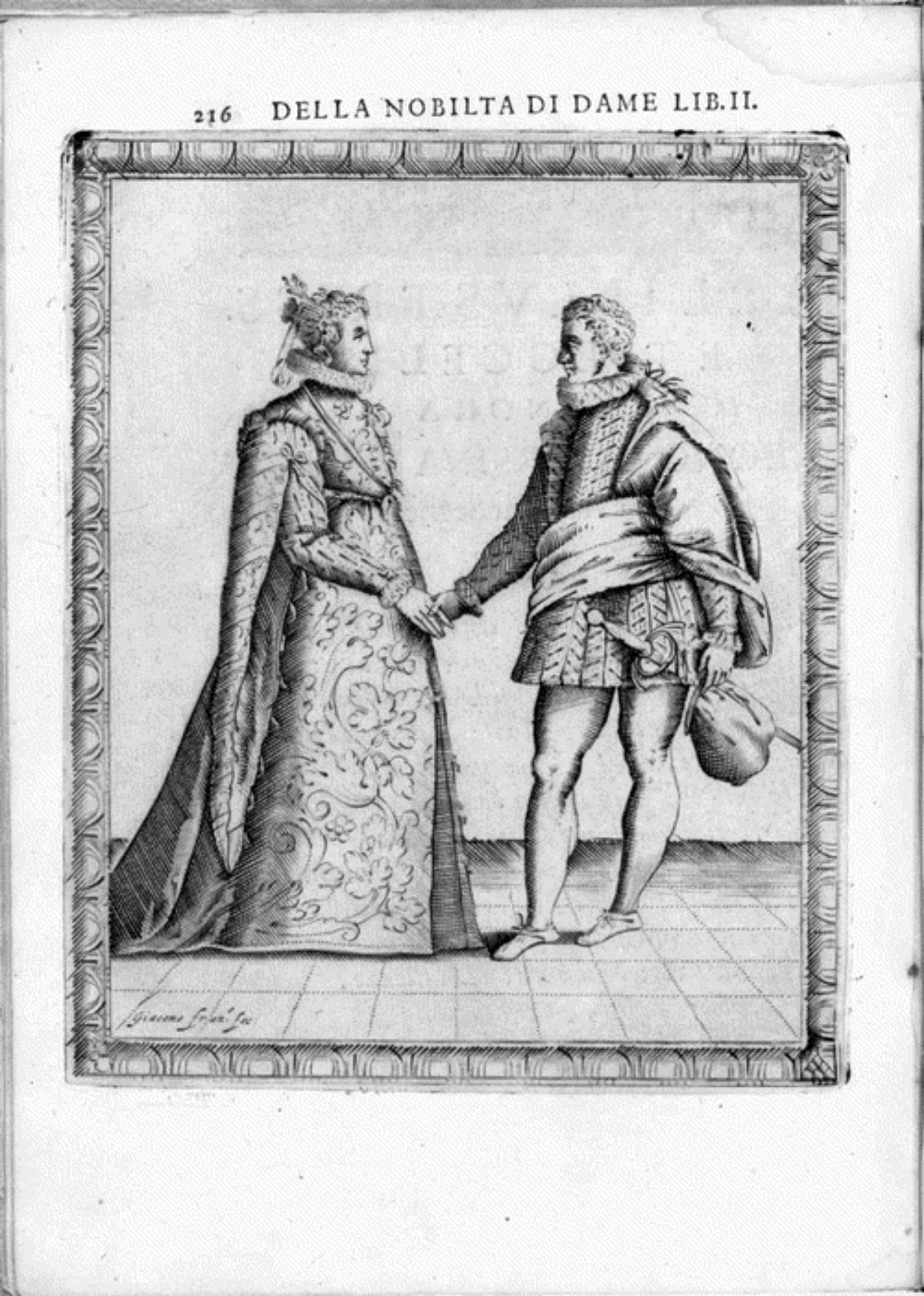
Caroso Nobiltà — Dance Plate (plate 21)
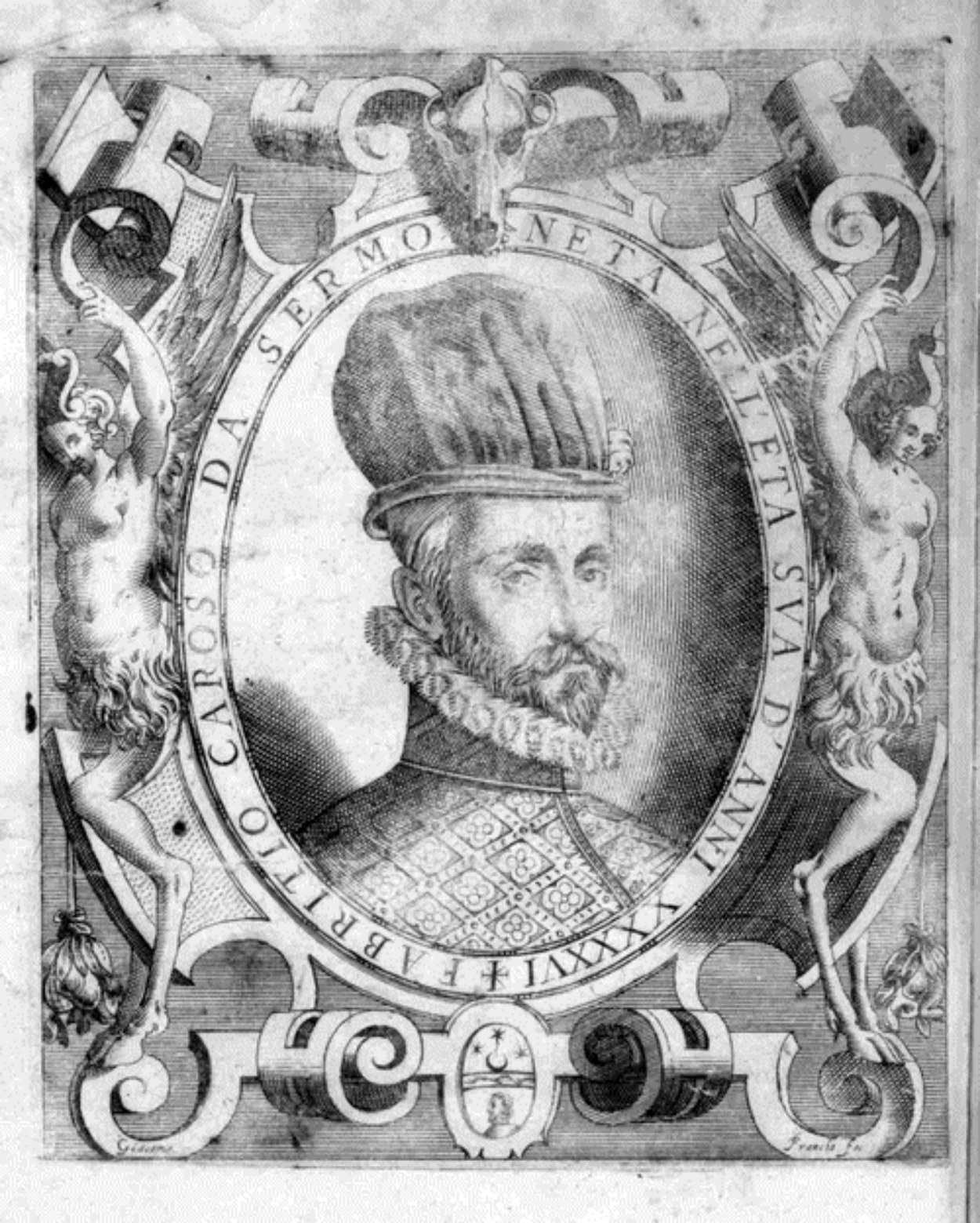
Fabritio Caroso da Sermoneta
- Medium:
- Woodcut
- Dance:
- Notation/Choreography
- Era:
- Pre-1700 (Renaissance/Baroque)
- Collection:
- Nobiltà di Dame (1600)
- Source:
- Library of Congress
- Rights:
- Public domain — free to use, share and adapt.
- Recorded as:
- Public Domain
This image is one of the primary sources through which we know Renaissance court dance at all. Caroso's notations—combining image, written choreography, and musical information—were revolutionary; they turned dancing from an ephemeral, orally transmitted art into a fixed, reproducible text. For dancers today, these plates are blueprints: they show the fundamental postures, hand positions, and social dynamics of the Renaissance ballroom.
What you are looking at
A woodcut showing a noble couple in formal Renaissance Italian court dress, standing indoors on a tiled floor. The woman on the left wears an elaborate gown with a high collar, puffed sleeves, and a richly patterned skirt with decorative brocade or embroidery; her hair is styled in the high, crowned fashion of the period. The man on the right, bare-legged and wearing a doublet with decorative horizontal bands, short hose, and a high collar with ruff, holds her hand in a formal gesture. Both figures are shown in three-quarter view facing slightly toward each other. The setting is spare—just the floor and a plain background framed by a decorative Renaissance border—focusing all attention on the couple's posture and the moment of their engagement.
The dancing
The two dancers are positioned at a measured distance, neither in close contact nor far apart. Their hands meet in a formal clasp at waist height—a contained, courtly touch rather than an embrace. Both figures stand upright with composed bearing. The woman's weight appears evenly distributed, her posture frontal and dignified. The man's stance is similarly balanced and formal. There is no visible footwork or active stepping; the moment is one of stillness and presentational geometry, typical of a formal greeting or opening pose in court dances.
The dance depicted
This plate illustrates a paired figure from one of the great choreographies of the Renaissance Italian court, likely the opening moment of a galliard, pavane, or branle—dances in which couples moved through formal spatial patterns with prescribed hand positions and measured steps. The image captures the initial encounter and positioning, the foundation from which the dance would unfold. Caroso's *Nobiltà di Dame* and its predecessor *Il Ballarino* were the authoritative printed sources for these dances, transmitted to dancers and musicians across Europe. The couple's formal stance and the precise geometry of their positioning exemplify the courtly restraint and intellectual order that characterized Renaissance dance notation: every position had meaning and was reproducible from the written description.
How it was made
This is a woodcut, a relief-printing process in which an image is carved into the surface of a wooden block, inked, and pressed onto paper. Woodcut allowed for crisp, bold lines and clear definition of forms—ideal for a printed book distributed to dancing masters and their patrons. The technique produces the characteristic strong contrasts between black line and white ground visible here. As a page from the *Nobiltà di Dame*, this was one of hundreds of such instructional images in a large, expensive printed volume; the circulation was wide but select, limited to the educated nobility and professional dancing masters of Italy and northern Europe who could afford the book and read Italian.
About this work
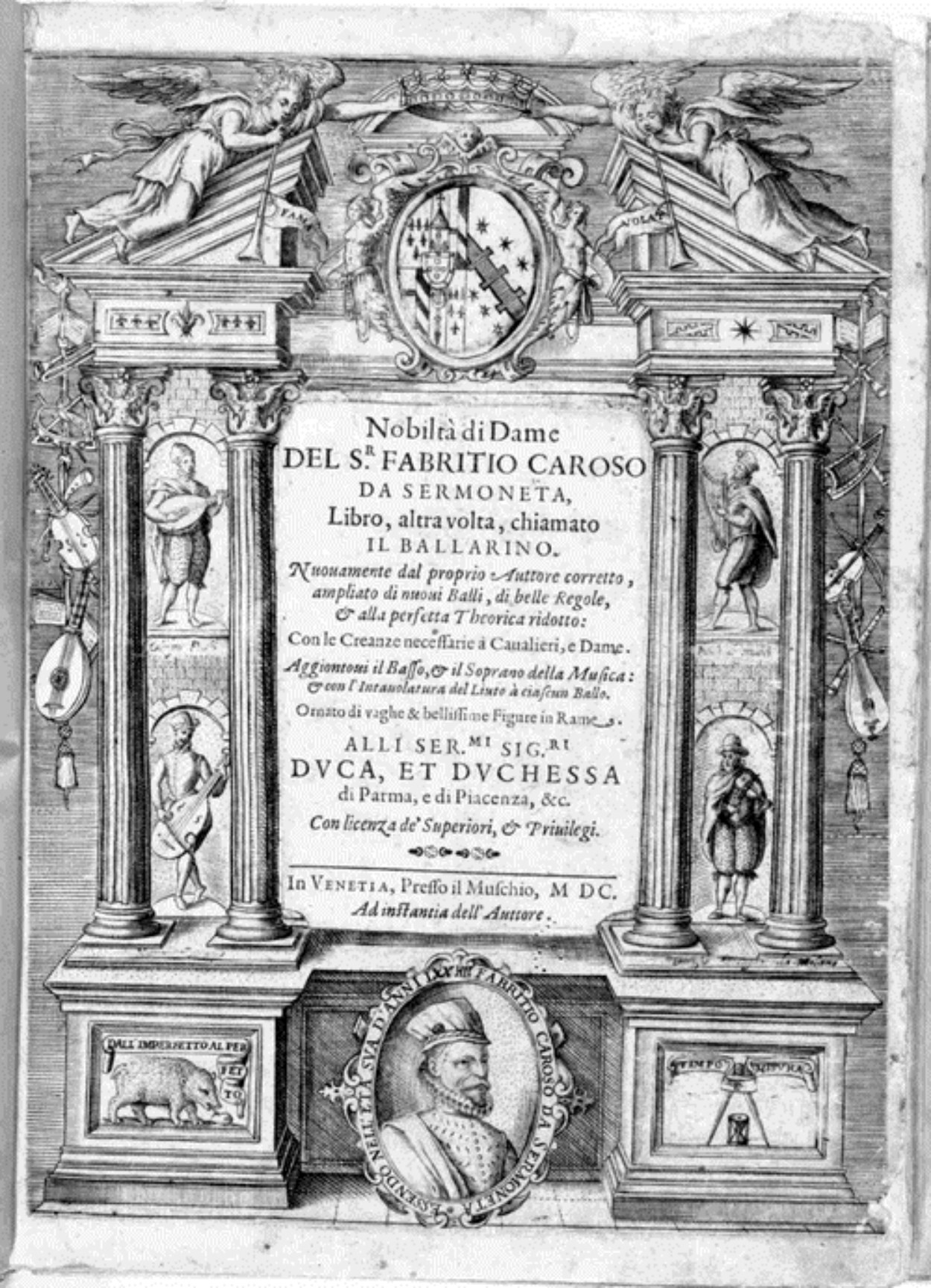
This is a woodcut plate from Fabritio Caroso da Sermoneta's *Nobiltà di Dame* (Venice, 1600), a foundational printed source for Renaissance Italian court dance. It shows a noble couple in formal dress positioned for the opening of a paired dance—a moment of geometric precision and courtly restraint that belies the complex choreography to follow. The image is not a realistic depiction of a performance but rather a prescriptive teaching tool: it shows the reader the correct spatial and postural relationship from which the dancer must begin. As such, it represents the profound shift in Renaissance culture toward the documentation and standardization of dance knowledge through print.
Caroso's treatises were the first to systematically notate dances in words and images, making them teachable and reproducible across distance and time. This plate belongs in a dance history collection because it shows us how Renaissance dance was preserved, taught, and transmitted—not through gesture alone but through the marriage of verbal description and visual diagram. For modern dancers and historians, it is a window into both the physical practices of the Renaissance court and the intellectual ambitions of its dancing masters.
How to look at it
Pay attention to the formal stillness of the image. This is not a moment of action or virtuosity but of *presentation*—the opening configuration from which movement will begin. Note how the artist has chosen to freeze the couple at the instant of their meeting, hands just touching, bodies upright and face-to-face. This is the visual grammar of Renaissance court propriety: the dance begins not with a step but with a geometry of bodies in space, and that geometry is meaningful. The woodcut line is clean and decisive, befitting a teaching image; every fold of cloth, every angle of the arm, is legible and repeatable.
The artist
Fabritio Caroso da Sermoneta (c. 1535–c. 1605) was a master of the ballo and one of the most influential choreographers and pedagogues of the late Renaissance. He served in the courts of Rome and other Italian noble families, and his two treatises—*Il Ballarino* (Venice, 1581) and the revised, expanded *Nobiltà di Dame* (Venice, 1600)—were the most comprehensive and widely circulated dance manuals of the era. Caroso's innovation was to combine practical choreographic notation with elegant woodcut illustrations and explicit musical accompaniment, creating a teaching instrument that could travel and instruct in his absence. His work established the model for all subsequent European dance notation and pedagogy.
The period
The Renaissance Italian court was the cradle of modern social dance. By the sixteenth century, dancing had become a central accomplishment of courtly life—a sign of grace, education, and noble status. The dances Caroso notated (pavanes, galliards, branles, voltas) were the ballroom language of the European nobility; to dance them correctly was to speak a universal courtly dialect. The publication of dance treatises in printed form—beginning with Domenico of Piacenza in the 1450s and culminating in Caroso and Cesare Negri in the late 1500s—reflected the Renaissance commitment to documenting and systematizing all forms of knowledge. By 1600, when the *Nobiltà di Dame* was published, printing had become the primary means of spreading dance instruction, and Caroso's refined, illustrated edition was the gold standard.
Where it lives
This plate is from a copy of the *Nobiltà di Dame* held in the Library of Congress collection. The *Nobiltà di Dame* was a large folio printed in Venice in 1600, produced in limited numbers for sale to courts and dancing masters across Europe. It is one of the rarest and most valuable dance books in existence.
Dance in this work
Questions about this work
What dance is this couple performing?
The image does not specify a single dance by title; it is a generic representation of the opening configuration for a paired court dance—likely a pavane, galliard, or branle. Caroso's text would have accompanied this image with the choreography and music. The formality and hand position suggest a stately dance rather than a vigorous one, so a pavane or branle is more likely than a galliard.
Why are they not touching more closely?
Renaissance court dance emphasized restraint and formal geometric relationships. Unlike later ballroom dancing, the couple moves through space side by side or in parallel patterns rather than in closed embrace. The measured distance and formal hand clasp shown here are entirely correct for the period and reflect both the dancing technique and the courtly etiquette that governed physical contact.
How would dancers have learned from this image?
Caroso's treatise combined this woodcut with written choreographic notation (describing the path through space, the foot positions, and the timing) and the music. A dancer with literacy and musical training could reconstruct the full dance from the text and image together. More commonly, a noble patron would hire a dancing master who owned the book to teach them in person, using the treatise as a reference.
What is special about the *Nobiltà di Dame*?
It was the first comprehensive, beautifully illustrated printed dance manual in Europe. Caroso revised and greatly expanded his earlier *Il Ballarino* (1581) to include more dances, finer engravings, and dedications to prominent noble women—hence the title, which means 'The Nobility of Ladies.' It became the most authoritative source for Renaissance court dance and was imitated and translated across Europe.
More Notation/Choreography artwork