49 works in this view — arrow keys or swipe to move between them.
Dance in Art
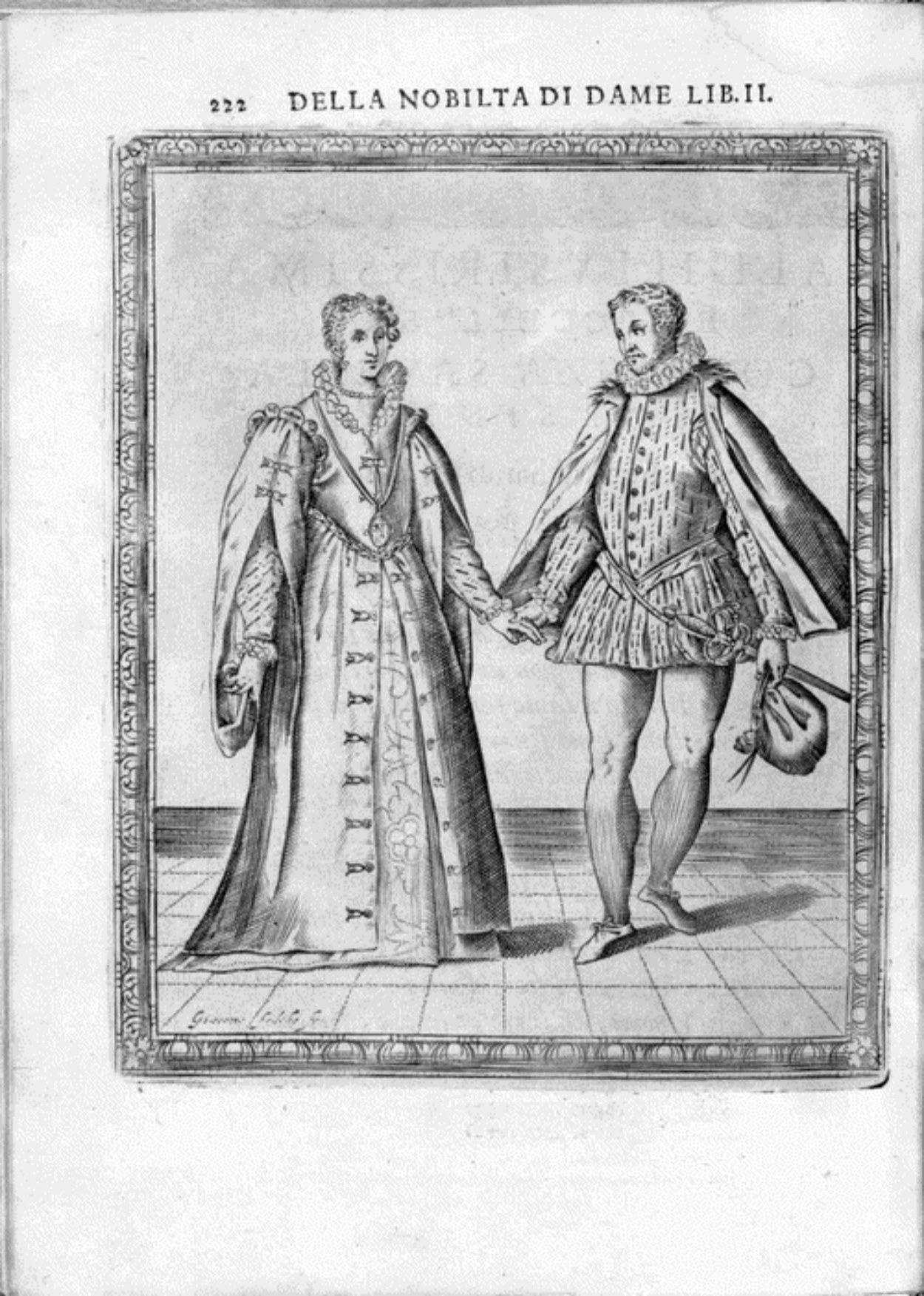
Caroso Nobiltà — Dance Plate (plate 22)
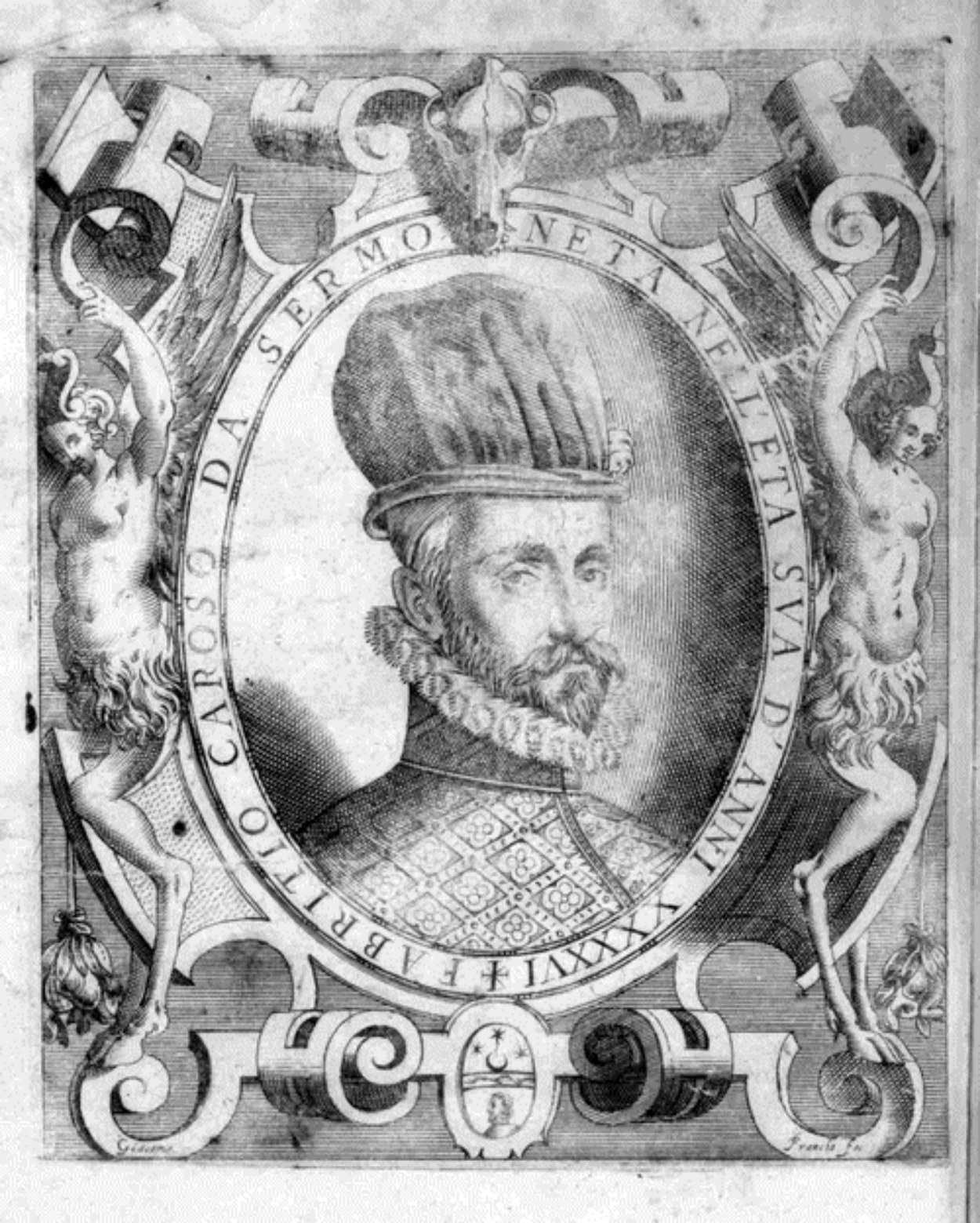
Fabritio Caroso da Sermoneta
- Medium:
- Woodcut
- Dance:
- Notation/Choreography
- Era:
- Pre-1700 (Renaissance/Baroque)
- Collection:
- Nobiltà di Dame (1600)
- Source:
- Library of Congress
- Rights:
- Public domain — free to use, share and adapt.
- Recorded as:
- Public Domain
Caroso's manual is one of only a handful of detailed, illustrated sources that allow modern historians and reconstructors to understand how Renaissance dances were actually performed—the rhythm, the steps, the social spacing, and the costume. No other source from the period provides this combination of written choreography, music notation, and visual representation. For dancers interested in historical practice, this plate is a primary document that directly shaped the reconstruction of Renaissance dance technique in the modern world.
What you are looking at
A woodcut depicts a noble couple in Renaissance Italian court dress, positioned facing one another in what appears to be an interior space with a tiled floor. The woman on the left wears an elaborate long gown with a high neckline, ornate decoration down the front, and a full train; her hair is bound up with curled details at the crown. The man on the right wears a short doublet with prominent puffed sleeves, decorative bands across the chest, and hose; he carries a hat in one hand and displays the confident stance of a courtier. Both figures are rendered with careful attention to the fashionable dress of the turn of the 17th century, and their relative positioning—facing, with hands appearing to meet or gesture toward one another—suggests they are about to begin or are beginning a paired dance. The composition is formal and symmetrical, framed within a decorative border typical of instructional woodcuts.
The dancing
The couple stands at roughly equal distance from the viewer, establishing a direct spatial relationship that mirrors the dance partnership. The woman's body is held upright with her arms at her sides or slightly forward; the man's posture is similarly erect but with a more pronounced weight shift to one leg, suggesting the beginning of movement. Their hands appear to be approaching or touching, indicating the hand-hold or greeting gesture that would initiate a Renaissance dance. The gentleman's extended leg and the lady's composed stance suggest they have not yet committed full weight into the movement, catching the moment of preparation or opening sequence.
The dance depicted
This is a notational plate from Fabritio Caroso's *Nobiltà di Dame*, a dance instruction manual. The couple depicted represents the paired figure—most likely the opening position of a *basse danse*, *pavane*, or *galliard*, the dominant court dances of the Italian Renaissance and early Baroque court. Caroso's method was to present the man and woman as they would stand at the outset of choreographed movement, allowing the reader to understand both the deportment and the costume appropriate to courtly dancing. The formality of their dress and the refinement of their stance confirm this is aristocratic dance of the highest social rank.
How it was made
This is a woodcut, a relief printing technique in which an image is carved into a wooden block, inked, and pressed to paper. Woodcut was the standard medium for dance instruction manuals of the 16th and 17th centuries because it could be reprinted many times and distributed widely, making it ideal for a manual meant for circulation among the nobility and their dance masters. The technique is evident in the linear hatching used to create shadow and volume, the crisp outlines defining the figures, and the uniform black lines of the border. The medium allowed for clear reproduction of costume detail—essential for a work teaching deportment and dress—while keeping production costs lower than engraving.
About this work
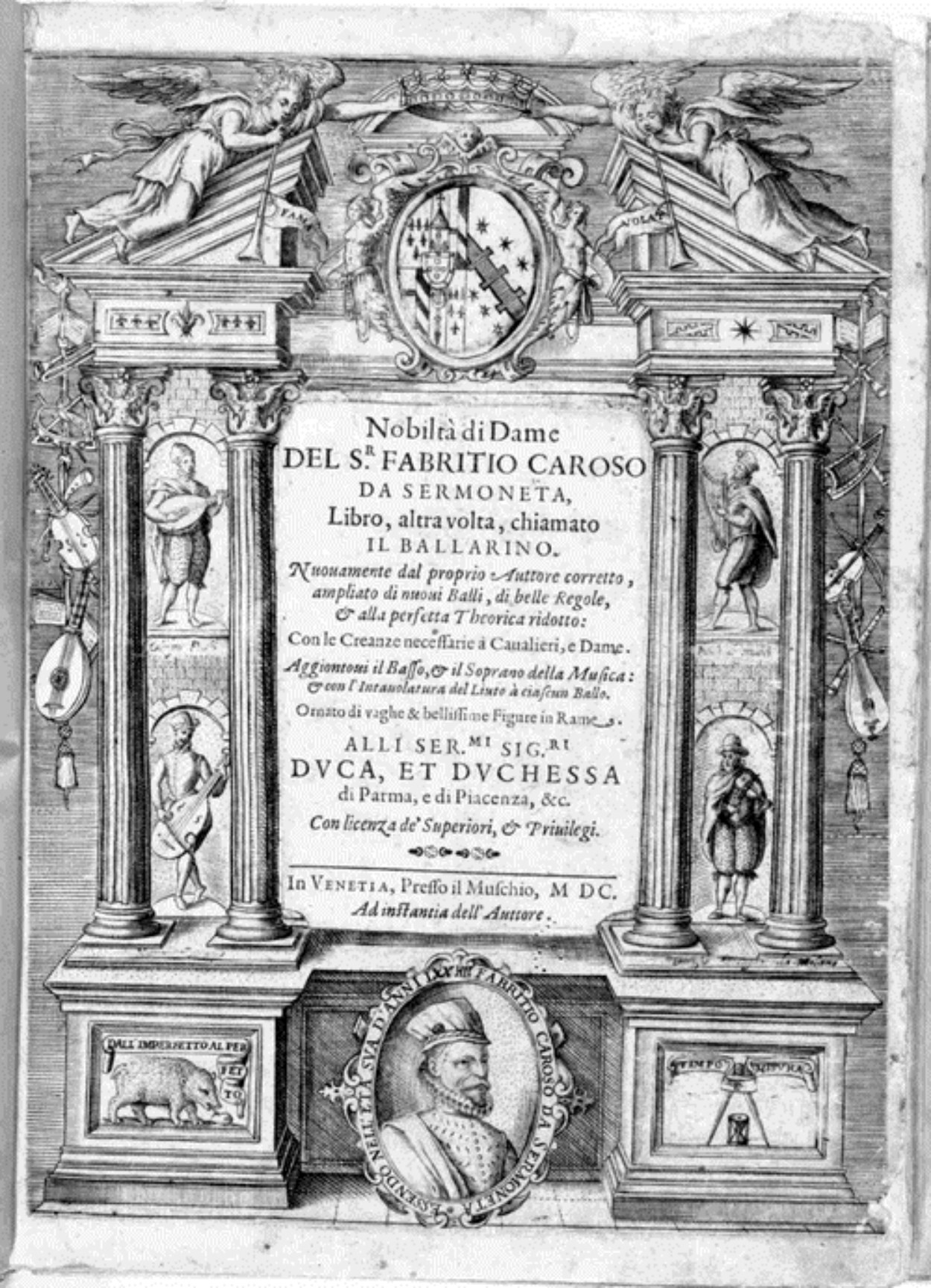
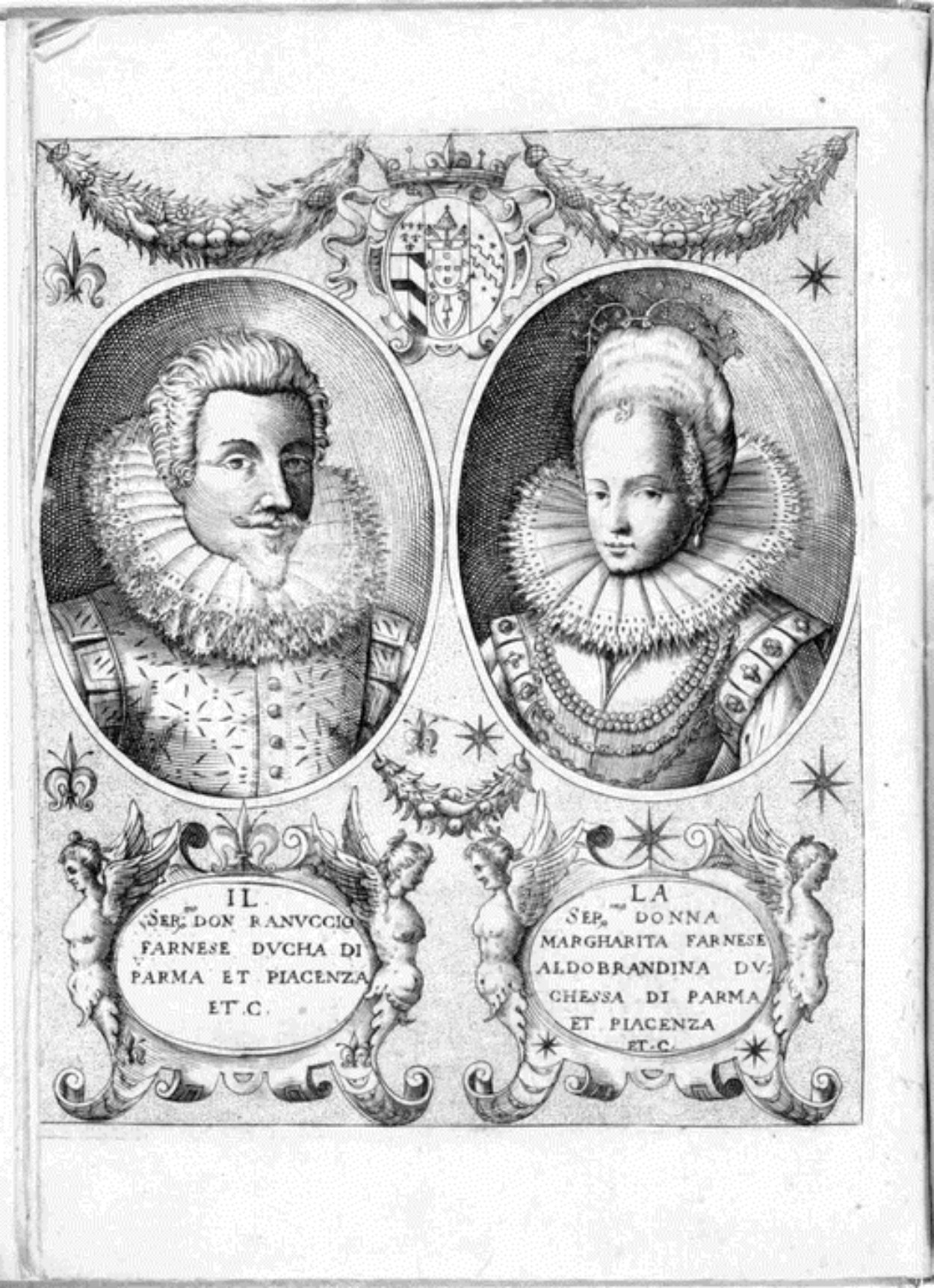
Caroso's *Nobiltà di Dame* (Venice, 1600) is the refined second edition of his *Il Ballarino* (1581) and stands as one of the most important surviving sources for the steps, rhythms, music, and social choreography of late Renaissance Italian court dance. This plate presents a noble couple in the opening position of a paired dance, their dress and bearing reflecting the highest standards of courtly refinement. The work was dedicated to Christine of Lorraine and represents the distillation of Cinquecento dance practice updated to reflect the fashions and tastes of the turn of the century. Caroso's plates are valuable not only as instructional diagrams but as precise visual records of how Renaissance nobility dressed, stood, and moved in formal social contexts.
How to look at it
Observe the precise details of dress: the woman's gown demonstrates the high neckline and front-laced bodice that define the period, while the man's doublet shows the characteristic puffed sleeves and decorative bands of early 17th-century Italian fashion. Notice the careful posture—both figures maintain an upright carriage that communicates nobility and training. The positioning of the hands is key: they are not clasped in a modern manner but are approaching one another in the gesture of Renaissance courtship, suggesting the opening greeting or hand-hold. The woodcut's linear style means the artist has conveyed movement not through gesture or blur but through the precise arrangement of the figures in space and the suggestion of weight distribution in their stance.
The artist
Fabritio Caroso da Sermoneta (c. 1526–1605) was an Italian dance master working primarily in Rome and the papal court. He was among the most celebrated and prolific dance instructors of the late Renaissance, known for systematizing and documenting the dances of the Italian nobility. His two treatises—*Il Ballarino* (1581) and *Nobiltà di Dame* (1600)—are the most detailed surviving dance manuals of the period and established him as the authoritative voice on courtly dance practice. His work bridged the 16th and 17th centuries, capturing both the older dances of the Cinquecento and the emerging styles of the early Baroque.
The period
The late 16th and early 17th centuries saw the codification and widespread documentation of European court dance. Dance instruction manuals with woodcut illustrations became fashionable among the nobility as markers of learning and refinement. Italy, particularly Venice and Rome, was the center of dance innovation during this period, and Italian dance masters were sought after across Europe. By 1600, when Caroso published *Nobiltà di Dame*, the great Renaissance dances—the pavane, galliard, and volta—were being refined and systematized even as newer dances were entering courtly practice. Caroso's work represents the culmination of Renaissance dance documentation and the bridge to the Baroque period.
Where it lives
This plate is from the Library of Congress holding of *Nobiltà di Dame*, the 1600 Venice edition. The work is a printed manual and was produced in multiple copies for distribution, making it a work of broad circulation among the educated nobility of the period rather than a unique object.
Dance in this work
Questions about this work
How do we know what these dancers are about to do?
Caroso's manual pairs each woodcut with written choreography and music notation that describes the steps and rhythms of the dance. The couple's positioning at the opening moment of the movement is consistent across multiple dances in the manual, and the specific posture and dress context allow modern scholars and reconstructors to identify which dance this most likely represents. The formal positioning and the hand approach suggest one of the major paired dances of the period: likely a pavane, basse danse, or galliard.
Why would anyone need a picture to learn a dance?
Dance instruction in the Renaissance depended on the integration of visual, written, and musical information. The woodcut allowed the student to see the proper posture, the placement of the feet, the costume, and the spatial relationship between partners before learning the steps from a master or from the written choreography. For the nobility, understanding the correct deportment—the way a body should be held in space—was as important as learning the steps themselves.
Is this the same as ballet?
No. This is Renaissance court dance, which predates and differs fundamentally from ballet. Renaissance dances like the pavane and galliard are performed in heeled shoes (not pointe shoes), move across the floor in patterns, and emphasize courtship and social interaction between partners. Ballet developed later and emphasizes turnout, elevation, and narrative. However, Caroso's work is part of the same continuous tradition of courtly and theatrical dance that eventually led to ballet.
Why do we still care about dances from 500 years ago?
Caroso's dances and his documentation of them represent a complete, sophisticated system of human movement that was socially important and artistically refined. They offer insight into how people moved, what they valued in the body, how gender relations were expressed through dance, and how instruction and learning worked. For modern dancers and historians, reconstructing and learning these dances connects us directly to the past and shows how bodies and movement change across time.
More Notation/Choreography artwork