49 works in this view — arrow keys or swipe to move between them.
Dance in Art
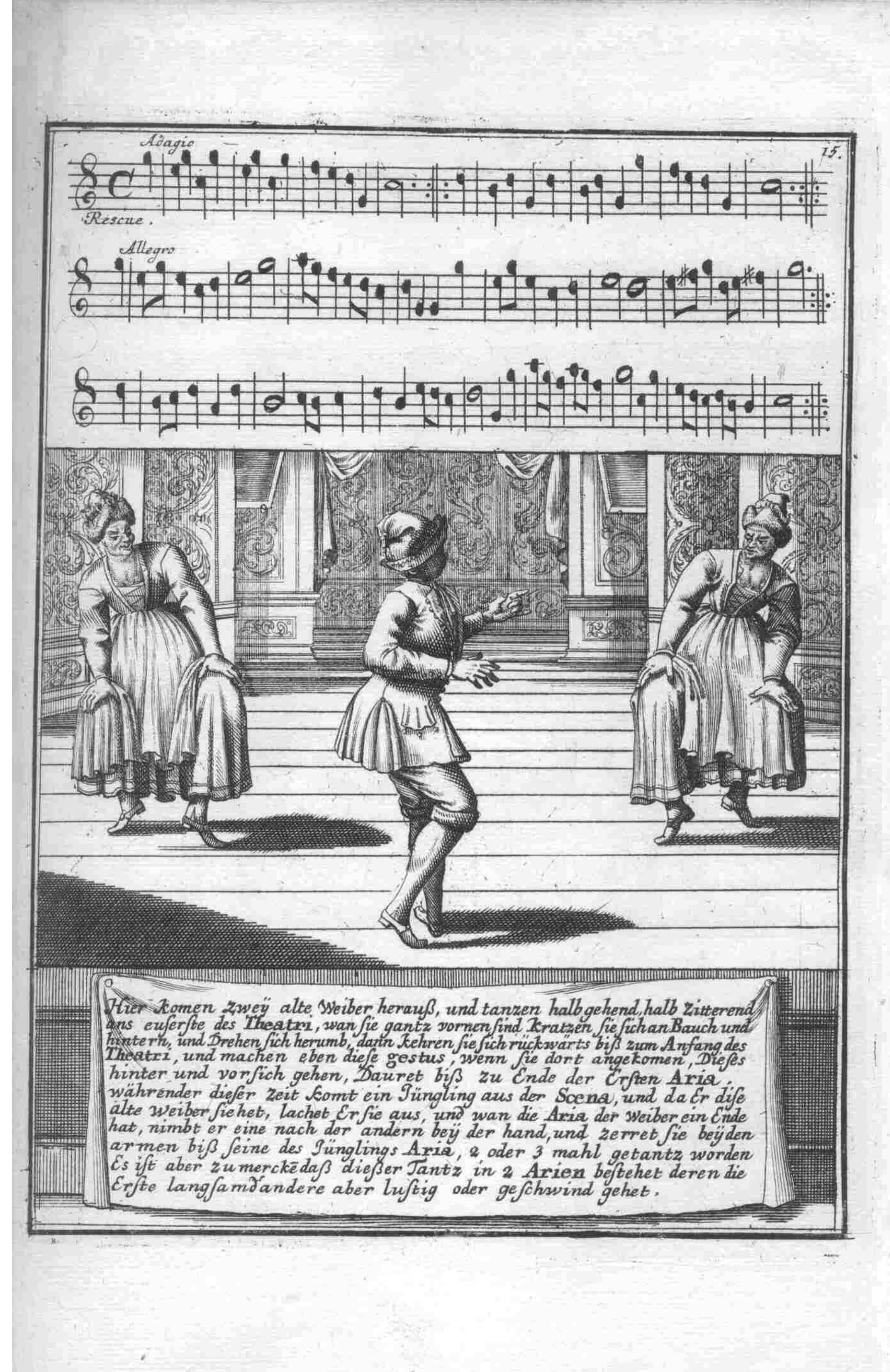
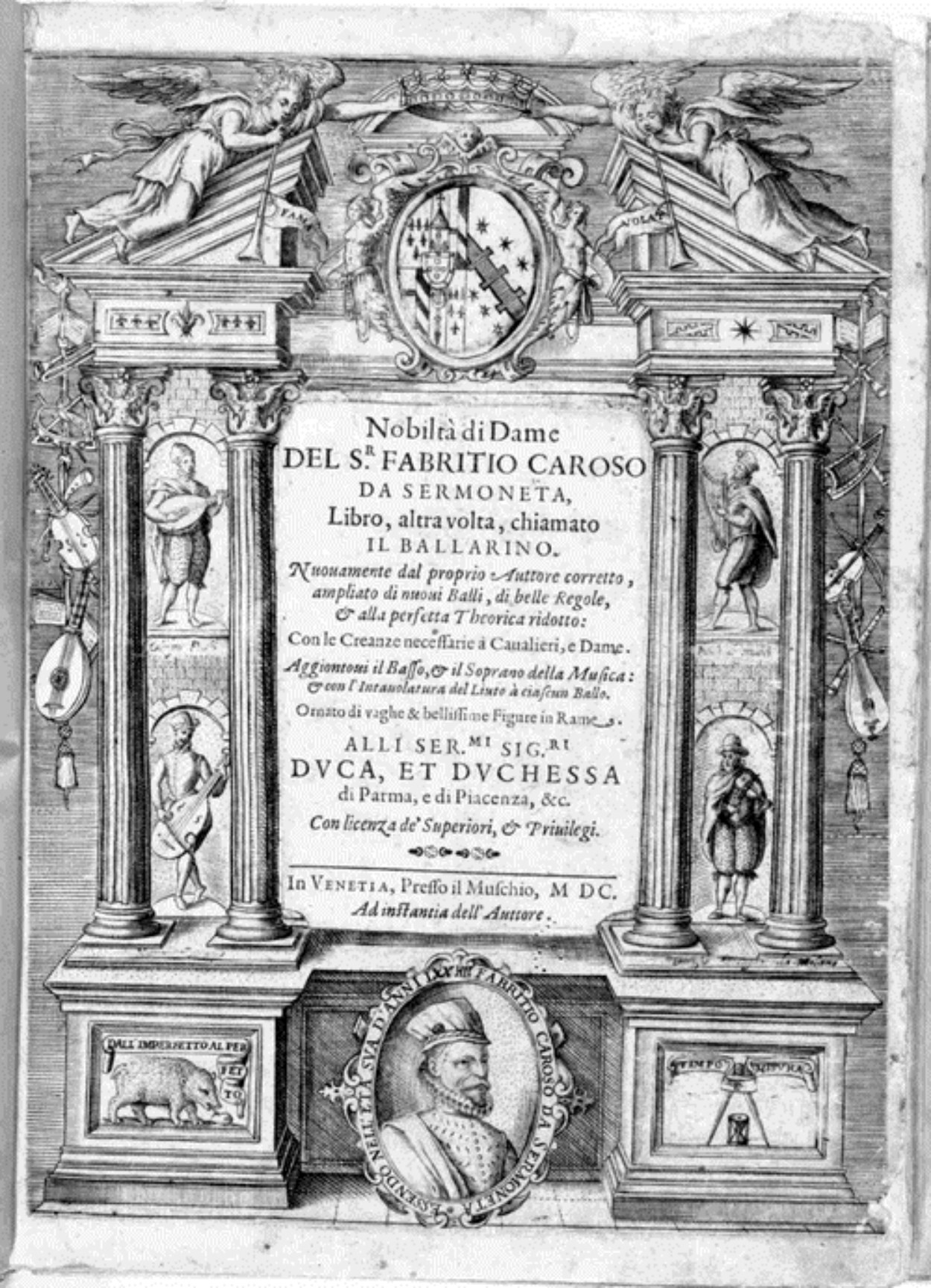
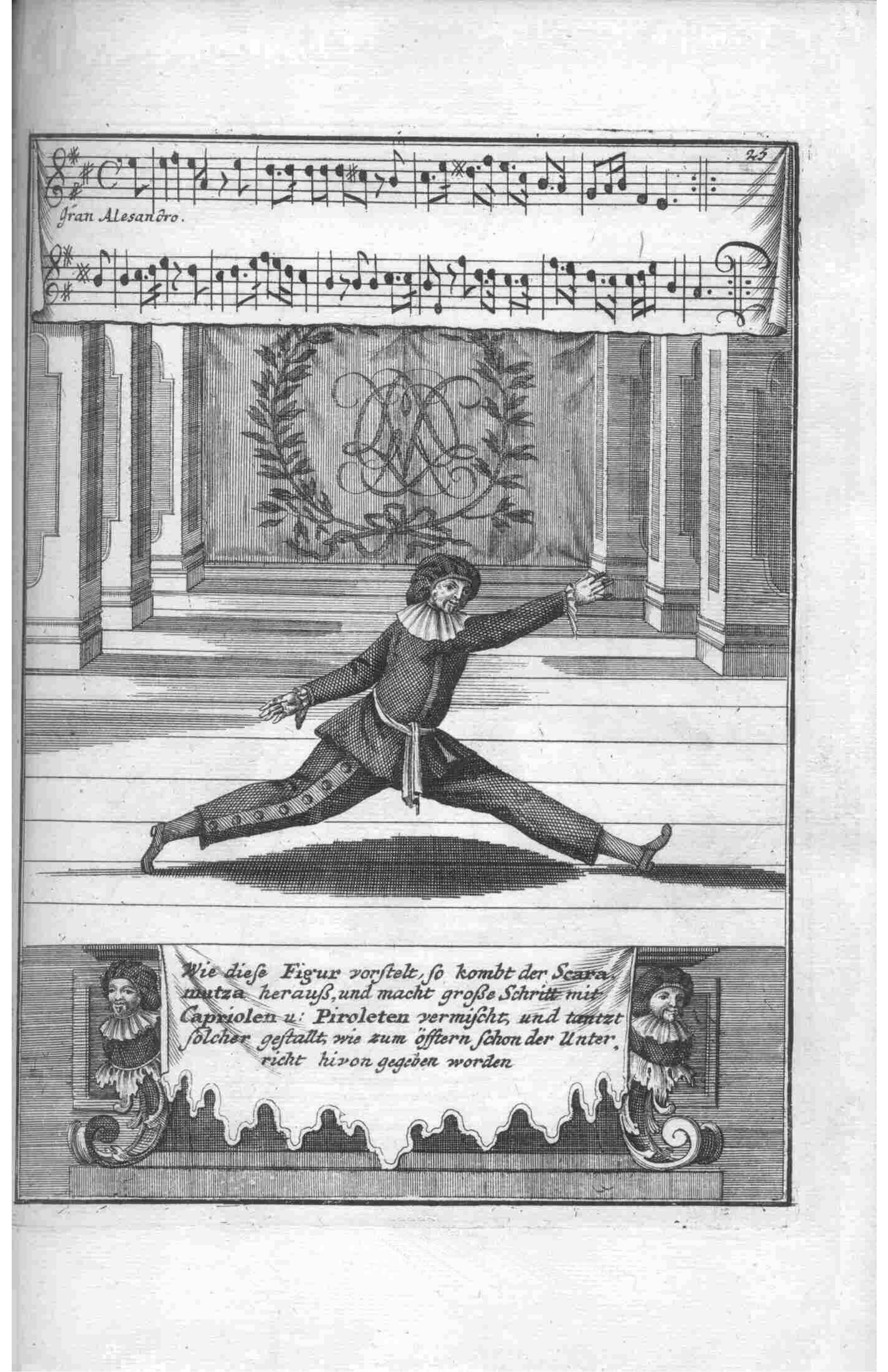
Caroso Nobiltà — Dance Plate (plate 24)
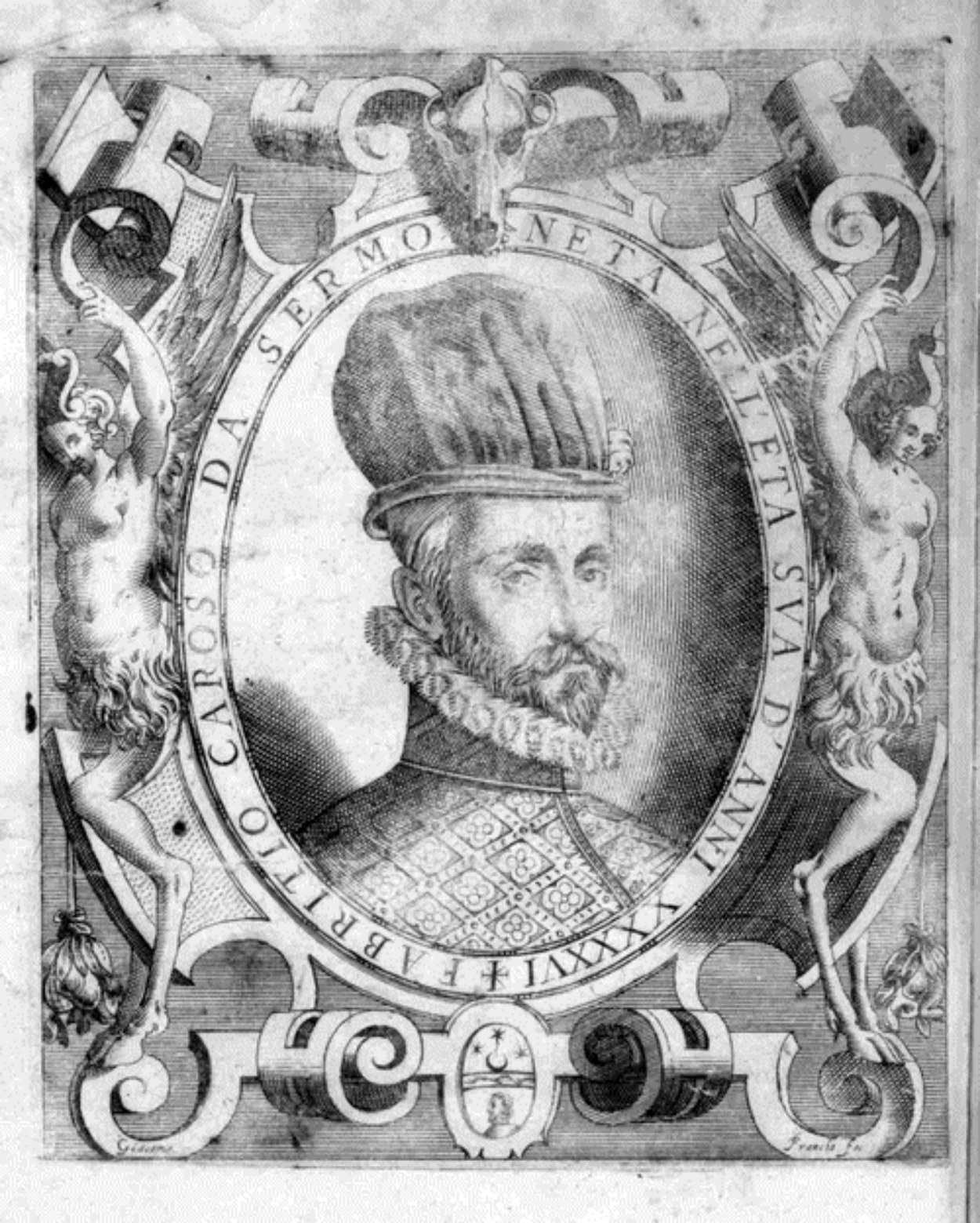
Fabritio Caroso da Sermoneta
- Medium:
- Woodcut
- Dance:
- Notation/Choreography
- Era:
- Pre-1700 (Renaissance/Baroque)
- Collection:
- Nobiltà di Dame (1600)
- Source:
- Library of Congress
- Rights:
- Public domain — free to use, share and adapt.
- Recorded as:
- Public Domain
This image is one of the few surviving visual records that shows how Renaissance court dancers actually positioned and presented their bodies during the most important social dances of the era. For dancers, choreographers, and historians, it bridges the gap between abstract notation and embodied practice, revealing the upright carriage, open frames, and careful spatial relationships that defined aristocratic movement. Caroso's *Nobiltà di Dame* is the foundational document of Renaissance dance history, and this plate is a representative page from the single most authoritative source.
What you are looking at
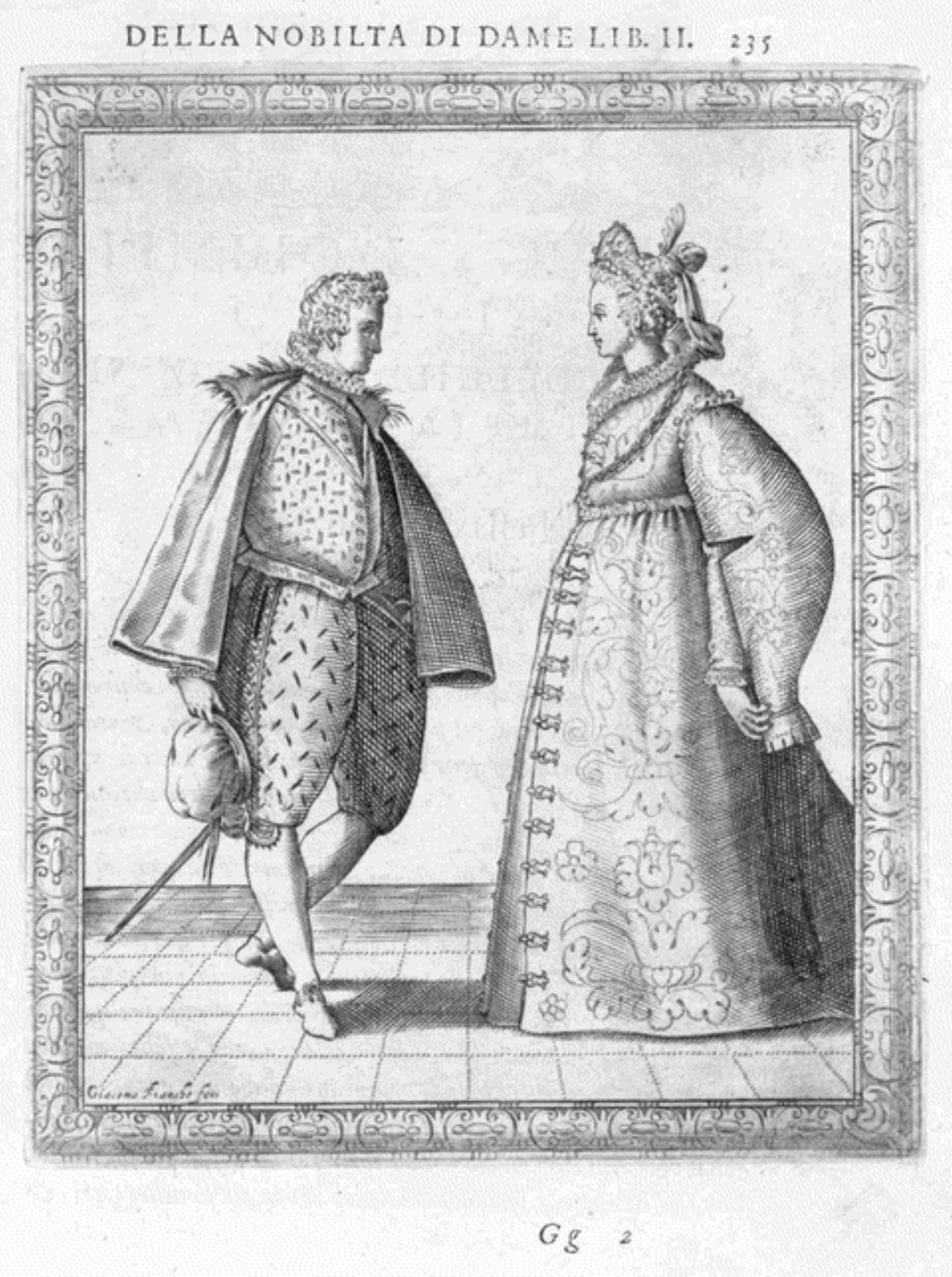
A woodcut illustration showing a nobleman and noblewoman in elegant Renaissance Italian court dress, positioned as though in conversation or the opening moment of a dance. The man stands to the left in a jeweled doublet with decorative slashing, wearing a short cape lined with fur and holding a sword hilt; his curled hair and forward-leaning posture suggest engagement. The woman stands to the right in a high-waisted gown with ornate embroidered or patterned bodice, long sleeves, and a fuller skirt; she wears an elaborate headdress with feathers and jewels, and her body angles toward the man. Both figures occupy a plain tiled floor set within a decorative Renaissance border. The composition emphasizes courtly elegance and formal interaction rather than vigorous movement—this is a moment of greeting or social positioning rather than an action step.
The dancing
The male figure displays an open, inviting frame with weight shifted forward and one arm extended in a welcoming gesture; his posture is upright and slightly turned toward his partner. The female figure maintains a more formal, upright carriage with arms held at the sides or before her; her body angles subtly toward the man. There is no hand-hold or closed position between them. The spacing and angles suggest the social distance and formal decorum of court dance—this appears to be a 'pair figure' as the manuscript notation might indicate, showing dancers positioned for a progressive or processional movement rather than in embrace.
The dance depicted
This plate illustrates a paired figure from Italian Renaissance courtly dance, most likely a pavane, galliard, or branle—the types of dances documented in Caroso's *Nobiltà di Dame*. The open frame, formal dress, and stately positioning are consistent with the dignified, processional character of the pavane, which was the foundational court dance of the sixteenth century. The illustration functions as a didactic image accompanying choreographic notation, showing dancers the proper deportment, dress, and spatial relationship for a sequence in a named dance. The 'pair figure' format suggests this plate demonstrates a specific formation within a larger choreography rather than a complete dance.
How it was made
This is a woodcut, a relief printing technique that allowed Caroso's choreographic manual to be widely reproduced and circulated in the late sixteenth and early seventeenth centuries. The technique's bold lines and high contrast suit the work's instructional purpose—figures and details must read clearly when printed in large numbers. The ornamental border is characteristic of Renaissance print design and signals the book's status as a luxury object intended for wealthy patrons and dancers aspiring to courtly refinement. Woodcuts of this period were created by cutting away the non-printing portions of a wooden block, then inking and pressing it onto paper; the result is durable and capable of many impressions.
About this work
This is a didactic plate from Fabritio Caroso's *Nobiltà di Dame* (Venice, 1600), the premier written source for Italian Renaissance court dance. It shows a nobleman and noblewoman in the formal dress and upright posture of late sixteenth-century aristocratic dancing, positioned in the 'pair figure' formation that Caroso's system of notation used to teach choreography. The plate serves both as a fashion illustration and as a movement diagram—it documents not just how nobly-born dancers should look, but how they should hold their bodies in relation to their partner. This image is crucial evidence for understanding how dances of the Renaissance court were actually performed, how they were taught, and what social meanings were encoded in bodily gesture and spatial positioning.
Caroso's manual was the most influential dance treatise of its era, reprinted and imitated across Europe. This particular plate exemplifies his method: pairing visual instruction (the illustration) with written choreographic information (the notation, here largely outside the frame) to preserve and transmit dance knowledge. The work reveals both the performative sophistication of Renaissance court culture and the emerging role of the printed book as an instrument for standardizing and spreading courtly practices.
How to look at it
Observe the stillness and formality of the pose—this is not a photograph of movement but a diagram of deportment and spatial relationship. Note how the man's weight and open posture initiate or invite interaction, while the woman's upright carriage and subtle angle toward him show how a partner responds. The illustration demonstrates that Renaissance court dance was as much about how you stood and presented yourself as about the steps you performed. The ornate dress, particularly the woman's headdress and jeweled bodice, was integral to the visual meaning of the dance; the body was displayed through the frame of costly fabric and ornament, and movement served to show off both.
The artist
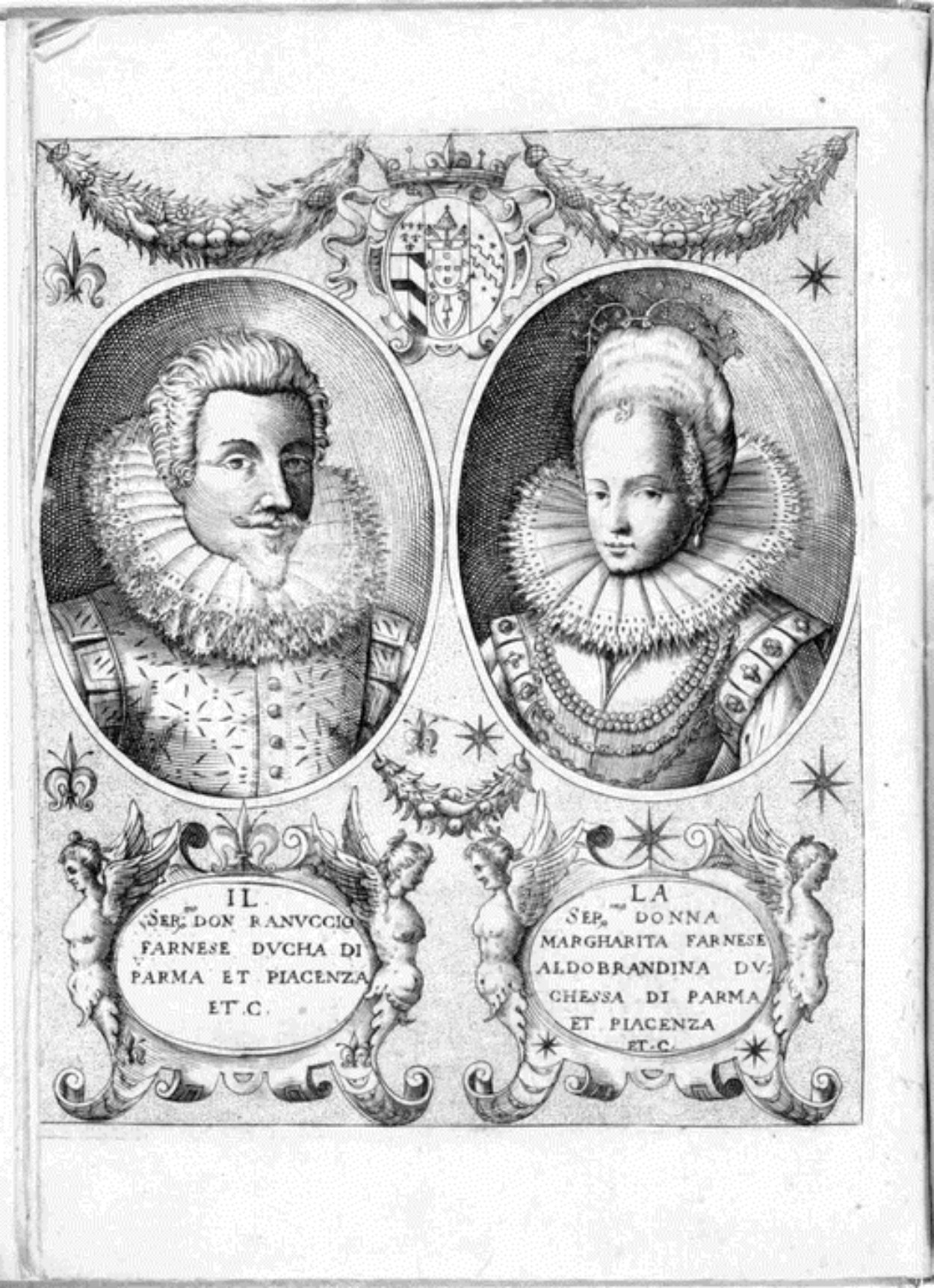
Fabritio Caroso da Sermoneta (c. 1526–c. 1605) was a celebrated dancing master at Italian courts, most notably at Rome and Urbino. His first treatise, *Il Ballarino* (1581), was the earliest comprehensively notated dance manual in print. *Nobiltà di Dame* (1600) was a refined and expanded revision, dedicated to Christine of Lorraine (the widow of the Duke of Lorraine and a prominent patron of court culture). Caroso's system combined Italian notation for steps with illustrations of pairs in characteristic formations, creating a model for dance instruction that influenced European practice for generations. His work represents the high point of Renaissance courtly dance documentation and established him as the most authoritative voice on how noblemen and noblewomen should move.
The period
In the late sixteenth century, Italian courts were centers of cultural refinement where dance was a key skill for the nobility. The pavane and galliard dominated court choreography; the pavane in particular was slow, processional, and emphasized deportment and partnering, while the galliard was the virtuosic jumping dance that demonstrated physical prowess. By 1600, when *Nobiltà di Dame* appeared, these dances were being systematized and recorded in unprecedented detail. The shift from oral tradition to printed instruction reflected both the prestige of the Italian courts and the emerging role of the printed book in standardizing courtly behavior across Europe. Caroso's work also captured a transitional moment: the Renaissance court dance tradition of the sixteenth century was about to give way to the baroque court dances of the seventeenth century, yet *Nobiltà di Dame* ensured that the sophistication of the earlier style was preserved and transmitted.
Where it lives
This plate comes from the first (1600) edition of *Nobiltà di Dame*, held in the Library of Congress. The work was a printed book, widely distributed among European nobility and dance professionals, making it one of the most influential documents in the history of dance.
Dance in this work
Questions about this work
What is a 'pair figure'?
In Caroso's notation system, a 'pair figure' is a formation showing two dancers in a specific spatial and postural relationship. It serves as a visual reference to accompany the written choreographic directions, helping dancers understand where they should stand and how they should position themselves relative to their partner.
How do we know what dance this plate illustrates?
The plate number and the written notation that would accompany it in the original book identify the specific dance. The upright carriage, open frame, and formal spacing are consistent with the pavane or a similar processional court dance; the *Nobiltà di Dame* contents page and textual references would confirm which choreography this plate belongs to.
Why is this book important for understanding Renaissance dance?
*Nobiltà di Dame* is the most comprehensive surviving record of how Renaissance court dances were actually performed. Before this, dance knowledge was transmitted orally by dancing masters. Caroso's combination of notation, illustration, and detailed verbal description allows modern dancers and historians to reconstruct and perform these dances with a precision that would otherwise be impossible.
What does the dress tell us about the dancers?
The jewels, embroidery, furs, and elaborate headdress are markers of aristocratic status. These were expensive materials meant to display wealth and rank. Dance in this context was a form of courtly self-presentation—the body, adorned with costly fabrics, was moved through space in a carefully controlled way to reinforce social hierarchy and refinement.
More Notation/Choreography artwork