49 works in this view — arrow keys or swipe to move between them.
Dance in Art
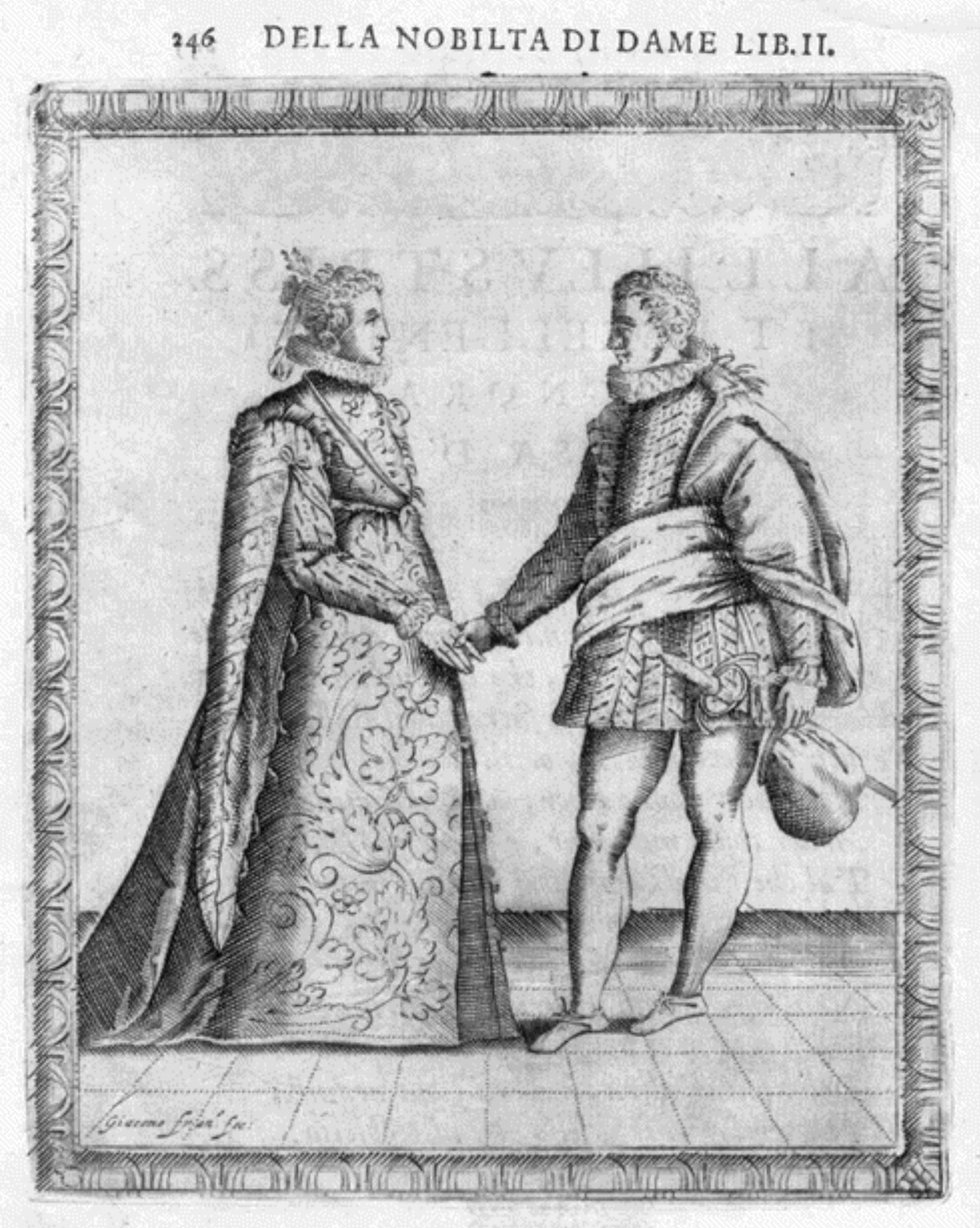
Caroso Nobiltà — Dance Plate (plate 26)
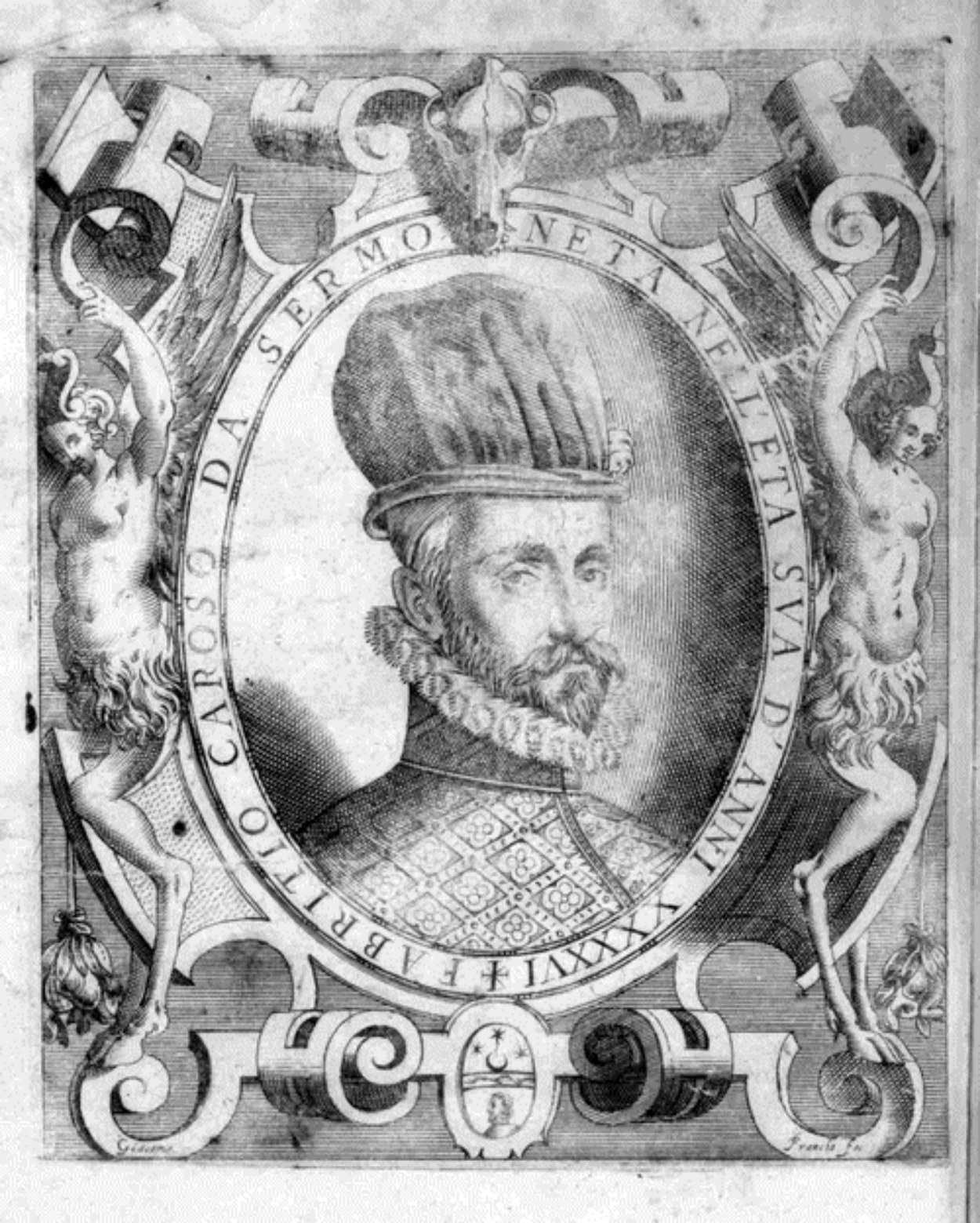
Fabritio Caroso da Sermoneta
- Medium:
- Woodcut
- Dance:
- Notation/Choreography
- Era:
- Pre-1700 (Renaissance/Baroque)
- Collection:
- Nobiltà di Dame (1600)
- Source:
- Library of Congress
- Rights:
- Public domain — free to use, share and adapt.
- Recorded as:
- Public Domain
Caroso's manual was the authoritative dance text of the late Renaissance, and these woodcuts are among the most direct visual evidence we have of how nobility dressed for and positioned themselves in courtly dance. The image reveals that Renaissance court dance was as much about correct posture, costume, and formal etiquette as it was about footwork—a reminder that dance history includes the social grammar of the body, not only its movement. For historians of dance, costume, and Renaissance courtly practice, this plate is primary evidence of how an accomplished dancer was expected to appear and comport themselves.
What you are looking at
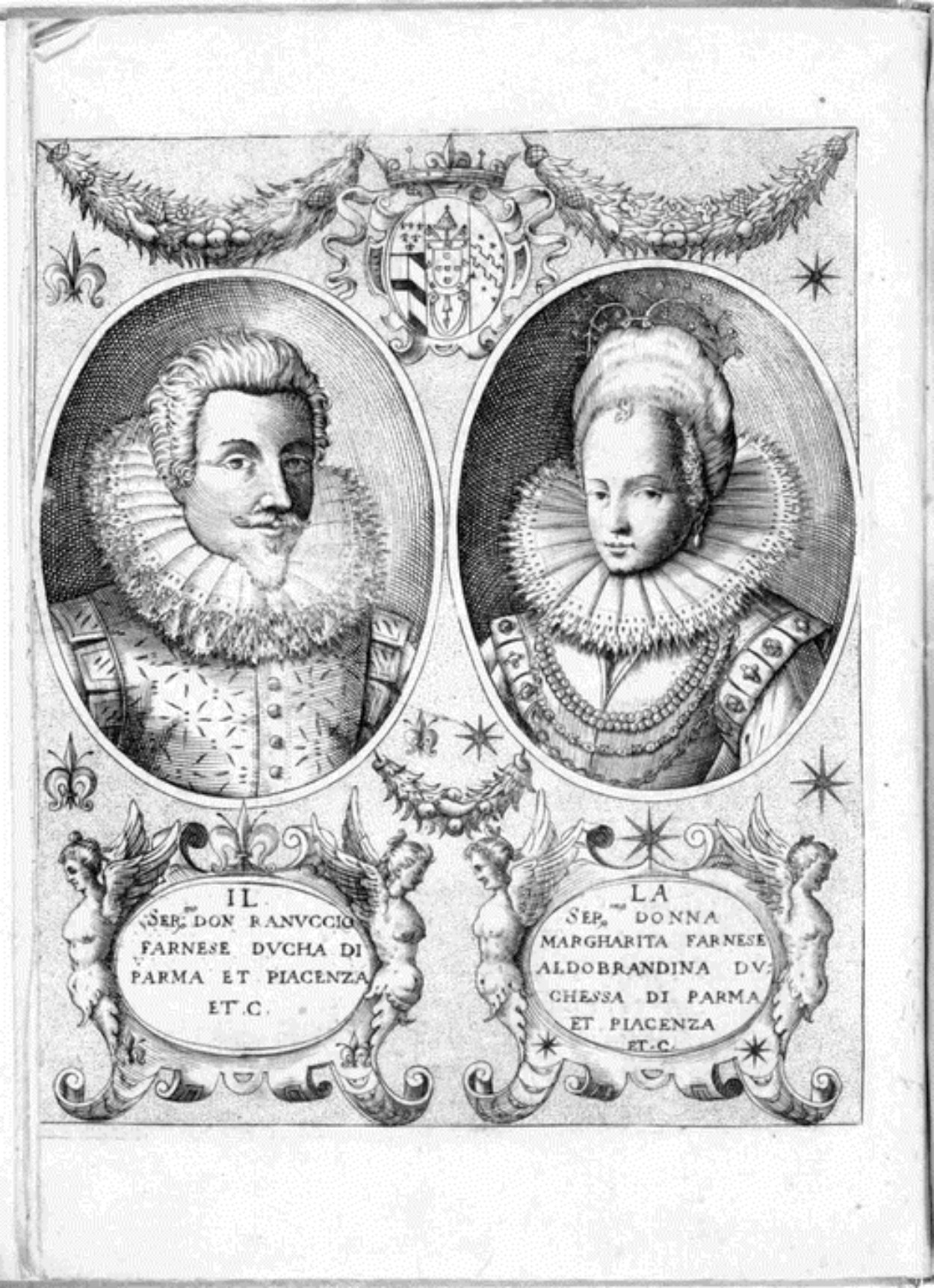
A woodcut depicts a noble couple in Renaissance Italian court dress, positioned in a formal frontal composition against a plain background. The woman on the left wears an elaborate gown with patterned brocade or embroidered fabric, a long train, and an ornate headdress with jeweled ornaments and what appears to be a veil or head covering in the fashion of late 16th-century Venice. The man on the right wears a doublet with decorative slashing, hose, and a ruffled collar; he holds what appears to be a feathered ornament or plume in his right hand. The couple's hands meet or nearly meet in the center of the composition, suggesting an encounter or greeting rather than an active moment of movement. The figures are positioned in profile or three-quarter view, with careful attention to the rendering of their costume details through the woodcut medium's linear hatching.
The dancing
Both figures stand upright with formal posture, their bodies aligned in a symmetrical composition typical of courtly presentation. The woman's weight appears centered, her long skirts dominating the visual space with their elaborate patterning. The man is depicted in contrapposto, with one leg bearing weight while the other is slightly relaxed. Their hands approach or touch at waist height in a restrained, courtly gesture of acknowledgment or salutation. Neither figure displays the dynamic, lifted quality of active dance movement; instead, the pose suggests a formal presentation or the beginning of a dance, a pause in social interaction rather than the middle of a step.
The dance depicted
This plate likely documents a courtly dance introduction or salutation rather than capturing active footwork or choreography in motion. The work appears to illustrate the formal etiquette of court dance as practiced in late 16th-century Venice—specifically the kind of paired figure that opened dances of the period. The restraint and formality of the pose, combined with the costume details and the couple's frontal presentation, suggests this is a pedagogical or documentary image meant to show the proper bearing and dress for court dance rather than the execution of a specific choreographed step. The image demonstrates the social and sartorial conventions governing dance participation among the nobility.
How it was made
The work is a woodcut, a relief printing technique in which an image is carved into the surface of a wooden block. Woodcuts were the primary mass-production medium for printed images in the Renaissance and allowed for relatively rapid dissemination of copies, making them ideal for illustrating dance manuals and instruction books. The technique's reliance on bold lines and areas of solid black or white, rendered through careful parallel hatching for tonal variation, is evident in the rendering of the figures' costumes and the decorative border. Woodcut's aesthetic—linear, graphic, with emphasis on clear outline and legibility—suited the documentary purpose of dance notation and instruction, allowing readers to perceive the essential formal elements of posture, costume, and bearing.
About this work
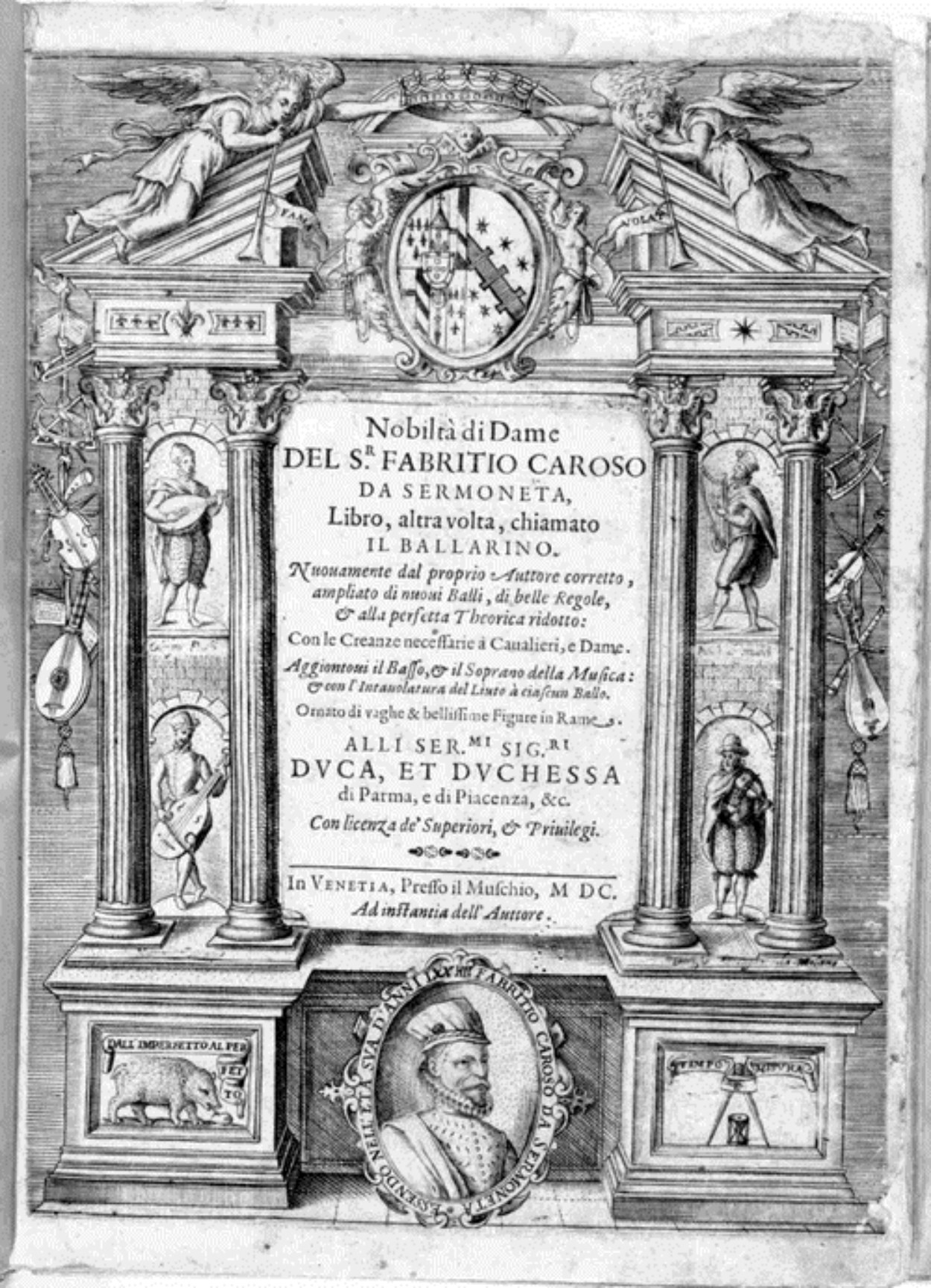
This is plate 26 from Fabritio Caroso's *Nobiltà di Dame* (Venice, 1600), the refined republication of his earlier dance manual *Il Ballarino* (1581). The work sits within a tradition of Renaissance and early Baroque dance notation that combined choreographic instruction with elaborate woodcut illustrations of proper court etiquette. Rather than freezing a moment of athletic or virtuosic movement, this image documents the formal presentation and social positioning required of noble dancers—the proper dress, posture, and deportment that preceded and framed actual dance steps. It belongs in a gallery of dance art not because it captures movement in progress, but because it is a foundational document of how Renaissance nobility understood dance as a social and courtly practice, one inseparable from costume, bearing, and the ritualized greeting between partners.
How to look at it
Attend first to the costume: the woman's elaborate brocaded gown and headdress establish this as an image of the nobility, not of professionals or lower social orders. Notice the formal symmetry of the composition and the reserved quality of the gesture—this is not a moment of exuberant movement, but rather a formal acknowledgment or salutation. The woodcut technique renders the figures' surfaces through fine parallel lines (hatching), which the eye reads as fabric texture and volume; this graphic precision was essential to a manual meant to teach proper appearance. Look at the hand positions and the alignment of the bodies: the couple faces slightly toward each other, their postures upright and controlled, embodying the ideal of courtly restraint and dignity that governed Renaissance social dance.
The artist
Fabritio Caroso da Sermoneta (c. 1526–1605) was one of the most celebrated dance masters of the Renaissance and early Baroque periods. Based primarily in Rome, he served the papal court and the nobility of Central Italy, becoming renowned for his refinement of choreography and his theorization of courtly dance. His first major publication, *Il Ballarino* (1581), established him as an authority on proper dance technique and etiquette; the later *Nobiltà di Dame* (1600), dedicated to Christine of Lorraine, Grand Duchess of Tuscany, represented both a consolidation of his life's work and an accommodation to the shifting tastes of early 17th-century court practice. Caroso's manuals are distinguished by their extensive use of woodcut illustrations to accompany detailed written choreographies, making them among the most comprehensive visual records of Renaissance dance practice.
The period
In the late 16th and early 17th centuries, courtly dance was undergoing significant transformation. The basse danse and pavane of the mid-Renaissance were giving way to faster, more elaborate choreographies such as the galliard, volta, and branle, while the social function of dance remained central to courtly life and noble identity. Venice and the Italian courts were major centers of dance innovation, and the publication of Caroso's manuals coincided with the increasing professionalization and codification of dance knowledge. The rising middle class of wealthy merchants and the stabilization of courtly hierarchies created demand for instruction books that could transmit elite practices to a broader audience. Woodcut printing, at its height as a medium during this period, made such instruction accessible beyond the immediate circle of a dance master's studio.
Where it lives
This plate is held as part of the *Nobiltà di Dame* (1600 edition), published in Venice. The work is one of a series of woodcut illustrations accompanying the choreographies and instructions in Caroso's manual, making it a primary source document for Renaissance dance practice and costume. As part of a printed book rather than a unique artwork, it would have circulated in multiple copies among dance enthusiasts, nobility, and dance masters throughout Europe.
Dance in this work
Questions about this work
Is this depicting an actual dance, or just two people standing still?
This is likely depicting the formal salutation or opening posture that preceded a dance—the moment when two partners would acknowledge each other before beginning choreographed steps. In Renaissance courtly practice, how you stood, bowed, and greeted your partner was as codified and important as the footwork that followed. The image is documentary rather than narrative; it is teaching proper bearing and dress rather than showing active dancing.
Why are they both fully clothed in such elaborate garments?
Costume was integral to courtly dance and to the display of status. A noble dancer's clothing—fabric, embroidery, jewels—advertised their rank and resources. Dance was a social and political performance, not a purely physical practice, and the garments worn were part of that performance. This image documents what a well-dressed dancer of noble birth was expected to wear.
What makes this a woodcut and not an engraving?
A woodcut is a relief print, carved from the surface of a wooden block; an engraving is an intaglio process, where lines are incised into metal. Woodcuts have a characteristically bold, graphic quality with strong contrasts between black and white and typically feature parallel hatching for tonal variation. Engravings allow for finer, more delicate linework. This image's bold outlines, clear composition, and reliance on hatching for shading are typical of Renaissance woodcut technique.
Who was Caroso and why does his work matter?
Fabritio Caroso was the preeminent dance master of the late Renaissance and the author of the two most authoritative dance manuals of the period. His publications are our most detailed and systematic record of how Renaissance courtly dances were structured, executed, and understood by their practitioners. Without Caroso's manuals, our knowledge of Renaissance dance would be fragmentary and speculative.
More Notation/Choreography artwork