49 works in this view — arrow keys or swipe to move between them.
Dance in Art
Caroso Nobiltà — Dance Plate (plate 27)
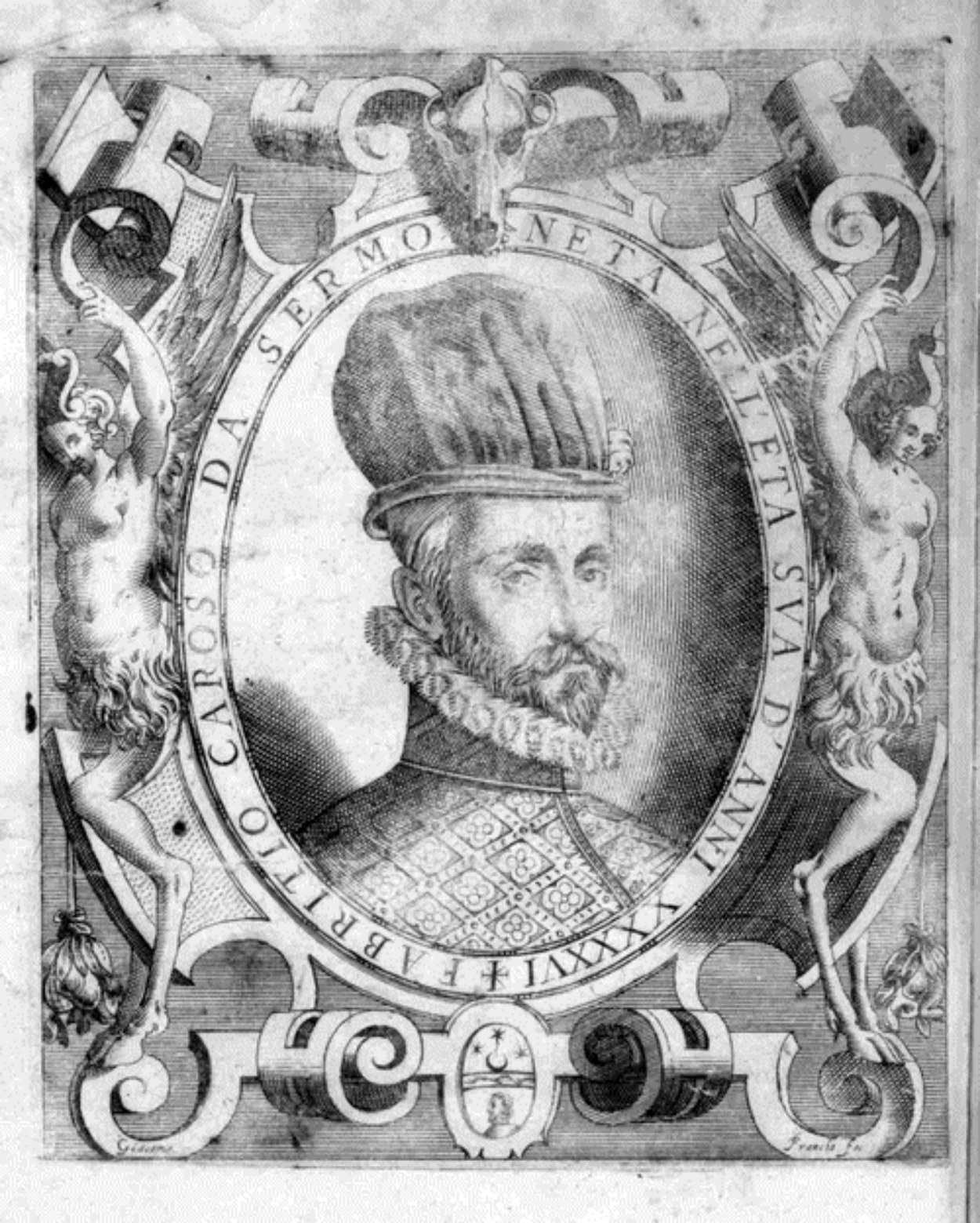
Fabritio Caroso da Sermoneta
- Medium:
- Woodcut
- Dance:
- Notation/Choreography
- Era:
- Pre-1700 (Renaissance/Baroque)
- Collection:
- Nobiltà di Dame (1600)
- Source:
- Library of Congress
- Rights:
- Public domain — free to use, share and adapt.
- Recorded as:
- Public Domain
Caroso's *Nobiltà di Dame* is one of the two most important surviving dance manuals of the Renaissance; this plate exemplifies how Italian courts used printed images to codify and disseminate the dances that defined noble status. The image is evidence that Renaissance dance was not improvised but carefully composed and taught, and that dress, posture, and movement were inseparable markers of rank and refinement.
What you are looking at
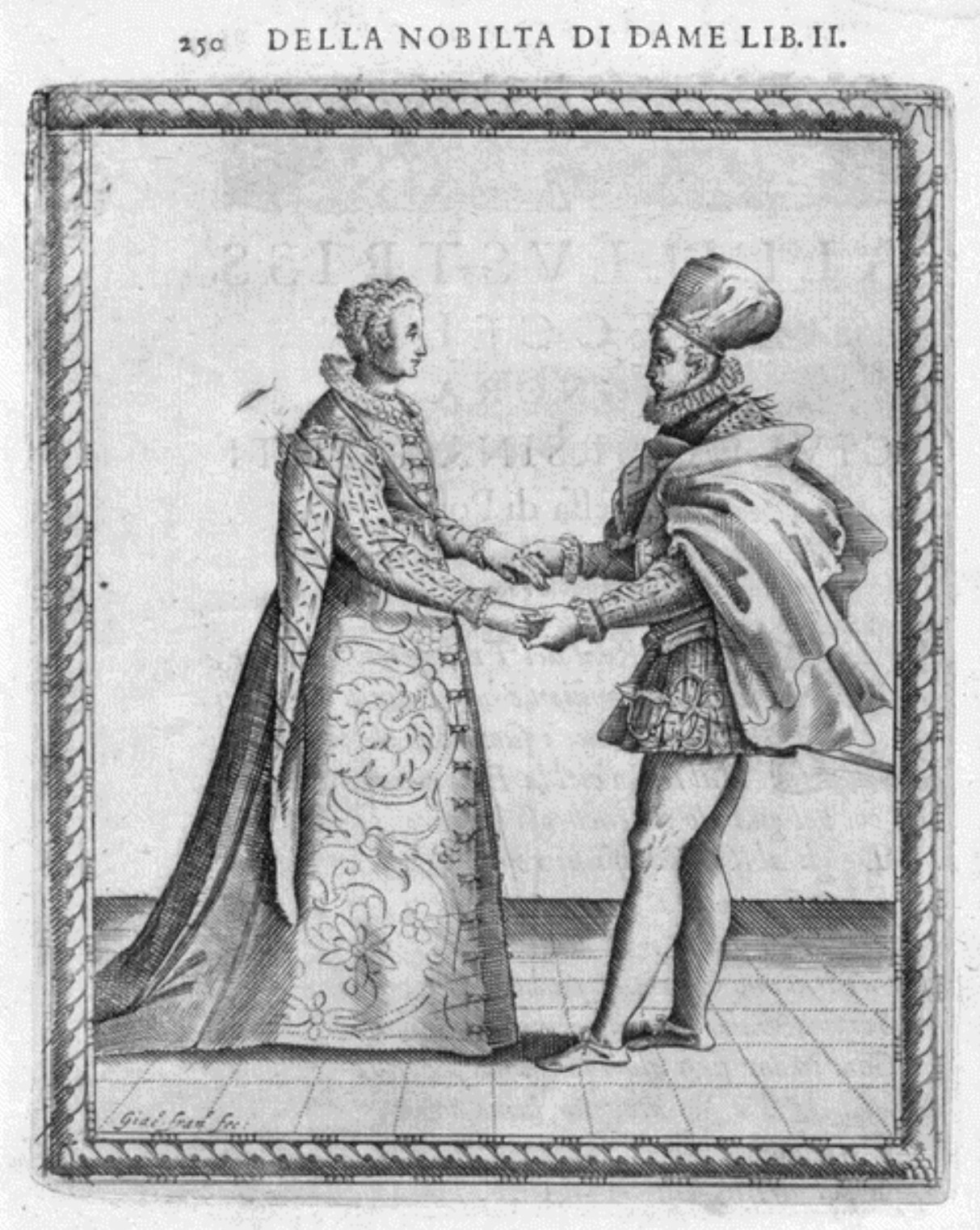
A woodcut illustration from Caroso's *Nobiltà di Dame* showing two figures in elaborate Renaissance court dress engaged in a paired dance. The woman on the left wears a richly patterned gown with ornate embroidery or brocade, a high collar, and a long train that trails behind her; her hair is styled up in the fashion of the period. The man on the right, shown in profile, wears a doublet with decorative slashing, hose, and a cloak draped across his shoulders; he sports a distinctive feathered cap. Their hands are joined or nearly touching at roughly waist height, suggesting an opening or greeting gesture of a formal dance. The setting is minimal—a tiled floor indicated by linear perspective—placing emphasis entirely on the figures and their interaction. The composition is formal and frontal, typical of didactic dance notation plates: the figures are positioned to show their dress and carriage clearly, as if presenting an ideal of courtly comportment as much as demonstrating a specific choreographic figure.
The dancing
Both figures stand upright with composed posture and minimal bend in the knees, consistent with Renaissance court dance technique. Their hands meet between them, neither figure leaning toward the other, suggesting a moment of formal introduction or the beginning phrase of a paired dance. The woman's weight appears centered, her body fully facing forward; the man is shown nearly in profile, allowing the viewer to see his leg line and the detail of his hose and shoe. No dramatic movement or extension is evident—the moment captured is stately and controlled, emphasizing nobility of bearing over dynamic action.
The dance depicted
This is a notation plate illustrating a dance from the Italian Renaissance court repertory, most likely a *pavane* or *galliard* variant, or possibly a figure from a *bassa danza* (basse danse) given the restrained, processional character. Caroso's *Nobiltà di Dame* (1600) is a refined revision of his earlier *Il Ballarino* (1581) and documents the dances performed in elite Italian courts at the turn of the 17th century. The paired, frontal presentation is typical of opening or greeting figures in coupled dances of this era. The image is didactic rather than narrative—it shows the proper dress, posture, and hand position for a recognizable choreographic moment, allowing a courtier to learn or recall the dance from the book.
How it was made
This is a woodcut, a relief-printing technique well suited to the wide circulation of instructional dance manuals. Woodcuts reproduce clearly across multiple printings and were the standard medium for book illustration in Venice in 1600. The fine lines of the cross-hatching and the precise detail of the figures' dress—the embroidery pattern on the woman's gown, the feathering of the hat, the slashing on the doublet—demonstrate the skill of the cutter and suggest an audience of educated courtiers who could afford an illustrated folio and would appreciate such refinement. The technique allowed for wide distribution of this authoritative text and helped establish Caroso's method as a model across Europe.
About this work
This is a woodcut plate from Fabritio Caroso's *Nobiltà di Dame*, a foundational printed source for Renaissance Italian court dances. It documents not a single moment of spontaneous movement but an ideal image: the proper dress, carriage, and opening hand-hold of a paired court dance as performed in the elite circles of late 16th and early 17th-century Italy. The work sits at the intersection of dance documentation, fashion portraiture, and instructional manual. It is valuable because it preserves both the choreography and the visual culture of an era when dance was integral to courtly identity, and because Caroso's meticulous notation influenced dance practice across Europe for generations.
How to look at it
Attend to the positioning of the hands and the uprightness of the torso: this is not a romantic embrace or a moment of abandon, but a formal, prescribed gesture with rules governing distance, height of the hand-hold, and the angle of the body. The precision of the dress—the exact pattern of embroidery, the angle of the feathered hat, the fit of the hose—tells you that this is as much a fashion plate as a dance diagram, meant to instruct the viewer on how a noble dancer should look. Notice that the engraver has chosen a moment of stillness or transition rather than a leap or turn; this reflects the Renaissance preference for controlled, processional movement and the didactic aim of the manual, which seeks to teach by showing the foundation of the dance, not its most spectacular instant.
The artist
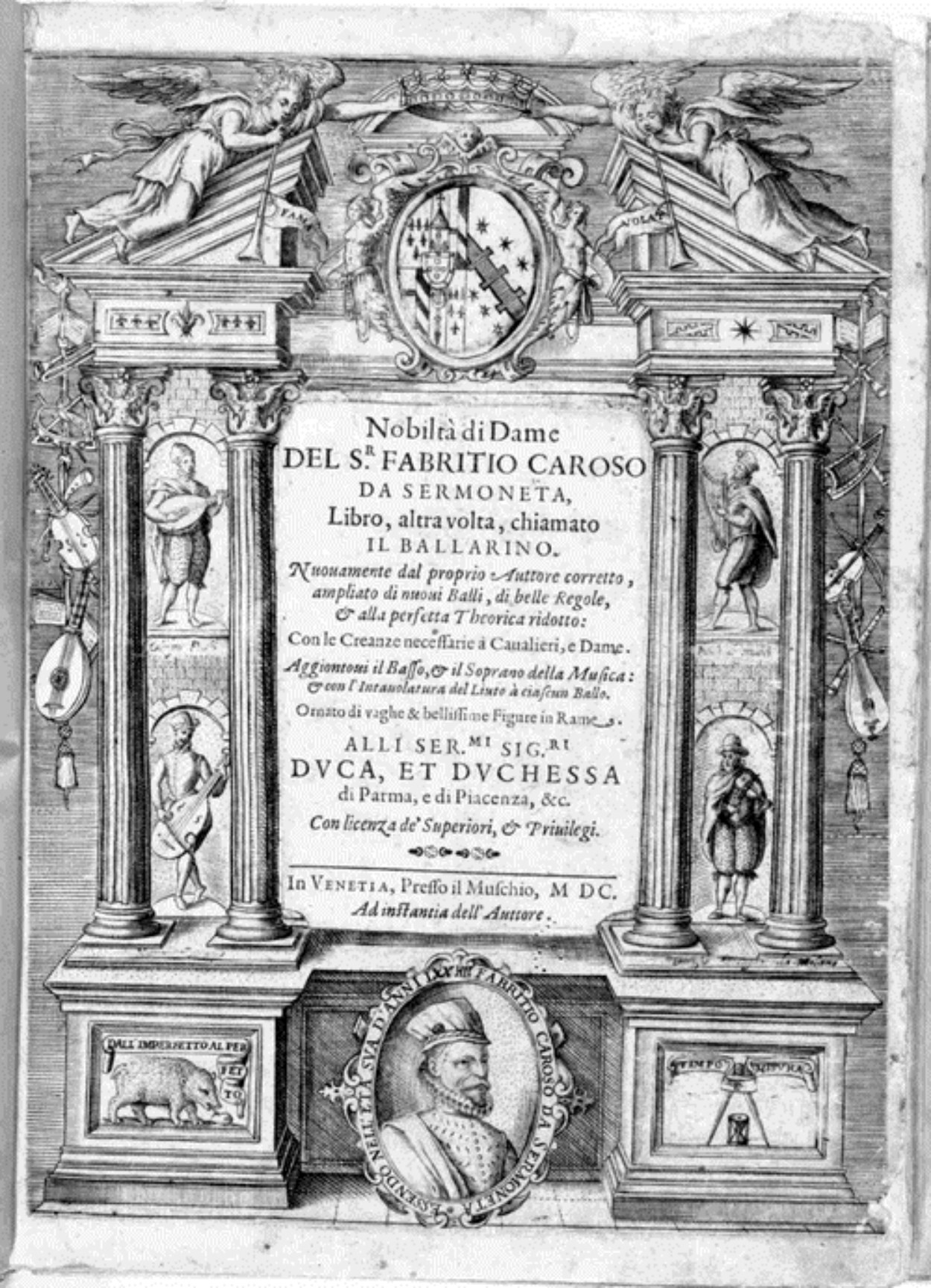
Fabritio Caroso da Sermoneta (c. 1527–after 1605) was a choreographer and dancing master active in Rome and other Italian courts. He published *Il Ballarino* in 1581, a landmark notation of dances performed in elite circles, and revised and enlarged it as *Nobiltà di Dame* in Venice in 1600, dedicating it to Christine of Lorraine. His work was the most widely circulated and imitated dance manual of the late Renaissance, translated and adapted across Europe. Caroso's notation system, combining text, musical notation, and woodcut diagrams, became a model for subsequent dance masters and remains the primary source for understanding how Renaissance court dances were actually performed.
The period
In the late 16th and early 17th centuries, dance was a core accomplishment of the nobility and a sign of courtly sophistication. The Italian courts, particularly those of Venice, Urbino, and Rome, were centers of an elaborate ritual culture in which dance demonstrated education, social status, and refinement. At the same time, the rise of printing made it possible to codify and distribute dance knowledge beyond personal apprenticeship. Caroso's manuals reflect a moment when dance transitioned from oral transmission to written and illustrated form, allowing it to be studied, preserved, and taught across generations and geographies. The stylistic evolution from *Il Ballarino* (1581) to *Nobiltà di Dame* (1600) also documents the gradual shift from the stately pavane and galliard toward slightly faster and more elaborate figures.
Where it lives
This is a woodcut plate from the 1600 Venice edition of *Nobiltà di Dame*. The Library of Congress holds the work as part of its collection of rare printed books on dance. It is one of approximately 100 such instructional plates in the complete manual.
Dance in this work
Questions about this work
What dance is this showing?
The specific dance is difficult to determine from the image alone, but based on the formal hand-hold, upright posture, and the context of Caroso's manual, this is likely an opening figure of a *pavane*, *galliard*, or *bassa danza*. Caroso's notation system combined woodcuts with text and musical notation; a reader consulting the full manual would find the choreography spelled out in his notation, which specified the exact sequence of steps and the musical accompaniment.
Why are the man and woman in such formal poses?
Renaissance court dance was not naturalistic or spontaneous; it was carefully choreographed and taught by masters. The formal posture, the controlled hand-hold, and the composed carriage were essential to the dance and to the courtly ideal it expressed. The woodcut freezes a moment in a precisely defined sequence, meant to instruct other dancers in the correct form.
How was this image used?
This plate was part of an instructional manual that courtiers and dancing masters consulted to learn or review the dances performed in elite circles. A noble person would study the text, the musical notation, and the woodcut diagrams to master the choreography. The manual was also a status object—owning an illustrated copy of Caroso's work signaled education and participation in courtly culture.
Why does Caroso's work matter?
*Nobiltà di Dame* is one of only two comprehensive dance manuals to survive from the Renaissance, and Caroso's notation system was the most influential and widely imitated of the period. Without these plates and texts, we would have almost no reliable knowledge of how Renaissance dances were actually performed. The manual is also evidence of a broader shift in the 16th century toward the documentation and systematization of knowledge through print.
More Notation/Choreography artwork