49 works in this view — arrow keys or swipe to move between them.
Dance in Art
Solo Dancer — Plate 60
Gregorio Lambranzi
- Medium:
- Copper-plate engraving
- Dance:
- Notation/Choreography
- Era:
- 1700s (Enlightenment/Minuet Era)
- Collection:
- Nuova e curiosa scuola de' balli theatrali (1716)
- Source:
- Library of Congress
- Rights:
- Public domain — free to use, share and adapt.
- Recorded as:
- Public Domain
Lambranzi's manual is one of the earliest and most detailed visual records of how baroque theatrical dance was actually performed—not the court minuet or social forms, but the professional stage vocabulary. For dance historians and performers, this manual is primary source material showing the technical and aesthetic values of early 18th-century theater dance: the emphasis on verticality, elegant extension, controlled balance, and the integration of music and movement. The copper-plate engravings are precise enough to inform reconstruction and teaching today.
What you are looking at
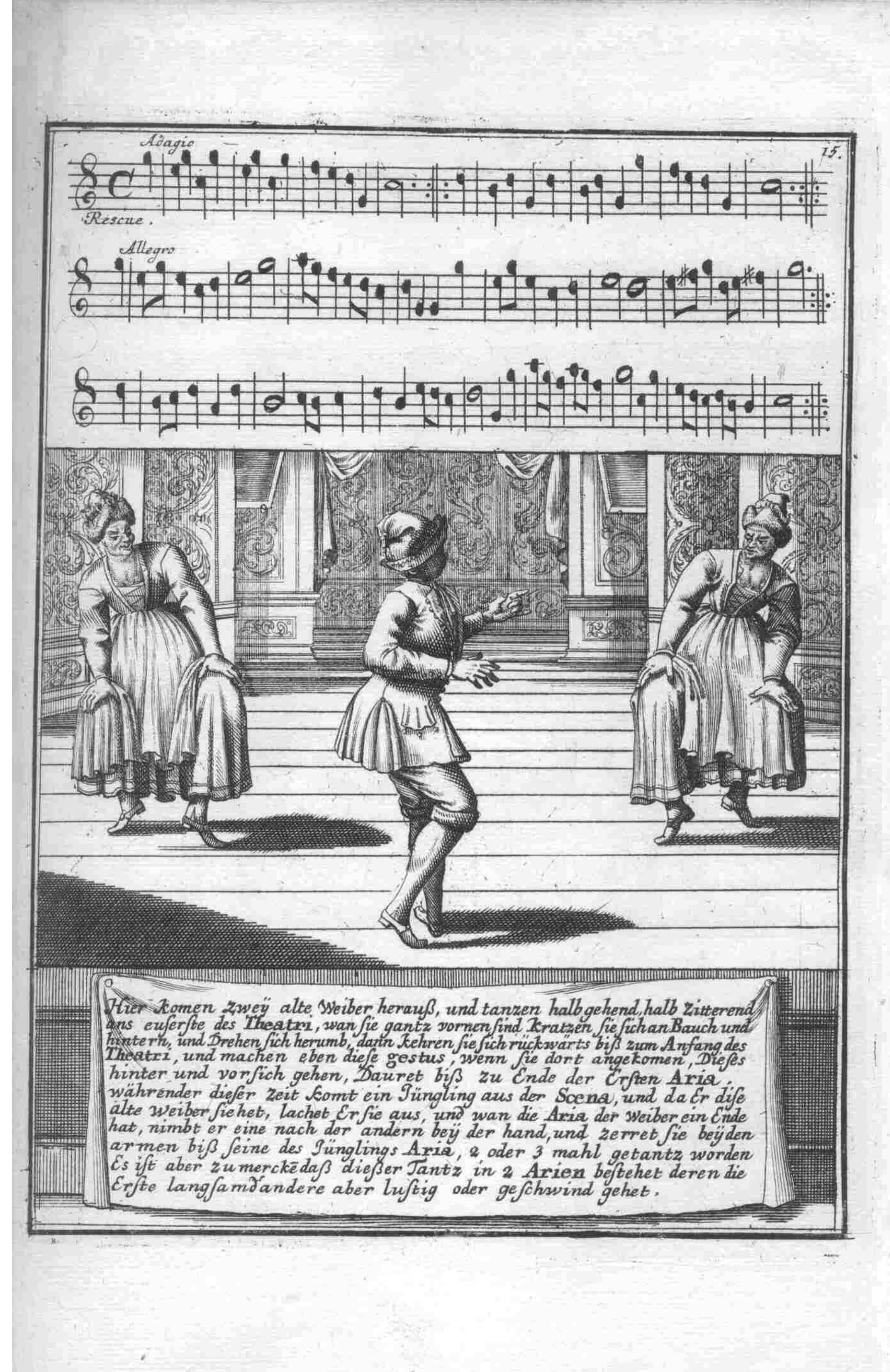
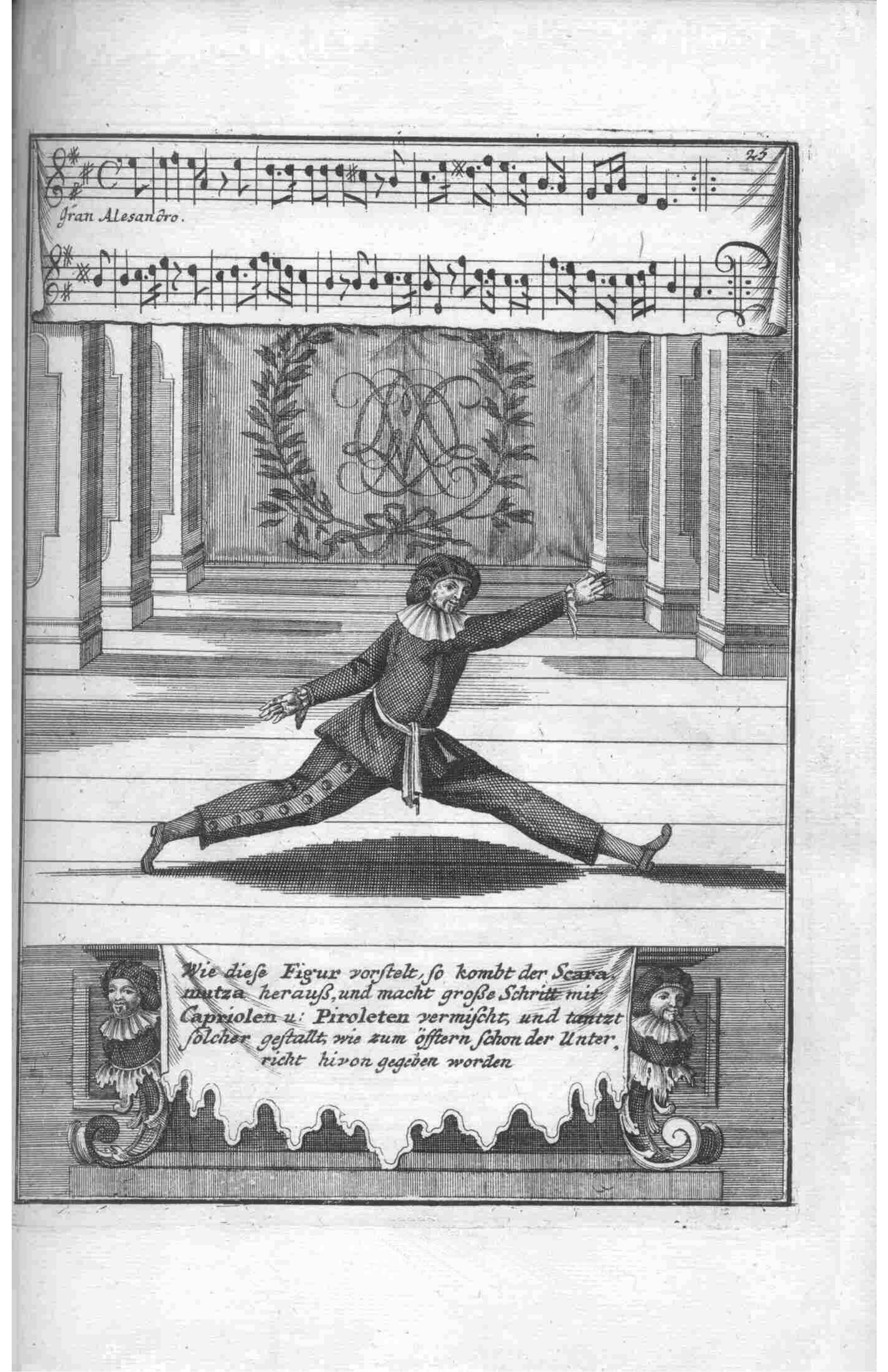
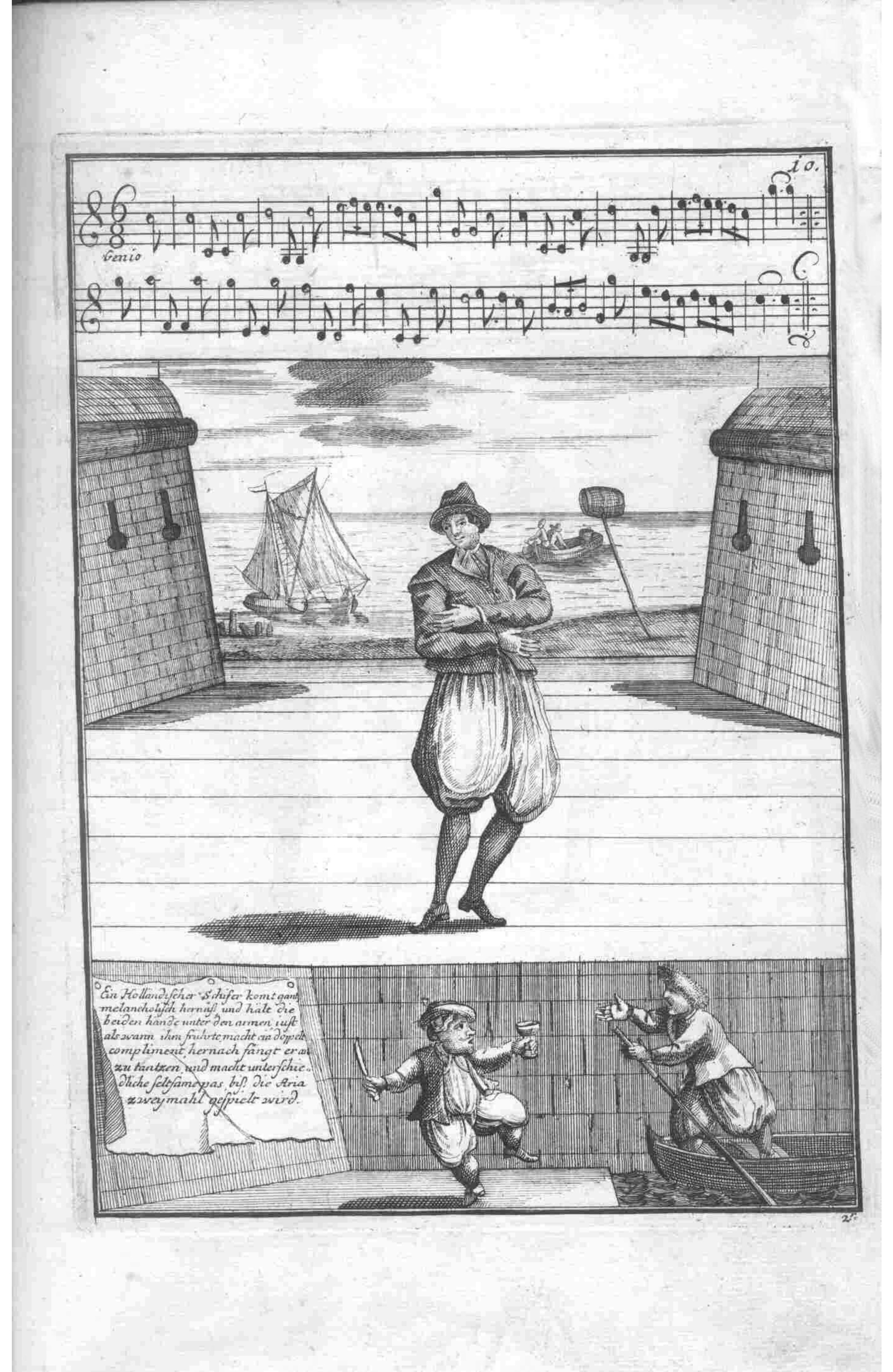
A solo dancer stands center stage within a shallow proscenium framed by draped curtains on either side. The dancer wears early 18th-century theatrical costume: a dark jacket with white shirt front, bloused breeches, and stockinged legs. The setting opens onto a harbor scene rendered in the distance—boats with sails, water, and architecture—creating the theatrical illusion of depth characteristic of baroque stage design. The dancer is caught mid-figure with one leg raised and arms positioned in an expressive gesture, the body oriented three-quarter to the viewer. Above the stage scene, two staves of musical notation show the accompanying air or melody for this solo. Below the image sits a German caption or verse describing the figure. The entire composition is a copper-plate engraving with fine hatching creating tone and dimension; the theatrical frame and distant seascape are rendered in linear perspective.
The dancing
The dancer's posture suggests a moment of elevation or controlled balance—one leg lifted, the opposite arm extended, the torso inclined. The stance is neither a codified ballet position nor a purely social gesture; rather, it reads as a theatrical "attitude" designed to display the dancer's control and elegance. The arms are not held in the tight upper positions of later ballet technique, but rather with a more relaxed, expressive amplitude. The weight appears to be carried on the standing leg, with the lifted leg bent and raised to roughly hip height. This is a soloist performing, not a partner dancer or group figure.
The dance depicted
This is theatrical dance of the early 18th century—likely a solo from a professional stage production or court spectacle, executed in the style taught and codified in the baroque period. The Lambranzi manual documents theatrical dance figures with their accompanying music; each plate pairs a step, attitude, or pose with its musical setting. The figure depicted here appears to be an *air* or *attitude*—a moment of display in a larger choreographic phrase. The style sits between French court dance (minuet conventions, geometric clarity) and Italian theatrical practice. Without the German text below visible at full clarity, the specific name of this figure cannot be confirmed, but the manual tradition shows these were real dances performed by professionals, not merely illustrations of technique.
How it was made
This is a copper-plate engraving, a technique that allowed fine detail and wide circulation in the early 18th century. Engraving involves incising lines into a polished copper plate with a burin; the plate is then inked and printed, allowing dozens of impressions from a single plate. The hatching visible throughout—especially in the curtains, the seascape, and the figure's clothing—is characteristic of engraved line work and creates tone and recession. This technique was ideal for technical instruction manuals: the clarity of line allowed precise depiction of posture and costume, and the durability of the copper plate meant the manual could be reprinted across Europe. The presence of musical notation at the top of each plate is integral to the engraving's purpose: dancers and musicians needed to work from the same source.
About this work
This is Plate 60 from Gregorio Lambranzi's *Nuova e curiosa scuola de' balli theatrali* (Nuremberg, 1716), one of the most influential choreographic manuals of the baroque era. The work documents theatrical dance figures with their music, offering insight into how professional dancers of the early 18th century performed on stage. Each plate shows a costumed soloist executing a named figure within a theatrical setting, with musical notation above to guide the musician's accompaniment. Lambranzi's manual was printed in both German and French editions and circulated widely among theater professionals, dancing masters, and courtly amateurs across Europe. This particular plate captures a moment of solitary display—a dancer caught in an *attitude* or expressive pose that demonstrates control, extension, and theatrical presence.
How to look at it
Attend first to the pose itself: the lifted leg, the extended arm, the inclined torso. This is not a step in progress but a moment of *pause*—an "attitude" designed for display. The theatrical framing (the draped curtains, the perspective backdrop) tells you this is stage dance, not salon dance. Notice how the figure is positioned: slightly off-center, shown three-quarter to allow the viewer to read the body's line and extension. The fine engraved line work creates volume in the costume and musculature of the legs, suggesting the dancer's training and physical presence. Finally, observe the relationship between the figure and the musical notation above: this is not a static pose but a moment mapped to specific music, the movement timed and shaped by what the musician plays.
The artist
Gregorio Lambranzi (c. 1665–c. 1726) was a dancing master active in Nuremberg in the late baroque period. He is known chiefly through his *Nuova e curiosa scuola de' balli theatrali*, published in Nuremberg in 1716 with a German text by Johann Georg Pasch and likely prepared for publication by an engraver (possibly a member of the Teuber family of Nuremberg engravers, though the signature is not always clear on surviving copies). The manual is not Lambranzi's invention alone but represents the codified practice of theatrical dance masters of the period. The work itself may have been initially compiled or demonstrated by Lambranzi and then given form through collaboration with other professionals. It represents the kind of practical, illustrated technical manual that was beginning to replace purely written descriptions of dance.
The period
The early 18th century was a moment of transition in dance notation and instruction. The baroque court dance tradition (minuet, courante, sarabande) was well established; Raoul-Auger Feuillet's notation system for dance had been published in 1700 and was spreading. At the same time, professional theatrical dance was developing its own vocabulary distinct from court forms. Lambranzi's manual captures this moment: it documents theatrical figures (some derived from court sources, others distinctly theatrical) with both music and visual representation. The manual appeared at a time when dance was beginning to be understood as a teachable, transmissible system rather than a purely social accomplishment. This plate's theatrical seascape backdrop and the professional quality of the costuming reflect the increasingly elaborate sets and technical sophistication of baroque theater.
Where it lives
This plate is one of 100 engravings from the first edition of the *Nuova e curiosa scuola de' balli theatrali*, published in Nuremberg in 1716. The manual exists in two principal versions (German and French) and was widely circulated among theater practitioners, dancing masters, and educated amateurs across Europe. The copy catalogued here appears to be from the Library of Congress collection, which holds several copies and editions of this foundational work.
Dance in this work
Questions about this work
What does the German text at the bottom say?
The text typically names or describes the figure being demonstrated. In some copies the text is legible; in others (including this one at current reproduction quality) it becomes difficult to read. The text would give the official name of this step or attitude and often included poetic or descriptive language about its character.
Is this ballet?
Not in the modern sense. This is early 18th-century theatrical dance—the ancestor of ballet and modern stage dance. The technique and vocabulary are different from classical ballet (which developed later in the century and codified further in the 19th century), but the emphasis on turnout, extension, and vertical carriage shows the roots of ballet training.
Who would have used this manual?
Professional dancing masters who taught theater performers, musicians who needed to understand the timing of dances, theater directors, and wealthy amateurs who wished to learn theatrical dance figures. The manual was a teaching tool and a reference, allowing dance to be standardized and transmitted across distances.
How accurate is the engraving as a dance record?
Very accurate by the standards of visual representation at the time. The engraver had to work from live demonstration or careful drawing, and the level of anatomical detail (the bend of the leg, the line of the arm, the angle of the torso) is precise. However, engraving cannot capture motion—only a frozen moment. Dancers of the period would have understood these poses as instants within flowing phrases.
More Notation/Choreography artwork