49 works in this view — arrow keys or swipe to move between them.
Dance in Art
Courtly Couple — Plate 61
Gregorio Lambranzi
- Medium:
- Copper-plate engraving
- Dance:
- Notation/Choreography
- Era:
- 1700s (Enlightenment/Minuet Era)
- Collection:
- Nuova e curiosa scuola de' balli theatrali (1716)
- Source:
- Library of Congress
- Rights:
- Public domain — free to use, share and adapt.
- Recorded as:
- Public Domain
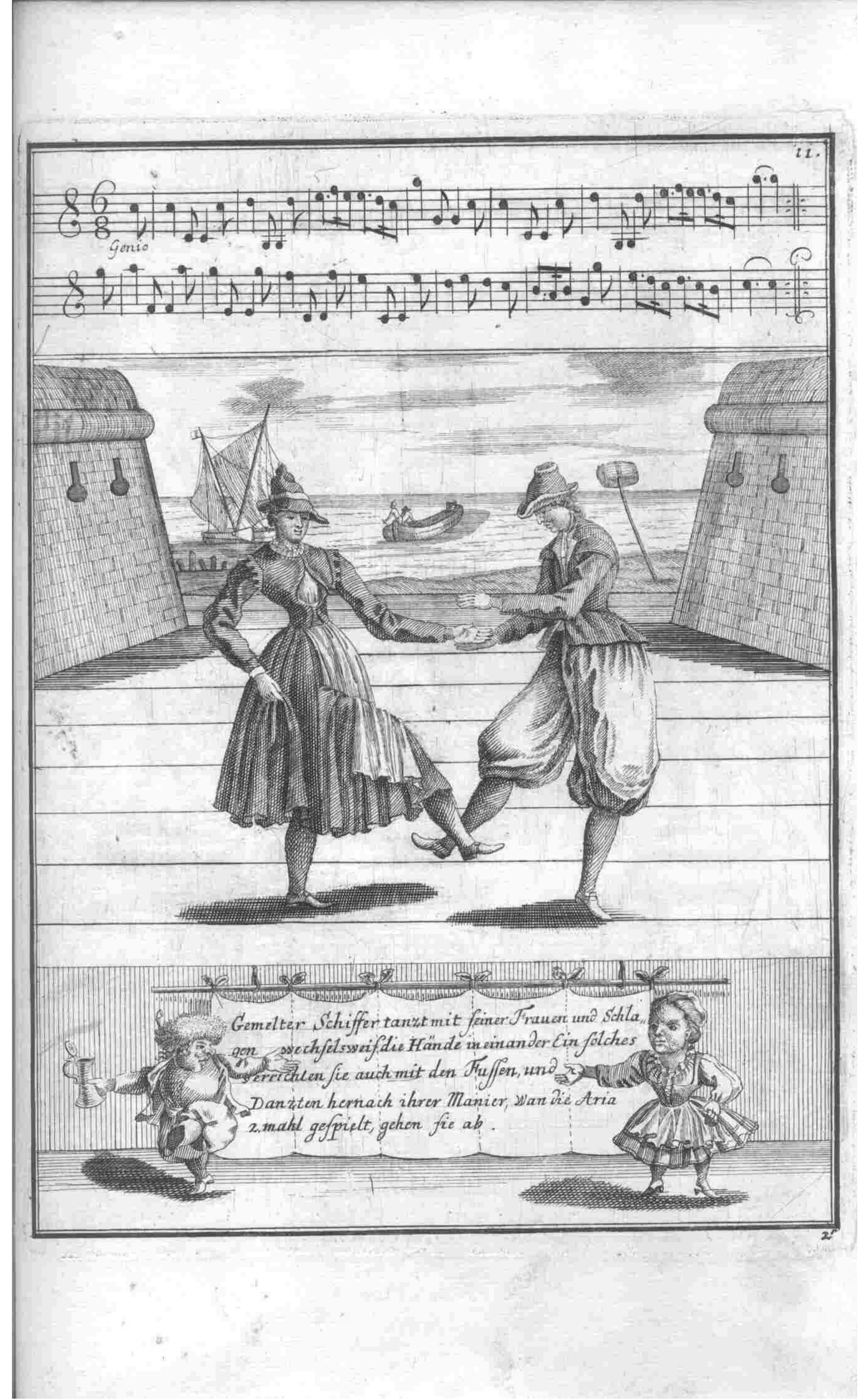
This engraving is one of the few early 18th-century visual records that combines choreographic notation with a clear depiction of actual body position, costume, and staging—it shows us not just what a minuet looked like but how a dancing master would have explained it to a student. Lambranzi's manual is recognized by dance historians as foundational to our understanding of baroque theatrical dance, and this plate is a characteristic example of his method and reach.
What you are looking at
A man and woman in elaborate early 18th-century court dress stand on a wooden stage framed by heavy curtains, posed in a moment of greeting or formal courtship. The woman wears a full-skirted dress with horizontal pleating, her body angled toward the man with one arm extended; the man, in breeches and coat, mirrors her pose with his right arm extended toward hers. Their hands nearly touch in the space between them. Behind them, a harbor scene with sailing vessels and small boats is visible through the stage opening, establishing an outdoor setting rendered in fine cross-hatching. The stage itself is defined by heavy draped curtains at left and right that frame the action and emphasize the theatrical presentation. The engraving is finely detailed throughout, with particular attention to the textures of fabric, the anatomy of the figures, and the linear perspective of the stage floor.
The dancing
Both dancers stand upright with weight distributed evenly, their bodies angled toward each other at roughly 45 degrees. The woman's left arm is raised and extended toward the man; his right arm mirrors hers. Their torsos maintain the formal carriage expected of courtly movement, with no visible flexion at hip or knee. The compositional symmetry and the mutual reach suggest a moment of salutation or the opening phrase of a partner dance—the kind of measured, geometric interaction typical of baroque court dances.
The dance depicted
This is almost certainly a minuet or a similar baroque courtly dance, most likely the opening or a formal moment within such a dance. The couple's posture, the mutual arm extension, and the theatrical framing all point to the formal paired dances that dominated aristocratic social and theatrical life in early 18th-century Europe. The notation visible at the top of the engraving would specify the exact steps and timing; without reading that notation, we can say only that the image captures a moment of formal approach and acknowledgment between partners—a staple moment in minuets and other dances of the period.
How it was made
This is a copper-plate engraving, a technique that allowed for fine detail, clear reproduction, and wide circulation through printing. The regularity and precision of the cross-hatching, the fine lines used to define form and shadow, and the clarity of the text are all characteristic of professional engraving work. As a page from a printed dance manual, this work was intended for multiple copies and broad distribution among the dancing masters and aristocratic students of Europe—it is both a technical record and a teaching tool, combining image and notation to preserve and transmit dancing knowledge.
About this work
Plate 61 from Gregorio Lambranzi's *Nuova e curiosa scuola de' balli theatrali* (1716) shows a courtly couple in a moment of formal interaction, captured as both an engraved image and a notated music score. Lambranzi's work was one of the most influential dance manuals of its era, combining choreography, music, costume guidance, and theatrical staging into a single comprehensive record. This particular plate exemplifies the symmetry, formality, and theatrical presentation of early 18th-century court dance as performed on stage—neither a ballroom scene nor a solo, but a carefully composed moment of paired aristocratic movement. The work survives as a crucial source for understanding not only what baroque dances looked like but how they were taught, notated, and integrated into theatrical practice.
How to look at it
Watch the moment of greeting captured here: the reaching gesture and near-touch between the dancers' hands is the choreographic moment Lambranzi chose to illustrate, likely because it is readable and symmetrical—a teaching point. The notation at the top of the page would specify the exact tempo, steps, and timing that lead to and follow this pose. The theatrical curtains and harbor setting behind the couple remind us that this dance is being performed on a stage, not in a ballroom, and that the pose and movement were designed to be seen from a distance, with clear sightlines and theatrical effect. The formal dress and careful posture show how completely the body was controlled in baroque court dance—there is no relaxation, no apparent weight shift, only formal alignment and the geometric precision of the reach.
The artist
Gregorio Lambranzi was a Nuremberg-based dancing master and author of one of the era's most systematic and influential treatises on theatrical dance. *Nuova e curiosa scuola de' balli theatrali* (New and Curious School of Theatrical Dances), published in Nuremberg in 1716, combined choreography, notated music, costume designs, and engraved figures to create a comprehensive dance manual. The work was addressed to professional dancers and dancing masters throughout Europe and was quickly translated and adapted; it remains one of the primary sources for understanding how baroque dances were performed on stage. Lambranzi's approach—pairing notation with visual representation and theatrical context—became a model for dance documentation.
The period
The early 18th century was the height of baroque court dance, when the minuet and related paired dances dominated both aristocratic social life and theatrical spectacle. Dancing was a core skill of aristocratic education and courtship, and the formalized choreography of the minuet expressed the orderly, geometric aesthetics of the baroque itself. This was also a period of intense documentation and systematization in dance: the invention of Beauchamp-Feuillet notation (early 1700s) made it possible to record dances in print, and masters like Lambranzi capitalized on this innovation to create portable, teachable records of their choreography. The theatrical framing of this image reflects the integration of dance into spoken drama and opera, which accelerated throughout the 18th century.
Where it lives
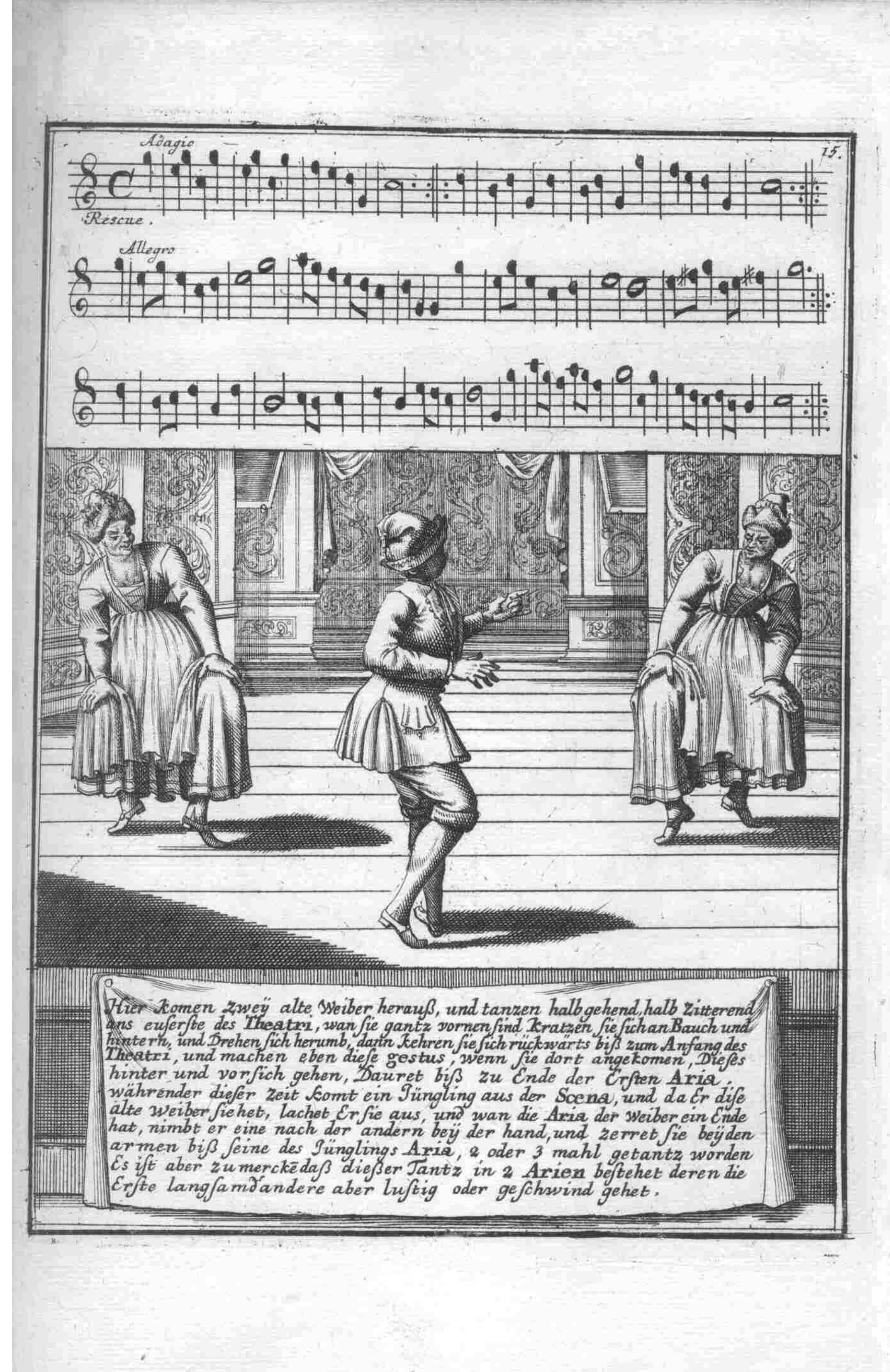
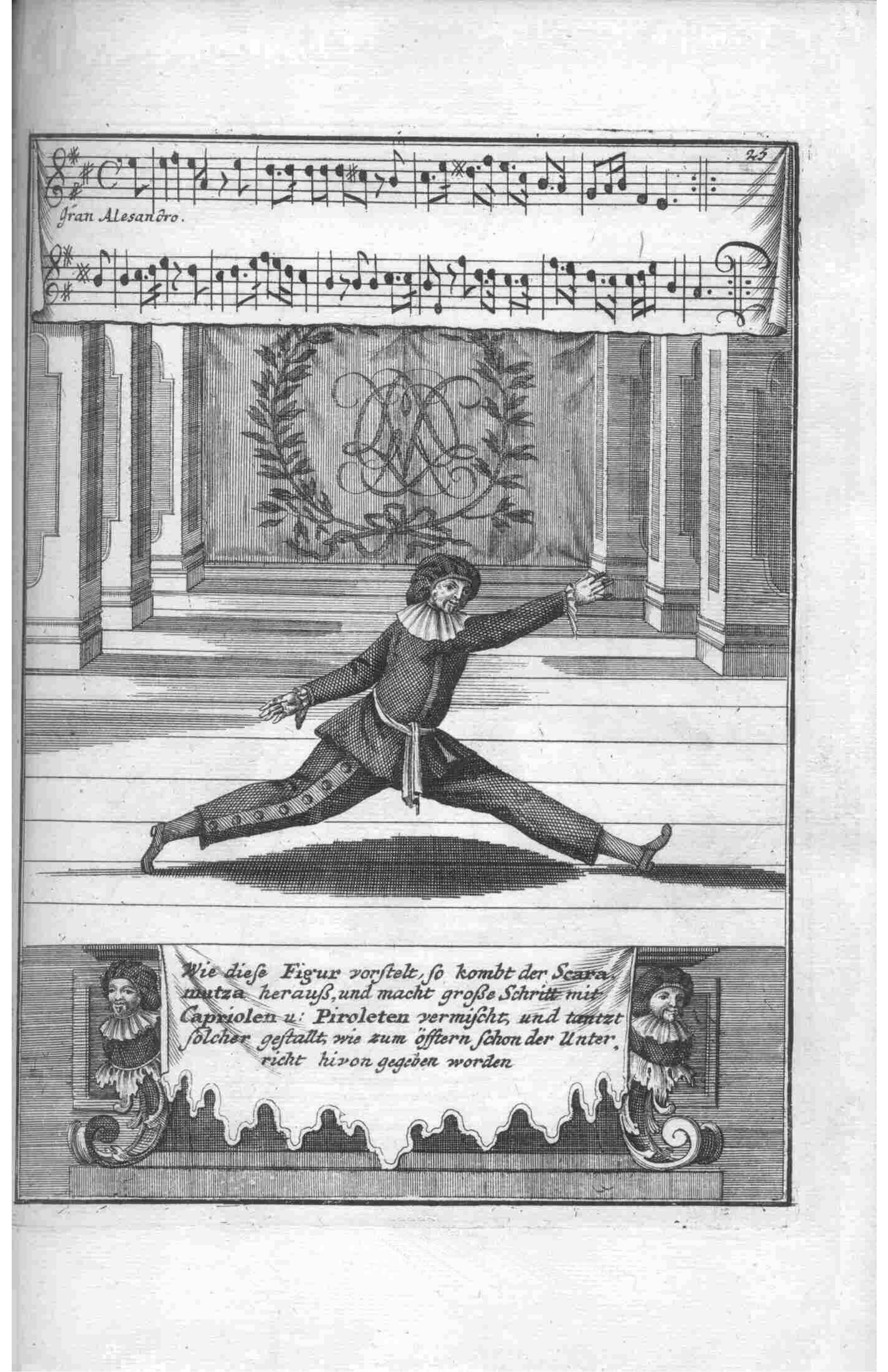
This plate is from *Nuova e curiosa scuola de' balli theatrali*, published by Lambranzi in Nuremberg in 1716, and now held in the Library of Congress. It is one of a sequence of plates, each pairing a single dance couple or figure with their music notation and a German verse caption describing the action and music.
Dance in this work
Questions about this work
What does the music notation at the top mean?
The notation at the top uses the Beauchamp-Feuillet system, which was the standard way of recording baroque dance steps in the early 18th century. It shows the exact steps, timing, and musical phrasing that accompany the pose depicted below. Without training in reading this notation, a modern viewer cannot extract the precise choreography, but the combination of image and score together preserves a complete record of the dance as Lambranzi taught it.
Was this dance performed in a theater or a ballroom?
Both. Lambranzi's manual documents theatrical dances, designed to be performed on stage (as the curtains and backdrop here suggest), but the same dances and their variations were also performed in ballrooms and at court celebrations. The theatrical framing in this engraving reflects Lambranzi's focus on staged, choreographed performance rather than social dance.
Why do the dancers look so stiff?
This is not stiffness but formality—the controlled carriage and geometric precision of baroque courtly movement. Every position was calculated, symmetrical, and designed to convey aristocratic refinement and order. The minuet and other baroque dances were built on a vocabulary of small, controlled steps, upright posture, and careful arm placement, all meant to display grace and social status rather than ease or naturalism.
Is this a minuet?
Almost certainly, based on the formal paired interaction, the upright posture, the mutual reach, and the historical context. However, without reading the notation and the German caption, we cannot be certain; Lambranzi's manual includes many baroque dances, and a few might resemble a minuet without being one. The image alone suggests a formal courtly couple dance of the period.
More Notation/Choreography artwork