49 works in this view — arrow keys or swipe to move between them.
Dance in Art
Combat/Duel — Plate 63
Gregorio Lambranzi
- Medium:
- Copper-plate engraving
- Dance:
- Notation/Choreography
- Era:
- 1700s (Enlightenment/Minuet Era)
- Collection:
- Nuova e curiosa scuola de' balli theatrali (1716)
- Source:
- Library of Congress
- Rights:
- Public domain — free to use, share and adapt.
- Recorded as:
- Public Domain
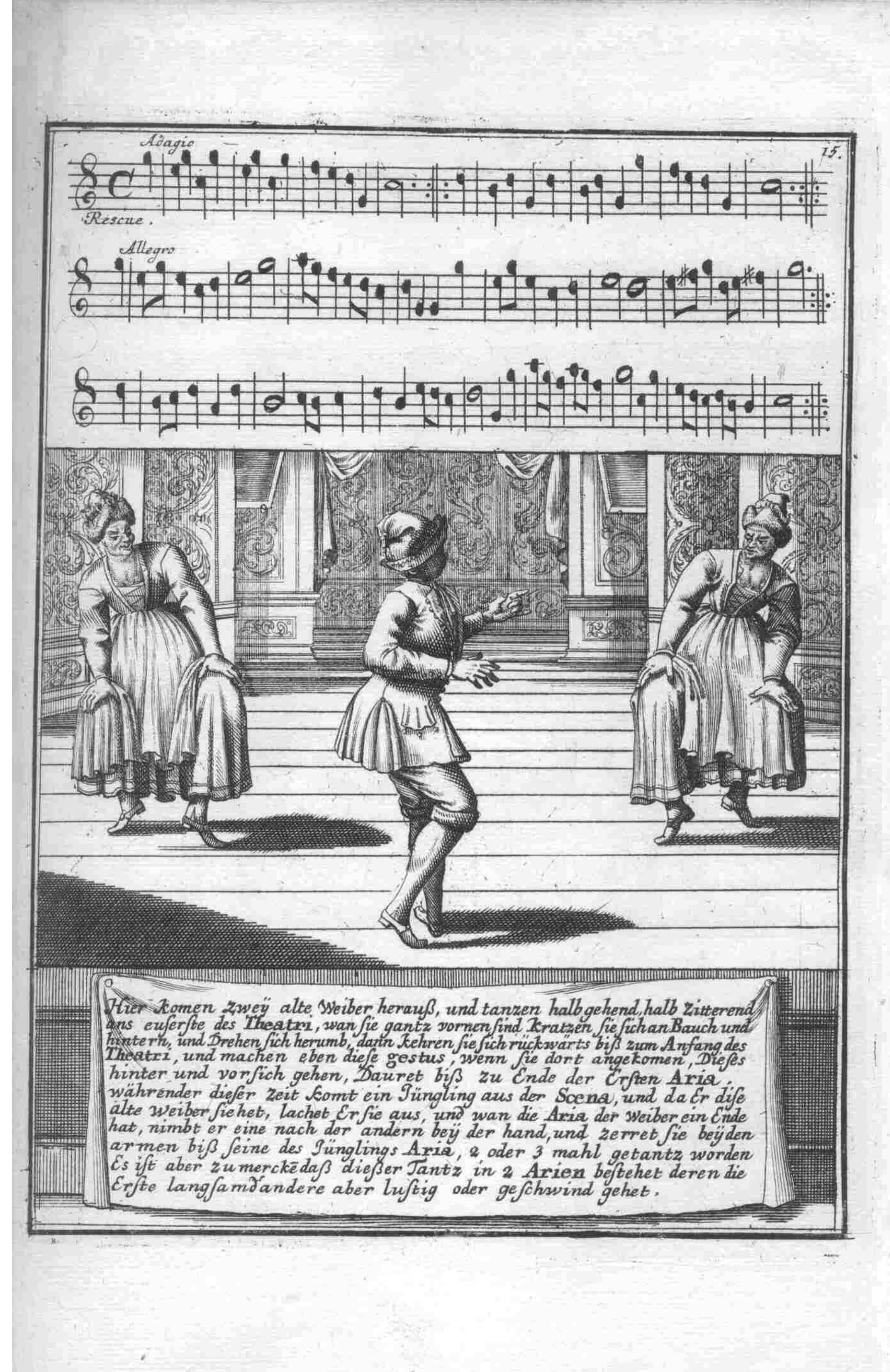
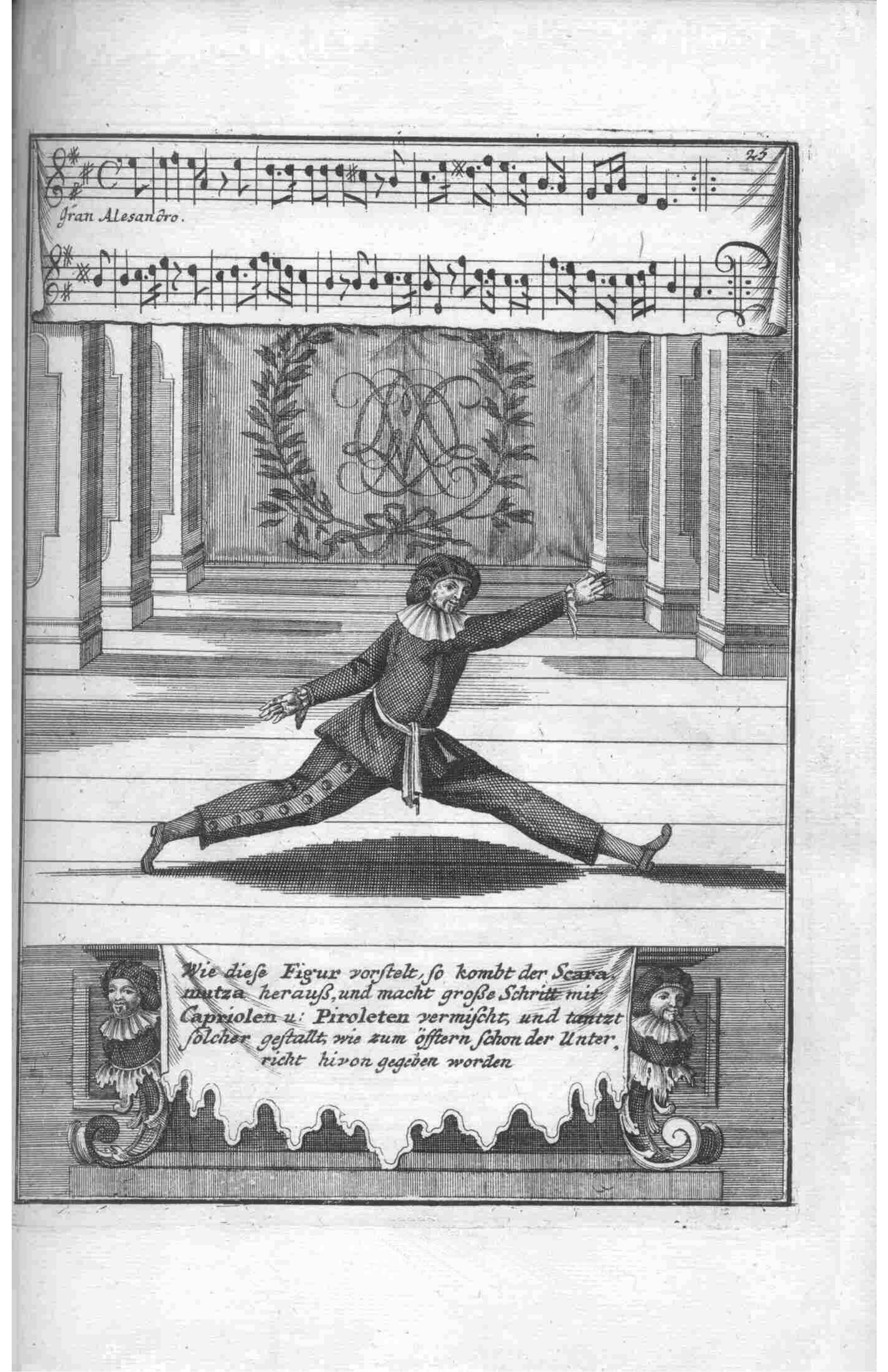
Lambranzi's manual is the most detailed surviving source for how theatrical dances were actually performed in the early 18th century—the only source that combines notation with a visual record of costume, posture, and spatial composition. This combat scene demonstrates that theatrical dance of the period involved heavy stylization, ornamental rather than martial movement, and a sophisticated vocabulary of character and scenario that predates later pantomime and modern theatrical dance.
What you are looking at
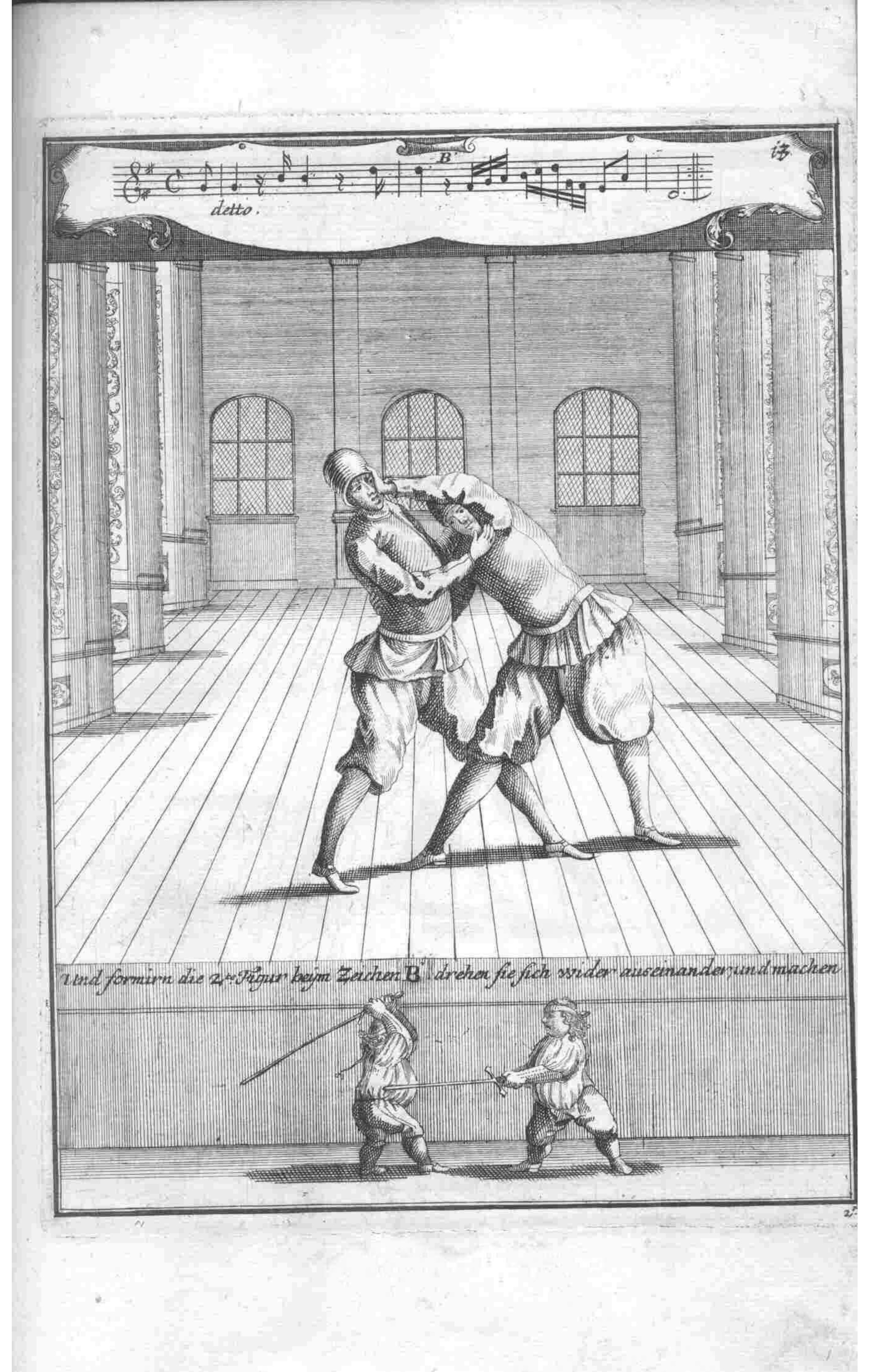
A richly costumed male dancer in a classical theatrical interior performs a stylized combat movement, captured mid-gesture in what appears to be a moment of intense physical engagement. The figure wears a plumed helmet, ornate breastplate or corseted tunic, and voluminous breeches, positioned in a deep lunge with one arm extended forcefully forward and the body twisted in dynamic tension. The setting is a columned stage interior with high arched windows and a polished wooden floor rendered in careful perspective, with decorative curtains framing the scene. Below the main image, two smaller figures enact a similar combat or combat-training sequence at a reduced scale. Musical notation appears at the top of the engraving, indicating this dance was set to a specific composed piece marked "detto" (likewise). The print is surrounded by an ornamental border typical of the period.
The dancing
The primary figure demonstrates an exaggerated, heroic posture: the body is sharply twisted in counter-rotation, with one leg deeply bent in lunge position and the other extended or bearing weight, while the upper body leans back dramatically. The arms are fully extended in a forceful, almost theatrical gesture of combat or conquest—the forward arm thrusts with clear martial intent. The smaller figures below mirror this engagement in a more compact form, suggesting either instruction or a paired variation. The body positions are anatomically stressed and formally composed rather than naturalistic, suggesting trained theatrical movement.
The dance depicted
This is a *ballo teatrale*—a theatrical dance from the early 18th-century German and Italian court tradition—specifically representing a stylized combat or duel scenario (as the title indicates). These dances were performed by professional or courtly dancers in theatrical contexts and were often paired with other comic or dramatic scenes. The combat is not meant as realistic fighting but as a codified, ornamental theatrical gesture, part of a broader repertoire of character dances that included peasant dances, comic scenes, and elaborate pantomime sequences. The dynamic asymmetry of the pose and the exaggerated tension suggest this was meant to be visually striking and entertaining rather than martial.
How it was made
This is a copper-plate engraving, a technique that allowed for fine linear detail, precise cross-hatching for shadow and depth, and repeatable impressions suitable for circulation as an instructional manual. The technique's capacity for crisp line and subtle gradation is fully exploited: the hatching conveys the cloth texture of the breeches and tunic, the geometric precision of the columns and floor receding into space emphasizes the theatrical stage setting, and the delicate rendering of the plumed helmet distinguishes it from the surrounding areas. Engraving was the preferred medium for dance instruction books of the period, as it could reproduce the fine anatomical detail and spatial clarity necessary for performers to learn from the printed image.
About this work
This is one of 104 copper-plate engravings from Gregorio Lambranzi's *Nuova e curiosa scuola de' balli theatrali* (Nuremberg, 1716), the most comprehensive illustrated dance manual of the early 18th century. Each plate pairs a notated musical phrase with a single costumed figure performing a specific theatrical dance character or scenario. The work documents the vocabulary of *balli teatrali*—the mixed-genre theatrical dances that entertained courts and public audiences across German-speaking lands and Italy in the period when court ballet was evolving toward opera and dramatic pantomime. This particular plate illustrates the combat or duel character, a stock scenario within the tradition, executed with the formal tension and heroic posture that marked the style.
How to look at it
Attend first to the asymmetry and tension in the body: this is not a balanced, reposed position but a moment of effort and direction, frozen mid-movement. The formal plumed helmet and ornamented costume signal that this is a *character* dance—a typed role rather than a generic beauty figure. The perspective of the stage and columns emphasizes that this is theatrical performance meant to be viewed from the front and from a distance; the enlarged gesture and exaggerated posture would carry meaning across a room or hall. The pair of smaller figures below shows that the same movement could be taught or performed at different scales, or could involve multiple dancers enacting variations on a theme.
The artist
Gregorio Lambranzi was an Italian dancer and dance master active in Nuremberg in the early 18th century. He is known almost entirely through this single publication, which he compiled, notated, and likely illustrated in collaboration with an engraver. The work synthesizes German and Italian dance traditions and suggests Lambranzi held a position of authority in the Nuremberg theatrical world—possibly as a ballet master or dance instructor to the court. The manual itself was influential and was republished, indicating his work had currency beyond its immediate context.
The period
Early 18th-century theatrical dance was in transition. Court ballet in France was becoming increasingly codified and technical, while in German-speaking territories and Italy, mixed-genre theatrical dances—combining ballet, pantomime, and comic character work—remained popular and varied. Lambranzi's manual documents this transitional moment: his characters include peasants, lovers, soldiers, and comic figures, many in recognizable ballet vocabulary (turnout, formal arm positions, geometric floor patterns) but deployed in narrative and character contexts rather than pure classical form. Musical notation in dance manuals was relatively new, reflecting growing interest in notating and preserving dance alongside music.
Where it lives
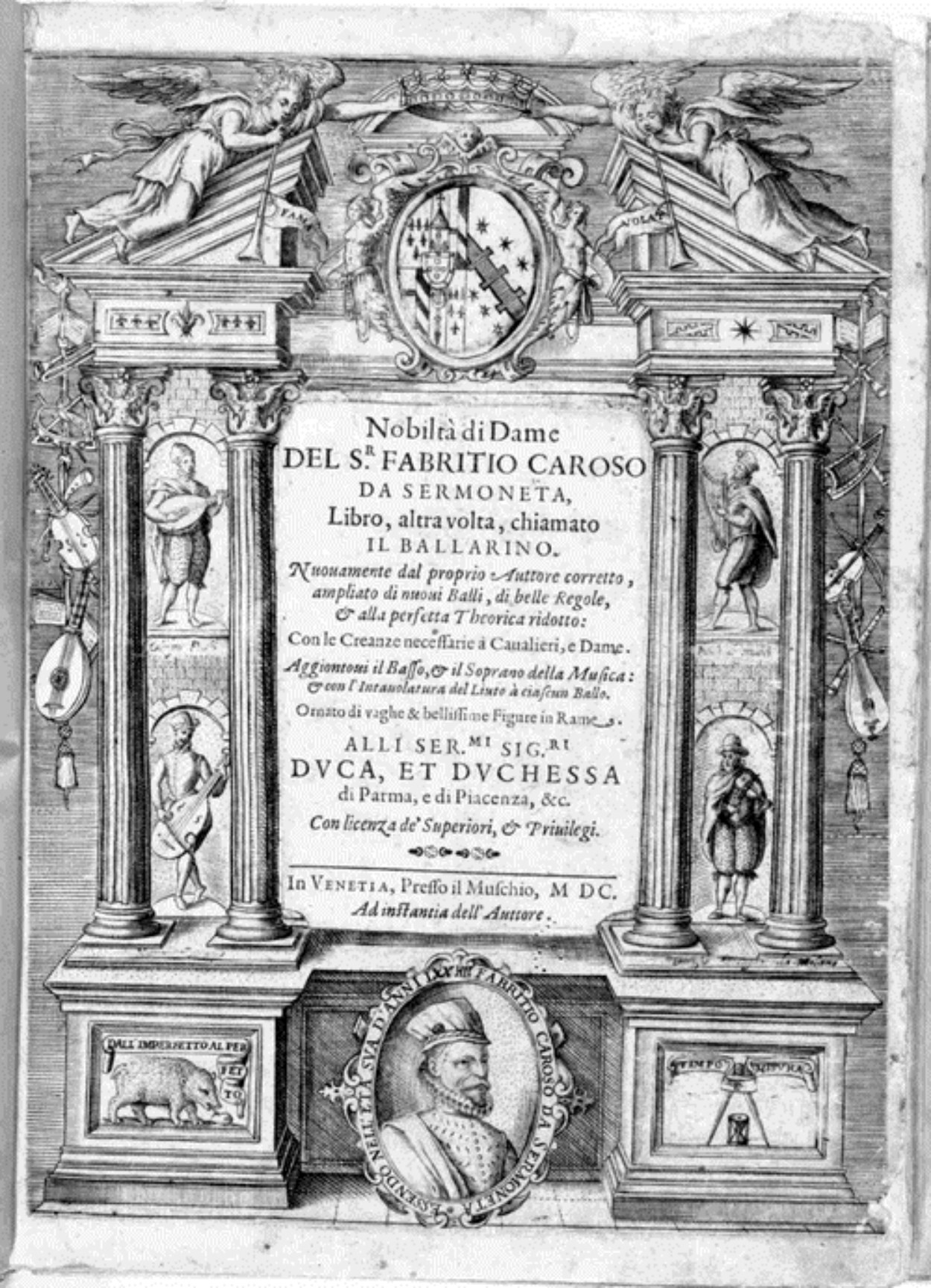
This plate comes from Gregorio Lambranzi's *Nuova e curiosa scuola de' balli theatrali*, published in Nuremberg in 1716. The work is held in the Library of Congress and is among the most complete surviving copies of this important theatrical-dance manual. The manual was designed as an instructional text, intended for circulation among dance masters, performers, and courtly audiences who wanted to learn or recall the theatrical dance vocabulary of the period.
Dance in this work
Questions about this work
What is a ballo teatrale?
A *ballo teatrale* (theatrical dance) was a dance performed in theatrical contexts—courts, public stages, intermezzos in opera—in 17th- and 18th-century Germany and Italy. These dances often portrayed characters or scenarios (peasants, soldiers, lovers, comic figures) and combined elements of dance, pantomime, and acrobatics. They were distinct from the more purely technical court ballet being developed in France.
Why is Lambranzi's manual important?
It is the most detailed surviving illustrated manual of early 18th-century theatrical dance, pairing musical notation with engravings of costume, posture, and gesture. It documents a rich vocabulary of character and scenario dancing that would otherwise be lost, and shows how theatrical and technical dance vocabularies coexisted and cross-pollinated in this period.
Could an engraving like this actually teach someone to dance?
Partly. The notation and image together provided a reference for a dancer or master who already understood the basic vocabulary. The engraving shows costume, overall posture, and the spatial context; the notation indicates music and timing; but the finer details of weight transfer, dynamics, and continuous movement would require live instruction or memory. Such manuals were memory aids and references rather than complete instructional systems.
What does the smaller pair of figures below represent?
The smaller figures likely show a variation or second performer executing the same character or a paired version of the same dance. Lambranzi's manual sometimes includes solo and paired versions of dances; the scale difference suggests this was a pedagogical choice to show how the movement could be adapted or taught to multiple dancers.
More Notation/Choreography artwork