49 works in this view — arrow keys or swipe to move between them.
Dance in Art
Courtly Couple — Plate 66
Gregorio Lambranzi
- Medium:
- Copper-plate engraving
- Dance:
- Notation/Choreography
- Era:
- 1700s (Enlightenment/Minuet Era)
- Collection:
- Nuova e curiosa scuola de' balli theatrali (1716)
- Source:
- Library of Congress
- Rights:
- Public domain — free to use, share and adapt.
- Recorded as:
- Public Domain
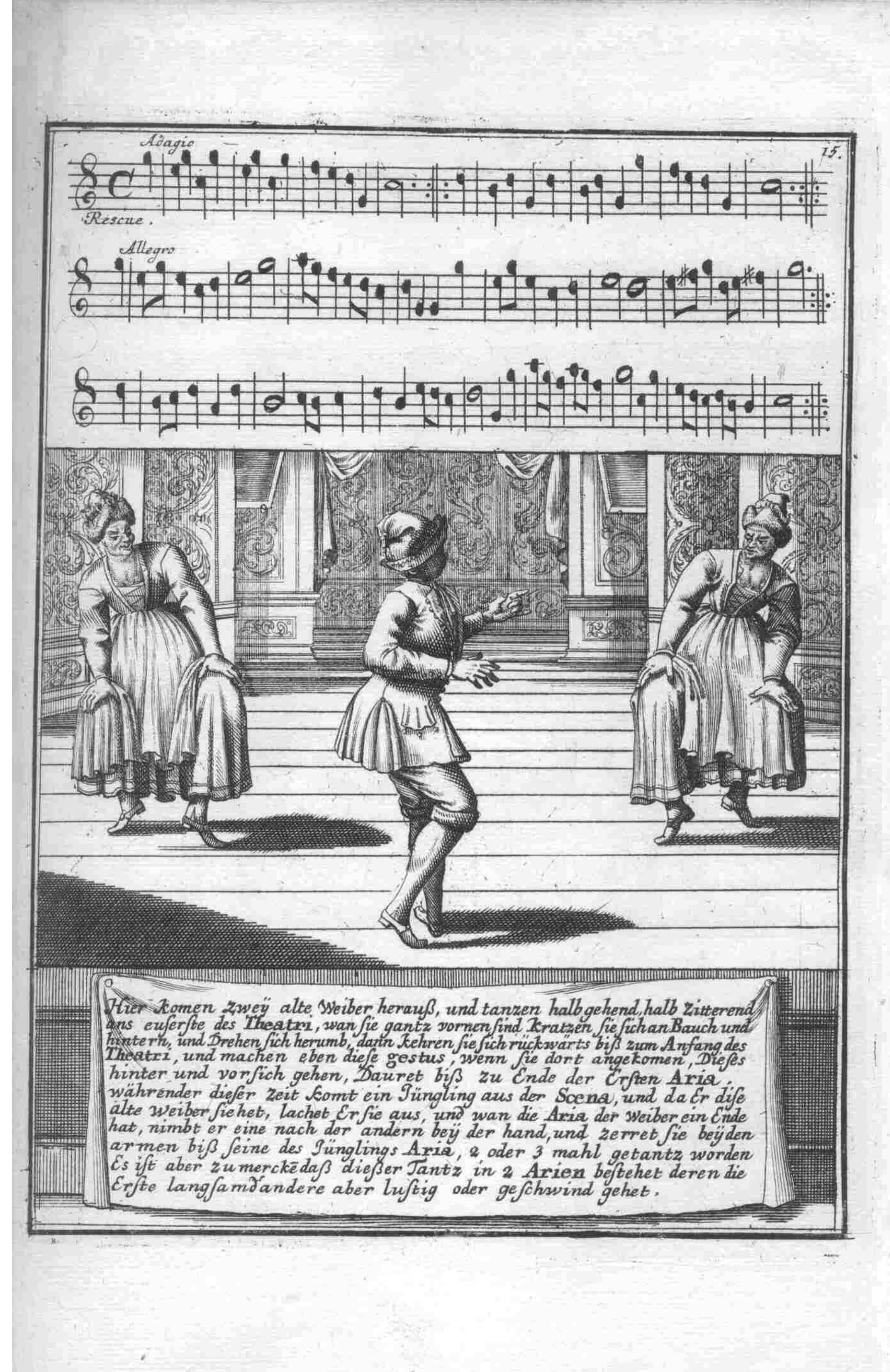
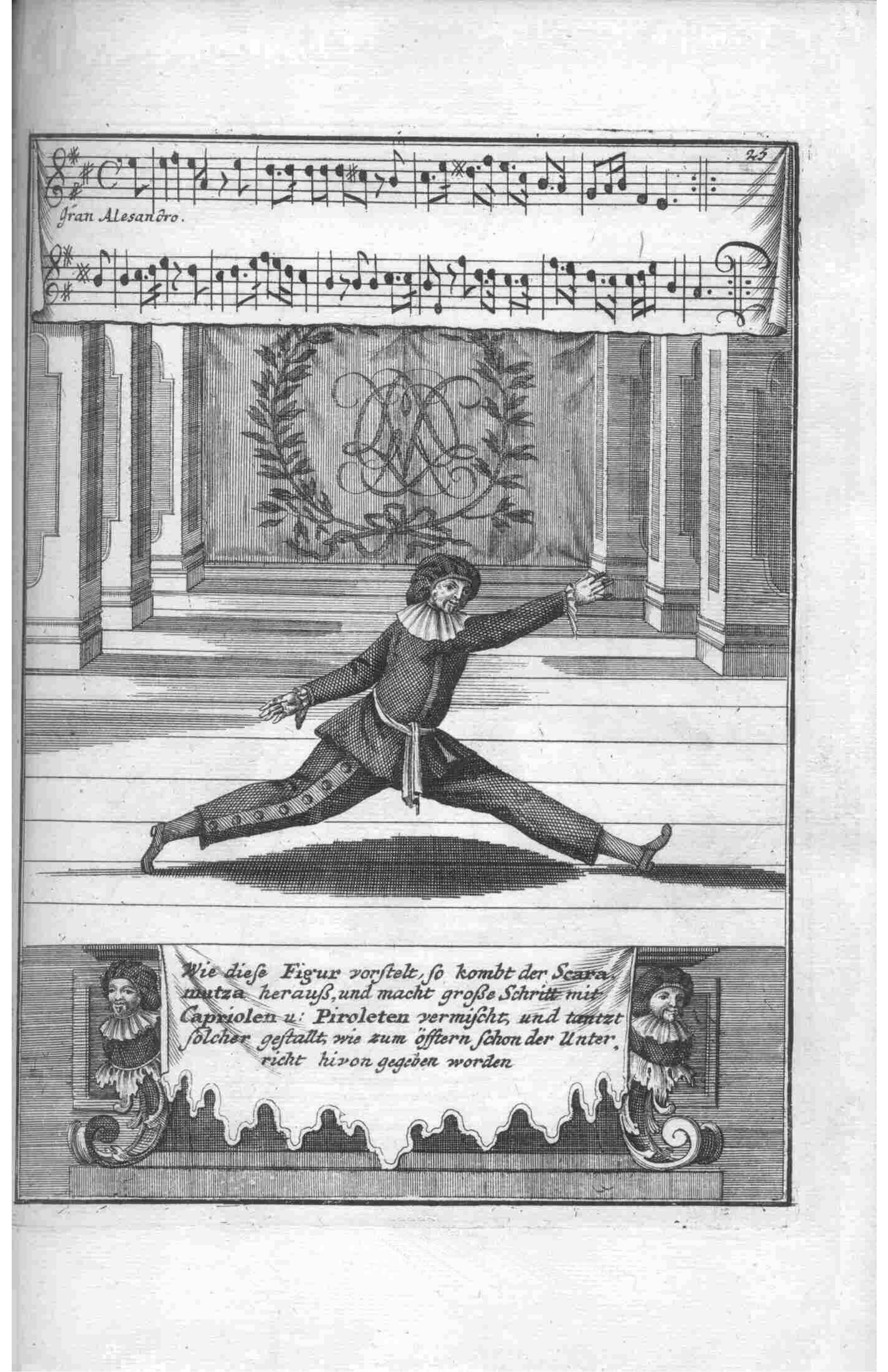
This plate documents a form of dance instruction that disappeared almost entirely after the late 18th century: the pairing of musical notation with a single engraved figure shown in isolated, geometric attitudes designed to teach the mechanics of a step rather than the feel or momentum of dancing. For historians and dancers, it reveals both what counted as a step in Baroque practice (the reverence was fundamental; its execution distinguishes the trained dancer from the untrained) and how that knowledge was transmitted—through visual geometry rather than narrative or kinetic description. Lambranzi's manual is one of only a handful of sources that show us dancing in this period from inside the profession itself.
What you are looking at
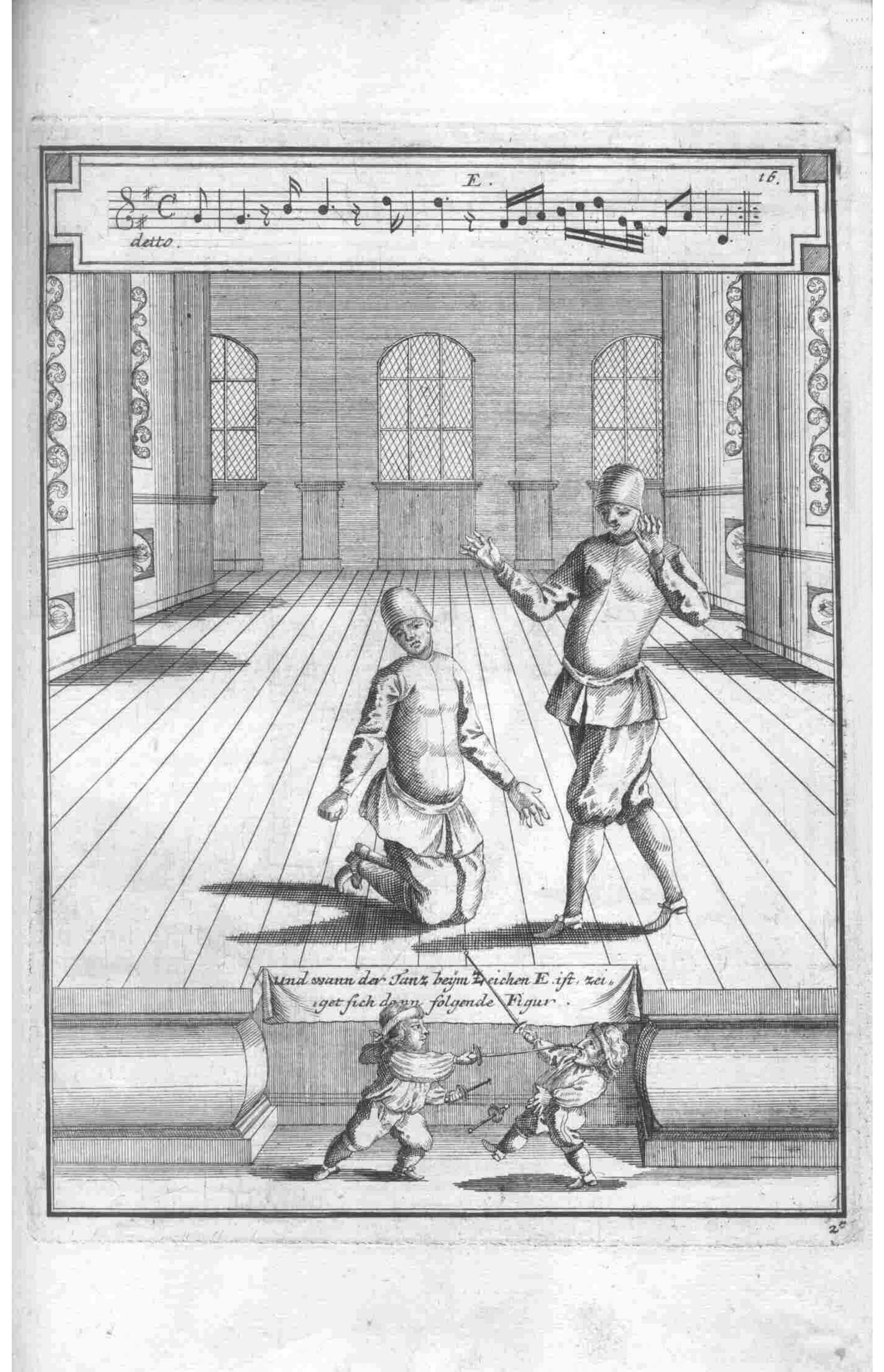
A copper-plate engraving divided into two registers. The upper scene shows two figures in a tall, austere interior with three arched windows, fluted pilasters, and a coffered ceiling. The space is rendered in precise linear perspective, with a checkerboard floor receding sharply toward the back wall. The two figures wear identical close-fitting caps and abbreviated tunics with short skirts; one kneels while the other stands beside him with arms extended in an attitude of instruction or demonstration. The lower register shows two small cherubs or putti in similar dress, mirroring the poses of the adult figures above. Musical notation at the top of the page—marked *detto* (meaning "the same")—provides the accompanying air. Below the lower scene runs a German caption identifying the step and its context within the manual's curriculum.
The dancing
Both adult figures maintain an upright carriage with weight distributed symmetrically. The standing figure extends both arms forward and outward at shoulder height, palms open, in what appears to be a teaching or demonstrative gesture rather than a dance embrace. The kneeling figure supports himself on one knee while the other leg extends; his arms hang naturally. The posture is formal and controlled, with no rotation of the torso; the frame is open rather than closed, and the positions suggest instruction or the spelling-out of a step rather than its execution in motion. The cherubs below repeat these exact attitudes, scaled and simplified.
The dance depicted
This is a reverence or révérence—a formal bow or curtsy executed as a discrete step within theatrical dance. The image shows the preparatory and executed phases of the gesture: one figure kneels (a deeply respectful posture) while the other remains upright and demonstrates the arm carriage appropriate to the step. In early 18th-century dance, the reverence was a fundamental courtesy performed at the opening and close of dances and often between dance figures, essential to both social and theatrical contexts. The plate teaches the geometry and bearing of the step rather than capturing a moment of social performance; the paired cherub figures below may indicate the step's appropriateness for dancers of any stature or social station, or may serve as visual confirmation of the step's essential form.
How it was made
Copper-plate engraving, as stated in the catalogue. The technique allowed Lambranzi to achieve fine linear detail in the architectural setting and precise definition of the figures' musculature and drapery. Engraving was the standard medium for the reproduction of dance instruction manuals in this period, as it could be printed in large editions and allowed the coordinated presentation of notation above and figure below on a single plate. The fineness of line and the capacity to render complex spatial recession—here, the receding checkerboard floor and diminishing column intervals—made it ideal for demonstrating the formal, geometric space in which courtly dance took place. Each plate in Lambranzi's manual paired a single air with a single step or figure, creating a pedagogical object that could be studied sequentially.
About this work
This is plate 66 from Gregorio Lambranzi's *Nuova e curiosa scuola de' balli theatrali* (Nuremberg, 1716), one of the most influential choreographic manuals of the early 18th century. It documents the reverence—a formal bow performed as a discrete dance step—in its preparatory and executed states, with musical notation above and a caption below. The plate serves as both a notational device and a visual diagram of the step's geometry and carriage, teaching not the step's dynamic or speed but rather the correct posture, weight distribution, and arm position appropriate to a fundamental courtly gesture. Lambranzi's manual, which survives in very few copies, captures the theatrical and social dance practice of the Baroque court at the moment when dance was beginning to be codified and standardized across Europe.
How to look at it
Attend first to the two figures and their relationship: the standing figure is teaching, not dancing. His extended arms show the arm carriage to be adopted; his upright posture models the carriage of the upper body. The kneeling figure executes the reverence itself—the act of respect embedded in the step's geometry. The architectural setting is not incidental: the formal, symmetrical space with receding lines reinforces the idea that correct dancing is a matter of geometry and proportion. The cherubs below are not decoration; they confirm that the step and its carriage are absolute principles, independent of the dancer's age or status. Look at how the artist has frozen the moment between preparation and execution, showing both the instruction and the result in a single image.
The artist
Gregorio Lambranzi was an Italian dancing master and choreographer active in the early 18th century. He is known almost entirely through this single published work, *Nuova e curiosa scuola de' balli theatrali* (New and Curious School of Theatrical Dances), issued in Nuremberg in 1716 in German and Italian editions. The manual contains approximately 52 plates, each illustrating a discrete step, figure, or dance type with notation and verse description. Lambranzi's approach—systematic, visual, and paired with music—was innovative and influential; the manual was reprinted and adapted through the 18th century. Beyond this publication, little is documented of Lambranzi's own practice or patronage, but the sophistication and precision of the manual suggest he was an accomplished teacher working within or near an important court.
The period
In the early 18th century, theatrical dance in Europe was undergoing rapid formalization. The minuet had become the dominant courtly form, and the dance vocabulary was increasingly standardized and transmissible across linguistic and geographical boundaries. Feuillet notation, which appeared in Paris in 1700, provided one system for recording dance; Lambranzi's visual and notational approach offered another, more immediately practical for a dancing master teaching from a book. The publication of dance manuals accelerated in this period—works by Taubert, Trevejo, and others appeared in German-speaking lands—reflecting both the commercial market for dance instruction and a broader Enlightenment impulse toward systematization and clarity. Lambranzi's manual belongs to a moment when dance was becoming a subject of written and visual analysis, not merely oral transmission.
Where it lives
This plate comes from *Nuova e curiosa scuola de' balli theatrali*, a 52-plate manual published in Nuremberg in 1716 (German edition) and the same year in an Italian edition. The work survives in very few copies; this plate is held in the Library of Congress collection. Lambranzi's manual is one of the most complete surviving records of early 18th-century theatrical dance technique and was widely circulated and reprinted through the 18th century.
Dance in this work
Questions about this work
What is a reverence and why is it important?
A reverence is a formal bow or curtsy performed as a discrete step, essential to courtly and theatrical dance. It was performed at the opening and close of dances and between figures, and its execution distinguished the trained dancer. The step combines the physical act of respect with precise geometric carriage, making it fundamental to the grammar of early 18th-century dance.
How would a dancer use this manual?
A dancer or dance master would study each plate sequentially, learning the step's correct posture, arm position, and weight distribution from the engraved figure, and understanding its musical phrasing from the notation above. The verse caption below provided additional context or mnemonic. The manual functioned as both a textbook and a reference work.
Why are there cherubs shown below?
The cherubs replicate the adult figures' poses, scaled smaller. In the context of dance instruction, they likely affirm that the step's form and carriage are universal principles—correct regardless of the dancer's age, size, or social rank. They may also serve a decorative function typical of the period's engraved ornament.
What makes this engraving a primary source?
It documents how dancing was actually taught and codified in the early 18th century, showing the step's mechanics through visual geometry and the coordination of notation with the dancing body. Very few such manuals survive, and fewer still show the step in such detailed isolation, making it invaluable evidence of Baroque dance pedagogy.
More Notation/Choreography artwork