49 works in this view — arrow keys or swipe to move between them.
Dance in Art
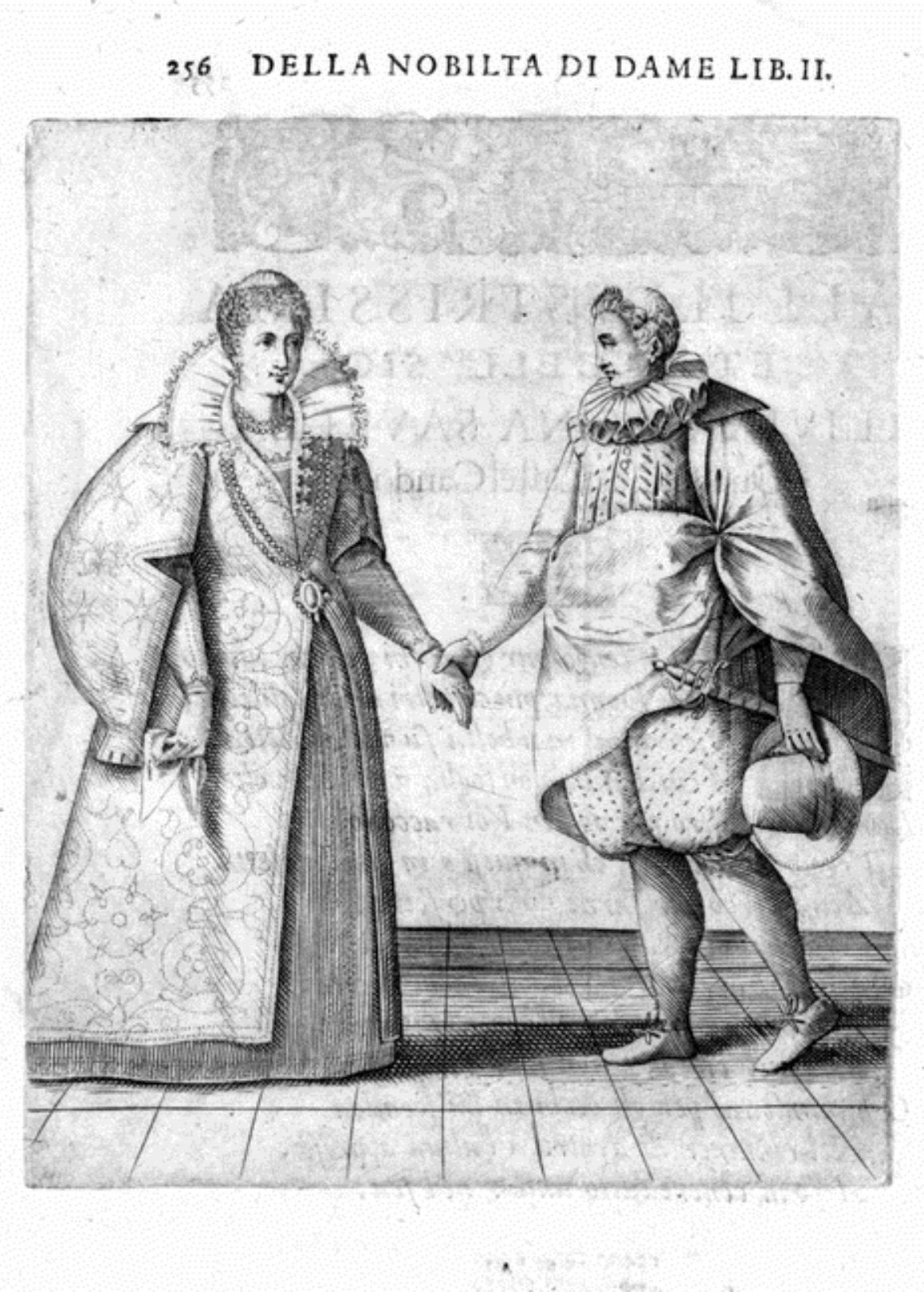
Caroso Nobiltà — Dance Plate (plate 28)
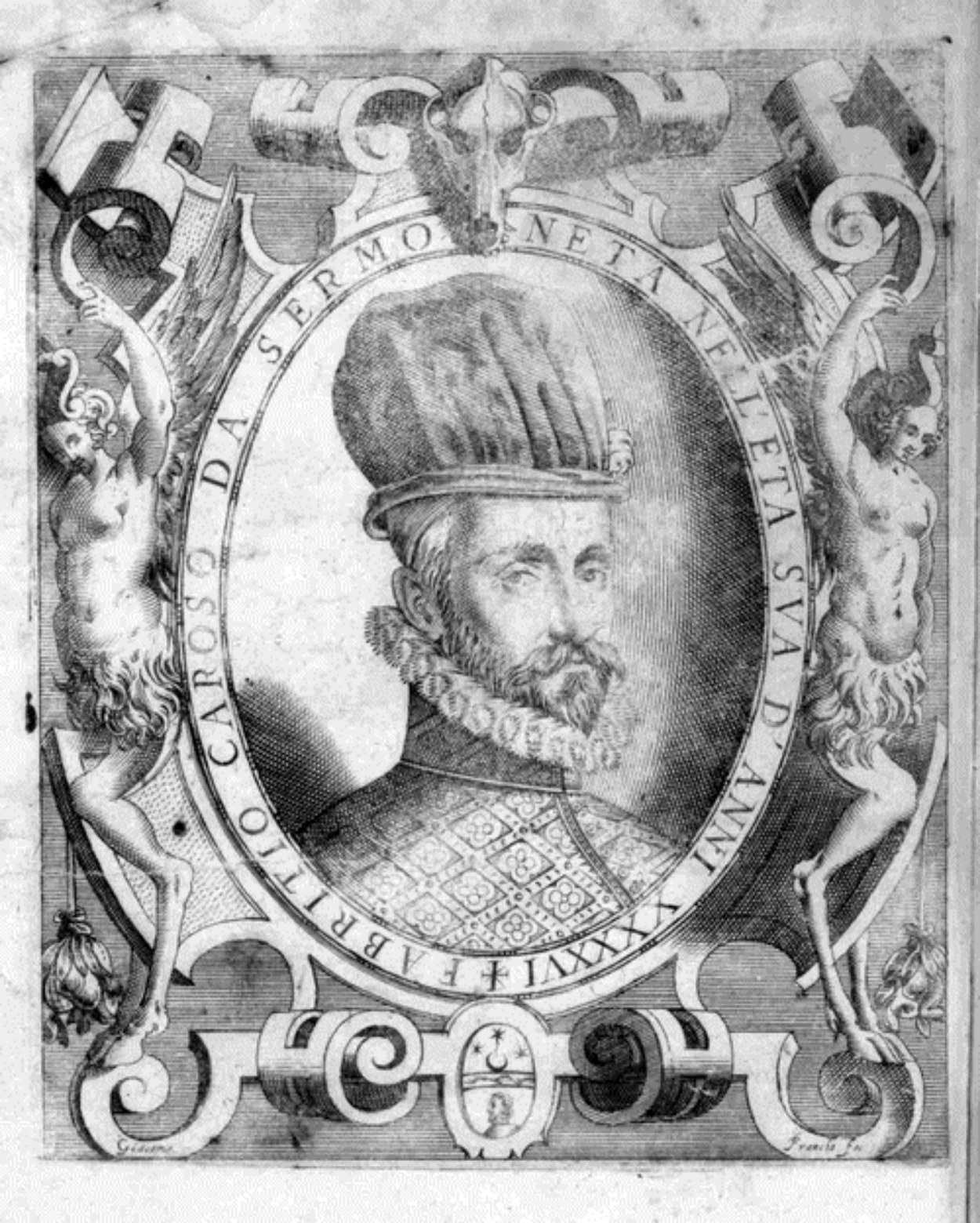
Fabritio Caroso da Sermoneta
- Medium:
- Woodcut
- Dance:
- Notation/Choreography
- Era:
- Pre-1700 (Renaissance/Baroque)
- Collection:
- Nobiltà di Dame (1600)
- Source:
- Library of Congress
- Rights:
- Public domain — free to use, share and adapt.
- Recorded as:
- Public Domain
Caroso's *Nobiltà di Dame* is one of the earliest and most detailed surviving records of how Renaissance courtly dances were actually performed—the positions, steps, rhythms, and social meaning. This plate reveals that Renaissance dance was not spontaneous or natural but highly formalized and codified, and that the body itself—its upright carriage, its symmetry, its restraint—was a language of nobility. For dancers and historians, Caroso's work is foundational evidence of how dance functioned as a marker of social status and courtly virtue in early modern Europe.
What you are looking at
A noble couple face each other in an elegant interior, hands joined in greeting or preparation for dance. The woman on the left wears a long formal gown of patterned damask or brocade with a dramatically oversized ruff collar edged in lace, a jeweled pendant at her throat, and a long cape lined in fur draped across her shoulders. Her hair is styled up in the fashion of the period. The man on the right is dressed in a doublet with slashed sleeves and a high standing collar, also with a large ruff, and wears a short cloak over one shoulder; his hose are padded and pronounced. Both figures stand upright with good posture on a tiled floor against a plain background. The moment captured is one of formal greeting or the opening of a dance—a posed, symmetrical composition that emphasizes decorum and mutual regard rather than active movement.
The dancing
Both dancers stand in an upright, aristocratic frame with shoulders back and heads held high. Their joined hands at chest level suggest the beginning of a courtly dance sequence—neither figure leans into the partnership. The woman's weight appears centered, her left side slightly advanced as if preparing to step. The man's stance is similarly formal and poised. The composition is perfectly bilateral, emphasizing the equal status and matched comportment expected of noble dancers. There is no sense of weight transfer or dynamic motion; instead, the image freezes a moment of formal presentation.
The dance depicted
This is a paired figure from Italian Renaissance court dance, most likely a pavane or galliard as danced in the early 1600s. Caroso's *Nobiltà di Dame* codified the choreography of the dances favored in Italian court circles, and this plate exemplifies the opening posture and greeting that preceded the choreographed sequences. The emphasis on upright posture, formal dress, and mutual deference reflects the function of Renaissance dance as a display of nobility, self-control, and courtly virtue. The couple's joined hands and symmetrical positioning suggest the 'riverenza' (reverence) or formal salutation that opened many such dances.
How it was made
This is a woodcut, a relief-printing technique that allowed for rapid and relatively affordable reproduction. The clear, bold lines and strong contrast between black and white are characteristic of woodcut work from this period. As a page from Caroso's treatise, it served not merely as decoration but as instructional material—readers would study such images alongside written choreographic notation to learn the correct posture, dress, and opening movements of court dances. Woodcut's graphic clarity made it ideal for this pedagogical purpose, and the technique's accessibility meant that copies of *Nobiltà di Dame* could circulate widely among the nobility and dancing masters of Europe.
About this work
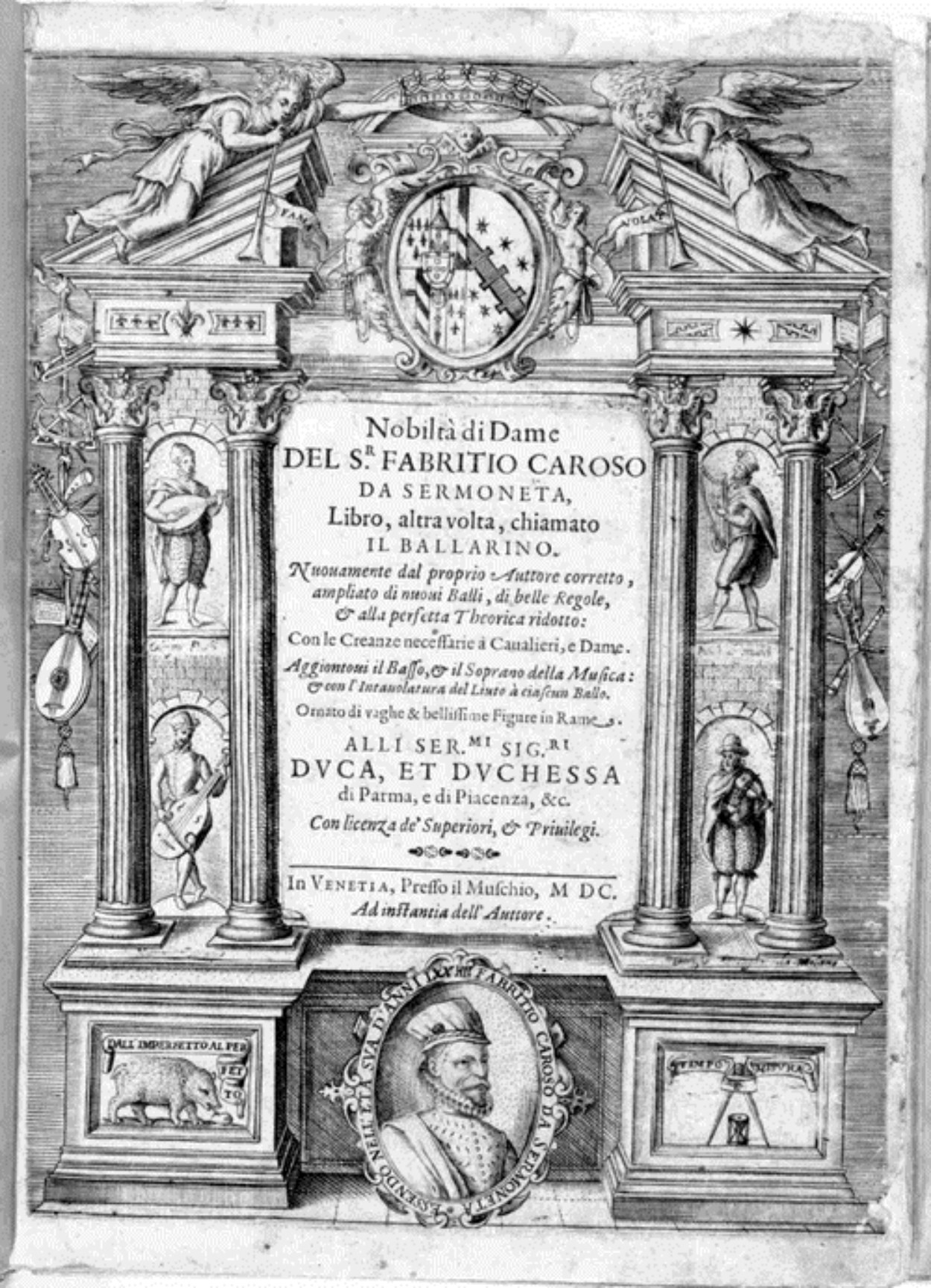
This woodcut plate is one of a series of instructional illustrations from Fabritio Caroso's *Nobiltà di Dame* (Venice, 1600), a foundational treatise on Italian court dance of the Renaissance and early Baroque periods. Caroso was a renowned dancing master whose writings preserved the choreography and etiquette of the dances performed in the courts of Italy and beyond. The plate depicts the formal opening moment of a paired dance—a 'riverenza' or courtly greeting—and exemplifies the aesthetics and values of Renaissance dance practice: formality, symmetry, noble bearing, and the careful regulation of the body. This image belongs in a gallery of dance because it is not merely a representation of dance but an instrument of dance pedagogy—a visual aid designed to teach dancers how to position themselves and begin their sequences.
Caroso's work represents a crucial moment in Western dance history, when the practices of the ballroom were first systematized and recorded in print. Unlike painting or sculpture, which might capture a moment of inspired movement, Caroso's woodcuts are prescriptive: they show not what dancers did in a single brilliant moment, but how dancers *should* move, step by step. The couple in this image are not individuals in mid-performance but models of comportment—idealized figures demonstrating the opening posture that any noble dancer of the period was expected to master.
How to look at it
Attend to the formality and symmetry of the composition: both figures are of equal importance, facing each other directly, and the line of their joined hands creates a vertical axis of balance. Notice the extreme formality of their dress—the vast ruffs, the jewels, the draped cloaks—which signals that this is not everyday movement but a carefully choreographed display. The artist has chosen the moment just before the dance begins, at the 'riverenza' or formal salutation. This is not the most visually exciting moment of the sequence (no leaps, no rapid footwork), but it is the essential one: it establishes the tone of mutual respect, noble bearing, and control that governs the entire performance. The woodcut medium renders this moment in clear, bold lines that emphasize the geometric precision of the pose.
The artist
Fabritio Caroso da Sermoneta (c. 1526/1535–after 1605) was one of the most celebrated dancing masters of the Italian Renaissance and early Baroque periods. He spent much of his career in Rome and Venice, teaching nobles and courtiers. His first treatise, *Il Ballarino* (Venice, 1581), was a major success and established him as an authority on courtly dance. The *Nobiltà di Dame*, published in 1600 and dedicated to Christine of Lorraine, was a substantially revised and expanded edition that incorporated innovations in Italian court dance practice at the turn of the century. Caroso's works were among the first to systematically notate dance choreography in print, using a combination of verbal description, geometric diagrams, and illustrations. His influence extended across Europe and his treatises remained authoritative references for dancing masters well into the 18th century.
The period
The Renaissance and early Baroque period saw dance emerge as a subject worthy of serious study and codification. The rise of the Italian city-states and their wealthy merchant courts created a class of patrons and performers who valued dance as a display of refinement and education. By the late 16th century, dance had become formalized into distinct named types—pavanes, galliards, courantes—each with prescribed steps, rhythms, and proper execution. The printing press made it possible to disseminate this knowledge beyond the immediate circle of a dancing master's students. Caroso's publications represent the culmination of a century of growing interest in the theory and practice of courtly dance. At the same time, the early 1600s saw the rise of ballet de cour in France, which would eventually eclipse the Italian tradition, but Caroso's work captures the peak of the Italian school and serves as a record of practices that were soon to become obsolete.
Where it lives
This plate is from the collection of the Library of Congress and comes from the 1600 Venice edition of Caroso's *Nobiltà di Dame*. Within the treatise, it functions as a pedagogical illustration accompanying written descriptions of the opening movement of a paired dance.
Dance in this work
Questions about this work
What dance are they doing?
The image shows the opening salutation ('riverenza') that preceded many Renaissance courtly dances, such as the pavane or galliard. The specific dance would have been indicated by the text accompanying this plate in Caroso's treatise. The image itself shows the formal greeting and posture rather than the actual steps of any one dance.
Why are their clothes so elaborate?
The sumptuous dress—the enormous ruffs, the patterned fabrics, the fur-lined cape—signals that these are noble dancers. In Renaissance courts, wealth and status were displayed through clothing, and dancing was one of the formal occasions for displaying one's rank and refinement. The dress also constrains movement in ways that shaped the style of the dance: the full skirts and heavy fabrics meant the woman's footwork was often invisible, while upright posture and arm positioning became more important.
Is this from a real dance performance?
This is a didactic illustration from a dance manual, not a record of a specific performance. The poses are idealized and standardized to teach proper form to students. However, the dress, the postures, and the sequences described in Caroso's text are based on actual court dances that were performed in Venice, Rome, and other Italian courts during this period.
Why use a woodcut for a dance book?
Woodcut was the most practical reproductive technique available in 1600 for printing illustrated books. It allowed sharp, clear images that could be reproduced in many copies at reasonable cost, making it possible to distribute the instruction widely. The bold lines and high contrast also served the pedagogical purpose: the poses are easy to read and study.
More Notation/Choreography artwork