49 works in this view — arrow keys or swipe to move between them.
Dance in Art
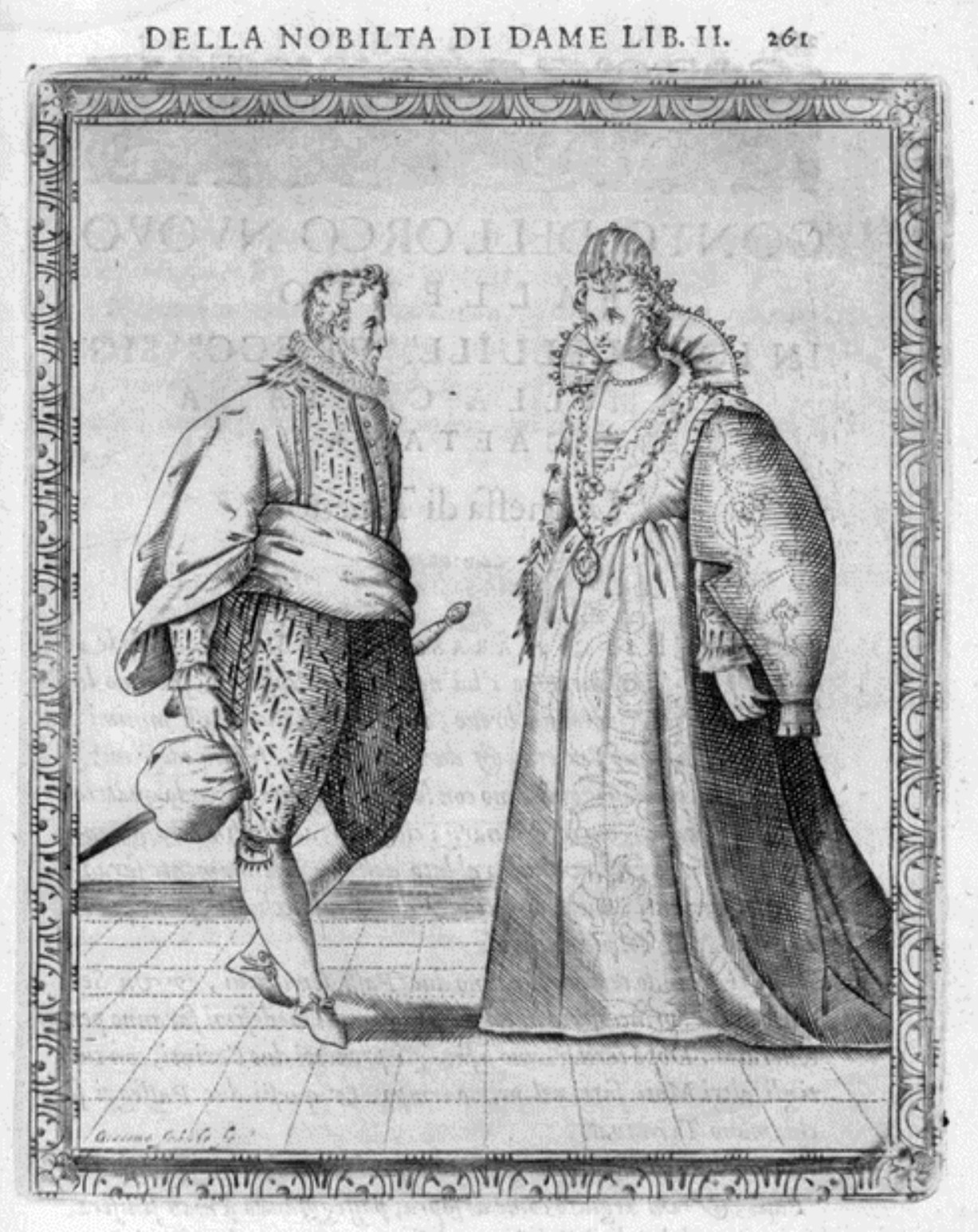
Caroso Nobiltà — Dance Plate (plate 29)
Fabritio Caroso da Sermoneta
- Medium:
- Woodcut
- Dance:
- Notation/Choreography
- Era:
- Pre-1700 (Renaissance/Baroque)
- Collection:
- Nobiltà di Dame (1600)
- Source:
- Library of Congress
- Rights:
- Public domain — free to use, share and adapt.
- Recorded as:
- Public Domain
Caroso's plates are among the earliest detailed visual records of courtly dance technique. While other sources from the period describe steps and patterns in words, Caroso's woodcuts show exactly how the body was arranged and held—information that would otherwise be lost and that modern reconstructors of historical dance rely on heavily. This specific image documents the formal spatial and postural logic of paired Renaissance courtship dances, the foundation of all later ballroom forms.
What you are looking at
A woodcut depicting two figures in Renaissance Italian court dress face each other in a formal confrontation or conversation, possibly a moment of courtship ritual. On the left stands a young man in elaborate patterned breeches and a decorated doublet with a white sash across his torso; his posture is turned three-quarters away from the viewer, one leg extended in a pronounced contrapposto, the other bent, as if caught mid-stride or in the deliberate stance of a dance figure. He holds a feathered hat in one hand. On the right stands a woman in a high-waisted gown with long sleeves and a full skirt, her blonde hair dressed high and adorned, wearing a prominent pearl necklace and what appears to be a ruff or standing collar; she faces the male figure directly, her posture upright and formal. Both figures occupy a shallow stage space defined by a simple floor line. The composition is symmetrical and frontal, typical of a choreographic notation or demonstration plate: the pair are isolated against a plain background, their bodies arranged to show the attitudes and relative positions demanded by a specific dance.
The dancing
The man's weight appears to rest primarily on his bent right leg while his left leg extends in a high, deliberate step—a characteristic posture of Renaissance galliard or similar elevated dances. His torso is turned away while his face regards the woman, creating a contrapposto line through the body. The woman stands in a more static, upright position with weight evenly distributed, her arms held at her sides in a formal frame. The relative positioning suggests a moment of approach or address rather than a coupled turn; the man's extended leg and angled body create a sense of dynamic movement that the woman's stillness answers.
The dance depicted
This is almost certainly a figure from a paired Renaissance dance, most likely a galliard or a similar aristocratic court dance of the late sixteenth or early seventeenth century. The man's posture—the pronounced elevation and extension of the leg, the turned-away torso, the deliberate positioning—closely matches the footwork and bearing documented in Caroso's own choreographic notation. The woman's formal, frontal stance suggests she is receiving or responding to the man's advances in the formal language of courtship dance. The isolated, demonstrative presentation indicates this is a teaching or notational plate meant to show dancers the exact positions and attitudes they should assume.
How it was made
This is a woodcut, a relief printing technique that allowed for wide circulation of instructional images in printed books. Woodcut's bold lines, high contrast, and relative simplicity of production made it ideal for choreographic notation: the figures read clearly and unambiguously from a distance, and the technique was economical enough to allow Caroso to include dozens of such plates in his manual. The medium's graphic quality—the sharp outlines, the hatching used to suggest texture and volume in the garments—emphasizes the formal geometry of the pose rather than its transient animation.
About this work
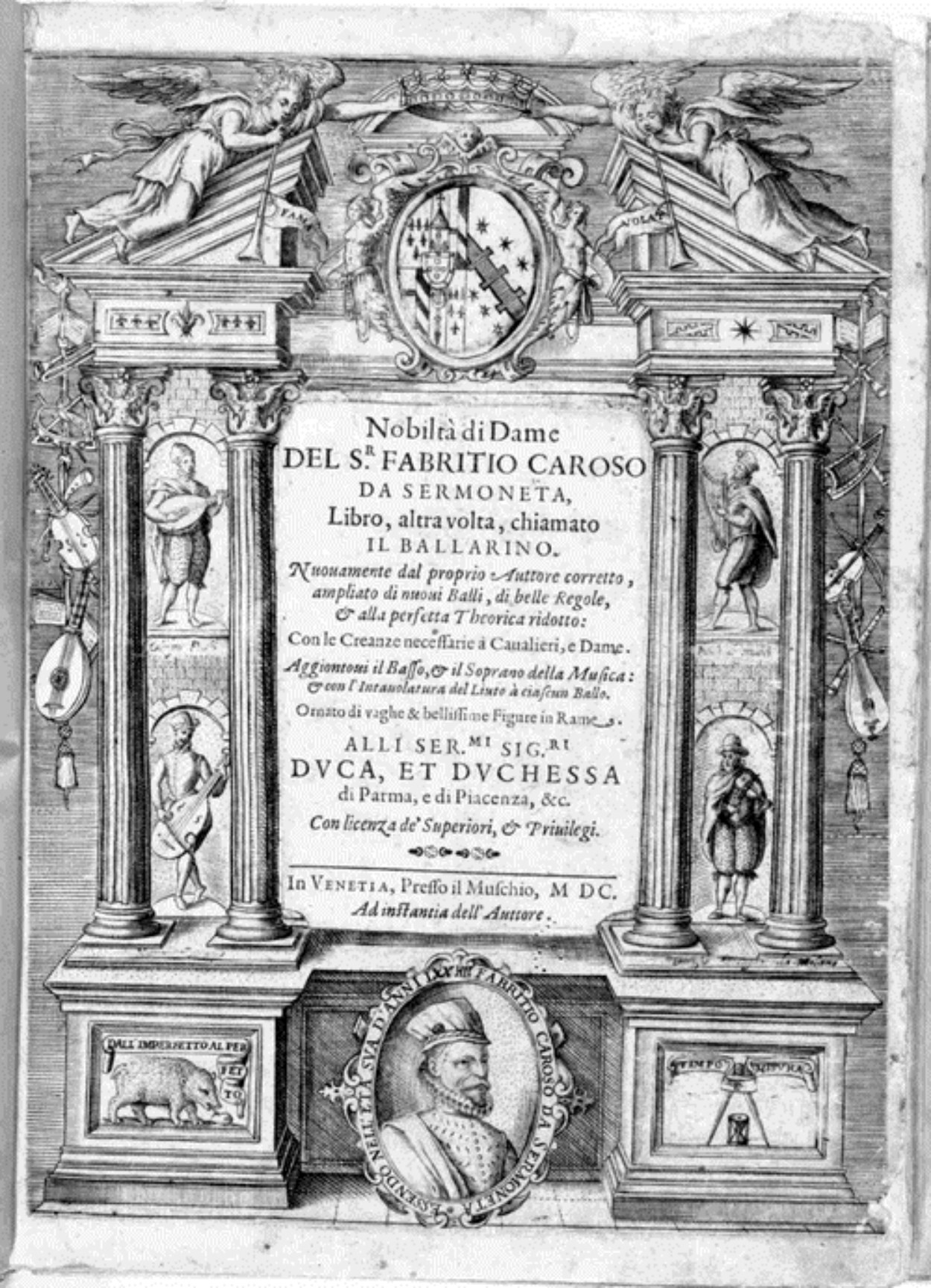
This plate comes from Fabritio Caroso's *Nobiltà di Dame*, the expanded and refined 1600 edition of his 1581 manual *Il Ballarino*—two of the most important sources we possess for Renaissance and early Baroque court dance. Caroso was a celebrated dancing master at the courts of Rome and other Italian cities, and his books were designed to teach the nobility the dances that defined their social rank and courtship rituals. The plates function as choreographic notation: each shows a dancer or pair of dancers in a key position or attitude within a specific ballo (named dance), allowing someone who could read dance notation to reconstruct the full choreography. This particular image demonstrates not just what a dance looked like but how the human body should be positioned and held during performance—the angle of the head, the extension of the limbs, the distribution of weight. For a dance historian or performer, such images are invaluable: they are among the only visual records we have of how aristocratic European dancers actually moved in the decades around 1600.
How to look at it
Look closely at the man's posture: the high extension of his left leg, the twist of his torso, and the careful placement of his weight all tell a story of controlled, deliberate movement. This is not a frozen moment of unrehearsed action; it is a calculated attitude, a position that must be held with strength and control. The woman's stillness by contrast emphasizes the man's activity—he is the dancer, she is being courted through the language of his movement. Note also how the space between them is measured and formal: this is not an embrace but a conversation, conducted at arm's length, in the public space of the court. The geometric clarity of the composition—the way both figures are shown in near-profile or three-quarter view so that their legs and the angles of their bodies are clearly readable—was a deliberate choice by both Caroso (in designing the dance) and the artist (in rendering it), meant to make the position unambiguous to a student learning from the page.
The artist
Fabritio Caroso da Sermoneta (c. 1526–1605) was one of the most celebrated and prolific dance masters of the late Renaissance. He taught at the courts of Rome, particularly among the nobility, and published two major manuals on courtly dance: *Il Ballarino* (1581), which established him as the definitive authority on Italian court dances, and *Nobiltà di Dame* (1600), a substantially expanded version with new dances and revisions reflecting the evolving fashions of turn-of-century courtly practice. Both books were hugely influential across Europe and helped to standardize court dance notation and pedagogy. Caroso was praised by contemporaries for his skill in creating new dances and teaching the nobility—an unusual position of prestige for a dance master. His work represents the culmination of Renaissance dance theory and practice.
The period
The late sixteenth and early seventeenth centuries saw a flowering of courtly dance in Italy and Western Europe more broadly. Dance had become central to aristocratic identity, courtship, and social display. The publication of dance manuals—by Caroso, Cesare Negri, Thoinot Arbeau, and others—reflects both the rising demand for instruction and the growing sense that dance was a refined art worthy of documentation and study. The galliard and related dances that dominated this period emphasized elevation, agility, and ornamental footwork, particularly for the male dancer; they were vehicles for displaying wit, athleticism, and courtly grace. By 1600, when Caroso published *Nobiltà di Dame*, the style was beginning to shift toward the more restrained, geometric choreography of early Baroque court ballet, though Italian court dance remained more energetic and improvisational than its French counterpart.
Where it lives
This plate is from *Nobiltà di Dame*, the 1600 Venice edition of Caroso's dance manual. The book survives in multiple copies in libraries and collections across Europe and North America. The holding of this specific copy is indicated in the record as the Library of Congress.
Dance in this work
Questions about this work
What is this couple dancing?
The exact named dance (*ballo*) cannot be determined from the plate number alone without cross-reference to Caroso's text, but the man's posture—with the high leg extension and contrapposto turn—is characteristic of galliards, correnti, or similar elevated dances of the period. Each of Caroso's named dances was built from a sequence of such positions.
Why is the man's leg in the air and the woman standing still?
In Renaissance courtship dances, the man typically danced—displaying his skill and vitality—while the woman responded with more reserved movements or simply maintained a formal presence. This reflected both the social hierarchy of the court and the choreography itself: the man led, the woman participated. The woman's stillness here is not passivity but a deliberate formal pose that the man's movement was designed to address.
How do we know how to dance these dances today?
Caroso's plates, combined with the written descriptions in the text, allow modern dancers and choreographers to reconstruct the dances with reasonable accuracy. Dance historians use the visual evidence of posture, spacing, and attitude shown in plates like this one, along with the verbal notations of steps and patterns, to piece together both the overall shape and the moment-to-moment execution of Renaissance balli.
Is this really how people danced, or is this idealized?
This is a teaching image, so it shows the *correct* or idealized form—the way a dancer should look when performing well. It is more formal and controlled than real performance may have been, but it reflects actual Renaissance dance technique and aesthetics. Caroso's goal was to instruct the nobility in the proper execution of these dances, so the image is both idealized and practically accurate.
More Notation/Choreography artwork