49 works in this view — arrow keys or swipe to move between them.
Dance in Art
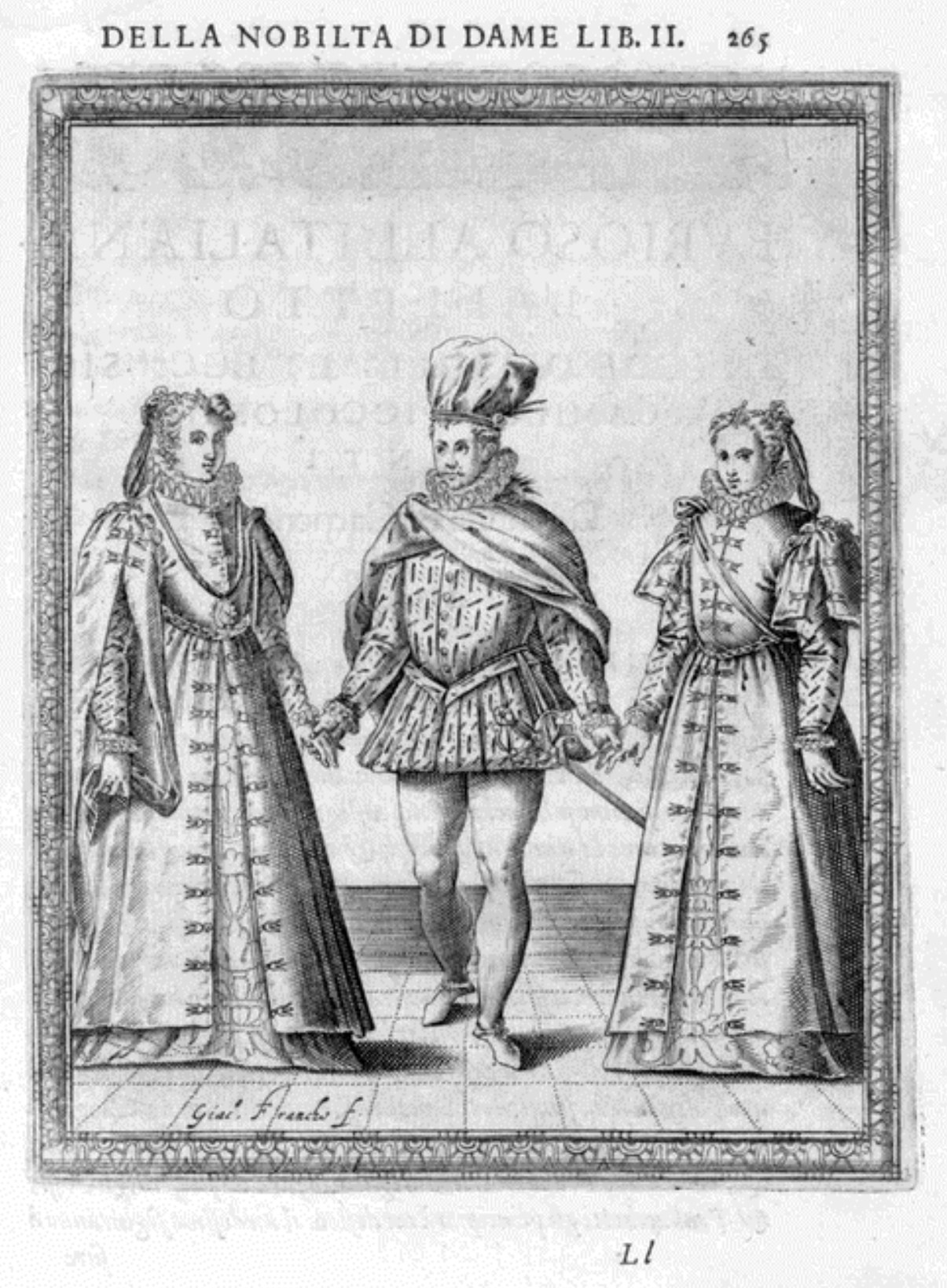
Caroso Nobiltà — Dance Plate (plate 30)
Fabritio Caroso da Sermoneta
- Medium:
- Woodcut
- Dance:
- Notation/Choreography
- Era:
- Pre-1700 (Renaissance/Baroque)
- Collection:
- Nobiltà di Dame (1600)
- Source:
- Library of Congress
- Rights:
- Public domain — free to use, share and adapt.
- Recorded as:
- Public Domain
For historians and dancers, this plate is invaluable evidence of how Renaissance court dances were actually performed and taught. It shows the upright carriage, the formal positioning, and the lack of close partnering that characterized the Pavane and similar dances of the period. Caroso's manual, with images like this, is the most detailed surviving choreographic record of the Cinquecento, allowing modern dancers and scholars to reconstruct actual sequences with unusual precision.
What you are looking at
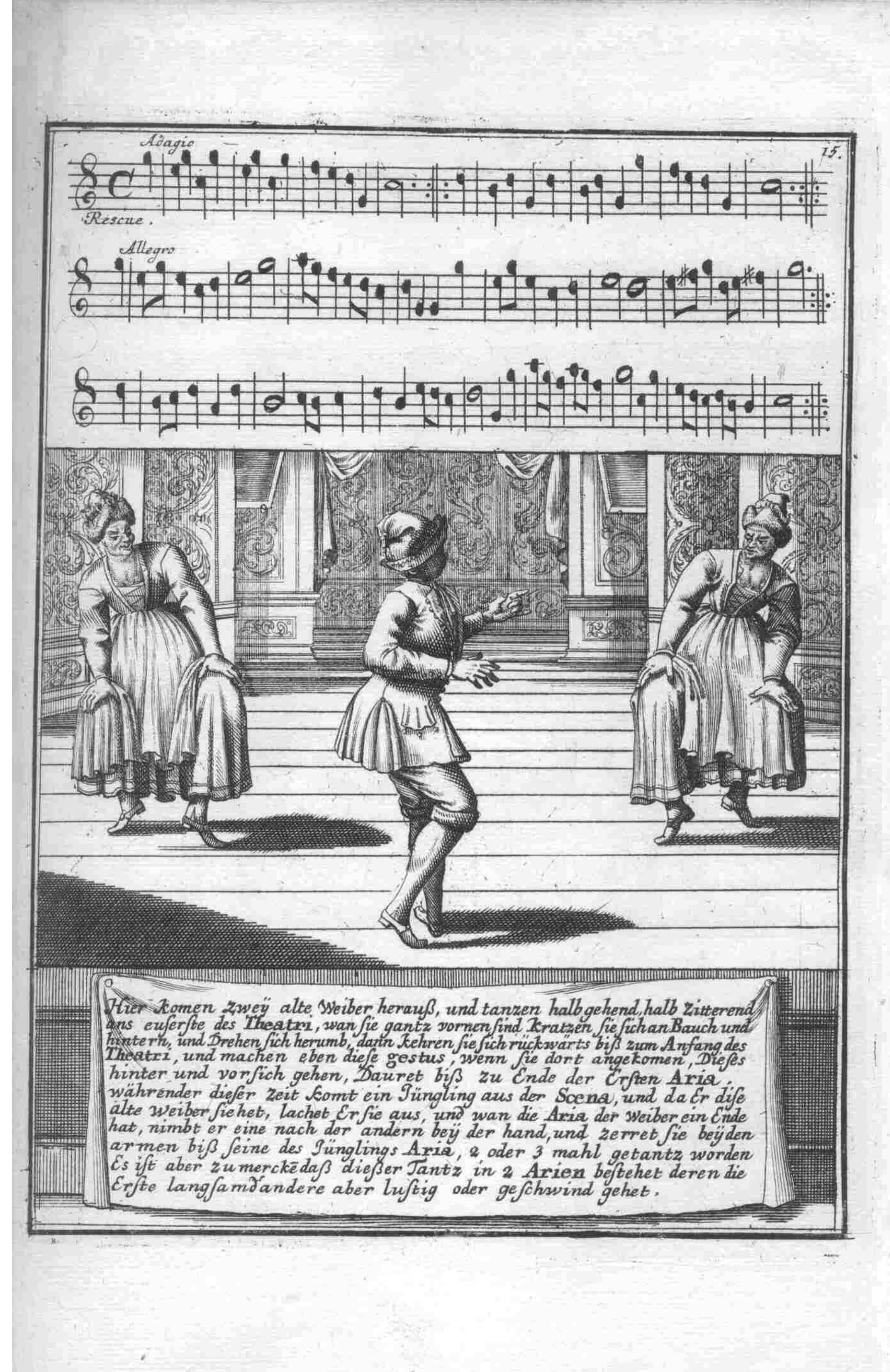
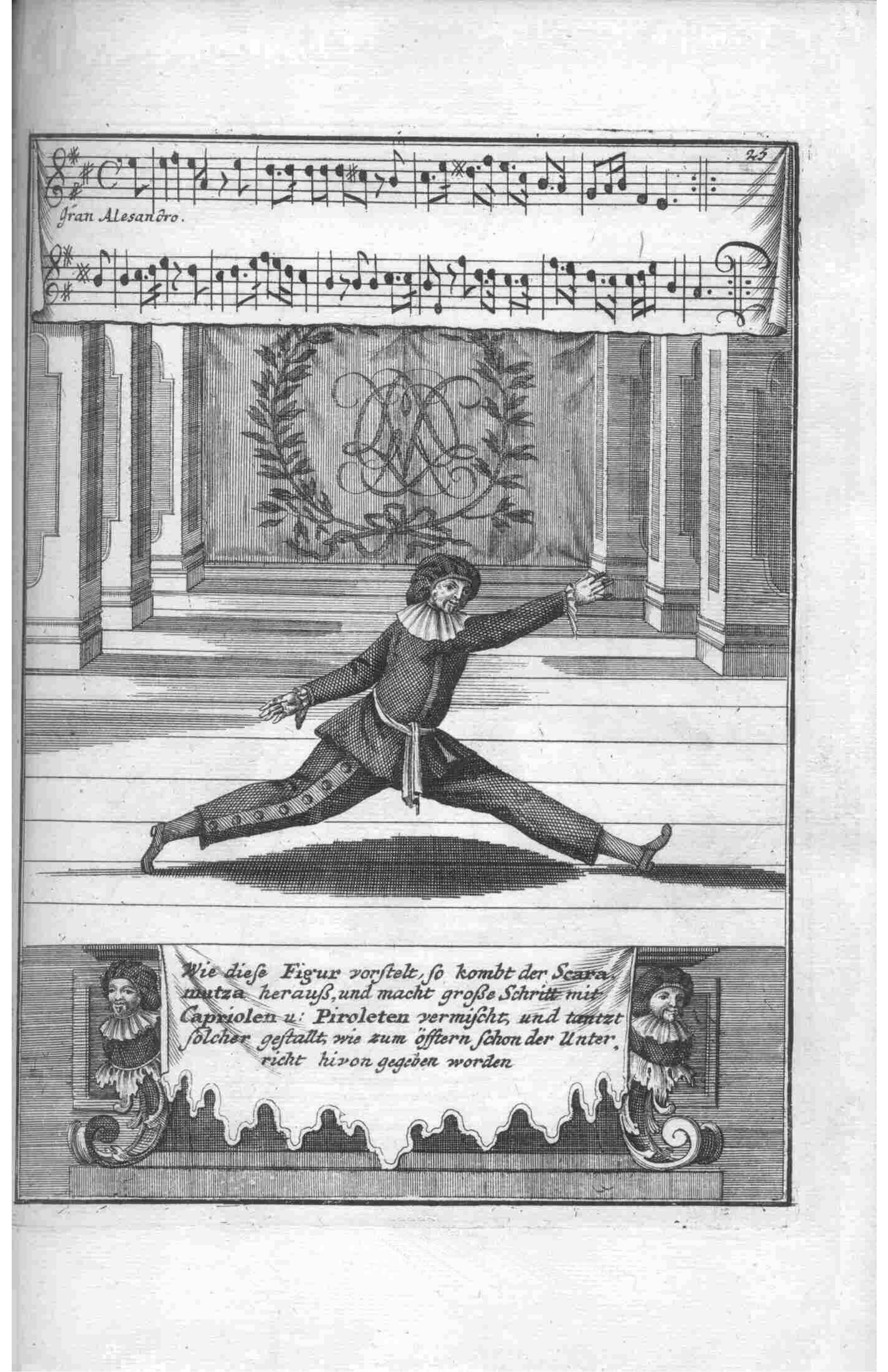
A woodcut depicting three elegantly dressed figures in Renaissance Italian court costume. The central figure is a man in a pleated doublet and hose, wearing a tall feathered hat and holding a sword; he stands in a composed, frontal pose. To his left and right are two women in long gowns with jewelled decoration, their hair arranged with pearls and their shoulders bare in the fashionable style. All three wear the high collars (standing ruff or collar) typical of late 16th-century dress. The figures stand on a tiled floor against a plain background, arranged in a formal line across the composition. The man's legs are notably exposed in the short hose of the period, while the women's gowns fall to the floor with long trains or sleeves flowing behind them. The woodcut medium gives the image a bold, high-contrast appearance suited to print reproduction and wide circulation.
The dancing
The three figures are arranged in a processional line with balanced spacing. All stand in an upright, stately posture with minimal weight shift or dynamic stance. The man's arms hang freely at his sides, his body oriented forward with no rotation or tilt; the women flank him symmetrically, their arms similarly composed and hanging. There is no contact between the figures—no hand-holding, clasping, or partnering hold. Their positioning suggests a moment of presentation or formal display rather than active movement, though their careful arrangement and symmetry imply choreographic intention.
The dance depicted
This plate illustrates a formal processional figure from Italian Renaissance court dance, most likely a Pavane or similar noble couple dance of the late 16th century. The inscription at the base (partially visible as 'Grat[ia]...') and the presence of a man flanked by two women suggests this may depict a specific figure or position from Caroso's notated choreographies. The stately, vertical posture and formal arrangement are characteristic of Cinquecento court dances, which prioritized dignity and measured movement over virtuosity. The image documents not an action in progress but the posed placement of dancers in a choreographed sequence, typical of how Renaissance dance notation instructed noble couples.
How it was made
This is a woodcut—a relief-printing technique that carves an image into the surface of a wooden block. The bold black lines and high contrast visible here are characteristic of woodcut work. As a page from a printed manual (Caroso's *Nobiltà di Dame*), this image was intended for wide circulation among the literate nobility across Italy and Europe; woodcuts were the standard reproductive medium for such technical and instructional books before engraving became common. The technique's boldness and clarity made it well suited to illustrating human figures and costume detail, allowing dancers and choreographers to learn positions from the printed page.
About this work
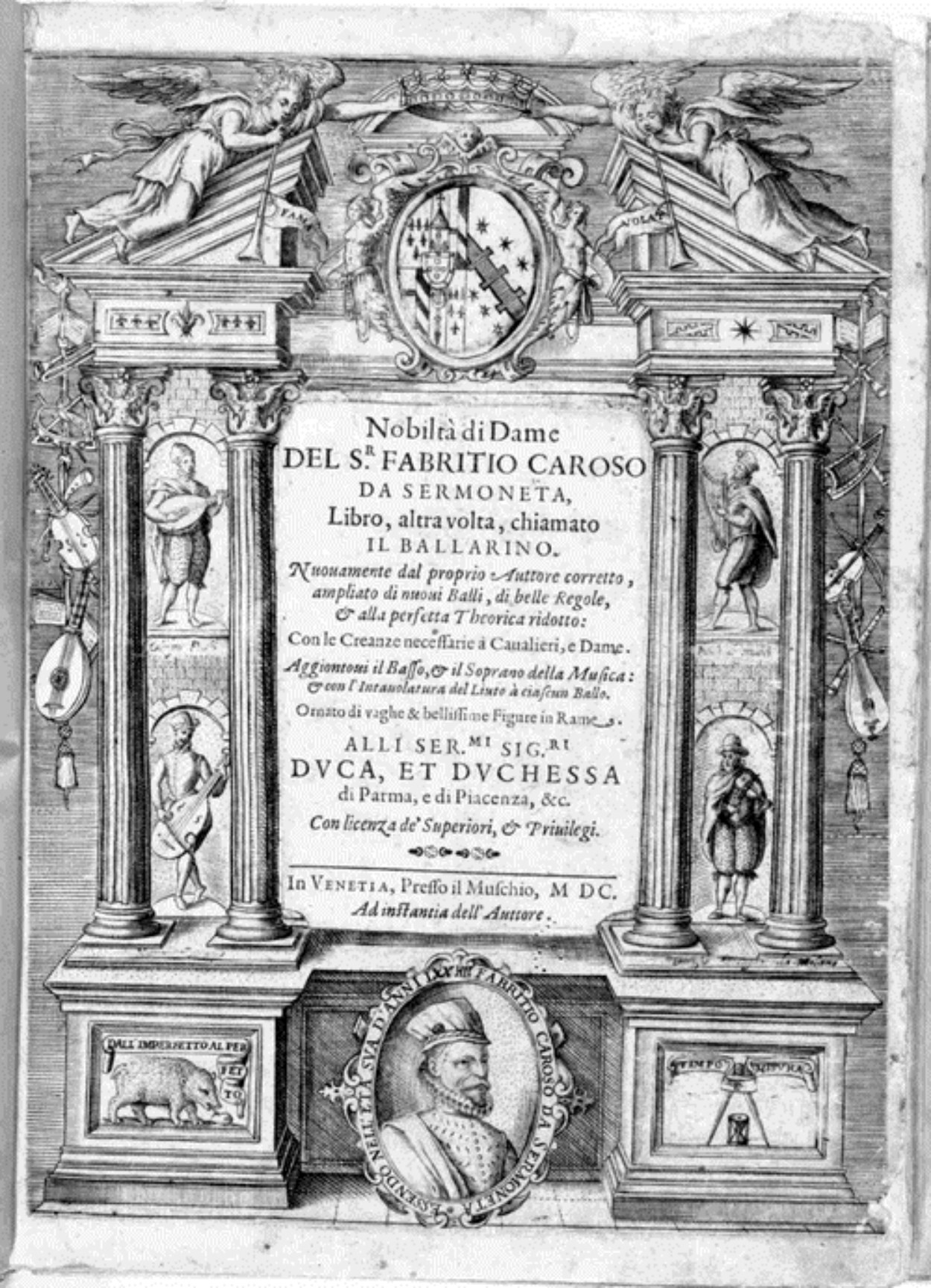
This is a woodcut plate from Fabritio Caroso da Sermoneta's *Nobiltà di Dame* (Venice, 1600), one of the most important surviving sources for late Renaissance Italian court dance. The image depicts three aristocratic figures in formal dress posed in what appears to be a specific moment or configuration from a choreographed dance of the Cinquecento. Caroso's manual, a refined re-edition of his *Il Ballarino* (1581), was the standard technical reference for noble dance practice at the turn of the 17th century; this plate is one of many illustrating actual positions and figures that noble dancers were expected to learn and perform.
The work belongs in a gallery of dance imagery because it documents how Renaissance dance was actually taught, transmitted, and visualized. It is not a celebration of virtuosity or spontaneous joy but a technical diagram—a frozen moment of a notated sequence meant to be replicated by practitioners. The formal, vertical posture and symmetric arrangement of the figures reveal the aesthetic values of Renaissance court culture: nobility, measured dignity, and the demonstration of rank through graceful restraint.
How to look at it
Look first at the carriage of the three figures: notice the upright spine, the level shoulders, and the absence of weight shift or contrappostal tilt. These are not bodies captured mid-leap or mid-turn, but bodies held in a formal, presentational stance. Next, observe the distance between the figures and the absence of hand contact—this tells you that the dance emphasized vertical dignity and spatial formality over intimate partnering. Finally, study the dress itself, especially the man's exposed leg and the women's long trains and jewelled surfaces; Caroso's dances were visual spectacles as much as kinetic ones, designed to display noble bodies, fine clothing, and measured grace. The moment frozen here is not a moment of action but of *placement*—the kind of position a choreographer would have written down in notation.
The artist
Fabritio Caroso da Sermoneta (c. 1526–c. 1605) was the leading dance master of late Renaissance Italy. Active in Rome and other major Italian courts, he was renowned for his teaching, his compositions, and his role in systematizing and codifying noble dance practice. He published *Il Ballarino* in Venice in 1581, a landmark instructional manual that combined narrative description with woodcut illustrations of dance positions and figures. He revised and expanded this work substantially as *Nobiltà di Dame*, published in 1600 and dedicated to Christine of Lorraine, the Medici duchess. Caroso's manuals are the most detailed surviving record of sixteenth-century court dance; his illustrations set a visual standard that was copied and imitated across Europe.
The period
In the late Renaissance, aristocratic dance was a central skill and social practice, essential to courtly identity and essential to marriage, diplomacy, and the performance of rank. The Pavane (or Pavan), a stately processional dance for couples, was the foundational noble dance of the mid-to-late 16th century; it was danced before royalty and at state occasions throughout Europe. Caroso's work documents the moment when Italian dance masters began to systematize and notate their practice in printed form, allowing dance knowledge to be preserved and transmitted beyond the court itself. The *Nobiltà di Dame* appeared at the very end of the Cinquecento, as the Pavane was beginning to give way to faster, more intricate dances like the Galliard. At the same time, the visual arts were increasingly called on to document human movement and gesture—a role that manuals like Caroso's fulfilled with unusual precision.
Where it lives
This woodcut is a plate from a printed book: *Nobiltà di Dame*, published in Venice in 1600, and now held in the Library of Congress. It is one of numerous dance plates illustrating actual figures from Caroso's notated choreographies, making it part of the most systematic visual record of Renaissance court dance that survives.
Dance in this work
Questions about this work
What dance is this plate illustrating?
The image most likely depicts a position or figure from a Pavane or similar noble couple dance of the late 16th century. The formal, stately posture and processional arrangement are typical of Cinquecento court dances. The inscription at the base (partially visible) may identify a specific figure, but without a clear reading of the full text, the exact choreographic sequence cannot be confirmed from the image alone.
Why are there two women and only one man?
Some Renaissance dances, especially processional figures, were performed by trios or in configurations where a single dancer was flanked or attended by two partners. This arrangement may illustrate a specific formation from Caroso's choreography, or it may represent a moment in a dance where the dancers occupy this spatial relationship. Caroso's manuals document many such variations.
How do we know how to dance from a still image?
Caroso's manual pairs these woodcuts with detailed written instructions in Italian, explaining the steps, timing, and figure of each choreography. A dancer reading the text could learn the sequence by reference to both the written description and the illustrative position shown here. The image anchors the written word and allows a reader to visualize the body carriage and spacing that the text describes.
Is this dress historically accurate?
Yes. All three figures wear authentic late 16th-century Italian court costume: the man's pleated doublet, short hose, feathered hat, and sword are consistent with high fashion ca. 1580–1600, as is the women's jewelled gowns, bare shoulders, high collars, and pearl-adorned hair. Caroso's illustrator was careful to depict current fashion, which was itself part of the spectacle of noble dancing.
More Notation/Choreography artwork