49 works in this view — arrow keys or swipe to move between them.
Dance in Art
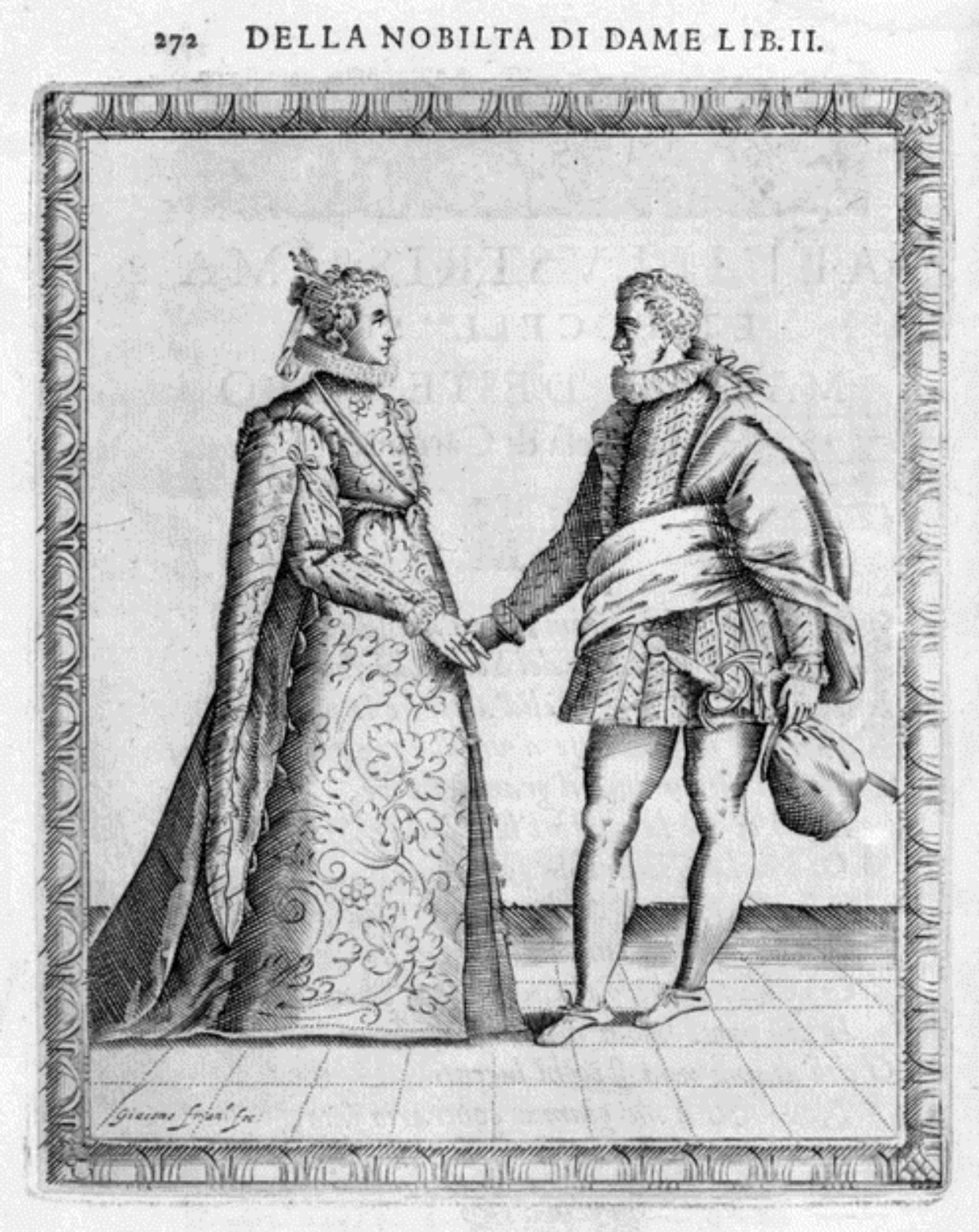
Caroso Nobiltà — Dance Plate (plate 31)
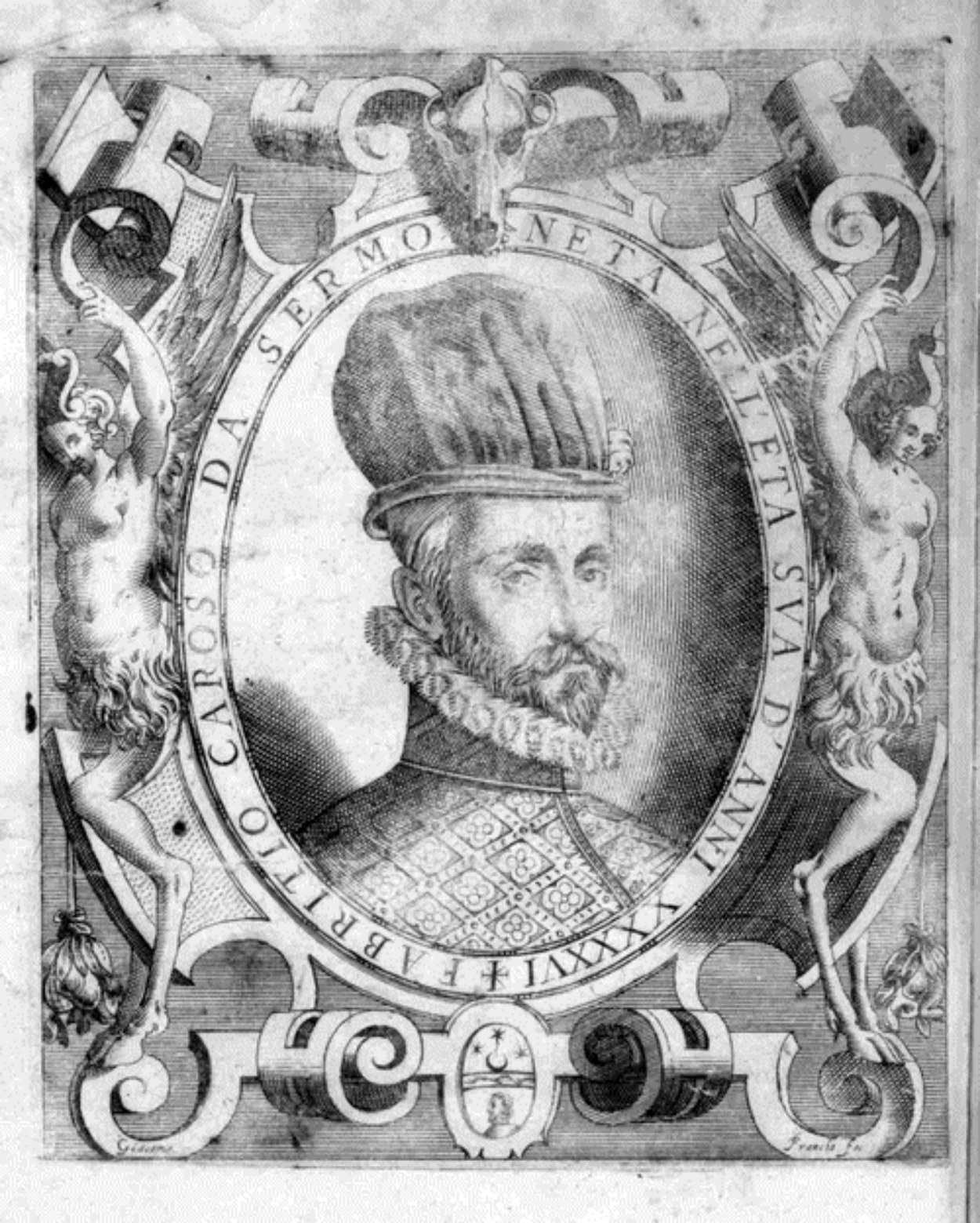
Fabritio Caroso da Sermoneta
- Medium:
- Woodcut
- Dance:
- Notation/Choreography
- Era:
- Pre-1700 (Renaissance/Baroque)
- Collection:
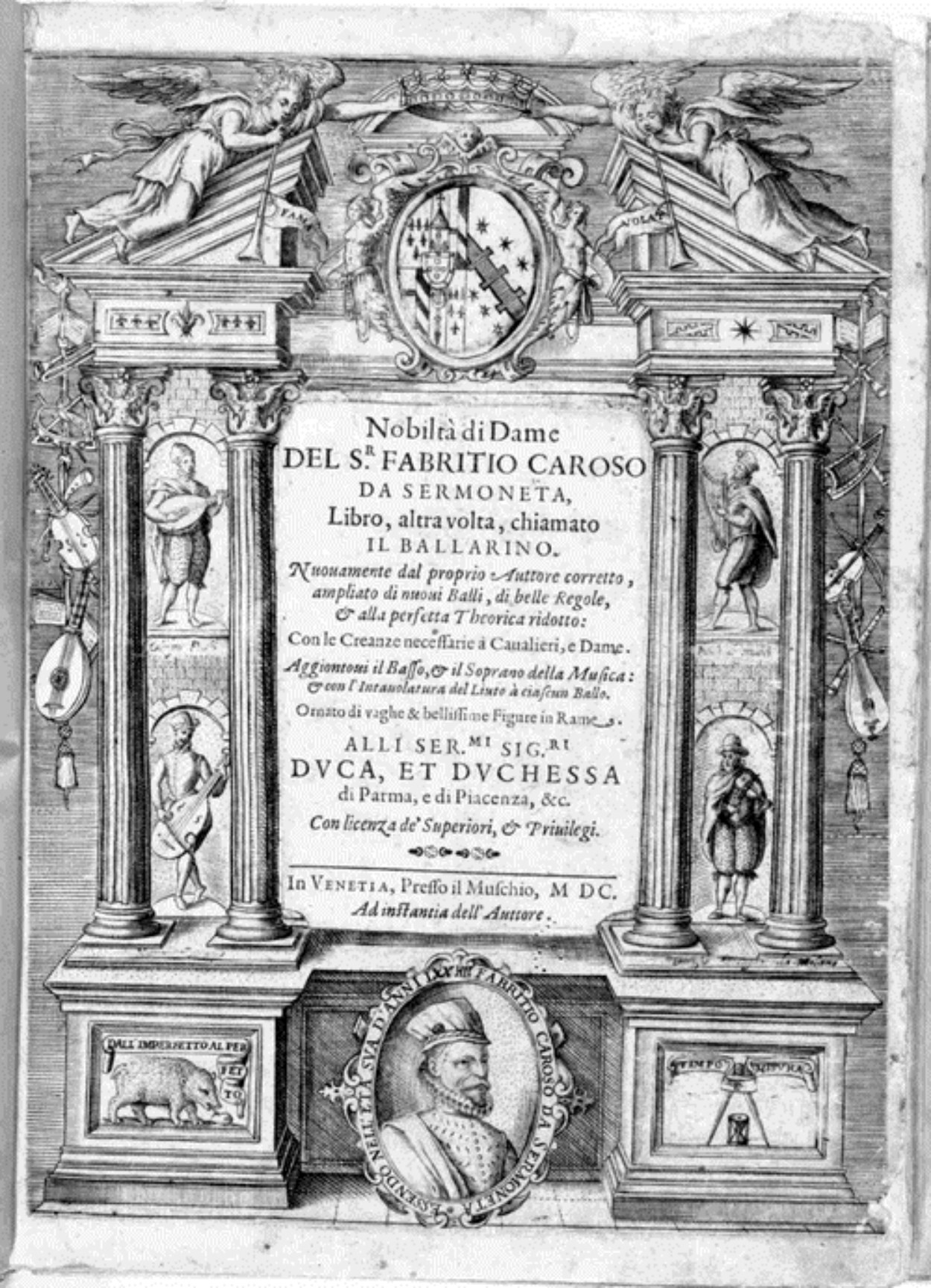
- Nobiltà di Dame (1600)
- Source:
- Library of Congress
- Rights:
- Public domain — free to use, share and adapt.
- Recorded as:
- Public Domain
Caroso's plates are among the only precise visual records of how Renaissance court dancers actually held themselves and related to their partners. This image demonstrates the aristocratic deportment and hand-hold that defined a whole class of dances—knowledge that would otherwise be lost to us. For anyone studying Renaissance dance, court etiquette, or the transmission of embodied knowledge before film, Caroso's *Nobiltà di Dame* is the most authoritative source we have.
What you are looking at
A noble couple in Renaissance court dress face each other in what appears to be an interior space with a checkered floor. The woman on the left wears an ornate gown with elaborate embroidered or patterned decoration across the bodice and skirt, a high collar, and a long train trailing behind. Her hair is styled up with a decorative arrangement. The man on the right wears a doublet with puffed sleeves, a ruff collar, hose, and holds what appears to be a feathered hat or plume in one hand. The two figures clasp hands at roughly waist height, their bodies angled toward each other in a formal, measured pose. The engraving employs fine cross-hatching to create texture and shadow, particularly in the fabric patterns and the figures' faces. The composition is frontal and symmetrical, emphasizing the formality and nobility of the pair.
The dancing
Both dancers stand upright with their weight distributed evenly, neither leaning or lunging. Their clasped hands are held at a moderate height between them, consistent with a partner dance hold of the period. The woman's posture is erect and composed; the man's stance is similarly formal and restrained. There is no suggestion of movement in progress—the moment captured is poised and stationary, as if demonstrating a position or greeting rather than active choreography. The spatial relationship between them suggests a measured distance appropriate to court etiquette.
The dance depicted
This is a demonstration plate from Caroso's instructional manual, almost certainly depicting one of the opening positions or salutations of a Renaissance court dance. The formal dress, the upright bearing, and the deliberate hand clasp are consistent with dances documented in Caroso's choreographies—likely an allemande, pavane, or similar processional or paired dance. The image serves as a visual reference for dancers learning the work, showing the proper deportment, dress, and initial hand position for a noble couple. Caroso's plates were pedagogical: they taught dancers how to stand, how to hold themselves, and how to relate to a partner, not just what steps to execute.
How it was made
This is a woodcut, a relief printing technique common in sixteenth- and early seventeenth-century instructional books. Woodcut allowed for sharp, clear lines and bold contrast suitable for reproduction in multiple copies, making Caroso's manual accessible to dancing masters and nobility across Italy and beyond. The technique's strength lies in clarity of outline and readable detail of costume and posture—less suited to subtle movement or shadow than engraving, but highly effective for anatomical and sartorial instruction. The decorative border framing the composition is also carved wood, a standard feature of printed books of this era.
About this work
This plate is one of thirty or more instructional diagrams from Fabritio Caroso's *Nobiltà di Dame* (Venice, 1600), a definitive treatise on court dance at the turn of the seventeenth century. The work documents the refined, geometric dances of the Italian Renaissance court, training both the body and the eye of the reader. Caroso's plates are among the most precise visual records of Renaissance dance practice: they show us not only the steps and figures, but also how dancers were expected to dress, stand, and present themselves in the presence of nobility. This particular plate demonstrates the formal greeting or opening frame of a paired dance, making it a primary source for both the choreography and the aesthetic ideals of the period.
The *Nobiltà di Dame* was a revised and expanded edition of Caroso's earlier *Il Ballarino* (1581), dedicated to Christine of Lorraine and reflecting the most fashionable practices of the late sixteenth-century Medici and Italian courts. These plates circulated widely and influenced dancing masters across Europe. For historians of dance, costume, and court culture, Caroso's diagrams are irreplaceable: they marry text, image, and embodied knowledge in a way that written choreography alone cannot achieve.
How to look at it
Look first at the couple's posture and the distance between them: what does Caroso choose to show us about how a noble man and woman should stand together? Note the precision of the hand clasp—it is neither tentative nor intimate, but formally prescribed. Attend to the costume details: the woman's embroidered gown, the man's doublet and puffed sleeves, the feathered hat. These are not generic noble dress but the specific fashion of Caroso's era, and dancers of the period would have worn similar clothes. The woodcut line is sharp and declarative; there is no ambiguity in the outline or posture. This is intentional: Caroso means to teach, not to suggest. The checkered floor grounds the figure in a real space, a room where court dances would actually take place.
The artist
Fabritio Caroso da Sermoneta (c. 1526–c. 1605) was a celebrated dancing master of Rome and Venice, renowned for his skill in court dances and his ability to codify and teach them. He published two major treatises: *Il Ballarino* (Venice, 1581), which established his reputation, and *Nobiltà di Dame* (Venice, 1600), a comprehensive revision reflecting forty years of practice and the evolution of court taste. Caroso was one of the first dance theorists to commission and oversee detailed woodcut illustrations of his choreography, treating dance as a subject worthy of the same careful documentation as rhetoric or music. His work was pedagogical in intent but also aspirational: he wrote for and about the nobility, codifying ideals of grace, measure, and civilized behavior. Caroso's influence extended across Europe and into the seventeenth century; his plates were copied, quoted, and imitated by later dancing masters.
The period
The *Nobiltà di Dame* (1600) was published at a pivotal moment in European dance history. The high Renaissance dances Caroso documented—the pavane, galliard, almain, and branle—were already becoming retrospective by 1600, even as Caroso presented them as current court practice. The turn of the century saw a shift toward faster, more spectacular dances and the emergence of ballet as a theatrical form. In Italy, the court spectacles of the Medici and other ducal courts were moving toward more elaborate, narrative choreographies. At the same time, the formalization of dance notation and the printing of choreographic treatises—a phenomenon pioneered by Caroso and his contemporaries—made dance a subject of intellectual and artistic study. The woodcut illustrations themselves belong to a broader sixteenth-century impulse to document and systematize knowledge visually: similar techniques were used in medical, architectural, and natural-philosophical treatises. Caroso's work sits at the intersection of humanist learning, court culture, and print technology.
Where it lives
This woodcut is plate 31 from the first edition of Caroso's *Nobiltà di Dame*, published in Venice in 1600. It is held by the Library of Congress. The *Nobiltà di Dame* survives in multiple copies and editions, making it one of the most widely distributed and consulted dance treatises of the Renaissance.
Dance in this work
Questions about this work
What dance is this showing?
Caroso does not label every plate with a specific dance name, but the formal paired position and hand clasp suggest the opening or a basic figure of a Renaissance court dance such as a pavane or allemande. The plate is primarily instructional, showing proper deportment and hand position rather than a specific step sequence. To identify the exact choreography, one would need to consult the text that accompanied this plate in the original manual.
How do we know this is a real dance and not just a formal greeting?
In Renaissance court practice, the boundary between formal greeting and dance was fluid. The salutation that opened a paired dance was itself a choreographed, measured movement governed by precise rules of distance and deportment. Caroso's plates often freeze the moment just before movement begins or at a key structural point—the opening frame that establishes the couple's relationship. This was essential pedagogical content: dancers needed to know how to stand and how to hold hands before they could execute the steps that followed.
Why is the woman's dress so elaborate and the man's outfit less decorated?
This reflects the actual practice of the period: noblewomen's gowns were the primary canvas for conspicuous display of wealth, status, and artistic taste. The embroidered or patterned fabric of her skirt and bodice would have been extraordinarily expensive. The man's costume shows status through the fine tailoring of his doublet and the fashionable cut of his hose and puffed sleeves, but the woman's gown is the visual centerpiece. Caroso's careful rendering of her dress serves both pedagogical and aspirational purposes.
Is this a woodcut or an engraving?
This is a woodcut, a relief printing technique in which the image is carved into the block and the raised surface is inked. Engraving is an intaglio process requiring different tools and plates. The quality and style of line in this image—sharp, clean, with bold contrasts between black and white—are characteristic of woodcut. The technique was ideal for producing multiple readable copies for a didactic manual.
More Notation/Choreography artwork