49 works in this view — arrow keys or swipe to move between them.
Dance in Art
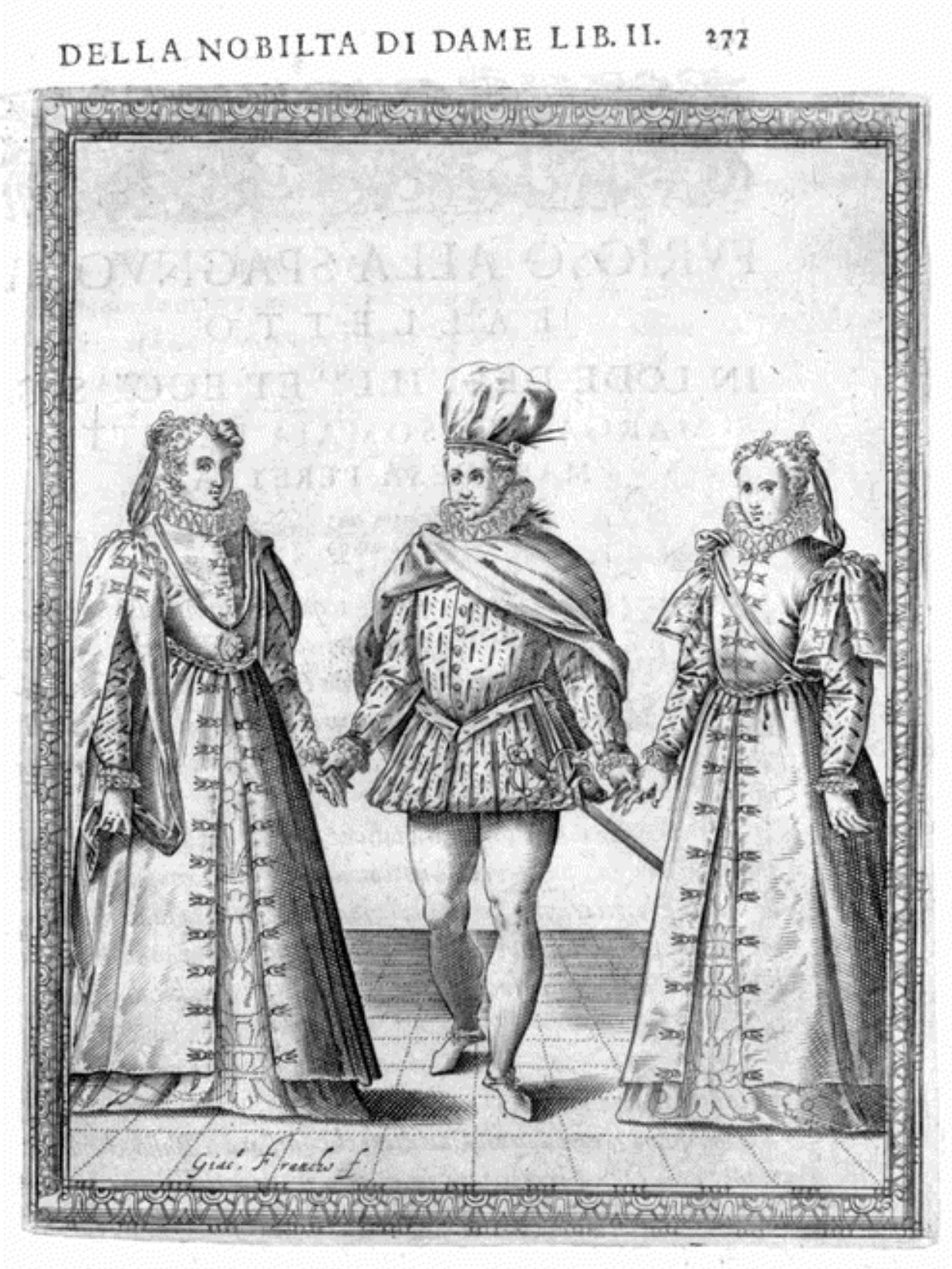
Caroso Nobiltà — Dance Plate (plate 32)
Fabritio Caroso da Sermoneta
- Medium:
- Woodcut
- Dance:
- Notation/Choreography
- Era:
- Pre-1700 (Renaissance/Baroque)
- Collection:
- Nobiltà di Dame (1600)
- Source:
- Library of Congress
- Rights:
- Public domain — free to use, share and adapt.
- Recorded as:
- Public Domain
For historians of dance, this is a direct view of choreographic notation through the body: Caroso translated his written descriptions into visual form, showing exactly how dancers stood, held themselves, and arranged themselves in space. For art historians, it is evidence of how the woodcut medium served elite knowledge-transmission and the codification of aristocratic behavior in the early modern period.
What you are looking at
A woodcut plate depicting three figures in Renaissance Italian court dress arranged in a formal line against a blank background. At center stands a man in elaborate military-style dress—a short pleated tunic with ornamental breastplate, puffed sleeves, and a tall feathered hat—holding hands with two women flanking him. Both women wear long gowns with intricate geometric patterns along the front panels, full sleeves with puffed shoulders, and elaborate headdresses with transparent veils or lappets. The man's legs are bare below the tunic, showing his muscled calves. All three figures stand upright in a formal pose, their bodies aligned vertically, suggesting the opening or closing formation of a courtly dance rather than a moment of active movement. The spacing and hand-holding suggest a paired or triadic choreographic formation.
The dancing
The three dancers are arranged in a straight line, each standing with weight evenly distributed and upright posture characteristic of Renaissance court deportment. The central male figure holds the hand of each woman, creating a connection across the trio. The women's arms hang naturally or rest lightly on their partners' hands; their long full skirts would have required composed, measured movement rather than rapid footwork. No one appears to be in motion—this is a posed moment or formation frame, the kind that precedes or concludes a choreographed figure, not a snapshot of climactic action.
The dance depicted
This plate illustrates a formal court dance from the Italian Renaissance, most likely a Pavane or Allemande given the upright deportment, close hand-hold, and the formal triple arrangement. These were stately processional dances of the 16th and early 17th century, often opened with paired couples or small groups in exactly this kind of formal stance. The image shows dancers at rest in formation rather than executing steps, which is consistent with how Renaissance dance notation and manuals documented dances—by freezing the body at significant structural moments. Caroso's *Nobiltà di Dame* is a primary source for Italian court dance practice, and this plate likely documents one of the set formations or opening postures described in the accompanying choreographic text.
How it was made
This is a woodcut, a relief-printed medium that allowed for mass reproduction and wide circulation of the dance manual. Woodcuts produce crisp, high-contrast lines ideal for clarifying complex costume detail and body position—essential for a choreographic manual where precision mattered. The fine cross-hatching visible in the shading and the delicate rendering of the ornamental borders suggest this was cut by a skilled formschneider. The medium's economy and legibility made it the standard choice for dance instruction books across Europe in this period; readers could study the image while referring to the text directions printed on the same page or facing page.
About this work
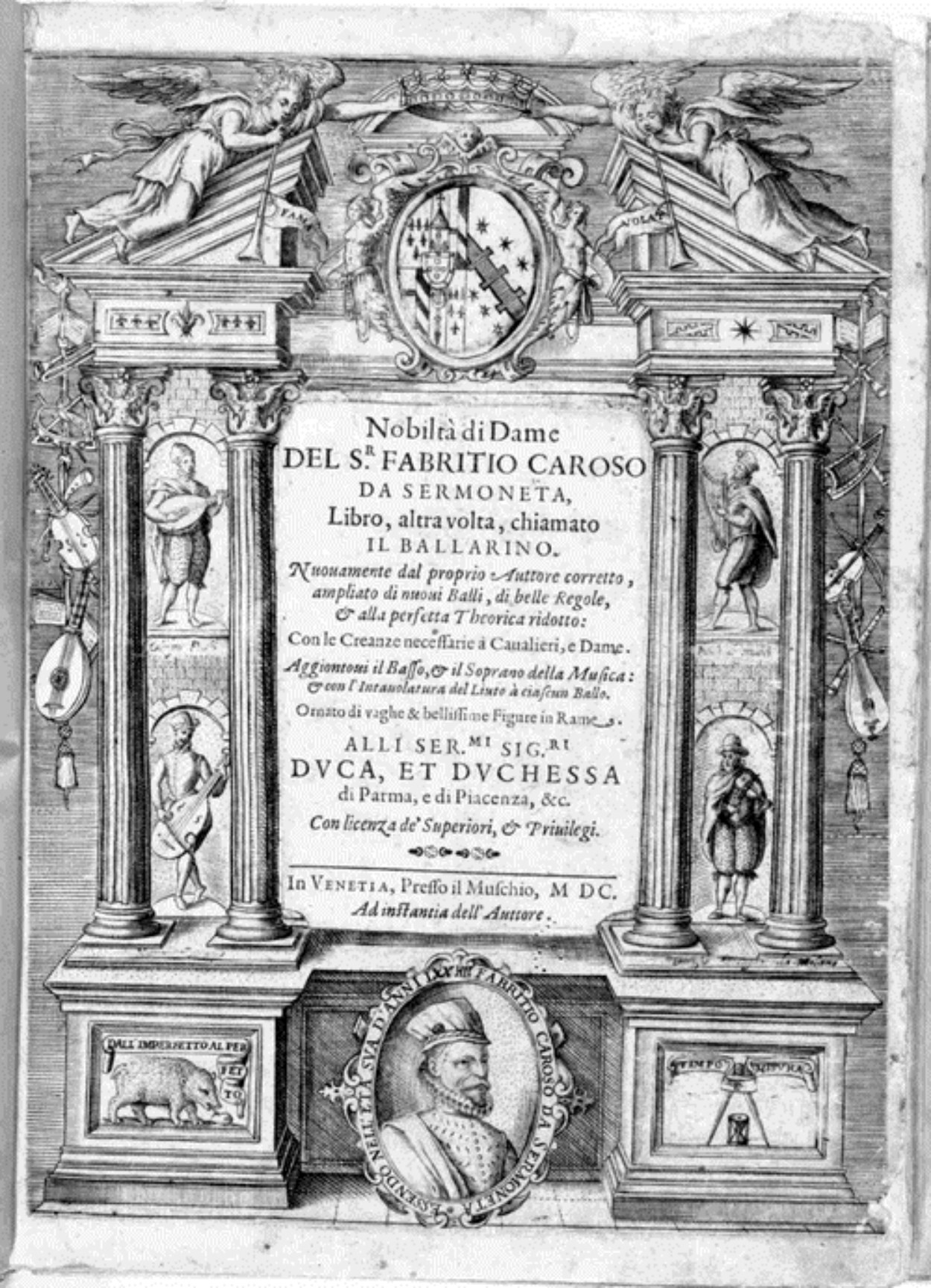
This is one of 208 woodcut plates from Fabritio Caroso's *Nobiltà di Dame* (Venice, 1600), a definitive manual of Italian Renaissance court dance. Rather than depicting a performance or a social gathering, it functions as a visual record of choreographic structure—a frozen moment in a formal courtly dance showing the disposition and dress of the dancers. Caroso's work was the most influential dance manual of its era, circulated throughout European courts and reprinted repeatedly; it codified the steps, figures, and courtly etiquette of the dances that defined Renaissance aristocratic life. This plate belongs in a dance history collection not as a picture of entertainment but as a primary source document—a didactic image meant to teach both the dance itself and the visual vocabulary of court nobility.
How to look at it
Read this image as choreographic notation, not as a moment of performance. The artist has posed the dancers in a formation state—the stance you would hold at the beginning of a figure or between phrases. Notice the formal symmetry and the deliberate positioning of the hand-holds; this is how Renaissance dancers organized themselves spatially. The costume detail matters: the man's short tunic and bare legs were essential to showing that a male dancer's movement came from the legs and feet, not from the torso; the women's long skirts were equally essential, showing that their movement was composed, the silhouette controlled. The blank background removes all distraction—this is a technical diagram dressed in the language of courtly elegance.
The artist
Fabritio Caroso da Sermoneta (c. 1526–after 1605) was the most celebrated dance master of the late Renaissance Italian court. He served major courts including the Medici in Florence and achieved international fame; his dance manuals were translated and reprinted across Europe. Caroso distinguished himself by publishing detailed, illustrated instructions for dances, moving beyond earlier manuals that documented steps in text alone. His *Il Ballarino* (1581) was the first edition; *Nobiltà di Dame* (1600) was a thoroughly revised and expanded second edition, reflecting shifts in fashion and the increasing formality of court dance by the century's end. His work is foundational to modern reconstruction of Renaissance dance.
The period
In the late 16th and early 17th centuries, dance was a central courtly accomplishment, essential to aristocratic identity and marriage negotiation. The dances depicted in Caroso's manuals—Pavanes, Galliards, Branles, and others—were performed at banquets, celebrations, and formal court ceremonies across Italy, France, and the Holy Roman Empire. By 1600, the date of this edition, the center of dance innovation was shifting toward the French court and the emerging ballet de cour, though Italian courtly practice remained prestigious. The turn of the century also saw increasing codification and formalization of court etiquette; Caroso's manual reflects this trend toward explicit documentation of 'noble' behavior. Woodcut printing was declining in prestige by 1600 relative to engraving, but remained the economical choice for large illustrated manuals intended for practical use rather than aesthetic display.
Where it lives
This plate comes from *Nobiltà di Dame*, a printed book published in Venice in 1600 and held in the Library of Congress. The work is one page in a sequence of 208 woodcut illustrations designed to accompany Caroso's written choreographic descriptions and commentary on noble dancing.
Dance in this work
Questions about this work
What dance are they doing?
The plate does not depict a dance in action; it shows the formal stance and arrangement of dancers at rest in formation, likely at the opening of a Pavane or Allemande. Without the accompanying text on the facing page, the specific dance cannot be identified with certainty. The image is part of a choreographic manual, so it functions as a notational diagram rather than a performance scene.
Why are the man's legs bare?
In Renaissance court dance, male dancers wore short tunics that exposed the leg and calf to allow for visibility of the footwork and the controlled, precise movement that demonstrated skill and status. The legs were essential visual evidence of a dancer's ability. The women's long skirts, by contrast, draped to the floor, conveying modesty and a composed, processional movement style.
Who would have used this book?
The *Nobiltà di Dame* was created for courtiers—noblemen and noblewomen who needed to learn the dances performed at court occasions, and for dance masters who taught them. Copies circulated among Italian courts and were exported to France and the German territories. A reader with access to this book and knowledge of dance could study the illustrations alongside Caroso's written instructions and reconstruct the choreography.
How do we know these are Renaissance dancers?
The costume—the woman's long gown with geometric embroidery, the man's short pleated tunic and feathered hat, the formal headdresses and veils—is specifically Italian court fashion of the late 16th and early 17th centuries. Caroso's text and the publication date confirm the period. The style of woodcut and printing also supports a date around 1600.
More Notation/Choreography artwork