49 works in this view — arrow keys or swipe to move between them.
Dance in Art
Caroso Nobiltà — Dance Plate (plate 35)
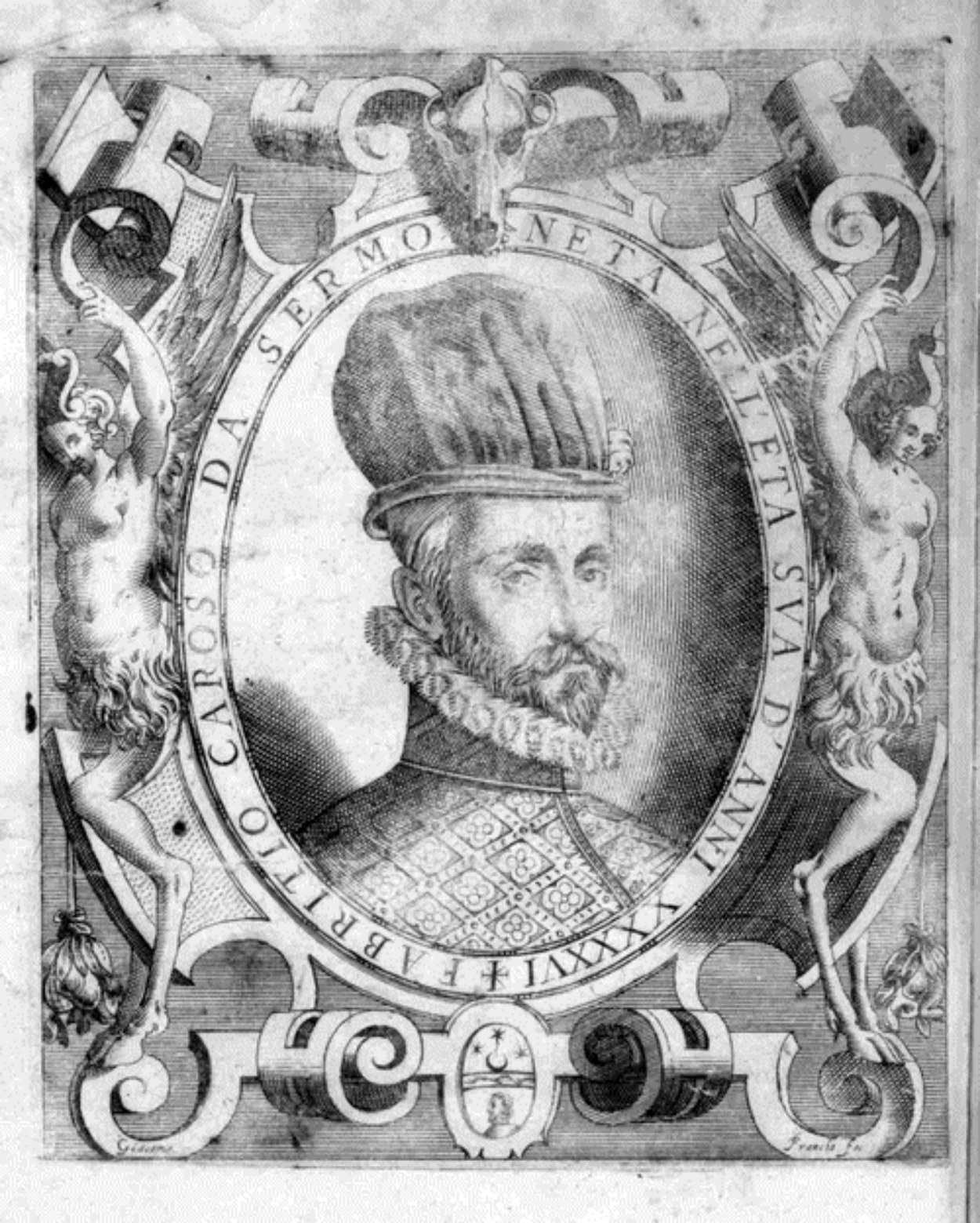
Fabritio Caroso da Sermoneta
- Medium:
- Woodcut
- Dance:
- Notation/Choreography
- Era:
- Pre-1700 (Renaissance/Baroque)
- Collection:
- Nobiltà di Dame (1600)
- Source:
- Library of Congress
- Rights:
- Public domain — free to use, share and adapt.
- Recorded as:
- Public Domain
Caroso's *Nobiltà di Dame* is one of the two most complete written and illustrated records of Renaissance dance technique to survive; this plate preserves not only the appearance of dancers and dress but the philosophy of approach, proportion, and courtliness that governed how Renaissance elites moved in relation to one another. For historians of dance, Renaissance art, and court culture, Caroso's plates are primary sources for understanding the grammar of the body in ceremonial social space.
What you are looking at
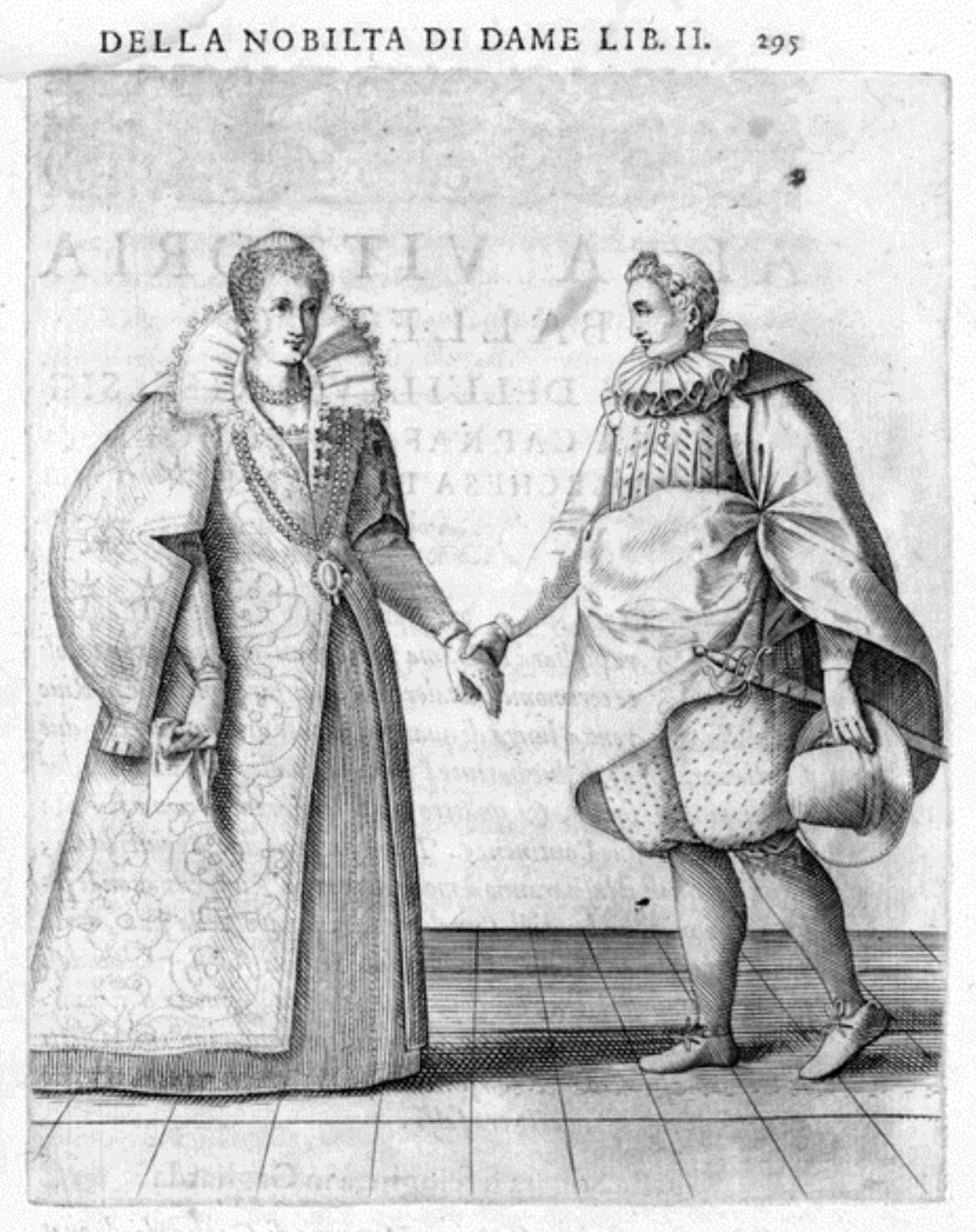
A woodcut depicting a moment of courtly greeting or negotiation between two figures in elaborate Renaissance Italian court dress. On the left stands a woman in a richly patterned gown with a high-necked embroidered bodice, small ruff collar, and a voluminous cloak or cape lined and edged in dark fabric, her hair styled close to the head in period fashion. On the right, a man in hose, doublet with ornate banding, a large ruff collar, and a dark cape trimmed with fur holds her hand in a formal gesture. Their bodies are angled toward each other, creating a diagonal composition across the wooden floor. The figures' posture and hand-holding suggest an opening to a paired dance or a formal salutation preceding one—the gesture is restrained and courtly rather than an active dancing position. The engraving's fine cross-hatching renders the textures of fabric with precision; the plain background and simple floor-line anchor the figures without distraction.
The dancing
Both dancers stand upright with weight evenly distributed, neither in the lunging or lifted frame of active choreography. The woman's left hand rests gently in the man's right, a formal engagement rather than a closed or promenade hold. Their bodies are not yet in motion but poised—the man's stance slightly forward, the woman's more reserved. The geometry of their positioning and the restraint of their gesture suggest the opening moment of a paired dance form, possibly a processional or basse danse derivative, where decorum requires the initial approach be measured and the connection subtle. No footwork is discernible; this is the moment before the dance begins.
The dance depicted
This plate depicts the opening courtesy and hand-engagement that precedes Italian court dances of the late sixteenth and early seventeenth centuries. The work comes from Caroso's *Nobiltà di Dame*, the definitive text of Italian Renaissance dance practice revised for the court of Marie de' Medici (Christine of Lorraine). Caroso's choreographies emphasize the nobility and grace expressed through approach, salutation, and paired progressions—all enacted through formal posture and measured steps. The image likely illustrates the moment of *salutatio* or opening engagement before the actual dance begins, a convention crucial to understanding Renaissance paired forms. The composed restraint and mutual regard between the figures embodies Caroso's philosophy that dance is a language of courtesy and social bond, not merely motion.
How it was made
A woodcut executed with fine cross-hatching to achieve subtle modeling of form and textile detail. The technique is capable of both crisp outlines and nuanced shading, as seen in the rendering of the woman's draped cloak and the man's furred cape. Woodcut allowed for relatively economical mass production and wide circulation; this plate would have been integrated into the printed text as both illustration and choreographic documentation. The precision of the engraving suggests it was cut by a skilled craftsperson working from a design; the fidelity to period dress and the anatomical naturalism indicate the artist understood both court fashion and the body's capability.
About this work
This is a woodcut plate from Fabritio Caroso's *Nobiltà di Dame* (Venice, 1600), depicting the formal opening moment of a paired Italian court dance. The image shows a nobleman and noblewoman in full Renaissance regalia, their bodies composed and poised as they make initial hand-contact—the salutation that precedes the dance proper. Caroso's revised treatise, issued at the turn of the seventeenth century and dedicated to Marie de' Medici, established the vocabulary of Italian Renaissance dancing for the courts of Europe. This plate serves both as choreographic record and as an emblem of dance's function in Renaissance court life: the formalization of social encounter through bodily discipline, costume, and mutual regard.
How to look at it
Observe the precision of the hand-engagement and the geometry of the bodies' relation: nothing is casual or accidental. The woman's reserved posture and the man's slight forward inclination establish a social hierarchy and courtesy that would have been read by contemporary viewers as fundamental to the dance's meaning. Note the clothing: the wealth of fabric, the small ruff, the fur trim, and the patterned hose all signal rank and investment in appearance. The floor-line and the empty background direct attention entirely to the pair and their opening moment. This is not action frozen in time but a prepared position held for the camera, so to speak—a teaching image meant to be studied and replicated.
The artist
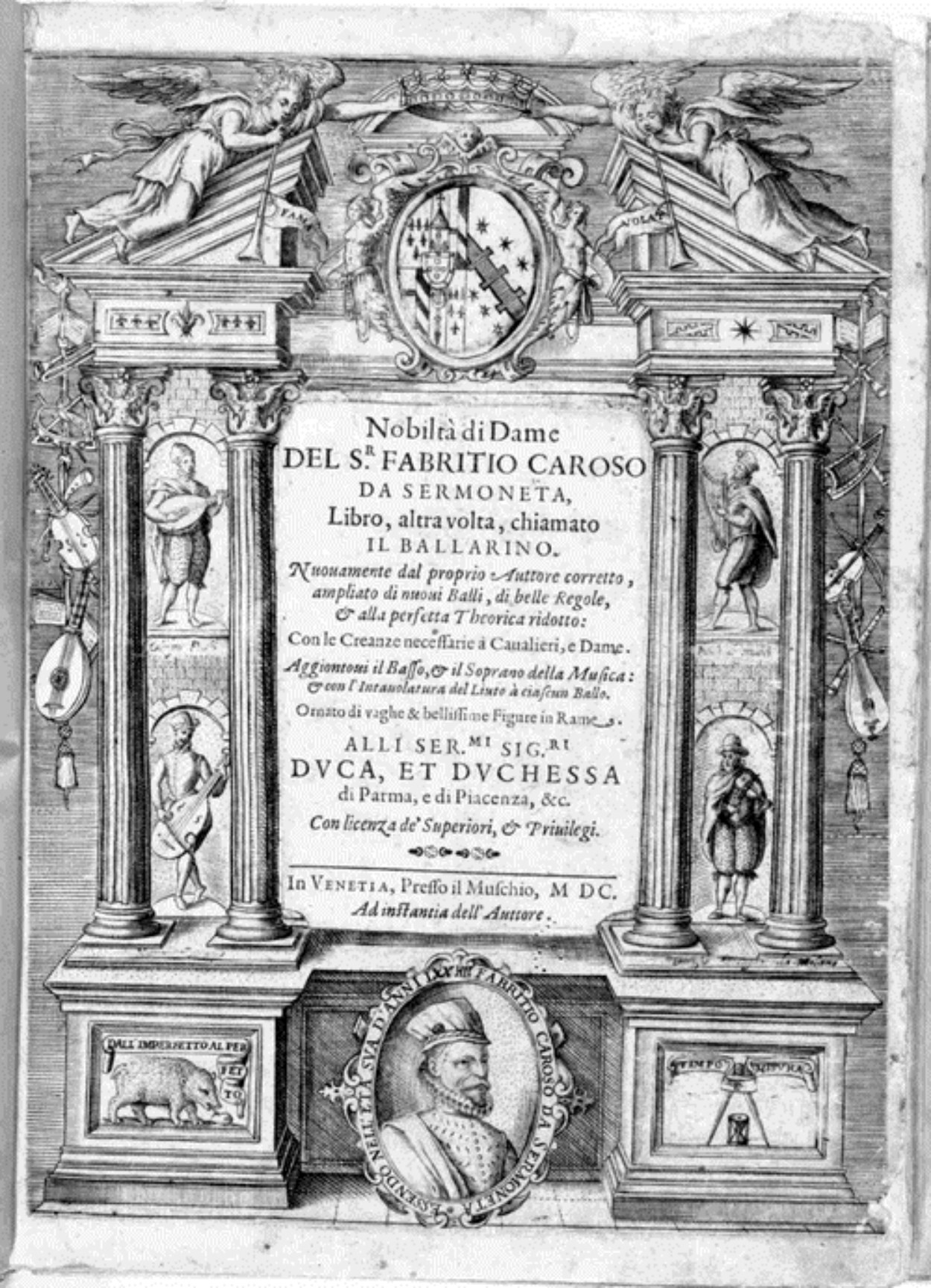
Fabritio Caroso da Sermoneta (c. 1525–c. 1605) was a master dancer and choreographer active in Rome and at the courts of Italy and France. He is known for two treatises: *Il Ballarino* (Venice, 1581), the first comprehensive manual of sixteenth-century Italian dance, and *Nobiltà di Dame* (1600), a substantially revised and enlarged edition that incorporated developments in court practice over two decades and reflected the tastes of the French court where Caroso spent his later years. Both texts combine precise verbal descriptions of steps and patterns with woodcut illustrations of pairs or groups in costume, making them among the most valuable documents of Renaissance choreography. Caroso's treatises were studied and imitated across Europe and remained in circulation well into the seventeenth century.
The period
The Renaissance dance documented by Caroso flowered in the Italian courts of the fifteenth and sixteenth centuries and spread throughout Europe as a marker of courtly refinement. By 1600, when *Nobiltà di Dame* was published, the style was entering its final phase; French and English courts were developing their own variants, and the Baroque court dances (minuet, bourrée, gavotte) were beginning to codify. Caroso's treatise captured a moment of transition: the mature Renaissance style at the moment before it would be absorbed into and transformed by Baroque practice. The plates themselves—engraved with the precision and elegance of contemporary portraiture—reflect the high cultural status accorded to dance in court life; dance manuals were luxury objects, and the illustrations were as important to their prestige as the text.
Where it lives
This woodcut is a plate from *Nobiltà di Dame*, the 1600 Venice edition. It appears in the Library of Congress collection. The plate is one of a series illustrating dance patterns and paired formations; this specific image carries the page number 295 and represents one moment within Caroso's systematic documentation of Renaissance choreography.
Dance in this work
Questions about this work
How do I know this is a dance and not just a formal portrait?
The caption and context identify it as a dance plate from Caroso's manual, and the hand-engagement and postural relationship between the figures are specific to the opening of a paired dance form. Caroso's treatise distinguishes choreographic moments and records them in sequence; this image is part of a choreographic narrative. The figures' precise positioning and the formality of their address are meant to be read as codified movement, not portraiture.
What happens next in the dance?
Caroso's text would have followed this plate with written descriptions of the steps and patterns to follow—likely a progression forward, possibly with turns or figure-eights, and with variations in tempo and weight. The specific choreography depends on which dance is being illustrated; Caroso documents many variants. Readers would have referred to the text and the image together to reconstruct the full sequence.
Could this be any other Renaissance dance form?
Caroso documented numerous paired forms—pavane, galliard, volta, branle, and others—all of which begin with some form of salutation and hand-engagement. The specific form cannot be determined from this opening moment alone; one would need the caption or surrounding pages to know which choreography is being illustrated. The opening courtesy was, however, a consistent feature across many Renaissance paired dances.
Why is the woman's cloak so elaborately rendered?
Costume was as central to Renaissance dance as technique; the cloak, ruff, and jewels signaled rank, wealth, and the occasion's formality. Caroso's illustrations preserve a record of what dancers wore, which shaped how they moved—the weight and drape of heavy fabric affected posture, arm carriage, and the mobility of the lower body. The artist's attention to costume is part of the choreographic document.
More Notation/Choreography artwork