49 works in this view — arrow keys or swipe to move between them.
Dance in Art
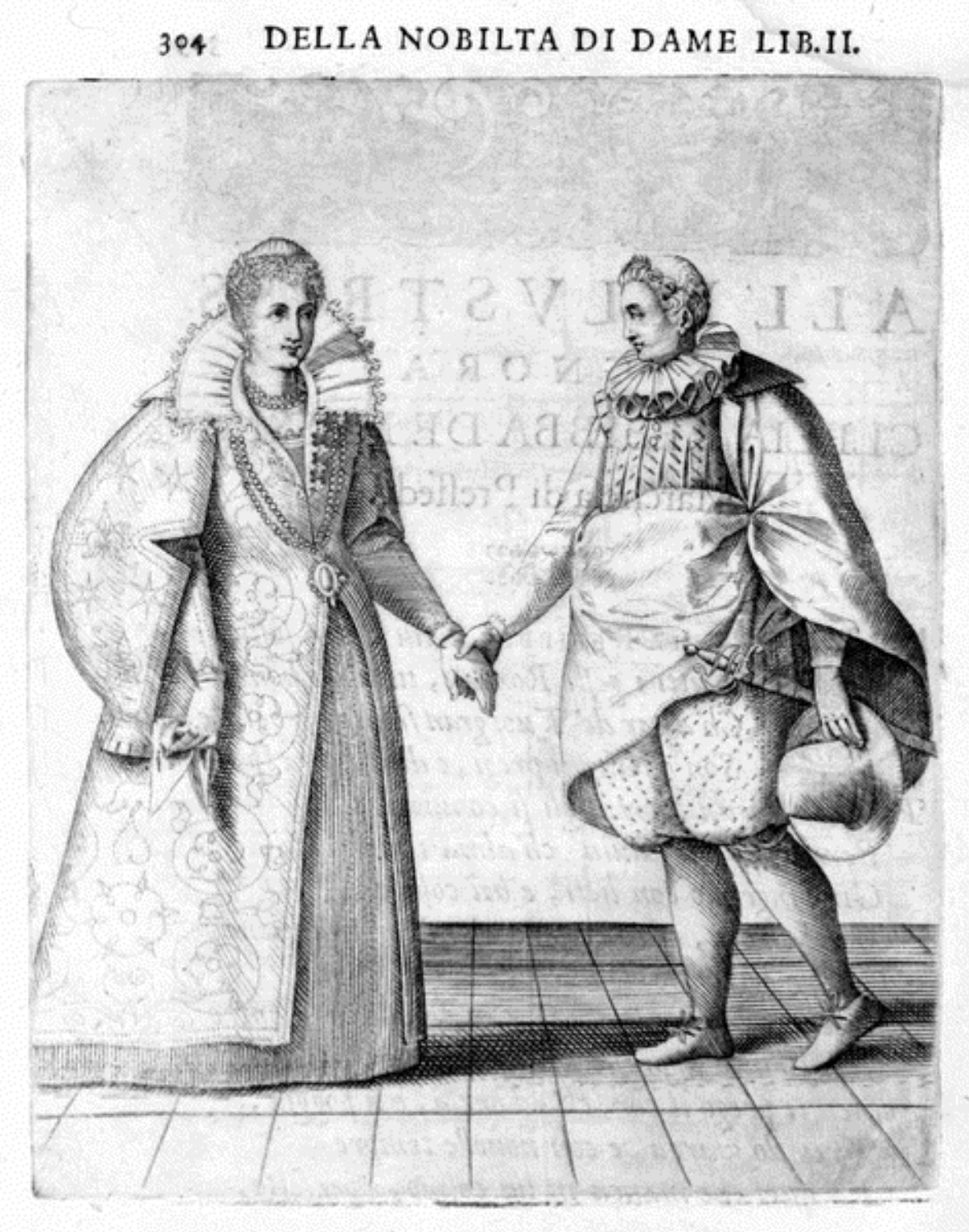
Caroso Nobiltà — Dance Plate (plate 36)
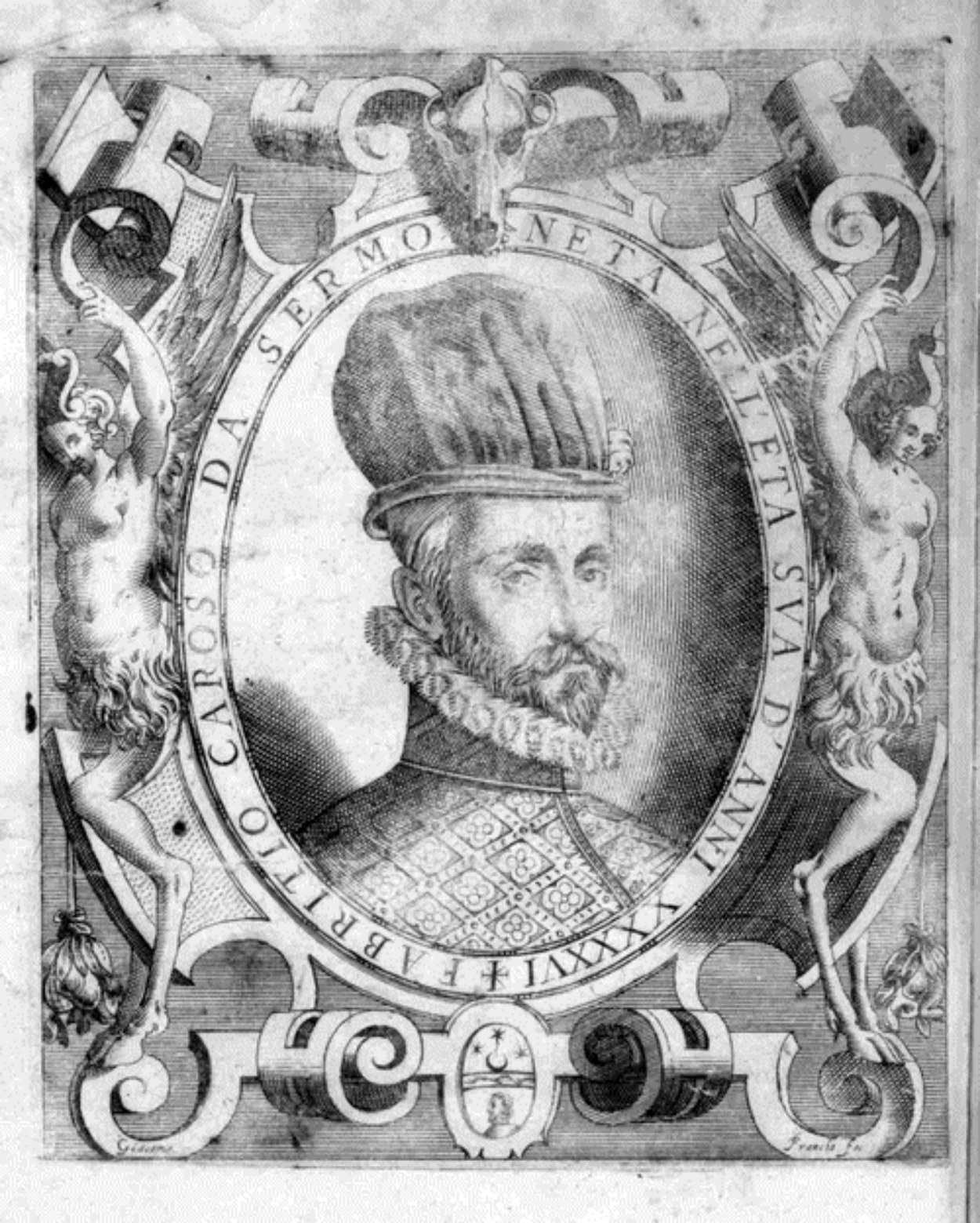
Fabritio Caroso da Sermoneta
- Medium:
- Woodcut
- Dance:
- Notation/Choreography
- Era:
- Pre-1700 (Renaissance/Baroque)
- Collection:
- Nobiltà di Dame (1600)
- Source:
- Library of Congress
- Rights:
- Public domain — free to use, share and adapt.
- Recorded as:
- Public Domain
For historians of Renaissance dance and dress, this plate is primary evidence: it shows the actual partnering position, costume, and physical frame of the most influential court dance tradition of its era. For readers of dance notation and choreographic history, Caroso is the earliest major Italian source in which social dances are recorded with precision sufficient to reconstruct steps and timing; this image shows what the written instructions were teaching. For visual culture historians, it documents the moment when dance instruction entered print as a commodity and a claim to authority.
What you are looking at
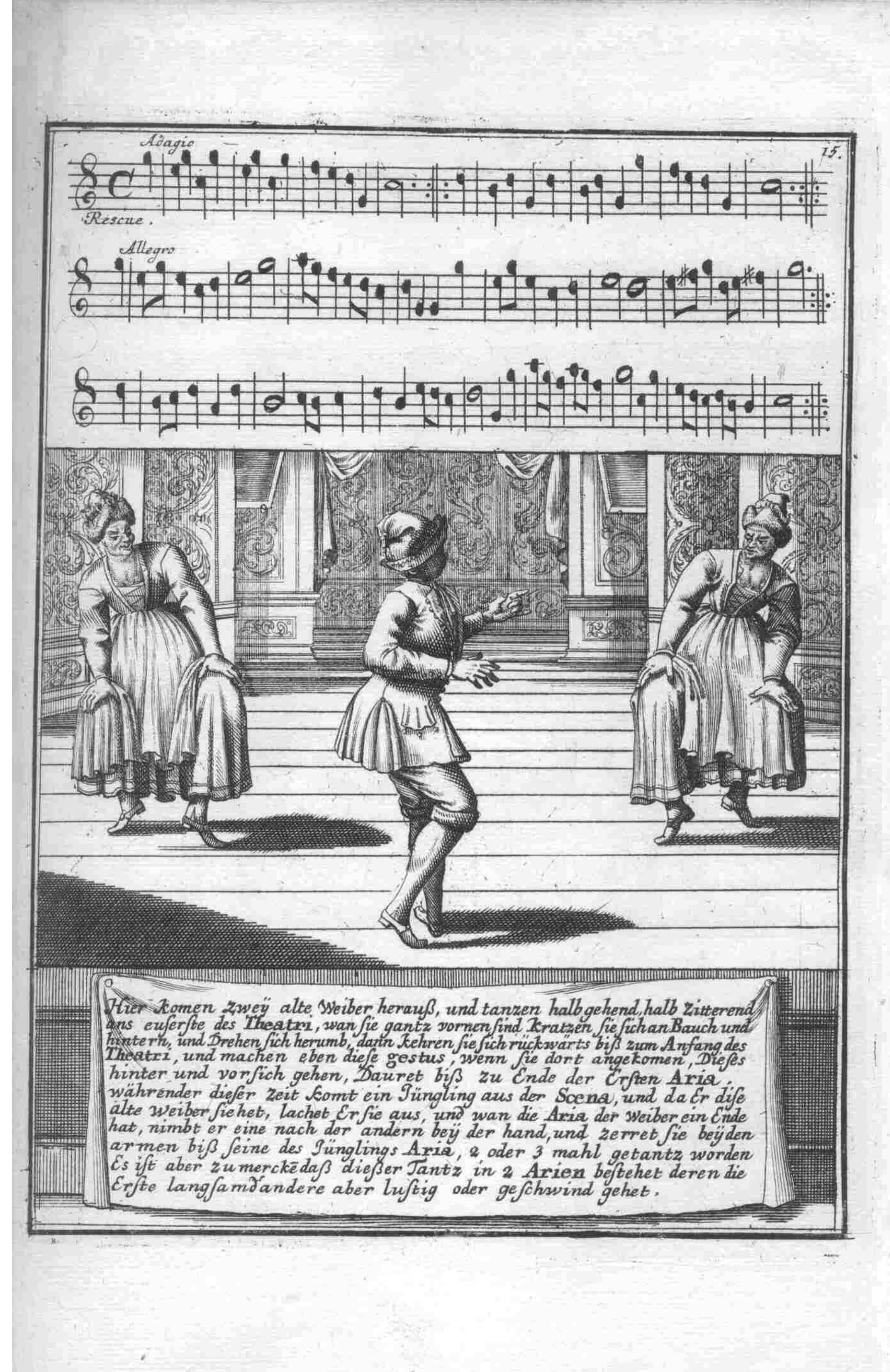
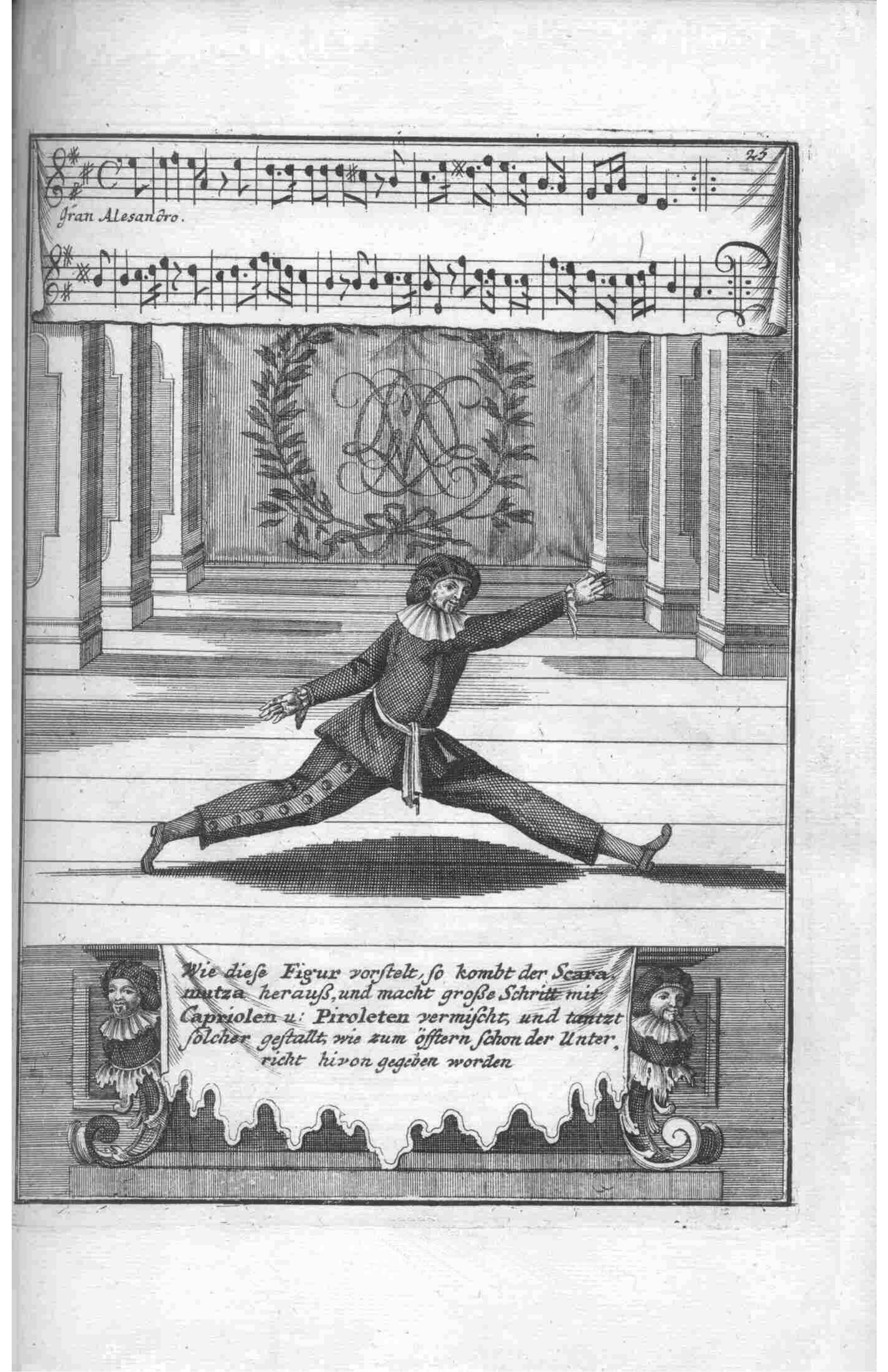
A woodcut depicting a pair of noble dancers in early 17th-century Italian court dress, standing in a composed confrontational pose on a tiled floor. The figure on the left wears an elaborate gown of patterned fabric with a high collar, a voluminous cloak lined in white fur draped from the shoulders, and an ornamental chain. The figure on the right wears a doublet with vertical ribbing, padded breeches, and a similar fur-lined cloak. Both wear the elaborate neckwear (ruffled collars) characteristic of the period. Their hands are joined or nearly joined at chest height, and their bodies are turned to face one another in a formal, measured posture. The composition is frontal and symmetrical, emphasizing the courtly ritual of the encounter rather than dynamic movement. The background is plain, focusing attention entirely on the figures and their relative positioning.
The dancing
Both figures stand upright with knees slightly bent, neither bearing weight heavily on a single leg. The hands approach but do not clasp firmly—a delicate reaching or gentle touch rather than a secure hold. The arms are extended forward at approximately waist to chest height, creating an open frame between the bodies. The shoulders are held back and the torsos remain relatively still; there is no suggestion of the weight shifts and body sway that characterise later ballroom forms. The posture is that of two people meeting and acknowledging one another in a formal dance, ready to proceed but captured in a moment of presentation and greeting.
The dance depicted
This is a dance from the Italian Renaissance court tradition, almost certainly one of the paired figures dances described and notated in Caroso's own choreographies. The positioning and dress place it within the early-17th-century Italianate court dance world. Caroso's *Nobiltà di Dame* codified and illustrated the sophisticated social dances of the Renaissance Italian court—forms like the pavane, galliard, and volta that required precise steps, careful partnering, and courtly bearing. The plate shows the opening stance of such a dance: two partners presenting themselves, establishing the formal frame and decorum that would govern the movement to follow. This is a teaching image as much as a record of performance.
How it was made
This is a woodcut, a relief printing technique that allowed Caroso's choreographic instruction to reach a wide audience of dancing masters and noble practitioners across Europe. The medium's bold lines and high contrast make the figures' costume details and formal arrangement instantly legible, which was essential for a choreographic manual. Woodcut's relative economy compared to engraving made the production of an illustrated book feasible, and its durability allowed many impressions to be pulled. The technique sacrifices the fine tonal gradation of engraving but gains immediacy and clarity—appropriate for a practical instructional document rather than a work of fine art.
About this work
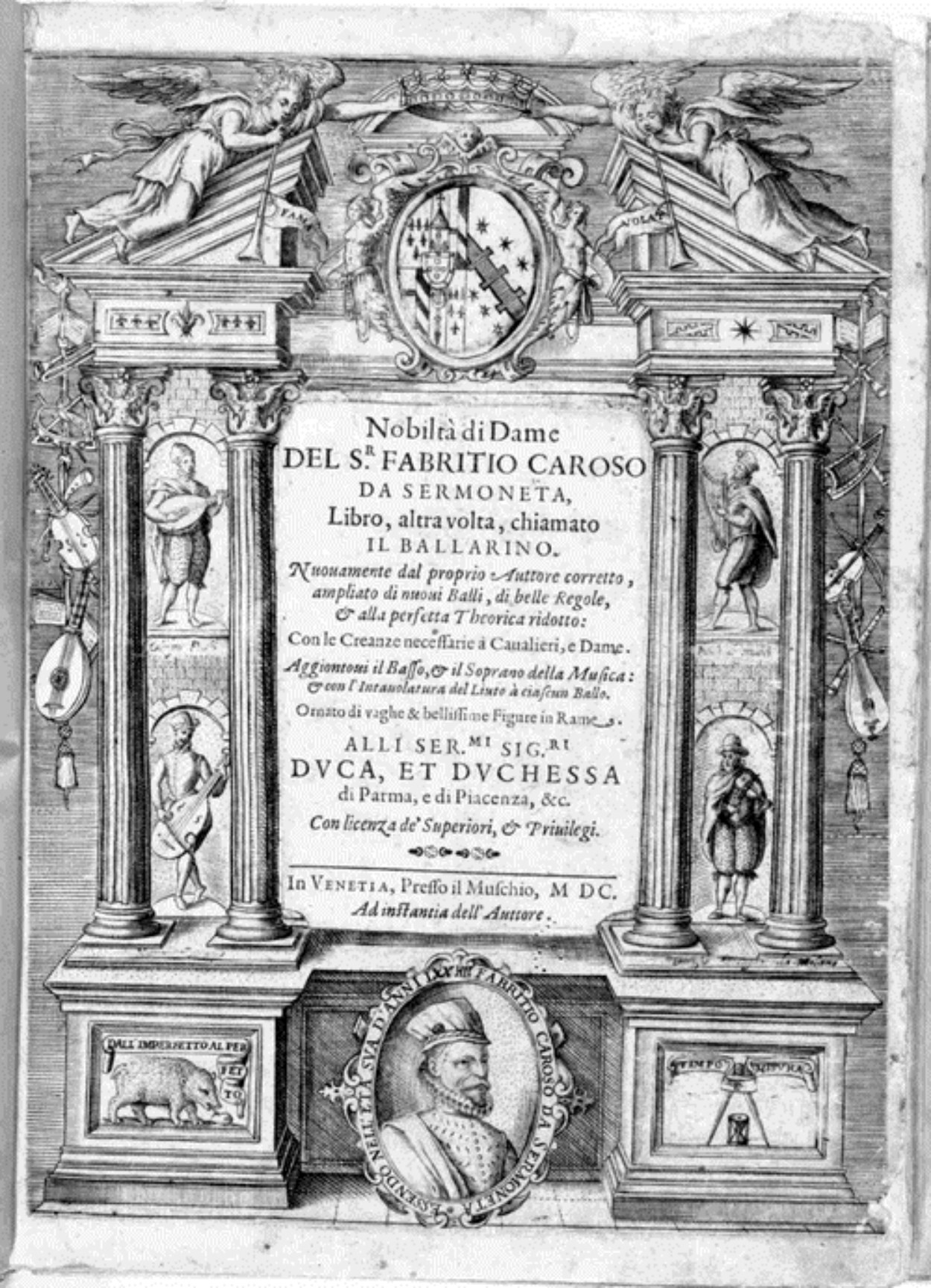
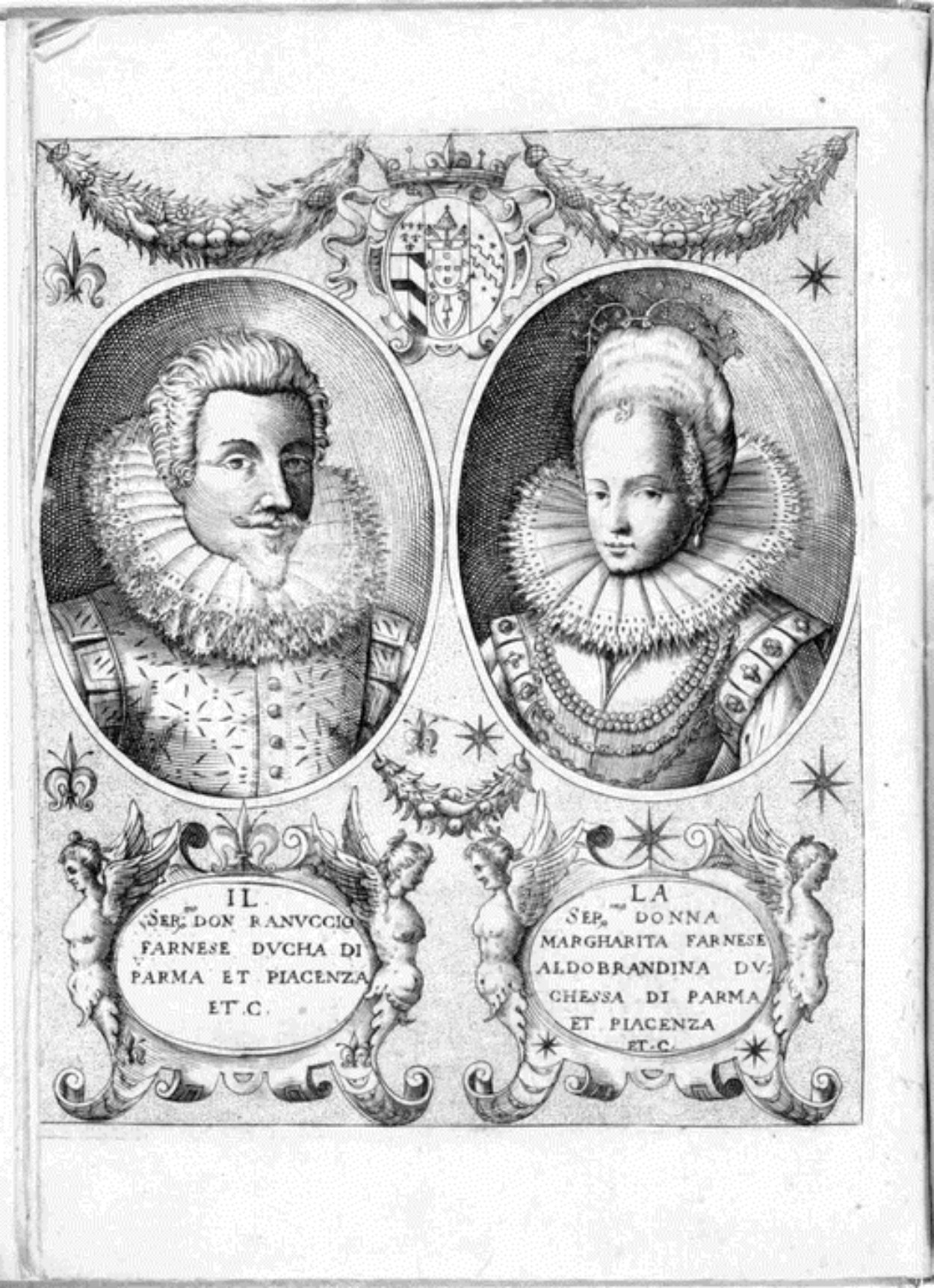
This is a page from Fabritio Caroso's *Nobiltà di Dame* (Venice, 1600), one of the most influential treatises on Renaissance Italian court dance. It depicts the opening position of a paired dance, showing a noblewoman and nobleman in formal court dress, facing one another with hands nearly joined. The plate is neither a portrait nor a scene of ballroom festivity, but a didactic image: Caroso used such figures to teach the steps, holds, and bearing required of dancers in the sophisticated courtly tradition he helped codify. The image is a link in a chain of transmission—from Caroso's choreographic notation and description to this woodcut to the dancing master's students across Italy and Europe.
How to look at it
Attend to the careful asymmetry within the symmetrical composition: the woman's cloak and the man's breeches are shaped differently, but both wear the markers of nobility and court status. Notice the precise distance between the dancers' hands—close but not grasped—which was the proper decorum of social dance; a firmer embrace would have been improper. The standing posture, with the slight forward tilt and bent knees, is not casual; it is the disciplined frame from which Caroso's choreographed steps would begin. The woodcut's clear lines allow the eye to read the exact angle of the arms and the relationship of the bodies, which is the whole point of the image.
The artist
Fabritio Caroso da Sermoneta (c. 1526–1605) was a celebrated Milanese dancing master and choreographer who spent much of his career in Rome. He published *Il Ballarino* in 1581, an early printed choreographic treatise with woodcuts, and revised and expanded it as *Nobiltà di Dame* in 1600, dedicated to Christine of Lorraine (Queen of France). Caroso was not primarily an artist or engraver; the plates were executed by professional woodcutters working from his descriptions and, presumably, from his demonstration or choreographic notation. His reputation rested on his skill as a dancer, teacher, and inventor of dances, and on his ability to capture and transmit that knowledge through the hybrid form of text, notation, and image.
The period
In the 1600s, Italian court dance was at the height of its international prestige. The Renaissance forms—pavane, galliard, volta, and dozens of named balli—were the language of courtship, diplomacy, and noble display across Europe. Dance instruction was increasingly professionalized and formalized; the publication of choreographic treatises (Caroso's, the earlier Orchésographie of Thoinot Arbeau, and later the French court dances) made dance a matter of written record as well as embodied tradition. At the same time, dance in Italy was beginning to move toward the theatrical: the early ballet forms would emerge in the 17th century. Caroso's *Nobiltà di Dame* represents the apogee of the social, paired-dance tradition before it ceded ground to theatrical spectacle.
Where it lives
This plate is from Fabritio Caroso's *Nobiltà di Dame*, printed in Venice in 1600. It is one of a series of paired-figure woodcuts in the treatise, each illustrating the opening stance or a moment from a specific named dance. The source listed is the Library of Congress, which holds copies of this and Caroso's earlier treatise.
Dance in this work
Questions about this work
Is this image showing a real dance or an invented pose?
It is showing a real opening position from Renaissance Italian court dances, but it is a didactic pose frozen for instruction rather than a moment captured from live performance. Caroso's treatises describe and prescribe steps, rhythms, and positions; this woodcut is part of that teaching apparatus. The dance itself would have involved steps, turns, and weight changes that this still image does not show.
What would these dancers do next?
That depended on the specific dance. From this opening position, Caroso's notation would prescribe a sequence of named steps—perhaps a forward and backward progression, a turn, a hop, or a more complex figure—performed in time to music. Different dances had different choreographies; a pavane involved stately forward steps, while a galliard incorporated jumps and aerial turns.
Was this kind of dancing still common in 1600?
Yes. Caroso's *Nobiltà di Dame* was a revised and expanded edition of his 1581 *Il Ballarino*, and the dances it described were still the standard courtly and noble practice in Italy and across Europe. However, theatrical dance and the early forms of ballet were beginning to emerge in Italy during this period, and within a generation or two, the social paired dances would cede ground to those new forms.
How do I read Caroso's notation for the actual steps?
Caroso used a verbal and symbolic notation system that differs from modern dance notation; it names positions and movements (reverenza, saltarello, passo, etc.) and describes rhythm. The text of *Nobiltà di Dame* explains the notation and describes each dance by name. Modern scholars of Renaissance dance have translated and reconstructed Caroso's choreographies into formats that practitioners can learn from.
More Notation/Choreography artwork