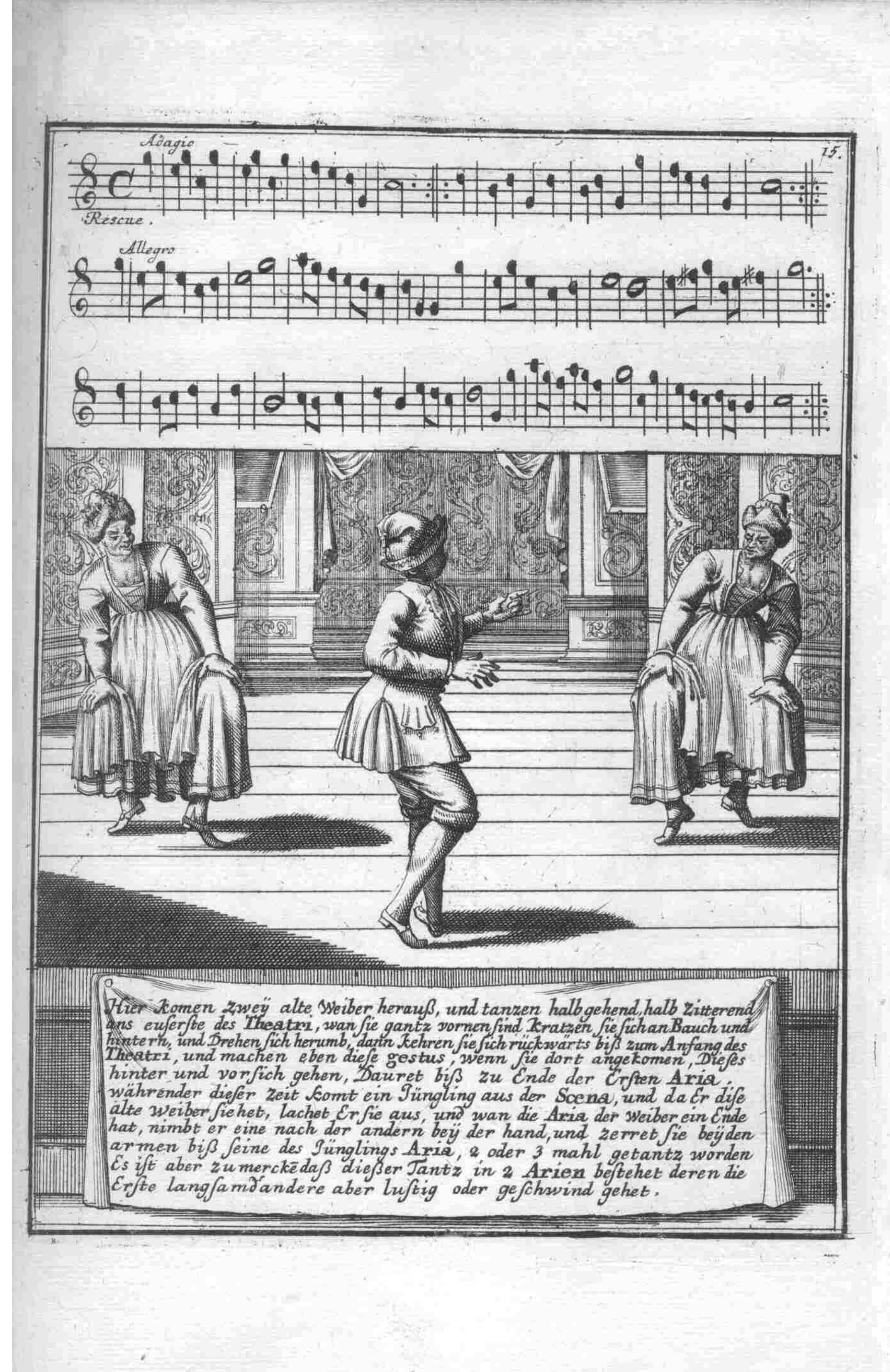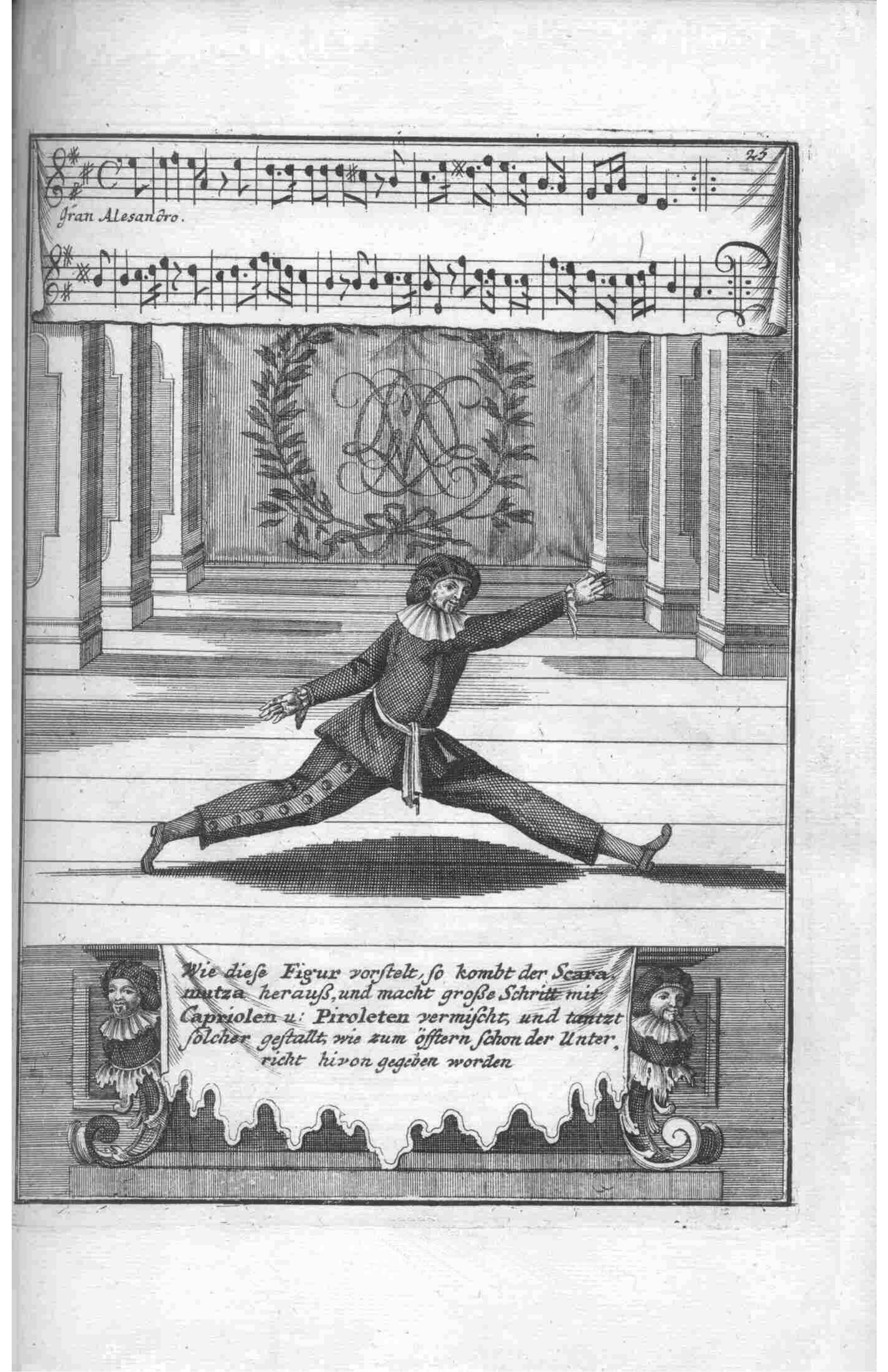
49 works in this view — arrow keys or swipe to move between them.
Dance in Art
Acrobatic — Plate 76
Gregorio Lambranzi
- Medium:
- Copper-plate engraving
- Dance:
- Notation/Choreography
- Era:
- 1700s (Enlightenment/Minuet Era)
- Collection:
- Nuova e curiosa scuola de' balli theatrali (1716)
- Source:
- Library of Congress
- Rights:
- Public domain — free to use, share and adapt.
- Recorded as:
- Public Domain
Lambranzi's manual is nearly the only surviving source for choreographed theatrical dance in this period and region. This plate specifically documents acrobatic and prop-based performance, genres that rarely appear in dance notation and that shaped theatrical entertainment for centuries. For historians of acrobatics, circus performance, and theatrical dance, and for dancers seeking historical precedent for prop work and genre-blending, this is primary evidence.
What you are looking at
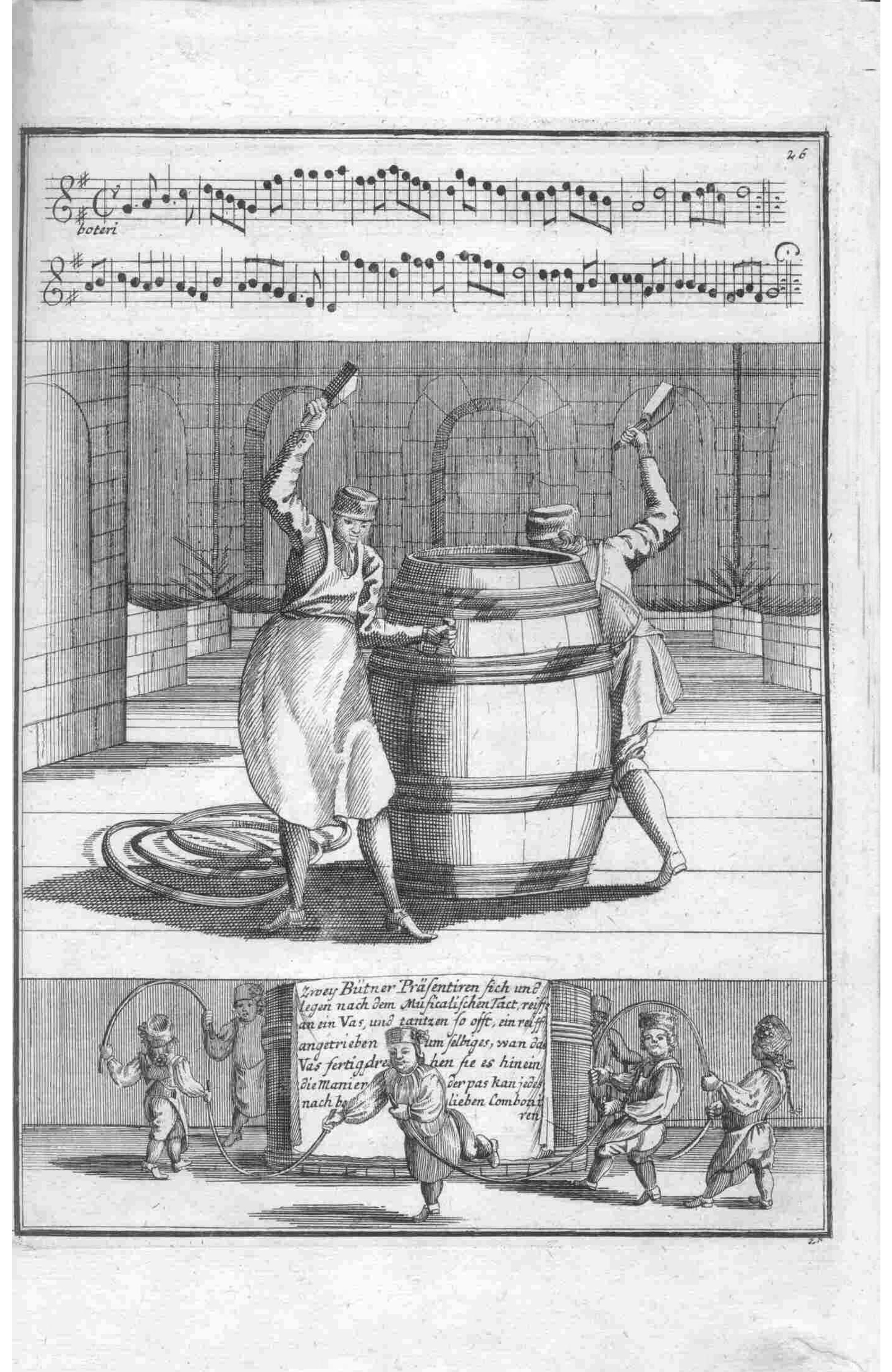
A theatrical stage scene showing a solo dancer in a curtained interior, performing with a large barrel as the central prop. The dancer wears period costume—a light-colored dress with long sleeves and a decorative hat—and is captured mid-movement with arms raised dramatically, one holding what appears to be a stick or baton. The barrel sits prominently at center stage, rendered in careful perspective with visible wooden bands. A coiled rope lies on the floor in the foreground. The setting is defined by vertical striations suggesting wooden wall paneling, with an arched doorway visible in the background. The engraving renders the scene with fine crosshatching and meticulous line work characteristic of early 18th-century copper-plate technique. Above the main illustration, two staves of notated music occupy the upper portion of the plate, labeled "botteri" (possibly referring to the barrel dance or barrel-related choreography). Below the main scene, a smaller panel shows four child figures interacting with what appears to be a rope or cord, with German text in the center—likely a caption or verse explaining the dance.
The dancing
The principal figure stands with weight shifted, legs in an asymmetrical position suggesting dynamic movement rather than a posed stance. Both arms are elevated and extended outward, creating an open, expansive frame—one arm raised higher than the other in an asymmetrical, expressive gesture. The figure's posture suggests acrobatic or vigorous movement rather than the controlled verticality of ballet. The secondary figures in the lower panel are smaller and schematic, depicted in simplified outlines, appearing to engage in play or group interaction. The costume and the dramatic arm positions suggest training in theatrical or circus-related movement rather than court dance.
The dance depicted
This is a theatrical acrobatic or prop-based dance, likely a barrel dance or related novelty number from early 18th-century German or Italian theatrical tradition. The barrel serves as both prop and obstacle, suggesting the dancer performs tricks with or around it—a form of theatrical entertainment blending dance with acrobatic skill. Lambranzi's manual documents such pieces as theatrical curiosities, demonstrating the range of movement and entertainment available beyond courtly minuet or ballet. The notation at top indicates this was choreographed or at least formally notated, suggesting it held a recognized place in theatrical repertoire. The rope in the foreground and the smaller figures below may indicate variant forms or progressions of the same movement phrase.
How it was made
This is a copper-plate engraving, one of 102 plates in Lambranzi's 1716 manual. The technique allowed for fine detail and wide circulation in an educational context; copperplate engraving was the standard for illustrated dance instruction books of the period. The pairing of musical notation above with the illustrated figure below follows the convention of dance manuals, allowing readers to correlate movement phrase with musical phrase. The careful rendering of perspective, fabric texture, and spatial recession demonstrates high technical skill and suggests the work was aimed at a literate, affluent audience—musicians, dancers, theatrical professionals, and educated patrons with access to expensive printed books.
About this work
This engraving documents a theatrical acrobatic dance with a barrel prop from Gregorio Lambranzi's influential 1716 manual of theatrical dances. Lambranzi's *Nuova e curiosa scuola de' balli theatrali* (New and Curious School of Theatrical Dances) assembled 102 choreographed pieces representing the full range of professional theatrical entertainment in German-speaking regions—from ballet and courtly dances to popular comic and acrobatic novelties. This plate belongs to that category of curiosities: a solo figure performing with a prop in a formally notated, choreographed sequence. The manual was reprinted and translated throughout the 18th century and remains one of the richest surviving documents of theatrical dance practice outside the court.
How to look at it
The artist has frozen the moment of maximum extension and gesture—the dancer's arms are fully raised, the body open and dynamic. This choice conveys the vigor and theatrical showmanship of the piece rather than a moment of balance or rest. The prominence and careful rendering of the barrel draws attention to the relationship between dancer and prop; note the dancer's position relative to it and the stance that suggests active engagement rather than passive decoration. The musical notation above invites comparison: reading the two together—note patterns and gesture—reveals how choreographic rhythm was understood to match musical structure. The secondary scene below (with children and rope) may document a progression or variation, inviting the question of whether this is a single dance or a family of related movements.
The artist
Gregorio Lambranzi (fl. early 18th century) was an Italian dancing master and choreographer active in Germany, particularly in Nuremberg. He compiled his manual *Nuova e curiosa scuola de' balli theatrali* drawing on his own teaching practice and the theatrical performances he encountered. The work represents the professional theatrical dance tradition of the German-speaking lands rather than French or Italian court practice, and its emphasis on novelty, variety, and popular entertainment distinguishes it from more conservative dance manuals of the era. The manual exists in two Italian editions (1716) and was later translated and reprinted in German and French, indicating its influence and the hunger for such documentation.
The period
In the early 18th century, theatrical dance in Germany was expanding beyond court ballet into public entertainment and popular theatrical forms. Minuet and courtly dances dominated fashionable ballrooms, but professional theaters and traveling entertainments drew on acrobatics, comic business, and novelty pieces aimed at broad audiences. Lambranzi's manual captures this dual world: it includes stately minuets and serious choreography alongside comic dances, character pieces, and acrobatic turns. Musically, the early 18th century saw dance notation systems developing (Feuillet notation was emerging as standard), and Lambranzi's pairing of notation with image represents an effort to preserve and teach choreography systematically. The emphasis on theatrical variety and popular appeal reflects the growing importance of commercial entertainment and professional performers distinct from court musicians and dancers.
Where it lives
This plate is from the 1716 Nuremberg edition of Lambranzi's *Nuova e curiosa scuola de' balli theatrali*, held in the Library of Congress collections. It is one of 102 numbered plates forming a systematic compendium of theatrical dances, each pairing notation with illustration and often accompanied by German verse or caption. The work circulated widely in the 18th century and was reprinted and translated, making it one of the most influential and accessible sources for dance history in this period.
Dance in this work
Questions about this work
What is the barrel for?
The barrel is the primary prop and obstacle in this choreography. The dancer performs tricks and movements in relation to it—possibly dancing around it, jumping over it, balancing, or using it as a pivot point. In theatrical acrobatic dance of this era, props served both as practical challenges testing the performer's skill and as visual novelties attracting audiences. The notation above would have specified the precise relationship of movement to prop.
Who danced these dances?
Lambranzi's dances were performed by professional theatrical dancers in public theaters, court spectacles, and traveling entertainments throughout German-speaking Europe. This particular piece—with its emphasis on acrobatic skill and novelty—was likely performed by specialized entertainers distinct from court ballet dancers, though the manual documents both registers. Lambranzi was a dance master, and the manual likely served his students and other professionals seeking to learn and teach choreography.
How do you read the music and dance together?
Each plate pairs Feuillet-style notation (or a related system) with an illustrated figure, allowing the dancer or reader to correlate the shape and timing of movement with the melodic and rhythmic structure of the music. The two staves of music at the top correspond to the phrase or phrases danced in the figure below. This was a teaching tool: by reading notation and image together, a musician-dancer could reconstruct the choreography and understand how movement matches musical structure.
Is this ballet?
No. Lambranzi's work documents theatrical dance broadly, including ballet and courtly forms, but this plate represents an acrobatic novelty or entertainment piece—a category distinct from ballet. Ballet in this period was primarily a courtly or courtly-influenced genre with a different movement vocabulary, training emphasis, and social function. Lambranzi captures the full theatrical ecosystem, which included this kind of virtuosic acrobatic work alongside more formal dances.
More Notation/Choreography artwork