49 works in this view — arrow keys or swipe to move between them.
Dance in Art
Negri — Dance Plate (plate 2)
Cesare Negri (il Trombone)
- Medium:
- Engraving
- Dance:
- Notation/Choreography
- Era:
- Pre-1700 (Renaissance/Baroque)
- Collection:
- Le Gratie d'Amore (1602)
- Source:
- Library of Congress
- Rights:
- Public domain — free to use, share and adapt.
- Recorded as:
- Public Domain
This is one of the primary documentary sources for how Renaissance court dance actually looked and was understood by dancers themselves. Negri's *Gratie d'Amore* is rarer and less widely circulated than Caroso, making reproductions of its plates essential for anyone studying the divergence between Venetian and Milanese dance traditions, or the evolution of court dance practice in the early 17th century. The engraving demonstrates that Renaissance dance was a systematized art form with precise rules of spacing, orientation, and deportment—knowledge that transforms modern attempts at historical reconstruction.
What you are looking at
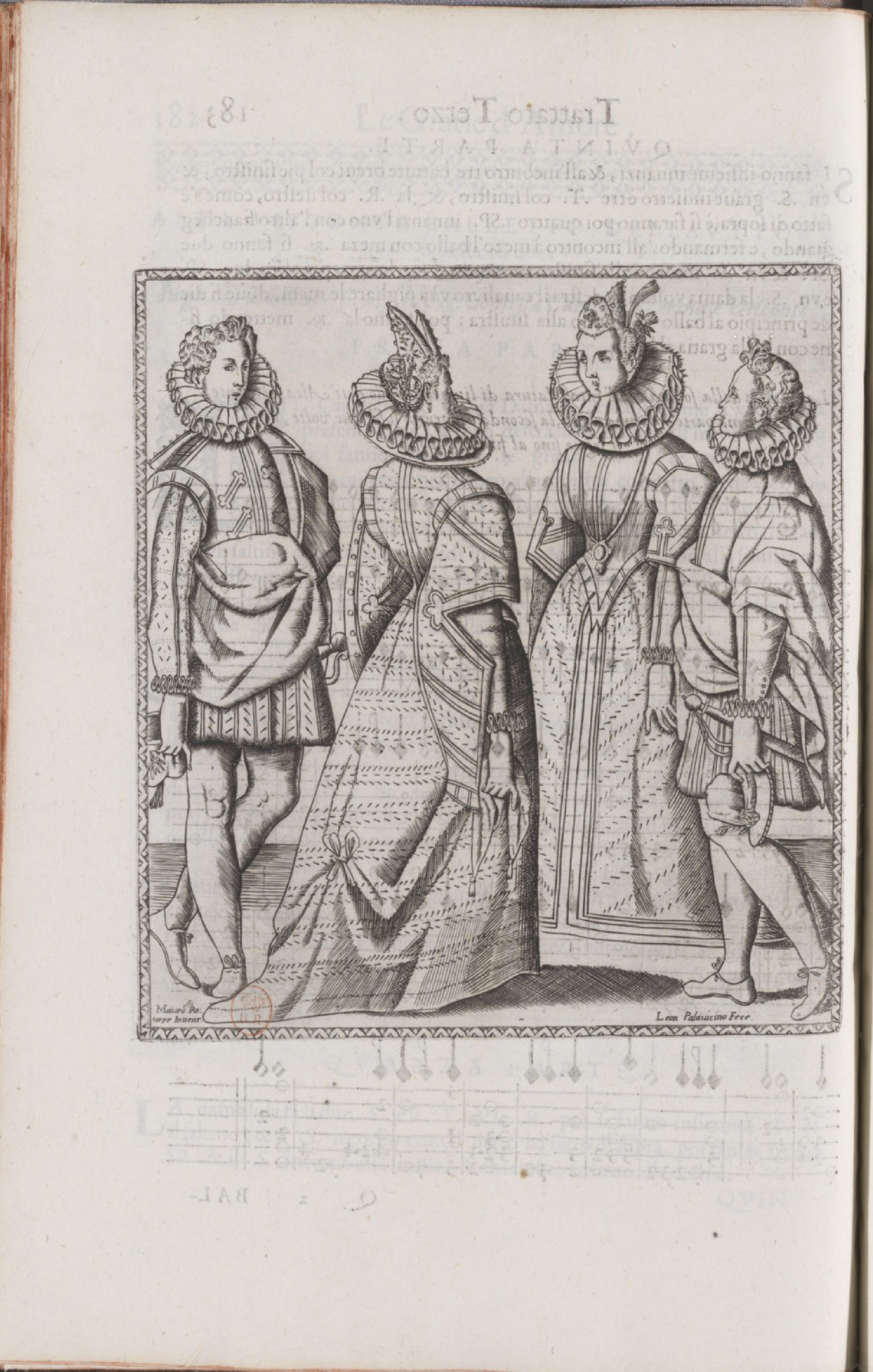
Four figures in elaborate court dress stand in formal arrangement against a plain background, framed by an ornamental border typical of Renaissance engravings. The two central figures are positioned closest to the viewer: a man in short doublet and hose with a distinctive plumed hat stands to the left; a woman in a full-length gown with geometric patterning stands to his right, her garment displaying the stiffened silhouette characteristic of early 17th-century court fashion. Two additional figures occupy the background, a man and woman similarly dressed, creating compositional depth. All four wear the high, deeply fluted ruffs and jeweled ornaments of the Milanese court. The engraving is finely detailed, with careful attention to textile patterns, pleating, and the jeweled decorations at throat and waist. The figures are arranged as if pausing in the middle of a dance or social interaction—poised rather than in violent motion, as befits a dance instruction manual.
The dancing
The foreground couple presents a formal, upright posture typical of Renaissance court dance. The man's weight appears evenly distributed, his stance open and forward-facing; the woman stands beside him with similar frontality, her body elongated by her fitted bodice and full skirt. Neither figure displays the extreme torque or contraposto of contemporary fine art portraiture. The spacing between the two foreground figures—close but not touching—and their parallel orientation suggest a side-by-side moment in a processional or coupled dance rather than an embrace or closed hold. The background couple mirrors this arrangement, establishing a repeating formal pattern. The overall impression is of controlled, geometric movement rather than energetic partnering.
The dance depicted
This is a plate from Cesare Negri's *Le Gratie d'Amore* (Milan, 1602), a foundational written and illustrated treatise on Italian court dance of the late Renaissance. Negri taught the dances of the Milanese court and other Italian courts; his work systematized and documented the geometric, processional dances that dominated courtly social life—primarily variations on the pavane, galliard, and related forms. The image illustrates an idealized couple (and backup pair) arranged as they would appear in such a dance, likely in the moment of a reverence (greeting), a natural pause, or a transition between figures. The formal dress and frontally-oriented bodies are consistent with the slow, stately character of the pavane or similar processional dances. Without the accompanying text, the exact choreography cannot be determined, but the compositional logic—paired couples in ordered spatial relationship—is the visual signature of Renaissance court dance instruction.
How it was made
This is a copper-plate engraving, a precise and labor-intensive printmaking technique that was the standard medium for dance instruction manuals of the period. Engraving allowed Negri to publish multiple copies of his designs, making his choreographic notation accessible to courts across Europe. The fine detail visible here—the individual pleats in the ruffs, the pattern-work on the woman's skirt, the precise rendering of jewelry and fabric texture—demonstrates the high level of finish expected of dance manuals aimed at noble audiences. The ornamental border frame signals the treatise's status as a learned, systematic work rather than a popular broadside. The engraving technique also preserved Negri's designs for later generations of dance historians, unlike manuscript-only systems that could be lost.
About this work
This engraving documents the visual language of late Renaissance Italian court dance at the moment of its most systematic codification. Cesare Negri's *Le Gratie d'Amore* (1602) stands alongside Fabrizio Caroso's earlier *Il Ballarino* as one of the two most important written and illustrated sources for Renaissance dance practice. Unlike Caroso's work, which emphasized the galliard and more athletic movements, Negri's treatise captured a moment when court dance was becoming increasingly formalized and processional. This plate exemplifies that shift: the figures are composed, orderly, and geometrically arranged, their dress speaks of extreme refinement, and the overall impression is of dance as courtly protocol rather than exuberant display. For dance historians, Negri's engravings are invaluable not only for what they depict but for how they depict it—they reveal the visual ideals and bodily norms that governed aristocratic movement in the early modern court.
How to look at it
Attend first to the posture and spacing of the figures: notice how upright they are, how little physical contact exists between partners, how frontally they are oriented. This is not the twisted, dynamic posture of athletic galliards but rather the formal verticality of processional dances. Observe the detail of the dress itself—the ruffs, the jewels, the patterned fabrics—which tells you that this is a form of movement constrained by and expressed through expensive, formal costume. The symmetry of the composition, with the background couple repeating the foreground arrangement, reveals that Renaissance court dance was fundamentally about pattern and order: the dance's meaning lay partly in the geometric relationships created by multiple dancers moving in concert. The moment chosen here is a pause or transition, not a leap or turn—typical of how dance manuals froze movement for pedagogical purposes.
The artist
Cesare Negri, known as 'il Trombone,' was a celebrated dance master active in Milan and at courts across Italy and France in the late 16th and early 17th centuries. Unlike Caroso, whose *Il Ballarino* (1581) was aimed at a broad courtly audience, Negri positioned himself as a theorist and systematizer of dance as a learned discipline. His *Le Gratie d'Amore* (1602, with later reprints) was the product of decades of teaching and choreographic practice. Negri's treatise is divided by social rank and occasion, and it emphasizes the geometric and processional dimensions of court dance, suggesting a more restrained and protocol-bound aesthetic than that of his Venetian contemporary. The quality of the engravings in his work—executed by prominent printmakers—reflects both the expense of such treatises and their status as prestige objects aimed at elite patrons.
The period
The early 17th century was the height of the printed dance manual as a genre. Caroso's *Il Ballarino* (1581) had established the market; Negri's *Le Gratie d'Amore* (1602) and *Nuove Inventioni di Balli* (1604) followed as the last and most elaborate of the major illustrated treatises before the form largely disappeared. This moment represents the end of an era: within a generation, court dance would begin its slow transformation from the geometric, coupled dances of the Renaissance to the more partnered and increasingly Francified forms of the Baroque. Visually, the plates in these treatises are also the final major flowering of Renaissance printmaking devoted to dance; after the early 1600s, such systematic visual documentation of courtly movement largely ceased until the 19th century. Negri's work thus captures a dying tradition at the moment of its most complete articulation.
Where it lives
This engraving is from the Library of Congress, which holds a copy of *Le Gratie d'Amore* (Milan, 1602). The work is a printed book—a treatise combining written choreographic notation with illustrative engravings—and this plate is one of a series documenting couples, steps, and formations throughout the treatise.
Dance in this work
Questions about this work
How do I know what dance this shows?
Without access to the accompanying text in Negri's treatise, the specific choreography cannot be determined from the image alone. However, the formal, processional character—the upright posture, the side-by-side coupling, the absence of dynamic gesture—strongly suggests a pavane or similar stately Renaissance court dance. The engraving is one plate in a systematic sequence; consulting the full treatise and its notation would reveal the exact movement sequence.
Why is the dress so elaborate?
Renaissance court dance was inseparable from courtly display and dress. The garments shown here—the plumed hat, the high ruff, the jeweled bodice, the patterned skirt—were expensive, status-marking garments worn only by nobles. Dance was a form of courtly self-presentation, and the movement was designed to be performed in, and to complement, such dress. The stiffness of the fabrics and the weight of the jewels actually shaped how the dance was performed.
Who were Negri's dancers?
Negri taught in Milan and at Italian and French courts, primarily instructing nobility and members of the royal household. These dances were not professional entertainments but rather social practices required of educated courtiers. The elaborate dress in the engraving indicates that this was a form of movement exclusive to the aristocracy.
What is *Le Gratie d'Amore*?
*Le Gratie d'Amore* (The Graces of Love), published in Milan in 1602, is Cesare Negri's comprehensive illustrated treatise on Italian court dance. It is one of the last and most elaborate of the Renaissance dance manuals, containing both written choreographic notation and finely detailed engravings showing dancers in costume. It represents the mature, systematized form of late Renaissance court dance practice.
More Notation/Choreography artwork