49 works in this view — arrow keys or swipe to move between them.
Dance in Art
Negri — Dance Plate (plate 3)
Cesare Negri (il Trombone)
- Medium:
- Engraving
- Dance:
- Notation/Choreography
- Era:
- Pre-1700 (Renaissance/Baroque)
- Collection:
- Le Gratie d'Amore (1602)
- Source:
- Library of Congress
- Rights:
- Public domain — free to use, share and adapt.
- Recorded as:
- Public Domain
Negri's treatise is one of only a handful of primary sources that preserve the actual choreography and etiquette of Renaissance court dance in readable form; this engraving documents not just a movement but a social ritual. For dancers and historians, the image is a rare window into how bodies were arranged, gestured, and dressed in the most formal contexts of the Renaissance court, and into the kind of visual instruction used to teach these practices to new generations of courtiers.
What you are looking at
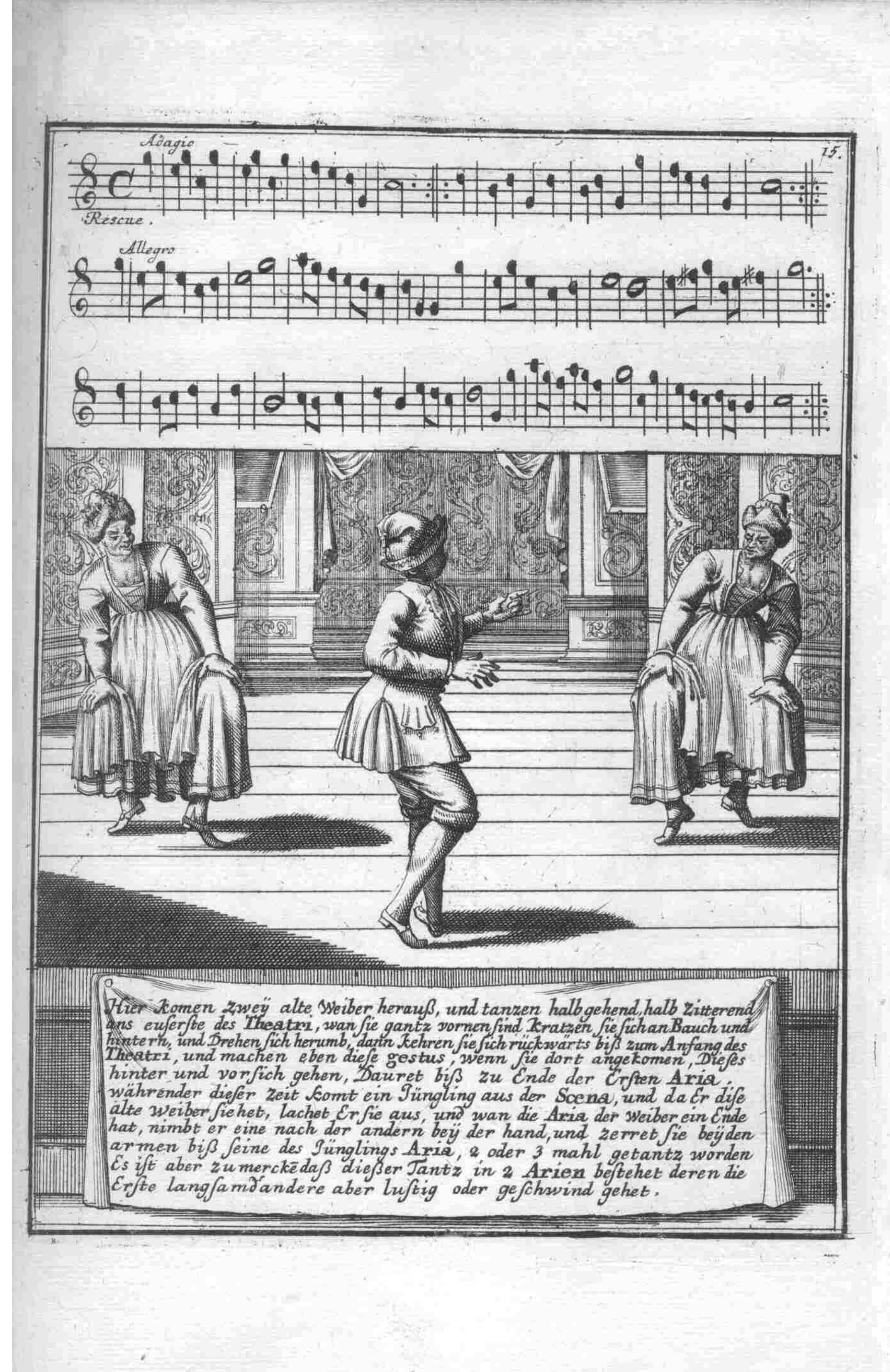
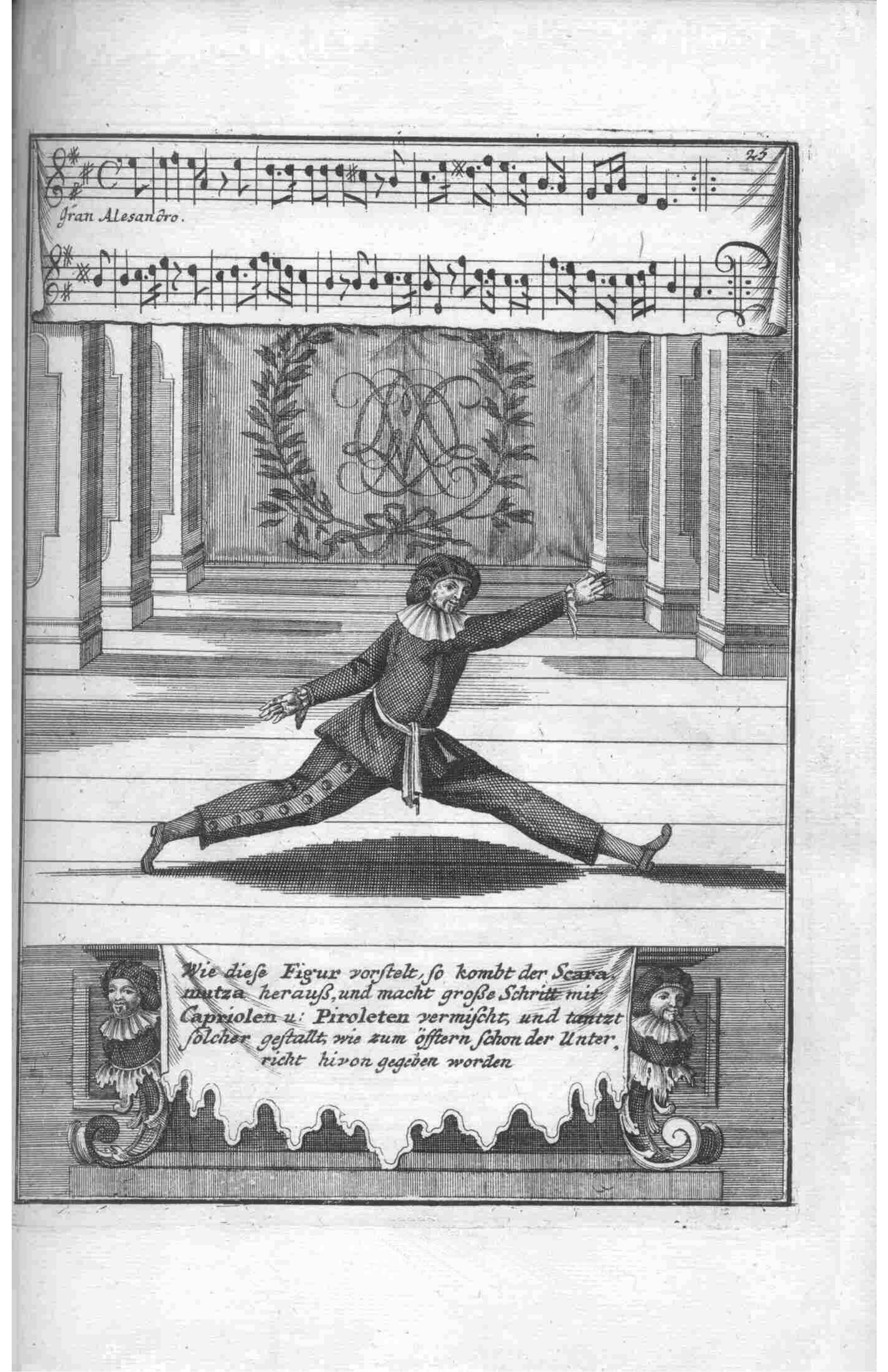
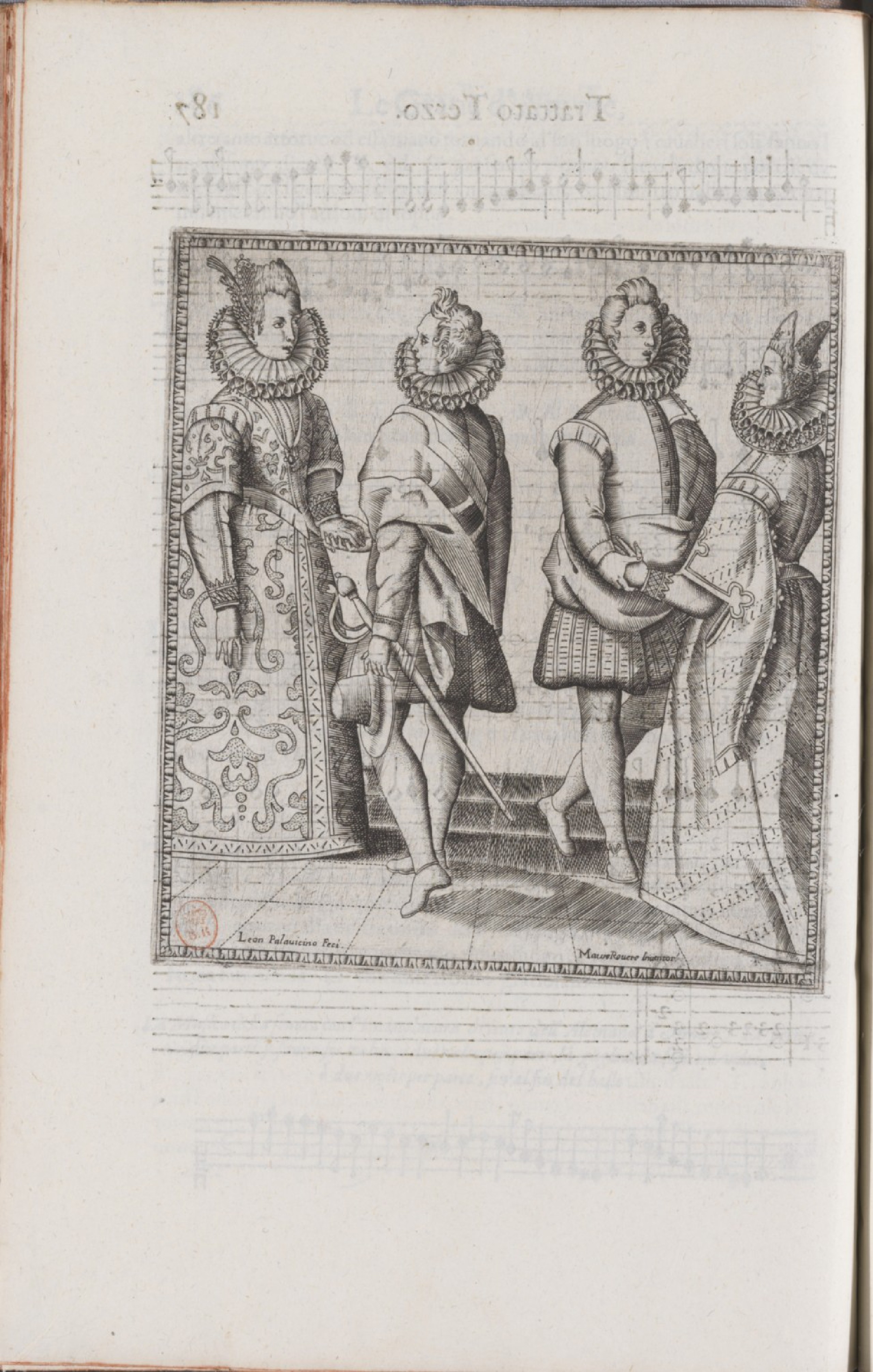
Four figures in Renaissance court dress stand in formal conversation or instruction within an ornate border frame typical of treatise engravings. The figures wear elaborate clothing: the women in full-skirted gowns with patterned sleeves and high collars, large cartwheel ruffs framing their faces; the men in hose, doublets, and cloaks. At left, a woman in a richly patterned gown gestures with her hand extended, while a central male figure in a cloak turns toward her, one leg advanced in what may be a dance position. To his right stands another woman in a similar costume, and at the far right a fourth figure partly visible in profile. The engraving includes decorative musical notation above the scene, suggesting the dancers would have performed to a specific composition. The frame is architectural, with classical ornament, elevating this from simple illustration to a formal presentation of courtly knowledge.
The dancing
The central male figure stands with weight distributed, his left leg bent and advanced, the torso turned toward the woman at left. His right arm is extended outward with the hand open in a gesture of address or invitation. The woman at left mirrors this with her own arm extended, creating a balanced, reciprocal composition. The other two figures adopt attentive postures, watching the primary pair. All four stand upright with the formal bearing expected of nobility, with no visible jumping, turning on the balls of the feet, or other vigorous movement—this is a stately, measured interaction.
The dance depicted
This is a court dance figure, most likely from the Renaissance-era Italian repertory of dances such as the pavane, galliard, or volta that were practiced and taught in the courts of Milan, Rome, and France in the late 16th and early 17th centuries. The posture and gesture suggest an introduction or opening phase of a couple dance—possibly the kind of formal, choreographed interaction described in Negri's *Le Gratie d'Amore*, where dance instruction mixed spoken rules, geometric patterns, and measured steps. The presence of notation above suggests this was a specific, repeatable composition rather than improvisation. The static framing of the moment—the gesture frozen mid-exchange—shows the artist choosing to document the dance as a language of courtship and social hierarchy, not as movement itself.
How it was made
This is an engraving, a printmaking technique that uses fine parallel lines and cross-hatching to build tone and volume. The skill visible here—the precise rendering of textile patterns, the subtle modeling of faces and hands, the crisp architectural border—shows this was made by a trained goldsmith or specialist engraver, not a quick woodcut. Engraving allowed fine detail and could be printed many times from the same plate, making it the medium of choice for high-status treatises meant for circulation among educated courtiers and professional teachers. The date 1602 places this in an era when engraving was the dominant way to disseminate knowledge of courtly practice across Europe.
About this work
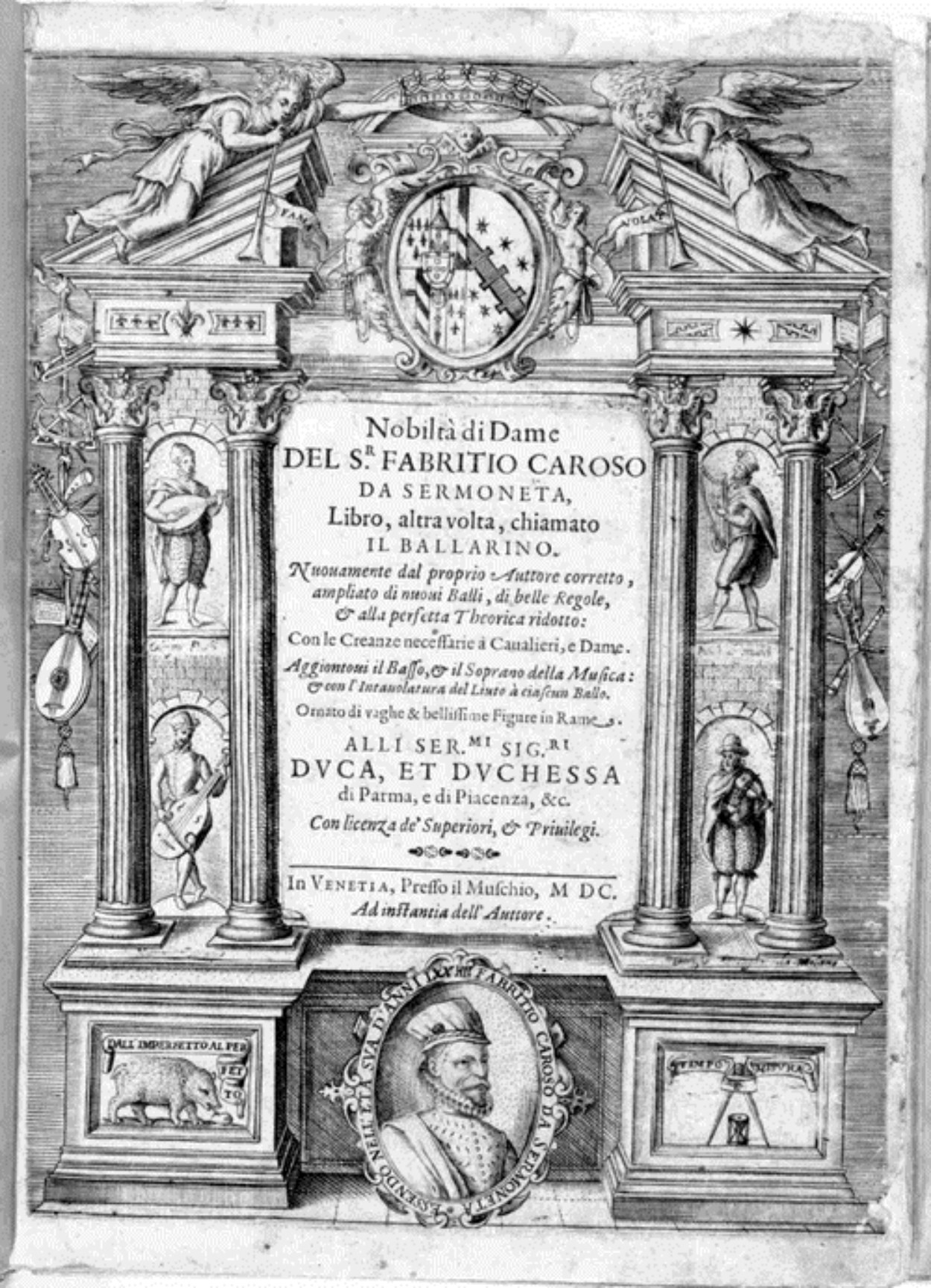
This is plate 3 from Cesare Negri's *Le Gratie d'Amore* (*The Graces of Love*), a treatise on courtly dance published in Milan in 1602, one of the major surviving documents of Renaissance Italian dance practice. Negri was a celebrated master working in Milan and teaching at courts throughout Italy and France; his treatise combines text, notation, and engraved figures to record specific dances and the rules of their performance. This particular plate shows four courtiers in the formal dress and spatial relationships of a couple dance—a moment of gesture and invitation rather than footwork, which is characteristic of how such treatises presented dance as social knowledge. The work belongs to a tradition of Renaissance dance documentation that includes the earlier and equally influential treatise by Fabrizio Caroso; Negri's plates are finer in detail and more ambitious in composition.
How to look at it
Notice the frozen moment of gesture: the woman and man facing each other with arms extended create a moment of symmetry and invitation, not action. This is typical of how Renaissance dance treatises presented dance—not as a blur of motion but as a series of posed attitudes that could be studied, memorized, and repeated. The formal, upright bearing of all four figures, the precision of their clothing, and the architectural frame all signal that this is not everyday movement but a highly codified social practice. The musical notation above the scene is a clue that this dance was bound to a specific musical form and tempo, making it reproducible and teachable.
The artist
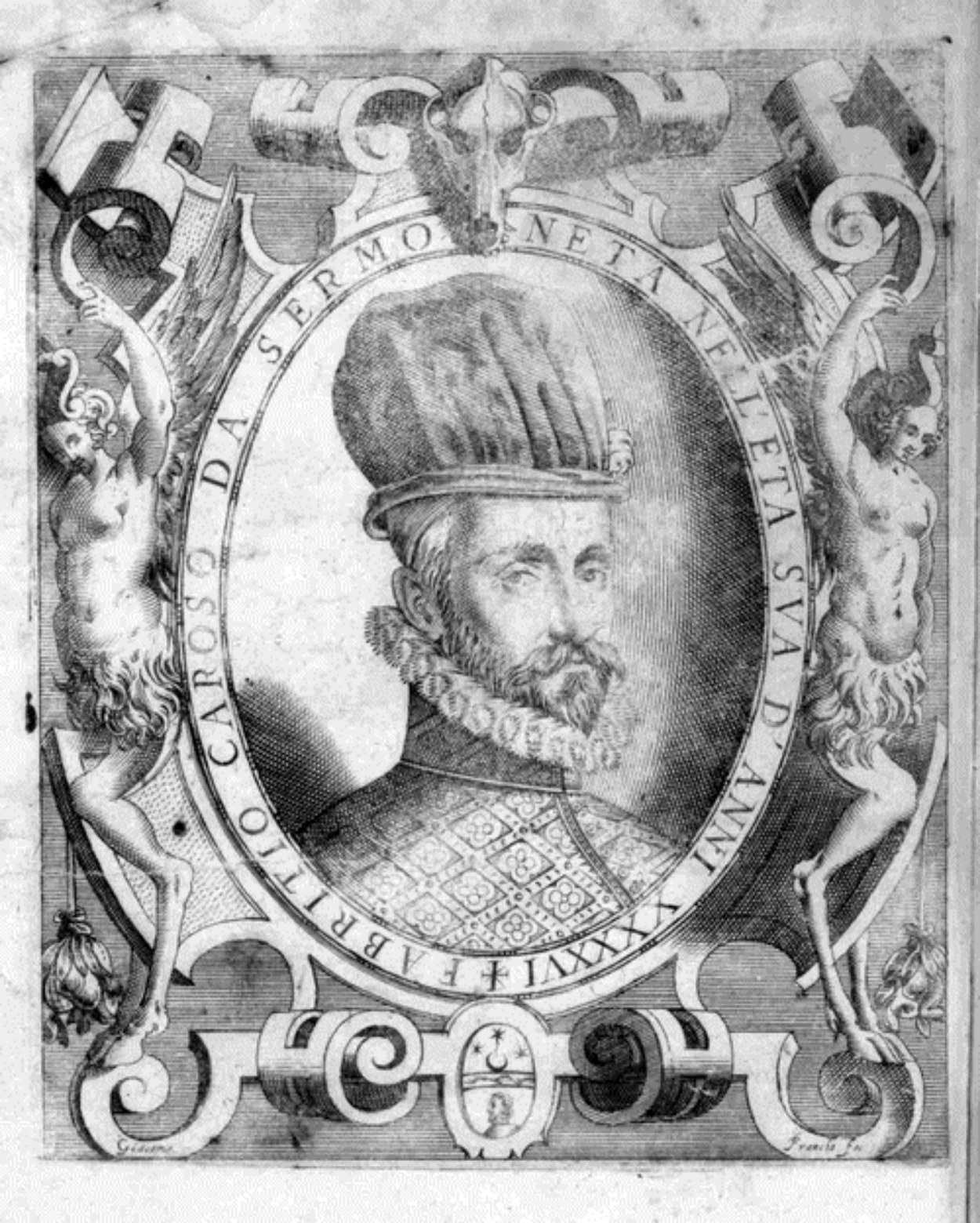
Cesare Negri, known as il Trombone (the Trombone, possibly a stage or family name), was a dancer and choreographer active in Milan in the late 16th and early 17th centuries. He served as a master of dance at the Visconti court and taught among the nobility across Italy and France, acquiring enough fame and patronage to commission and publish an elaborate treatise with engraved plates. His *Le Gratie d'Amore* (1602) and an expanded edition published in 1604 were ambitious projects that placed him in direct dialogue with Caroso, the other great dance master of the period. The quality of the engravings and the range of dances documented suggest Negri had both the resources and the reach to make his work a standard reference for courtly practice.
The period
In the late 16th and early 17th centuries, court dance was a primary marker of noble status and courtly refinement, as important to courtly life as music, poetry, or riding. The Renaissance had seen a shift from medieval line dances and group formations to couple dances emphasizing symmetry, balance, and the interaction of male and female partners—ideals that reflected broader Renaissance humanism and its focus on proportion and harmony. Italy was a center of innovation in both dance and dance notation; treatises by Caroso (1581, 1600) and Negri (1602) represent the peak of this documentary tradition. By the early 1600s, printed treatises with engravings were the primary way dancing masters circulated new material and established their authority; the medium itself—the formal engraving, the careful notation, the elaborate frontispieces—was part of the claim to knowledge and prestige.
Where it lives
This engraving is from the Biblioteca Italiana or Library of Congress copy of *Le Gratie d'Amore* (Milan, 1602/1604), Negri's treatise on dancing. The work was printed in Milan and circulated among courtiers, dancing masters, and libraries across Europe, making it one of the most widely distributed dance treatises of its era.
Dance in this work
Questions about this work
What is Cesare Negri's *Le Gratie d'Amore*?
*Le Gratie d'Amore* (The Graces of Love) is a comprehensive treatise on courtly dancing published in Milan in 1602 by Cesare Negri, a renowned dancing master. The book combines written descriptions of dances, musical notation, and engraved illustrations of dancers to teach and preserve the repertory of Italian Renaissance court dances. It is one of only two major treatises of its kind to survive, making it an invaluable source for understanding how people danced in the Renaissance.
What dances are shown in Negri's plates?
The treatise documents a range of dances popular in Italian and French courts, including the pavane, galliard, canarie, volta, and others. Each dance is presented in stages, from the opening gesture and courtship ritual to the footwork and turns. The plates show both solo figures and couples, capturing the formal introductions, partner connections, and spatial geometry that defined these dances.
How do we know what these engravings depict?
The engravings are accompanied by detailed written text in Italian that describes the steps, patterns, and etiquette of each dance. The notation above and below the figures indicates the music and timing. By comparing the visual representation with Negri's written descriptions, historians can reconstruct how these dances were performed and what they meant in the context of Renaissance courtly life.
Why were dance treatises printed with engravings?
Engraving was the most prestigious and detailed printmaking technique available in the early 17th century, capable of rendering fine detail in both costume and gesture. Using engravings for a dance treatise signaled that the author was a master of high status, that the knowledge was valuable and reproducible, and that the work was intended for circulation among educated courtiers and professional teachers. It was a form of both instruction and prestige.
More Notation/Choreography artwork