49 works in this view — arrow keys or swipe to move between them.
Dance in Art
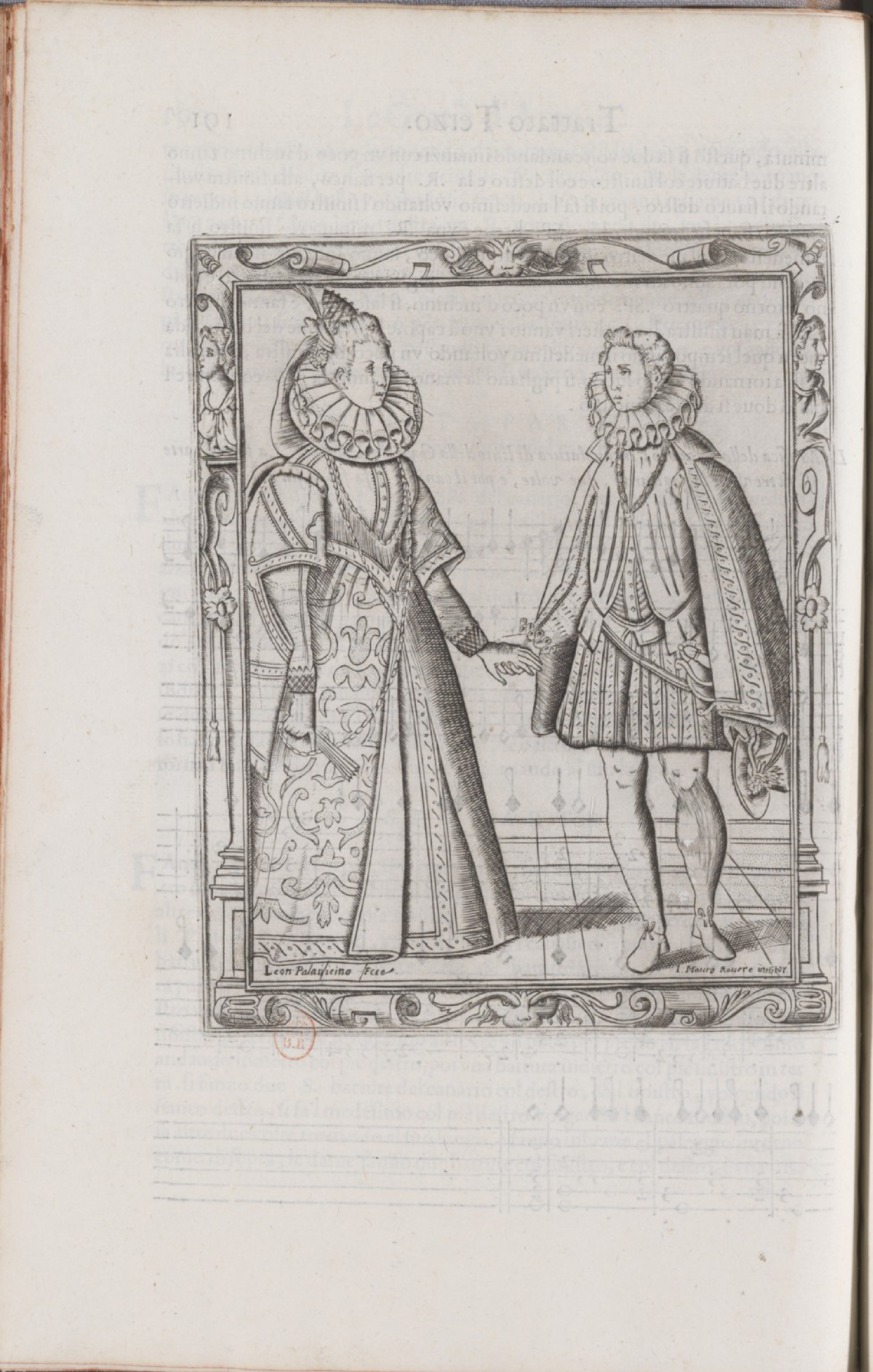
Negri — Dance Plate (plate 4)
Cesare Negri (il Trombone)
- Medium:
- Engraving
- Dance:
- Notation/Choreography
- Era:
- Pre-1700 (Renaissance/Baroque)
- Collection:
- Le Gratie d'Amore (1602)
- Source:
- Library of Congress
- Rights:
- Public domain — free to use, share and adapt.
- Recorded as:
- Public Domain
This plate is essential primary evidence for how Renaissance Italian court dances were actually performed—not just the steps (which other notation systems preserved) but the posture, costume, spacing, and social register of the dances. For historians of dance, fashion, and courtly behavior, Negri's plates are among the most detailed visual records of early modern court culture. The work also marks the emergence of dance as a subject worthy of expensive printed instruction, elevating it from folk or popular practice to an art form for elite study and performance.
What you are looking at
Two figures in rich Renaissance court dress stand facing each other in a formal encounter, their bodies angled to present both profile and three-quarter view to the viewer. The figure on the left wears an elaborately patterned gown with a high waistline, long sleeves with decorative slashing, and a dramatically arched ruff collar; a floor-length cape with ornamental trim sweeps behind. The figure on the right, smaller in stature, wears a shorter doublet and hose in the masculine style, with a similar ruff and a draped cloak. Both have high-crowned heads suggesting elaborate hairstyles or headdresses typical of Milanese court fashion in the early 1600s. They hold hands or clasp hands at waist height in what appears to be a formal greeting or opening figure. The setting is minimal—a checkered floor suggests an interior court space—and the composition is framed by a decorative Renaissance border with scrollwork and ornamental flourishes. The engraving is finely detailed, with careful cross-hatching to model the fabrics and create depth.
The dancing
Both figures stand upright with weight evenly distributed, their bodies in a relaxed but dignified posture. The hand-clasp is central to the composition—it is gentle and formal rather than a grip, suggesting a courtly salutation or the opening gesture of a partnered dance. Neither figure shows significant forward or backward lean; their spines are straight and their heads held level. The stance and proportions suggest the male figure (on the right) may be younger or of lesser rank, a common pairing in Renaissance court dances. There is no suggestion of active footwork or elevation; this is a moment of stillness or a slow processional phrase.
The dance depicted
This is almost certainly a figure from Negri's choreography for one of the dances described in *Le Gratie d'Amore*. The pose matches the conventions of Renaissance Italian court dances—likely an Allemande or Pavane—in which partners moved in stately procession and performed periodic formal salutations with hand-taking. The simplicity of the gesture and the emphasis on dress and bearing over virtuosity suggests a social dance for the nobility rather than a professional performance piece. Negri's treatises documented both the steps and the social protocol of such dances, and this plate serves as a visual reference for the hand position and posture that students of the dance master would have studied.
How it was made
The work is a fine-line engraving, characteristic of printed dance treatises of the early 17th century. The technique allowed for precise rendering of costume detail and spatial clarity, making it suitable for instructional reproduction. The engraver has used cross-hatching and fine parallel lines to model fabric texture and create the illusion of three-dimensional form—the folds of the cape, the structure of the ruff, the weight of the decorated gown. This level of refinement required multiple printings and would have circulated to courts and households across Italy and beyond, making it a widely distributed instructional image rather than a unique artwork.
About this work
This is one of the instructional dance plates from Cesare Negri's *Le Gratie d'Amore*, a landmark choreographic treatise published in Milan in 1602/1604. The plate documents a formal couple figure—likely an opening salutation or hand-taking from an Allemande, Pavane, or other court dance of the period—as it would be performed by nobility at Milanese court. The image combines visual instruction with social spectacle: the elaborate dress and bearing are as much part of the dance notation as the hand position. Negri's plates represent a crucial moment in dance history when choreography began to be systematically documented in print, creating a permanent record of court dances that would otherwise exist only in the memory of trained dancers and in the oral transmission of movement knowledge.
How to look at it
Study the hand position closely—this is the key instruction. The clasp is not passionate or energetic but formal and templated, showing the viewer exactly how to greet a partner at the start of a dance. Notice the absolute uprightness of both figures: Renaissance court dancing required an erect carriage and minimal vertical movement, very different from later ballroom or contemporary dance. The lavish detail of the costume is not ornamental but instructional—the ruff, the draped cloak, and the structured gown all constrain movement and determine what steps and actions are possible. The checkered floor grounds the figures in a real space, suggesting this is a moment from actual courtly practice rather than an abstract diagram.
The artist
Cesare Negri (c. 1535–after 1604), called 'il Trombone,' was the most celebrated dance master of his era and the founder of a dynasty of choreographers and movement instructors based in Milan. He served at the courts of northern Italy and France, teaching nobility and creating dances for court spectacles. His *Le Gratie d'Amore* (1602, with a revised edition in 1604) was the most comprehensive and lavishly illustrated dance treatise of its time, containing over 100 named dances with step descriptions and instructional plates like this one. Negri's work synthesized and elevated the Italian dance tradition documented earlier by Caroso, and his treatise remained the gold standard for courtly dance instruction well into the 17th century.
The period
In the early 1600s, Renaissance court culture was at its height, and dancing was a central accomplishment for the nobility. The formal court dances of Italy—Pavane, Allemande, Galliard, Volta—were highly codified, and mastery of them signaled education, grace, and fitness for court life. The publication of Negri's treatise coincided with the rise of professional dance masters as distinct from musicians or other court servants; dance was becoming a subject of systematic analysis and written instruction. In visual art, precise engraving technology had made detailed costume documentation possible, allowing dance treatises to achieve a new level of visual clarity and reproducibility. This same period saw the emergence of ballet de cour in France and the early stirrings of what would become theatrical ballet.
Where it lives
This engraving is from *Le Gratie d'Amore: Nuovissimo trattato di ballare* (Milan, 1602/1604), a printed treatise held in the Library of Congress. The work is one of a series of instructional plates woven through the text, each illustrating a key figure or moment from Negri's choreographies. As a printed book, it was distributed to courts, noble households, and dance masters across Europe, making it one of the most widely circulated dance documents of its era.
Dance in this work
Questions about this work
What dance is this showing?
The catalogue identifies this as 'plate 4' from Negri's treatise, but without seeing the facing text, the exact dance cannot be confirmed from the image alone. The formal hand-clasp and upright posture are consistent with the opening of an Allemande, Pavane, or similar processional court dance. Negri describes over 100 named dances in the treatise, many of which begin with such a salutation.
Is this a real dance or a made-up picture?
Both. Negri's treatise documents real dances that were performed in actual courts, but each plate is an idealized representation created for instruction. The artist (likely a professional engraver working from Negri's designs) has posed the figures to show the correct posture and hand position as clearly as possible, rather than capturing a moment from an actual performance.
Why is one figure so much smaller than the other?
The size difference may reflect a difference in status or age—male and female partners in court dances did not necessarily have equal rank. It could also be a limitation of the composition or an attempt to show two figures in clear profile and three-quarter view simultaneously. Negri's other plates show similar proportional variations.
How do we know how Renaissance dances actually went?
Negri's treatise, along with Caroso's and a few others, gives us step descriptions and visual documentation that scholars can reconstruct into actual movement sequences. Modern dance historians use these texts and images to teach and perform Renaissance dances much as they were done 400 years ago, though always with awareness that print sources are incomplete guides to lived practice.
More Notation/Choreography artwork