49 works in this view — arrow keys or swipe to move between them.
Dance in Art
Negri — Dance Plate (plate 5)
Cesare Negri (il Trombone)
- Medium:
- Engraving
- Dance:
- Notation/Choreography
- Era:
- Pre-1700 (Renaissance/Baroque)
- Collection:
- Le Gratie d'Amore (1602)
- Source:
- Library of Congress
- Rights:
- Public domain — free to use, share and adapt.
- Recorded as:
- Public Domain
This is a primary source for understanding how Renaissance court dances were actually performed—the posture, the formal hand positions, the spatial relationship between partners, and the elaborate dress that shaped movement. For historians and dancers, Negri's plates are among the few visual records of this foundational repertory and one of the earliest systematic attempts to document dance in images paired with written notation.
What you are looking at
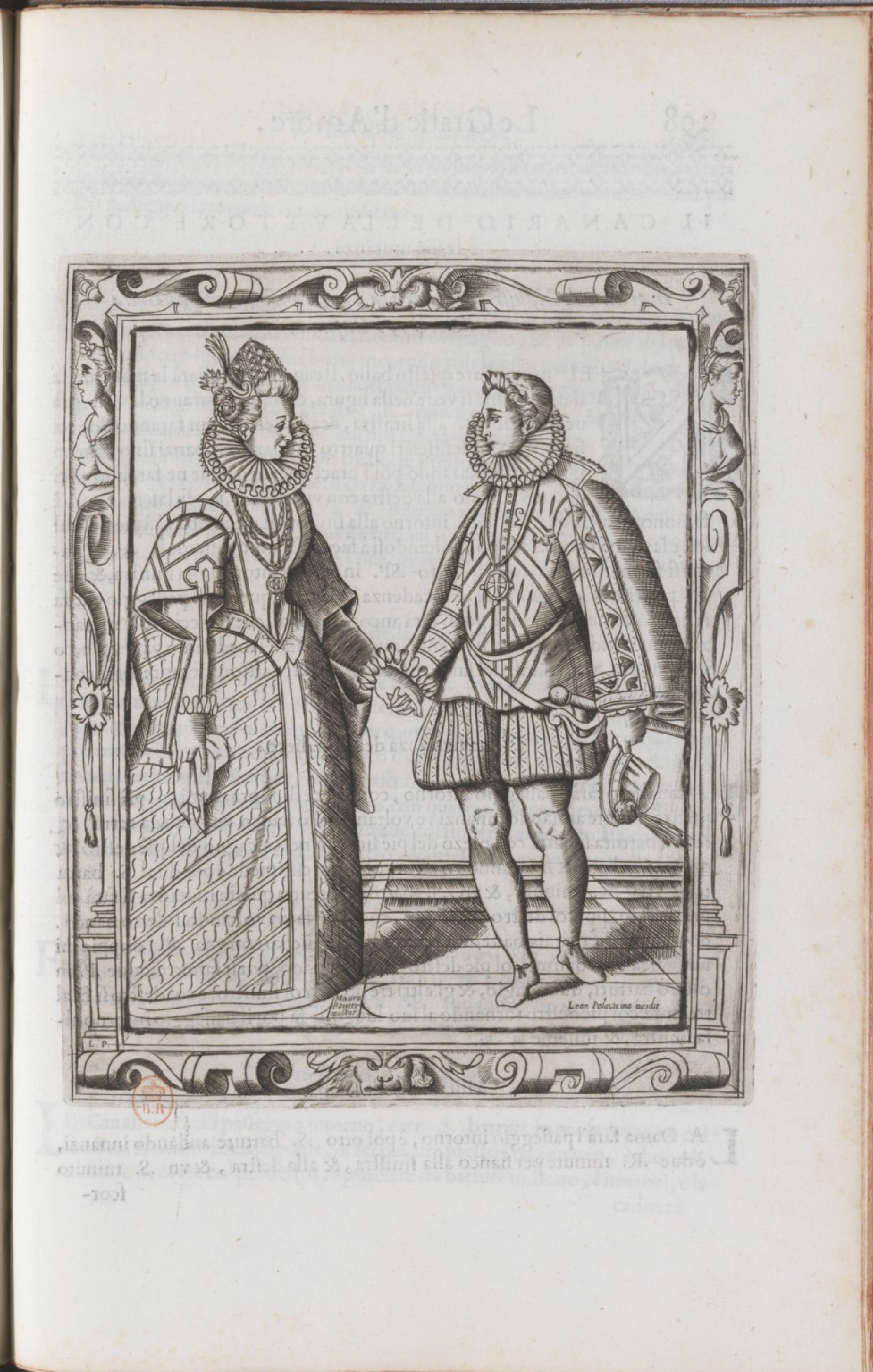
An engraved plate from Cesare Negri's treatise shows a richly dressed couple in a formal court setting, likely Milan or northern Italy in the early 1600s. The woman stands at left in three-quarter view, wearing an elaborate gown with diagonal striped or patterned fabric, a deeply plunging neckline, and an enormous stiffened ruff collar of the kind worn in late Renaissance courts. Her hair is elaborately dressed with jewels or ornaments. The man faces her from the right, dressed in a doublet with vertical striped or quilted patterning, short hose, and stockinged legs; he too wears a large formal ruff. They are holding hands or about to join hands in a formal greeting or opening gesture. The setting is a plain interior defined by a decorative archway or frame. The engraving is surrounded by an ornate border of scrollwork, cartouches, and classical ornamental motifs typical of Italian Renaissance print design. The line work is fine and deliberate, showing the careful documentation of both garments and the precise moment of connection between the dancers.
The dancing
Both figures stand in upright, dignified posture characteristic of court dance. The woman's weight appears evenly distributed; the man inclines slightly toward her. Their hands meet or are about to meet at roughly waist height in what appears to be a formal hand-join or salute—a moment of initiation or greeting rather than a turn or traveling step. Neither figure shows the twisted torso or complex weight shift of a turn in progress. The spacing between them suggests the opening of a dance for two, with the formal distance and approach typical of courtly choreography.
The dance depicted
This is a documented figure from Cesare Negri's choreography manual *Le Gratie d'Amore*, which catalogued the dances of the late Renaissance Italian court. Negri was the celebrated Milanese dance master whose methods shaped court dance across Italy and France in the late 16th and early 17th centuries. The plate shows the opening of a couple dance—likely an *Allemande*, *Pavane*, *Galliard*, or *Volta* based on the formal hand-join and upright carriage, though without the accompanying text it is difficult to identify which specific dance is depicted. What is clear is that this represents the highly codified, geometrical approach to partnered court dance before the Baroque minuet became dominant.
How it was made
This is an engraving—a print made by incising lines into a metal plate, inking it, and pressing it onto paper. The technique allowed Negri to distribute his choreographic system to courts across Europe and to preserve a visual record of the precise dress, posture, and formal positioning that his dances required. The ornamental border and fine detail suggest this was made for a wealthy, educated audience; the *Le Gratie d'Amore* was published in Milan and printed in multiple editions, making it one of the most widely circulated dance manuals of its era. The engraving's clarity and precision made it far more reproducible and portable than a painted alternative would have been.
About this work
This is one of a series of coupled figures engraved for Cesare Negri's *Le Gratie d'Amore* (Milan, 1602), a foundational choreographic treatise that documented late Renaissance court dance at the moment it was transitioning toward the Baroque. The image is not decorative; it is instructional—a visual component of a dance manual meant to be read alongside written descriptions of steps, timing, and musicality. It represents a crucial moment in dance history when court choreography was becoming standardized and theorized, and when the Italian court had become the artistic center of Europe. Negri's manual was studied and emulated well into the 17th century, making these engravings among the most influential dance images of the period.
How to look at it
Pay attention to the hand-join and the formal distance between the figures—this is the opening phrase of a highly codified dance, not an action in progress. Notice the posture: both dancers are upright, their weight evenly placed, with no suggestion of the twisting or bending that would characterize a turn or a traveling step. The ornate dress is not mere decoration; the stiffness of the ruffs, the structure of the doublet, and the weight of the patterned fabrics all constrained and shaped how movement could happen. The engraver has chosen to show the moment of formal greeting or initiation, when the dancers acknowledge their partnership and the dance is about to begin—a moment of stillness and geometry before the steps commence.
The artist
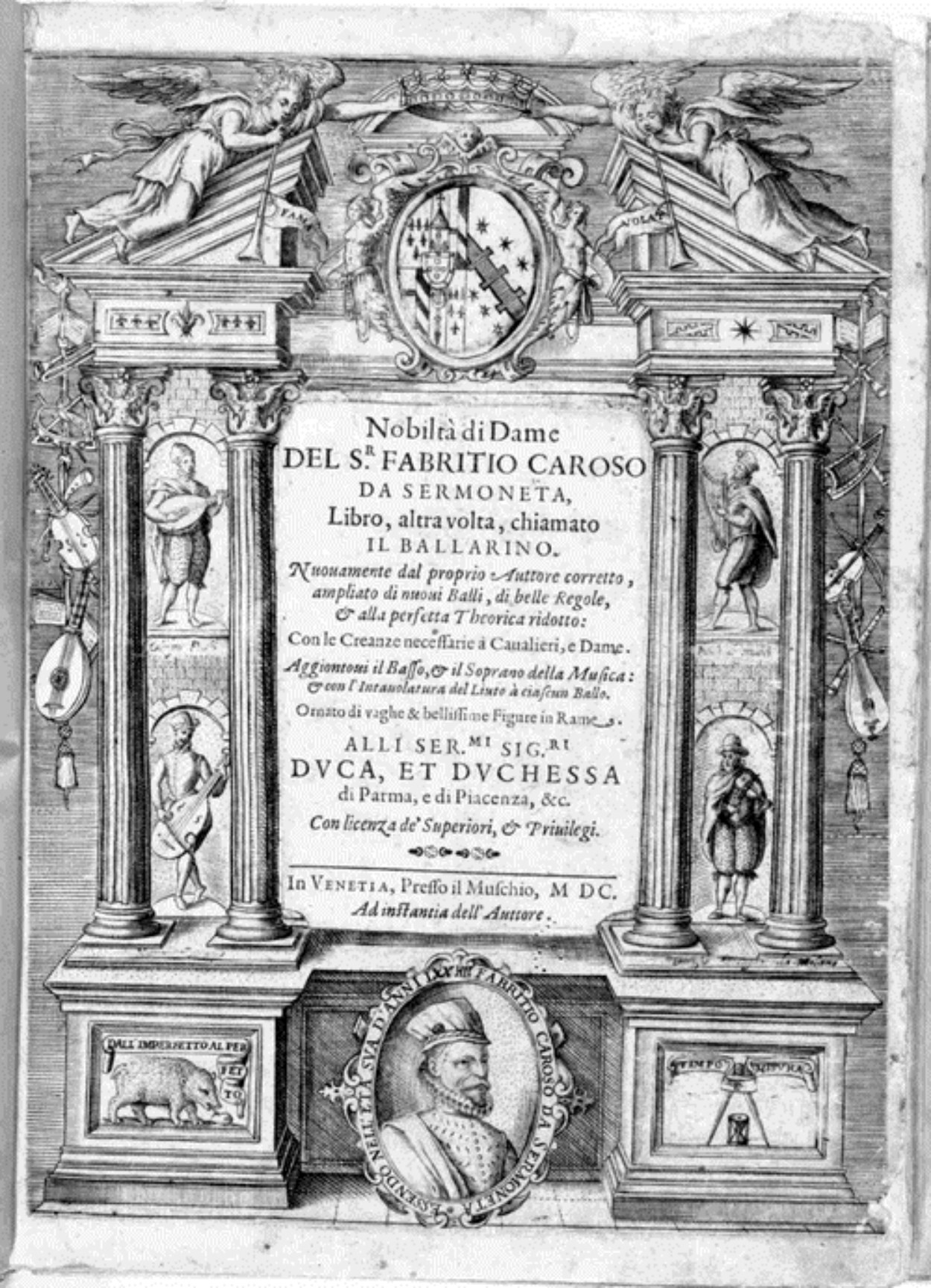
Cesare Negri (c. 1535–c. 1605), known as il Trombone, was the most celebrated dance master of the late Italian Renaissance. Based in Milan, he taught at the court of the Gonzaga family in Mantua and traveled to France to teach at the royal court. His *Le Gratie d'Amore* (The Graces of Love), published in 1602 and again in an expanded edition in 1604, was the most comprehensive choreographic manual of the period, containing descriptions and illustrations of dozens of dances with instructions for their performance. Negri's system represented the culmination of Renaissance dance theory and had enormous influence on the development of Baroque court dance. The engravings in the treatise are attributed to various hands; the quality and consistency suggest a workshop production overseen by Negri's specifications.
The period
In the late 16th and early 17th centuries, Italian courts—particularly Milan, Mantua, and Rome—were centers of dance innovation and theory. The transition from the Renaissance *pavane*, *galliard*, and *volta* toward the more regularly metered Baroque *minuet* was underway. Negri's manual documents this moment of codification, when dance was shifting from an improvisation-based court pastime toward a systematized art form with fixed steps, timing, and social protocols. The enormous ruffs and fitted doublets visible in the engraving date the work precisely to the 1600s; by mid-century, this silhouette would have looked archaic. Print technology and the growing literacy of the European nobility made it possible for Negri's system to circulate widely and to influence dance practice across Europe.
Where it lives
This plate is from *Le Gratie d'Amore*, a printed treatise published in Milan in 1602 and reprinted in 1604. The work is held in the Library of Congress and other major institutional collections. It was one of the first and most influential systematic attempts to document court choreography in print, combining written instructions with engraved illustrations.
Dance in this work
Questions about this work
Can you tell which specific dance this is from the image alone?
No. The image shows the opening position—a formal hand-join and upright carriage—which is common to several Renaissance couple dances including the Allemande, Pavane, and Volta. The accompanying text in Negri's treatise would specify the steps, timing, and music, but without that information the image shows only the formal opening phrase.
Why are they dressed so elaborately?
This is court dress of the Milan court around 1600. The enormous stiffened ruffs, the patterned fabrics, the jeweled hair ornaments, and the fitted doublets all signal nobility and courtly status. These were the clothes in which people actually danced at court; the garments constrained and shaped movement, so understanding the dance means understanding how these heavy, stiffened textiles affected posture and step.
What makes Negri's manual different from other dance books of the time?
Negri's *Le Gratie d'Amore* was the first and most comprehensive printed system of court dance, combining detailed written descriptions with coordinated engravings showing posture, positioning, and dress. It was far more methodical and widely distributed than earlier, manuscript-based guides, making it the foundational text for documenting Renaissance court dance and for teaching it across Europe.
Is this a painting or a print?
This is an engraving—a print made from an incised metal plate. Engravings allowed Negri's choreography to be reproduced and distributed far more widely and cheaply than a painted original could have been, which is why the manual had such lasting influence.
More Notation/Choreography artwork