49 works in this view — arrow keys or swipe to move between them.
Dance in Art
Negri — Dance Plate (plate 6)
Cesare Negri (il Trombone)
- Medium:
- Engraving
- Dance:
- Notation/Choreography
- Era:
- Pre-1700 (Renaissance/Baroque)
- Collection:
- Le Gratie d'Amore (1602)
- Source:
- Library of Congress
- Rights:
- Public domain — free to use, share and adapt.
- Recorded as:
- Public Domain
Negri's Le Gratie d'Amore is one of the two canonical Renaissance dance treatises (alongside Fabrizio Caroso's work) and the only major Italian source to survive with comprehensive illustration. This plate demonstrates how court dance was taught through the combined authority of written rule and visual example, making it essential for understanding Renaissance pedagogy, technique, and the social function of dance at court.
What you are looking at
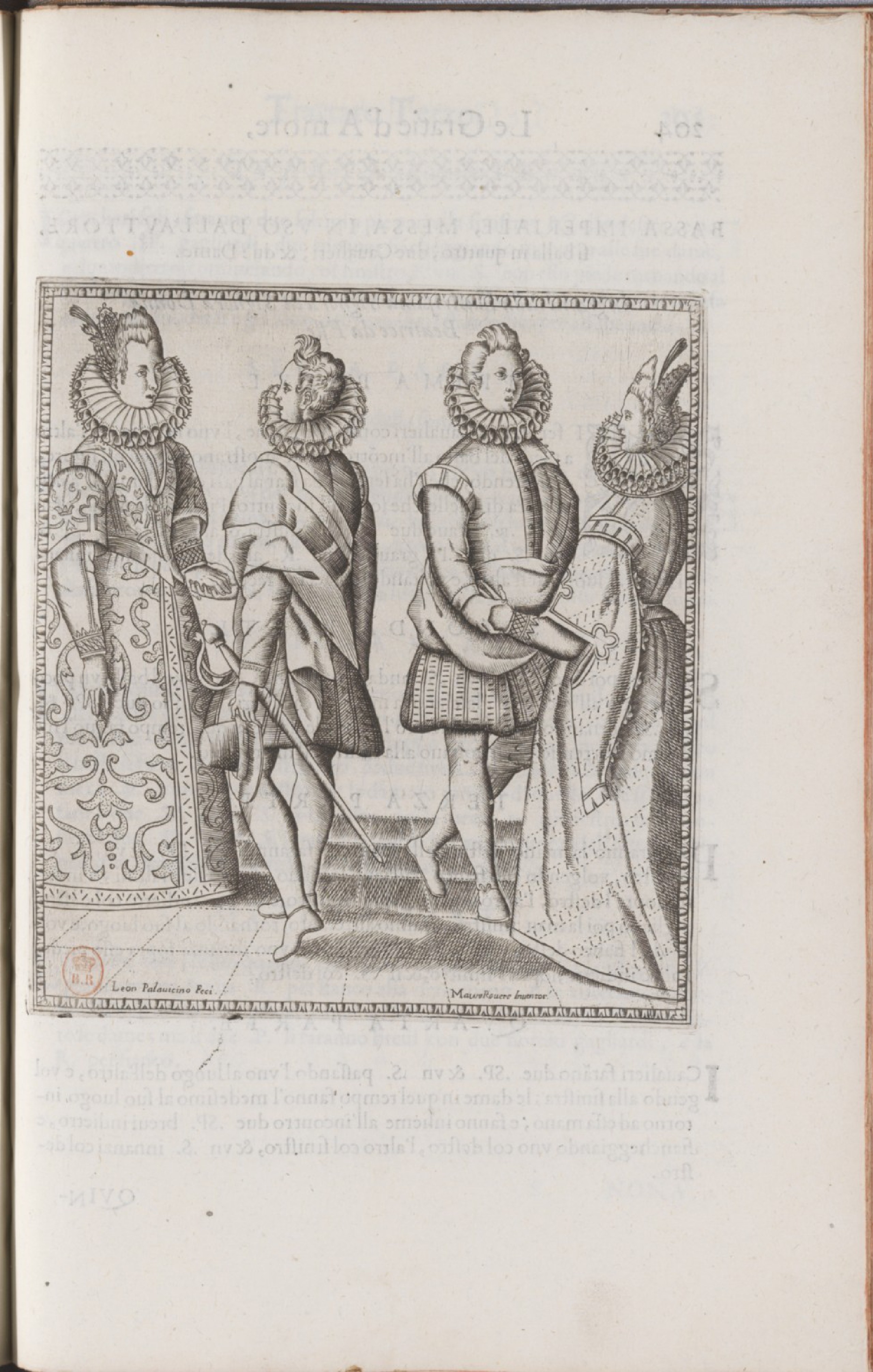
Four figures in Renaissance court dress stand in formal arrangement against a plain background, framed by a decorated border. From left to right: a woman in an ornate patterned gown with a high collar and ruff; a man in doublet and hose with a diagonal sash; a second man in similar dress with a skirt-like garment and fitted doublet; and a woman in an elaborate draped robe with decorative embroidery. All wear the high, fluted ruffs characteristic of late-16th-century fashion. The figures are bareheaded except for their elaborate collars, standing in studied poses that suggest choreographed positions rather than casual stance. The woman on the left extends one arm in a gesture of presentation; the central figures are in profile or three-quarter view, with weight distributed in a formal, geometric arrangement typical of court dance documentation.
The dancing
The four dancers occupy distinct spatial zones without touching, arranged in a line that reads from left to right as a series of individual poses rather than a coupled ensemble. Each figure maintains an upright carriage with carefully positioned arms—the leftmost woman's arm extended in a refined gesture, the men with arms at varied heights suggesting positions within a dance sequence. The weight appears centered and controlled, with no evidence of dynamic movement, hopping, or spatial transition. The stance is distinctly formal and static, consistent with the courtly basse danse or pavane, where dignity of posture and precision of placement supersede obvious physical exertion.
The dance depicted
This plate depicts dancers performing one of the fundamental court dances of the Italian Renaissance, most likely a pavane or a variant of the basse danse tradition that Negri taught and documented. The four figures represent the standard configuration for a paired dance or processional choreography: two couples arranged to show the essential positions and deportment rather than a moment of dynamic movement. Negri's treatises are systematic pedagogical instruments, and this plate functions as a visual grammar of stance and placement—showing students and performers the proper alignment, costume, and formal bearing expected at court. The static arrangement is not a failure of the artist to capture movement but rather a deliberate choice to make the technical positions legible and reproducible.
How it was made
This is an engraving on paper, recognizable from the fine hatching lines, uniform linear quality, and careful descriptive detail achieved through the burin. Engraving allowed for precise, reproducible imagery, crucial for a dance manual intended to circulate among courts and dance masters across Italy and France. The decorative border—a common feature in Renaissance engravings—frames the scene formally and elevates the content, signaling that this is both a practical teaching document and an object of artistic and courtly prestige. The technique's clarity and capacity for fine detail made it ideal for rendering the intricate patterns of embroidery and the structured geometry of pose that Negri's system demanded.
About this work
This is a single plate from Cesare Negri's Le Gratie d'Amore (Milan, 1602/1604), one of the most important dance treatises of the Renaissance and early Baroque periods. Negri, known as "il Trombone," was the leading dance master of Milan and a figure of international renown; his manual compiled the essential court dances and their proper execution for an elite European audience. The plate shows four dancers in the formal costume and static poses prescribed for noble performance, exemplifying the Renaissance ideal of dance as geometry, restraint, and measured grace rather than virtuosic spectacle.
Negri's work stands at the intersection of dance practice and artistic print culture. His treatise combined written description with engraved figures in a systematic way that influenced dance pedagogy for generations. This particular plate serves a didactic purpose: it shows the correct posture, arm position, and spatial relationship for dancers undertaking a court choreography. The work belongs in a dance history collection both as a historical document of Renaissance technique and as evidence of how dance knowledge was codified, transmitted, and valued in the early modern period.
How to look at it
Attend first to the absolute stillness of these figures: none is in mid-movement, none is caught transitioning from one position to another. This static choice is not artistic limitation but didactic strategy. Each figure shows the dancer in the position he or she should hold—the feet placed precisely, the spine upright, the arms in a defined gesture. Look at the feet: you can see how weight is distributed and where the supporting leg is placed. The arrangement of four figures in a line reads as a sequence of positions within a single choreography, or the positions of two couples in their formal opening. Notice how the elaborate costume—the ruff, the embroidered panels, the draped sleeves—frames and emphasizes the body's geometry; clothing is part of the dance vocabulary here, not incidental to it. The engraver has rendered every detail of needle-work and construction, because at court, how you wore your clothes was part of how you danced.
The artist
Cesare Negri (c. 1535–c. 1604), called "il Trombone" (the trombone), was the preeminent dance master of late-Renaissance Milan. He served the Gonzaga and Sforza courts, taught nobility across Italy and France, and compiled his teachings into Le Gratie d'Amore, published in 1602 and reissued in expanded form in 1604. His treatise is systematic and comprehensive, covering the fundamental dances (pavane, galliard, courante, canary) with detailed descriptions of steps, spatial patterns, and proper deportment. Negri positioned himself as a reformer of dance practice, emphasizing elegance, geometric precision, and the integration of dance with courtly virtue. His work was widely circulated and influential; it codified Renaissance dance technique for an international audience of nobles and professional dance masters.
The period
This plate was created at the very end of the Renaissance, at a moment when court dance was fully systematized and documented through print. The late 16th and early 17th centuries saw the flourishing of illustrated dance treatises—a phenomenon unique to this period and region. Dance had become a subject worthy of the same careful analysis and reproduction that governed other learned arts. At the same time, the style of dress and the dances themselves were transitional: the high ruffs and elaborate embroidery shown here belong to the 1580s–1600s, and the dances Negri described (pavane, galliard) were already becoming old-fashioned by the time of publication, replaced in court favor by the minuet and other Baroque forms. Negri's treatise thus preserves a tradition even as it was being superseded.
In the visual arts, the engraved treatise was itself a Renaissance innovation—a way of combining text, image, and portable format to reach an educated, affluent audience. Negri's choice to publish through engraving (rather than manuscript circulation) signals both the increasing availability of print technology and the increasing prestige of dance as a subject worthy of artistic attention.
Where it lives
This plate is taken from Le Gratie d'Amore, Cesare Negri's illustrated dance treatise first published in Milan in 1602, with a revised and expanded edition in 1604. The work survives in numerous copies in libraries and collections across Europe and North America. As a printed engraving, it was produced in an edition and circulated widely among courts, dance masters, and libraries, making it a document of both technical pedagogy and courtly culture.
Dance in this work
Questions about this work
How do I know these people are dancing?
The poses are too formal and geometric to be natural stance. The arrangement of four figures in sequence suggests a choreographed pattern. The context—this is a page from Negri's dance manual—confirms it. But visually, you can recognize dance positions from their precision, the careful placement of feet and arms, and the relationship between the figures' bodies and the space around them.
What dance is this?
The plate does not identify itself, but the stance, the formal pairing, and Negri's method suggest either a pavane or a variant of the processional court dances that dominated his pedagogy. The static poses and dignified bearing are characteristic of pavane or basse danse style. Without the text that would accompany this plate in the full treatise, certainty is not possible, but the formal geometry and restrained arm movement point toward one of these foundational court forms.
Why are they dressed so elaborately?
This is court dress from the 1580s–1600s, and it is essential to understanding how Renaissance dance was performed. The high ruff, the embroidered panels, the draped sleeves, and the fitted doublet are not theatrical costume but the actual clothing worn by nobles at court. Dance and costume were inseparable; the way fabric moved and the way the body had to adjust to wearing such garments were part of the dance technique itself.
Is this an accurate record of Renaissance dance?
Yes, with the caveat that Negri was systematizing and formalizing practice, not simply documenting it. His treatise presents an ideal or reformed version of court dance—the way it should be done according to his method. Other dance masters had different priorities and emphases. But Negri was teaching at the highest level, to nobles and professionals, and his work is one of our best sources for understanding elite Renaissance technique.
More Notation/Choreography artwork