49 works in this view — arrow keys or swipe to move between them.
Dance in Art
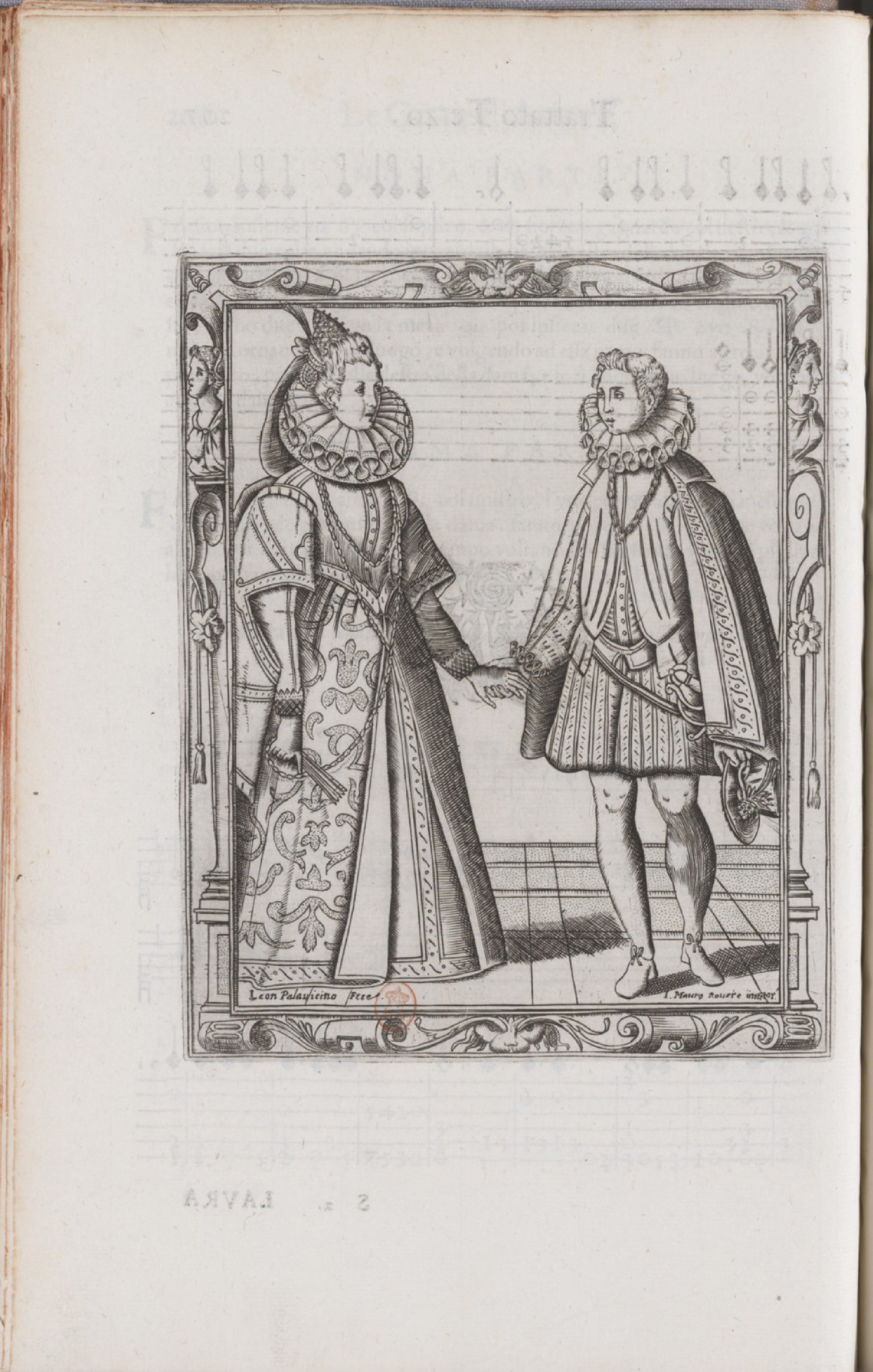
Negri — Dance Plate (plate 7)
Cesare Negri (il Trombone)
- Medium:
- Engraving
- Dance:
- Notation/Choreography
- Era:
- Pre-1700 (Renaissance/Baroque)
- Collection:
- Le Gratie d'Amore (1602)
- Source:
- Library of Congress
- Rights:
- Public domain — free to use, share and adapt.
- Recorded as:
- Public Domain
This image is among the most valuable surviving documents of Renaissance Italian court dance practice, showing precisely how bodies were positioned, how partners related spatially, and what the social codes of gesture and address looked like in performance. For dancers and historians, Negri's plates are primary evidence of a major European dance tradition at the moment of its fullest development and documentation, made by a celebrated master who trained dancers across Italy and France.
What you are looking at
Two figures in elaborate early 17th-century court dress stand facing each other in an ornate framed space, their bodies positioned in formal engagement. The figure on the left wears a heavily patterned doublet with ornamental sleeves and a voluminous skirt decorated with scrolling designs, paired with an enormous cartwheel ruff collar standing vertically around the neck. The figure on the right wears a shorter doublet and breeches with a matching ruff, draped with a long cloak. Both figures have one hand extended toward each other in a gesture of connection or greeting, their bodies held upright with formal bearing. The setting is defined by decorative Renaissance-style framing with scrollwork and floral ornaments at the corners and along the borders, against a plain background with faint musical notation visible at the top of the page. The engraving is executed with fine parallel hatching lines creating depth and shadow across the figures' garments.
The dancing
Both dancers stand with upright posture and balanced weight distribution typical of Renaissance court dancing. Their arms are extended toward each other at approximately shoulder height in a symmetrical, mirrored pose suggesting a moment of approach or acknowledgment between partners. The positioning indicates a side-by-side or facing relationship rather than a close embrace, maintaining formal distance appropriate to court protocol. The woman's elaborate skirt creates a wide silhouette that would restrict certain movements; the man's shorter costume allows greater leg visibility and mobility. The mutual hand gesture suggests a specific choreographed moment of connection—possibly a salute, hand-taking, or reverential acknowledgment—rather than an active turning or traveling movement.
The dance depicted
This plate illustrates a couple posed within the context of Renaissance Italian court dance, most likely a pavane, galliard, or almain based on the formal, frontal positioning and the couple's dress. The printed treatise context indicates this is a notated or described dance from Negri's repertory, intended to guide dancers learning steps and gestures from the written text. The formal hand gesture and upright stance without visible weight transfer suggest a moment of courtly address or ceremonial salutation rather than vigorous footwork—possibly from the opening or closing of a dance, or a specific figure such as a riverenza (reverence) or similar gesture of respect. The image documents how Renaissance court dances combined processional dignity with intricate footwork, emphasizing the social and courtly aspects of partner interaction.
How it was made
This is a finely executed line engraving, likely made from a copper plate, employing hatching and cross-hatching to create tonal modeling and depth. The technique allowed for precise detail in the ornamental borders and the intricate patterns of the dancers' garments, including the lacework and embroidery visible on the fabrics. Engravings of this quality required skilled craftsmen and significant investment in materials and printing, indicating circulation among educated court audiences and professional dancers who could afford treatises. The presence of musical notation at the top of the page suggests this engraving was integrated into a printed book designed as both a visual and musical guide—a hybrid document combining notation, image, and likely textual description on facing pages.
About this work
This is a dance plate from Cesare Negri's *Le Gratie d'Amore* (Milan, 1602/1604), one of the most important Renaissance dance treatises produced at the turn of the 17th century. The engraving depicts a couple in the formal dress and composed posture of Italian court dancing, positioned to illustrate a specific choreographed moment—likely a reverential gesture or partnered greeting. As plate 7 in a substantial illustrated treatise, it functioned as a practical teaching tool for dancers, courtiers, and dancing masters learning from Negri's written descriptions and notated steps.
Negri's work synthesized and built upon earlier treatises like Caroto's *Il Ballarino*, extending the vocabulary of Renaissance dance at a moment when court dancing was becoming increasingly formalized and technically demanding. The engraved couple figures in this series allowed readers to study body position, gesture, and partnership dynamics in stillness—a necessary complement to the written choreographic descriptions and musical notation that would have accompanied the visual representation on the facing page.
How to look at it
Notice the deliberate frontality of both figures and the way their bodies are presented as though for study—this is instruction, not narrative action. The hand gesture is the key detail: the extended hands toward each other signal a specific choreographed moment that would have meant something precise to dancers of the period. Look at the contrast between the woman's voluminous, heavily patterned skirt (which would restrict footwork and shift the visual emphasis upward to the ruff and face) and the man's shorter costume (which displays the leg and foot more clearly). The ornate framing signals that this image is a formal document, a page within a prestigious printed book, not a casual illustration of social dancing. The musical notation barely visible at the top reinforces that this couple's position corresponds to a specific moment in a notated composition.
The artist
Cesare Negri (c. 1535–c. 1604), known professionally as 'il Trombone,' was a Milanese dancing master of international renown whose career spanned the second half of the 16th century. He composed dances for the Sforza court in Milan and for noble courts across Italy and France, and was known for his pedagogical gifts as much as his choreographic innovation. *Le Gratie d'Amore*, published when Negri was in his late sixties, compiled decades of professional practice and represented both a codification of the Renaissance dance tradition and an attempt to preserve choreographic knowledge through the printed book—a costly and labor-intensive undertaking that required the engraver's collaboration to produce legible couple figures and decorative framing.
The period
In the early 1600s, Renaissance court dance was at a transitional moment. The pavane and galliard, which had dominated the second half of the 16th century, were beginning to yield ground to new forms like the allemande and courante that would define Baroque dance. Negri's treatise, published at the end of his career, was partly a retrospective codification of Renaissance practices, but it also included new material reflecting changing court tastes. In the visual arts, fine line engraving had become the standard medium for technical instruction and the dissemination of knowledge to courtly and professional audiences. The careful formal posturing in this image reflects the period's investment in dance as a marker of courtly refinement and social status, where precise gesture and dignified carriage were as important as footwork.
Where it lives
This engraving is held in the Library of Congress and is taken from *Le Gratie d'Amore*, the 1602/1604 Milan edition of Negri's comprehensive dance treatise. The work was issued in a limited edition for a courtly and professional audience—dancing masters, noble pupils, and music patrons—and printed copies survive in major libraries across Europe. Each numbered plate in the treatise corresponded to specific dances or figures described in the accompanying text and notated in the musical staves visible in the margins.
Dance in this work
Questions about this work
What is the couple actually doing in this image?
They are posed at a specific moment within a choreographed dance—most likely a salute or reverential gesture (called a *riverenza*) that opened or closed Renaissance dances or marked a formal moment of address between partners. The image freezes a single moment to allow dancers to study body position, hand placement, and spatial relationship from Negri's written description. This is instructional documentation, not a narrative scene.
What do the ruffs tell us?
The enormous cartwheel ruffs worn by both figures—particularly the woman's vertical ruff—date this firmly to the 1590s–1610s and indicate extremely high-status court dress. They would have severely restricted the dancer's head and neck movement and required careful, upright carriage to avoid damaging the starched linen. Their presence signals that this dance was performed in formal court settings, not popular or vernacular contexts.
Why is this an engraving and not a painting?
Engraving allowed Negri's treatise to be printed in multiple copies, making it possible for dancing masters across Europe to own and study the same images—a crucial advantage over hand-painted manuscripts. The fine detail possible in engraving also made it ideal for showing the intricate patterns of embroidered garments and the subtle positioning of hands and arms that were essential to understanding the dance.
How do we know what dance this is?
We don't know with complete certainty from the image alone. The formal upright posture, symmetrical positioning, and reverential hand gesture are consistent with Renaissance court dances like the pavane, almain, or galliard—the primary dances of Negri's era. The facing plates of the treatise would have included written description and musical notation that specified the exact dance and the steps to perform it.
More Notation/Choreography artwork