49 works in this view — arrow keys or swipe to move between them.
Dance in Art
Negri — Dance Plate (plate 8)
Cesare Negri (il Trombone)
- Medium:
- Engraving
- Dance:
- Notation/Choreography
- Era:
- Pre-1700 (Renaissance/Baroque)
- Collection:
- Le Gratie d'Amore (1602)
- Source:
- Library of Congress
- Rights:
- Public domain — free to use, share and adapt.
- Recorded as:
- Public Domain
This image is an essential primary source for understanding how Renaissance and early Baroque court dances were performed, taught, and valued. Negri's plates are among the most detailed visual records we have of how the body was positioned and dressed in formal dance of this period, and the presence of musical notation connects the visual and sonic dimensions of the dance. For dancers and historians, this work demonstrates the integration of dance instruction, costume, music, and social ritual that characterized the courtly tradition.
What you are looking at
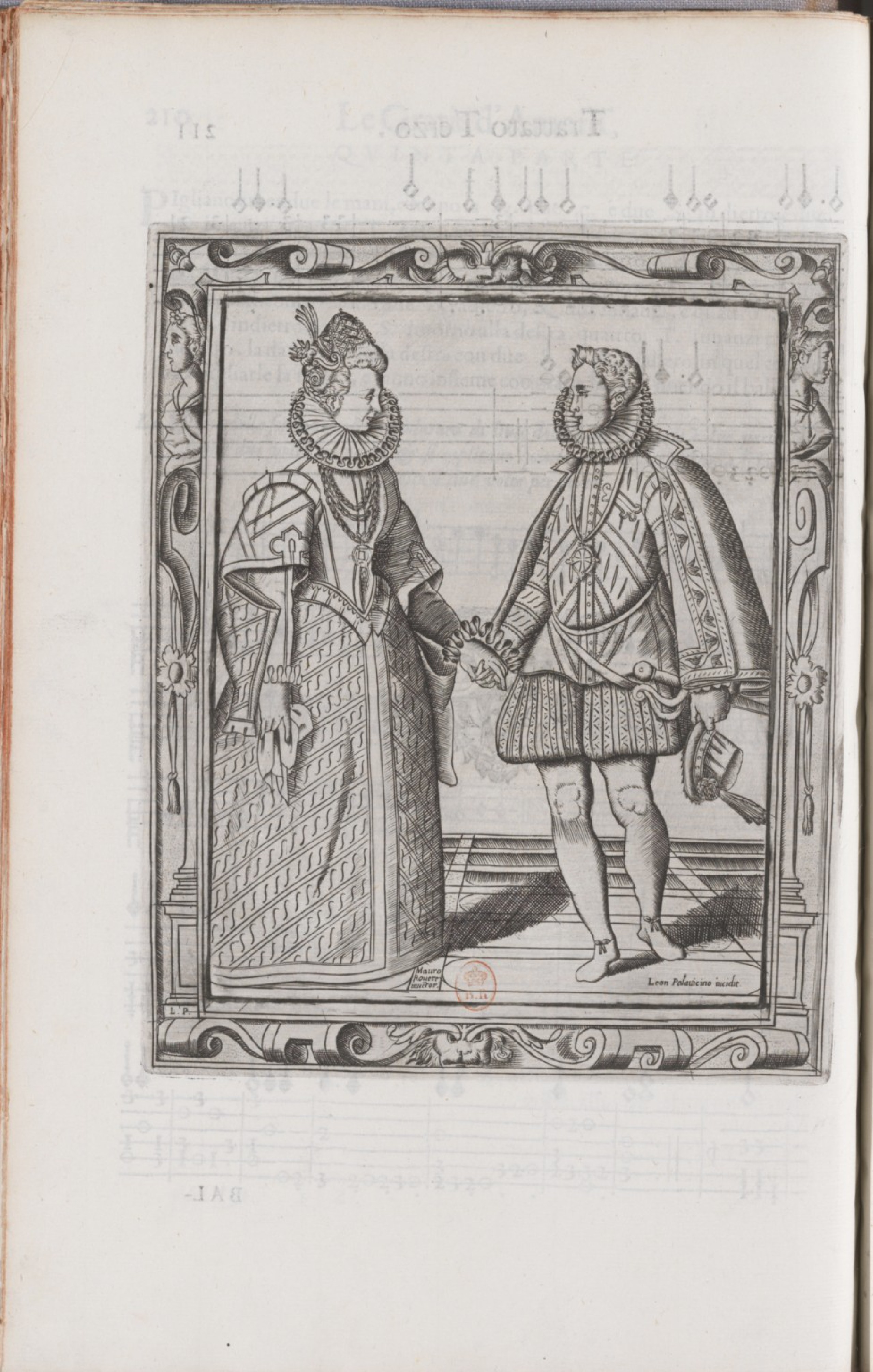
An engraved couple in elaborate early 17th-century court dress stand facing each other in a formal confrontation pose. The woman on the left wears a richly patterned gown with diagonal hatching indicating embroidery or brocade, a high ruffled collar, an ornate headdress with feathers or plumes, and long strands of pearls or beads across her chest. The man on the right, dressed in a pleated tunic or jerkin with similar patterned decoration, wears a matching ruff and feathered hat; he stands with his legs apart and appears to hold something in his right hand (possibly a glove or prop). Both figures are rendered in three-quarter view, their bodies angled toward each other. The frame is an elaborate decorative border typical of Renaissance printed books, with scrollwork, floral motifs, and small portrait busts at the corners. Behind the figures, a musical staff with notation is faintly visible, suggesting the dance had an associated air or melody.
The dancing
The two dancers maintain an upright, formal carriage characteristic of court dance. Their positioning is frontal and symmetrical, with the woman's weight appearing centered while the man stands with a wider stance, his legs extended and slightly bent at the knees. The gesture is one of formal address or greeting—they do not touch, but their bodies are oriented toward each other in a moment of salutation or acknowledgment. The precision of the engraving allows us to read the exact fall of fabric and the positioning of limbs; both dancers appear poised in a controlled, measured moment rather than in dynamic motion.
The dance depicted
This plate from Negri's *Le Gratie d'Amore* depicts a figure pair for a court dance of the late Renaissance or early Baroque period, most likely an Italian ballo or a variant of the branle, galliard, or pavane. The careful rendering of the couple's formal dress, symmetrical positioning, and the presence of musical notation above them indicate this is a didactic image meant to teach the positions and deportment required for this particular dance. The absence of any visible physical contact and the formal, almost ceremonial stance suggest a processional or greeting phase of the dance, before more elaborate footwork or turning figures would commence. Negri's notation system, visible in the staff above, would have provided dancers with the exact sequence of steps and timing.
How it was made
This is an engraving on paper, a medium that allowed for fine linear detail and wide distribution of dance instruction books. Engraving was the standard technique for printing dance manuals in the 16th and 17th centuries, as it permitted both text and images to be printed together and reproduced in multiple copies. The high level of finish in this plate—the careful cross-hatching to indicate fabric texture, the precise rendering of costume details, and the decorative border—indicates this was a significant commission, created by a skilled printmaker working from the dance master's designs. The inclusion of musical notation and the formal presentation format meant this plate served simultaneously as a visual guide and as a prestige object, demonstrating the refinement of courtly dance to an educated audience.
About this work
This is plate 8 from Cesare Negri's *Le Gratie d'Amore* (Milan, 1602/1604), a foundational dance instruction manual published at the height of the Italian Renaissance court dance tradition. Negri was among the most celebrated dance masters of his era, and his treatise combined detailed written descriptions of steps with engraved figures showing the positions, carriage, and dress appropriate to each dance. This particular plate presents a couple in the formal opening position of a court dance, their elaborate costume and upright bearing encoding information about rank, sophistication, and the refined movement that courtly dancing demanded. The work belongs to a tradition of dance notation and pedagogy that extends from Domenico of Piacenza through Fabrizio Caroso and into the Baroque era. It documents not only a specific choreography but an entire system of courtly gesture, dress, and musical accompaniment that was central to European court culture.
How to look at it
Attend to the formal stillness of the figures: this is not a photograph of movement, but rather a representation of a single, crucial moment—the opening stance or greeting pose of the dance. The engraver has chosen to freeze the dancers in a position of formal address, before the actual step-work begins. The costume details are not decorative excess but functional information: the cut of the garments, the width of the ruff, the height of the headdress, and the fall of the fabric all indicate the body position and movement that the dance requires. Look at the slight bend in the man's knees and the tension in both figures' posture—this is controlled, measured movement, not naturalism. The musical notation above signals that this visual information is inseparable from the music that accompanies it.
The artist
Cesare Negri (c. 1535–c. 1605), known as 'il Trombone,' was one of the most celebrated and influential dance masters of the late Renaissance. Based in Milan, he taught at courts throughout Italy and France, and his methods were sought by the nobility. Unlike some of his contemporaries, Negri was not a dancer himself but rather a theorist and choreographer who developed new notational systems and who was keenly interested in codifying and preserving the principles of court dance. His *Le Gratie d'Amore* (The Graces of Love), published in 1602 and again in an expanded edition in 1604, was the culmination of his career and became the definitive reference work for late Renaissance dance practice. The treatise combines elaborate prose descriptions with engraved figures and musical notation, making it one of the richest sources for understanding how Renaissance dance was composed, taught, and performed.
The period
The early 17th century was a moment of transition in European court dance. The energetic, virtuosic galliard and the grave pavane—hallmarks of the 16th-century court—were beginning to give way to more restrained and symmetrical figures influenced by emerging Baroque aesthetics. Italy, particularly Milan and Venice, remained centers of dance innovation and courtly refinement. At this moment, dance was understood as one of the essential accomplishments of a courtier: it demonstrated grace, education, physical control, and social status. The publication of elaborate printed dance manuals with engraved plates reflects both the prestige of dance and the emerging market for instruction among the nobility and bourgeoisie. Music and dance were tightly integrated; each dance had its prescribed melody and rhythm, notated and preserved in print.
Where it lives
This plate is from *Le Gratie d'Amore: Nuovamente composte dal Sig. Cesare Negri Milanese* (Milan: Heirs of Francesco and siblings Ponzio, 1602; second edition 1604). The work is held in the Library of Congress and other major collections. It is one of a series of engraved figures illustrating the dances and positions described in Negri's text.
Dance in this work
Questions about this work
What dance is being shown in this plate?
The catalogue record identifies this as a 'paired figure for a dance described in Negri's treatise,' but the specific dance name is not visible in the image itself. Based on the formal opening position, symmetrical stance, and the period, it is likely a pavane, branle, or Italian ballo. The musical notation above the figures would have identified the melody and tempo, which would in turn indicate the specific dance. To know for certain, one would need to cross-reference this plate number with Negri's written descriptions.
Why are they not touching or holding hands?
Many Renaissance and early Baroque court dances began with a formal greeting or processional phase before the dancers came into contact. The opening position shown here—with the dancers facing each other at a distance—represents the start of this sequence. The actual steps, turns, and hand-holds would follow, as described in Negri's text. This plate captures the moment of courtly address that preceded the more animated portions of the dance.
How would a dancer use this image?
A dancer learning from Negri's treatise would read the detailed prose descriptions of each step and figure, then consult the engraved plates to see the exact body position, carriage, and costume required. The plates served as visual reinforcement of the written instruction and as models of courtly deportment. The inclusion of musical notation on the plates connected the visual and sonic information, so the dancer could understand both the movement and its musical context.
What do the costumes tell us?
The elaborate embroidered fabrics, the high ruffs, the feathered headdresses, and the jewelry all indicate high-ranking courtiers. The precision with which these details are engraved—the cross-hatching to show brocade, the individual strands of pearls—demonstrates that costume was an integral part of the dance, not an afterthought. The dancer's body had to accommodate the weight and volume of these garments, and the movement had to display them to best effect.
More Notation/Choreography artwork