49 works in this view — arrow keys or swipe to move between them.
Dance in Art
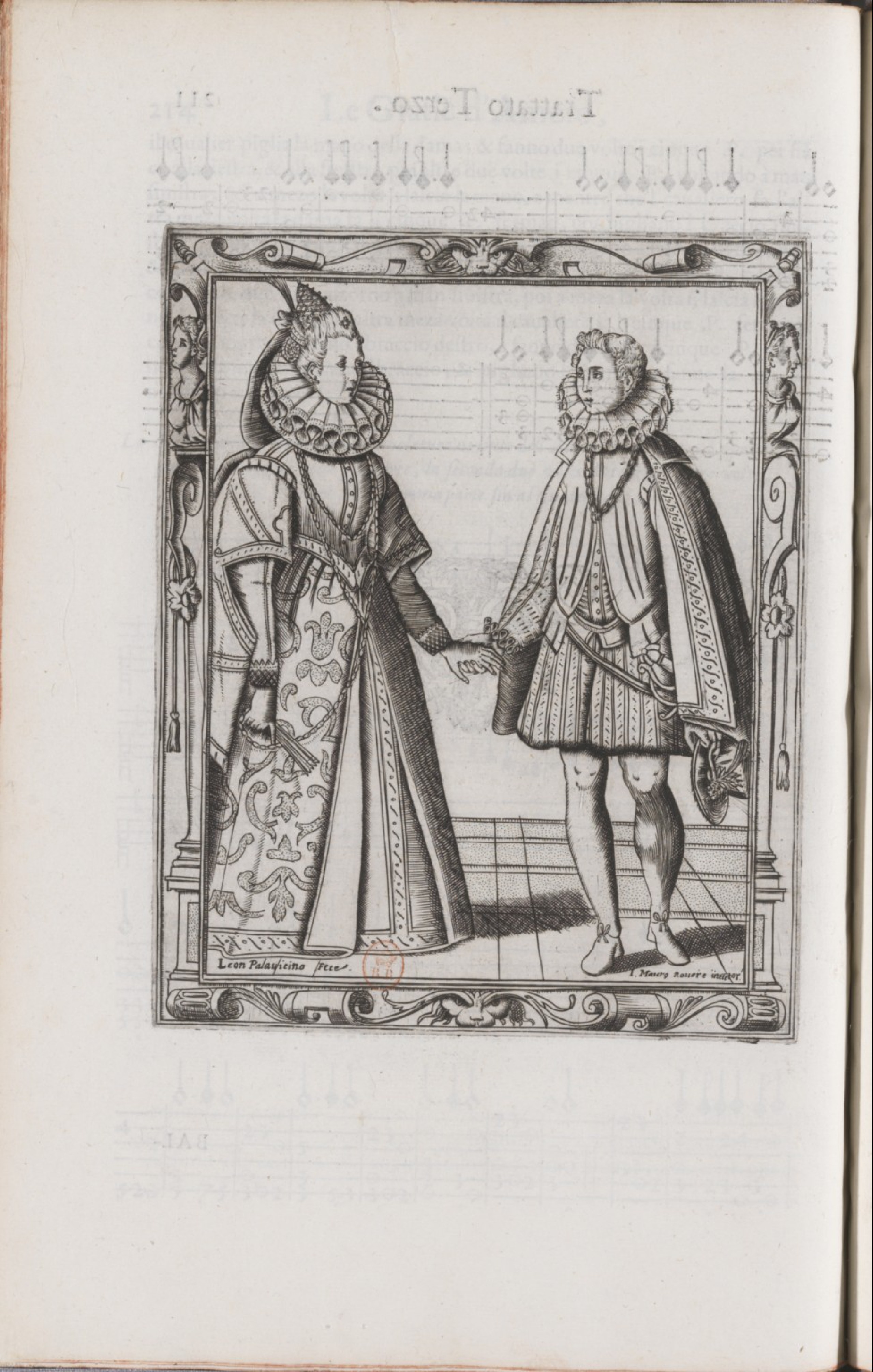
Negri — Dance Plate (plate 9)
Cesare Negri (il Trombone)
- Medium:
- Engraving
- Dance:
- Notation/Choreography
- Era:
- Pre-1700 (Renaissance/Baroque)
- Collection:
- Le Gratie d'Amore (1602)
- Source:
- Library of Congress
- Rights:
- Public domain — free to use, share and adapt.
- Recorded as:
- Public Domain
For dancers and historians, this plate is evidence of how Renaissance court dances were formally taught, notated, and transmitted across Europe. Negri's treatises are among the only surviving detailed choreographic records from this period, making them invaluable for understanding the technique, aesthetics, and social function of Renaissance dance. The paired figures and formal poses also document the visual presentation and deportment that defined nobility and courtly status in the Renaissance.
What you are looking at
A formal Renaissance court couple stands facing each other in an ornate architectural frame, their hands meeting in a gesture of salutation or partnership. The woman on the left wears an elaborate gown with a heavily patterned damask or brocade skirt decorated with scrollwork and floral motifs, worn under a dark fitted bodice; her ruff collar is high and fan-shaped, and her hair is dressed with jewelry. The man on the right wears a short doublet with slashed sleeves, fitted hose, and shoes; he is bare-legged below the knee in the fashion of the period, and wears a similar ruff collar. Both figures are positioned in an upright, formal stance suggesting the beginning of a dance figure rather than active movement. The setting is a classical interior with fluted pilasters and an ornamental border of scrollwork and masks typical of Renaissance print design. The engraving's fine crosshatching creates subtle modeling in the drapery and faces. The couple's posture and hand position suggest a moment of introduction or the opening phrase of a formal dance, characteristic of courtly choreography.
The dancing
The two figures stand upright with good carriage, their torsos facing forward and their heads turned slightly toward each other. Their hands meet at approximately waist height in what appears to be a gentle clasp or salutation—neither a closed ballroom hold nor a hand-in-hand side-by-side frame, but rather a formal paired position. The woman's weight appears centered, her skirts hanging in elegant vertical folds; the man similarly balanced. Both maintain the upright, dignified posture expected of court dancers, with no flexed knees or active footwork visible. The positioning suggests a moment of pause or preparation rather than mid-movement.
The dance depicted
This is a dance notation or choreographic illustration from Cesare Negri's *Le Gratie d'Amore*, one of the principal Italian Renaissance dance treatises. Negri's work documented the ballo (formal court dances) taught in Italian noble courts in the late 16th and early 17th centuries. The couple's formal, upright frame and hand position are consistent with the opening poses of Renaissance couple dances such as the pavane or variants of the galliard. The emphasis on dignified carriage and the paired but not close hold reflects the courtly aesthetics of late Renaissance dance. Without the accompanying text (which would describe the specific steps and patterns), the exact dance cannot be identified with certainty, but the formal salutation pose is typical of the opening figura (figure or phrase) in Negri's choreographed dances.
How it was made
This is an engraving, a relief printmaking technique that allowed precise, reproducible images and made possible the wide circulation of Negri's treatise across European courts. The fine parallel lines (hatching and crosshatching) create tone and volume in the drapery and faces; the ornamental border and architectural frame were cut as part of the copper plate. Engraving was the standard medium for dance notation treatises of the period, as it provided clarity, durability, and the ability to print multiple copies. The technique's requirement for precise, controlled lines likely encouraged the formal, posed presentation of dance figures rather than capturing movement in progress.
About this work
This engraving is a choreographic notation plate from *Le Gratie d'Amore* (Milan, 1602/1604), the dance treatise by Cesare Negri, the celebrated Milanese dance master. It presents a Renaissance court couple in the formal opening pose of a ballo, one of the courtly couple dances that defined elite social practice in late 16th- and 17th-century Italy. The work sits at the intersection of dance notation and court portraiture: it documents not just the appearance of the dancers but the prescribed positions and sequences that structured court performance. Negri's treatise represents one of the most detailed surviving records of Renaissance choreography, and his plates combine the elegance and precision of contemporary court dress with the practical needs of teaching dance across distance and time.
How to look at it
Attend to the formality and restraint of the pose: these are not exuberant or athletic figures but upright, dignified, and carefully positioned. Notice the woman's elaborate dress and jewelry, which would have restricted movement and made any such dance a display of status and control rather than virtuosity. The hand position—meeting without grasping—is key to understanding Renaissance partnering; it is less intimate than later ballroom dancing but more connected than the side-by-side or facing formations of some earlier dances. The engraving's clarity allows you to read the precise details of costume and posture that would have communicated rank, fashion, and courtly identity to a contemporary viewer.
The artist
Cesare Negri (c. 1535–c. 1604), known as il Trombone, was the most celebrated Italian dance master of the late Renaissance. Born in Milan, he taught at the Sforza court and traveled widely throughout Italian courts and to France, establishing himself as an authority on courtly dancing. He published *Le Gratie d'Amore* in 1602 (a revised and expanded edition appeared in 1604) to codify the choreographies, rules, and philosophy of court dance. His treatise was more comprehensive and more visually elaborate than earlier dance manuals (notably Fabrizio Caroso's *Il Ballarino* of 1581), combining detailed written descriptions of steps and figures with engraved illustrations of couples in characteristic poses. Negri's work systematized the ballo and the balletto as courtly arts and influenced dance practice across Europe into the 17th century.
The period
The late 16th and early 17th centuries saw dance elevated to a principal art of the Renaissance court. Courtly dance was understood as a moral and physical discipline, a display of noble breeding and grace, and a form of social bonding among the elite. The Italian court dances documented by Negri—the pavane, galliard, and their variants—were slow, stately, and formally structured, quite different from the folk dances of the period. The publication of dance treatises, beginning with Caroso in 1581 and Negri in 1602, was a response to the demand for standardized instruction and the desire to preserve and transmit choreography in an age before film or notation systems. Engraving was the cutting-edge technology for reproducing images with precision, and its use in dance treatises reflects the cultural prestige of the art form and the sophisticated audience for such manuals.
Where it lives
This engraving is from *Le Gratie d'Amore*, Cesare Negri's dance treatise published in Milan in 1602 (a second edition in 1604). The Library of Congress holds a copy of this edition. The treatise consists of written descriptions of dances accompanied by engraved plates showing couples and groups in characteristic poses and figures.
Dance in this work
Questions about this work
How is this different from later ballroom dancing?
Renaissance court dances like those in Negri's treatise were more formal and structured, with prescribed patterns and figures danced across the floor. The hold was lighter and the posture more upright. Later ballroom dances (waltz, quadrille) developed closed holds, rotational movement, and different musical meters. Renaissance dances emphasized courtly dignity; Romantic-era ballroom emphasized elegance in motion.
Why is the woman wearing such an elaborate skirt if she was dancing?
The heavy, formal gown was itself part of the performance and a marker of status. Renaissance court dances were slow and controlled, designed to display expensive dress and noble bearing rather than athletic virtuosity. The dancer's ability to move gracefully despite the weight and restriction of the costume demonstrated both breeding and skill.
Is this plate a notation system?
Not in the modern sense—it does not record exact positions or counts the way a Labanotation or Benesh score does. Rather, it is a visual aid to accompany the written descriptions in the treatise text. The image shows the opening or characteristic pose of a figure; the text explains the steps, timing, and choreography. A reader with some dance training would use both text and image together to reconstruct the dance.
Who was allowed to dance these dances?
Court dances were performed by and for the noble elite. Both men and women of noble or courtly rank learned them as part of their education. Negri himself was a professional dance master who taught these dances to noble families and courtiers, but the performance contexts were closed court occasions, not public entertainment.
More Notation/Choreography artwork