49 works in this view — arrow keys or swipe to move between them.
Dance in Art
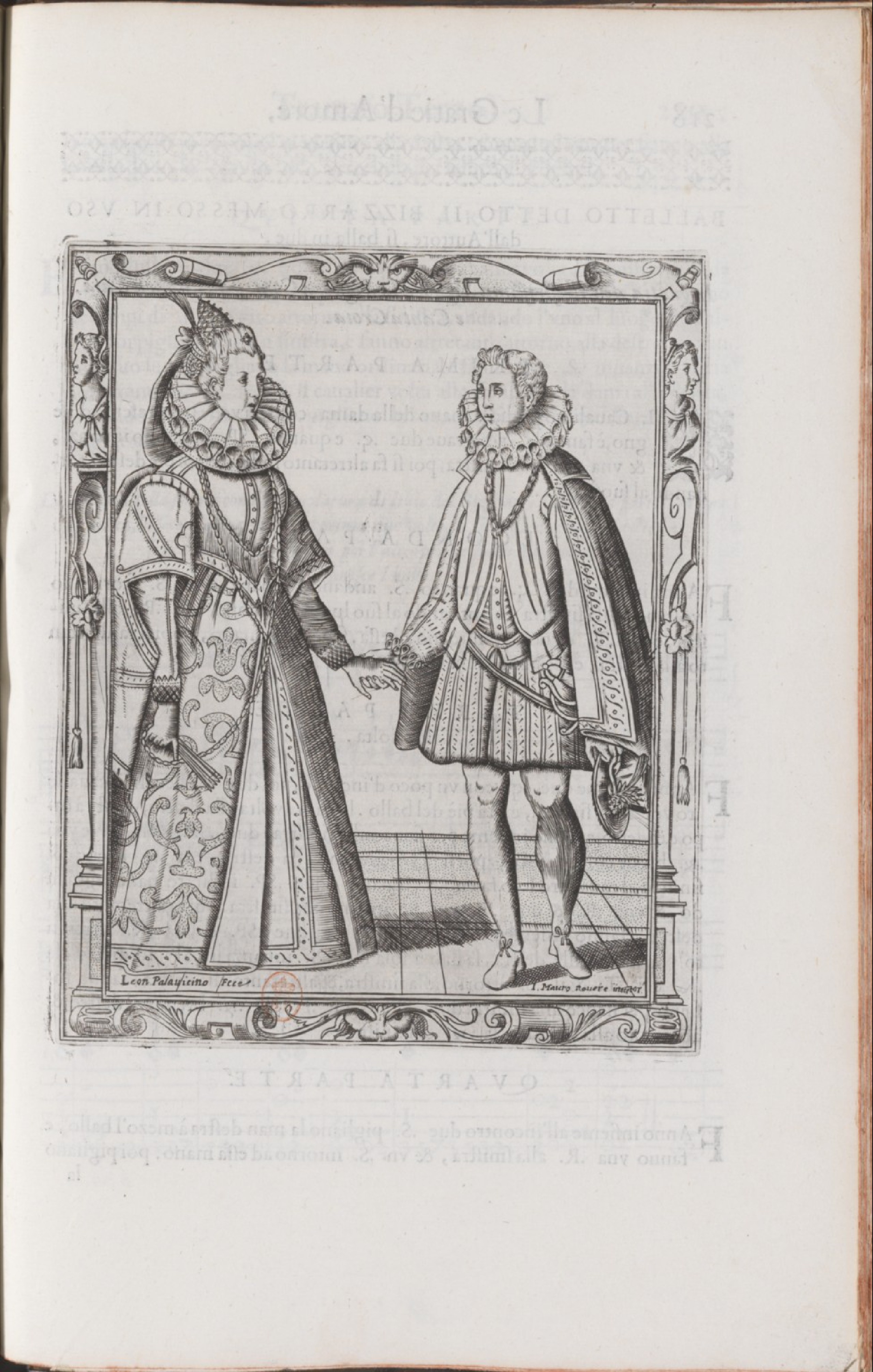
Negri — Dance Plate (plate 10)
Cesare Negri (il Trombone)
- Medium:
- Engraving
- Dance:
- Notation/Choreography
- Era:
- Pre-1700 (Renaissance/Baroque)
- Collection:
- Le Gratie d'Amore (1602)
- Source:
- Library of Congress
- Rights:
- Public domain — free to use, share and adapt.
- Recorded as:
- Public Domain
This engraving is one of the earliest visual documents of notated Renaissance dance choreography and shows how movement was literally illustrated to teach dancers the positions and holds required by Negri's prescribed dances. For historians and dancers, Negri's plates are among the few primary sources that pair explicit choreographic instruction with visual representation of the body in space.
What you are looking at
This engraving depicts two richly dressed figures in a formal court setting, likely representing a dance couple from a Renaissance Italian treatise. The figure on the left wears an elaborate gown with a patterned brocade skirt, a fitted bodice with intricate embroidery, and a dramatically high starched ruff collar adorned with intricate pleating. Her hair is pinned up in the fashionable style of the period. The figure on the right, in male dress, wears a doublet and hose with a similarly imposing ruff collar, a short draped cloak or cape, and stands with one leg slightly advanced. Both figures are shown in profile or three-quarter view, and their hands appear to join or touch, suggesting the formal hold required for a courtly paired dance. The composition is framed within an ornate Renaissance border featuring scrollwork, floral motifs, and classical details. The engraving technique creates fine linear detail throughout, from the textile patterns to the articulation of the figures' limbs.
The dancing
The male figure stands with weight distributed evenly, one leg slightly forward in a stance ready for movement. The female figure mirrors this stance, her body inclined slightly toward her partner. Their hands meet between them in what appears to be a hand-hold or finger-touch common to Renaissance court dances. Both figures maintain upright posture from the neck through the torso, with no flexion at the waist. The positioning suggests a moment of contact or introduction within a dance phrase rather than a vigorous movement sequence—the bodies are poised and formal, not caught mid-action.
The dance depicted
This plate illustrates a Renaissance Italian court dance, most likely an allemande, pavane, or galliard from the Negri tradition, though the static posed quality and hand-hold suggest a more processional or stately dance rather than the vigorous galliard. Negri's *Le Gratie d'Amore* (1602) compiled and notated the dances of the Italian courts and those taught by Negri himself, who was celebrated as a master of choreography across Italy and France. The image documents a moment of connection or introduction in a formal paired dance, showing the precise hand positioning and bodily alignment that defined courtly dancing of the late Renaissance. The figures' alignment and the formality of their dress indicate this was a dance of significant social importance, performed at court.
How it was made
This is an engraving, a technique that allowed for precise linear detail and fine tonal modeling through parallel lines and cross-hatching. Engraving required a copper plate and specialist skill; the detail visible here—the texture of fabric, the articulation of fingers, the decorative border—demonstrates technical competence. As part of a published treatise, this engraving served an instructional function, distributed to courts and dance masters across Europe. The print format meant multiple impressions could circulate; this particular example is held by the Library of Congress. The engraving's clarity and formal composition made it an effective teaching tool for dancers and choreographers studying the prescribed movements of court dances.
About this work
This is one of ten dance plates from Cesare Negri's *Le Gratie d'Amore* (Milan, 1602/1604), a foundational Renaissance dance treatise that paired written choreographic notation with engraved figures demonstrating the posture and positioning required for court dances. Negri was one of the most celebrated dance masters of his era, sought across Italian and French courts. The plate documents the formal paired stance and hand-hold of late Renaissance court dancing, showing how dancers were expected to hold their bodies—upright, controlled, and precisely positioned. This work sits at the intersection of dance notation and visual documentation: Negri's plates became the standard by which dancers of the period learned formation and carriage, making them foundational documents in the history of European court dance.
How to look at it
Attend to the precision of the hand-hold and the alignment of the bodies—this is a pose that required training and discipline to achieve. The formality of the stance is not a lack of liveliness but a marker of control and courtly decorum. Notice the relationship between the bodies: they are parallel and symmetrical, not intertwined or dramatically engaged, which tells you this is a moment of formation or processional movement rather than a climactic turn or leap. The elaborate dress is not decorative excess but part of the dance itself—the skirt's drape, the ruff's structure, and the doublet's fit all constrained and shaped the body's movement.
The artist
Cesare Negri, known as il Trombone (c. 1535–after 1604), was one of the most celebrated and prolific dance masters of the late Renaissance. Based in Milan, he taught at courts across Italy and France and was renowned for both his teaching and his choreographic innovation. *Le Gratie d'Amore* was his major published work, combining written choreographic descriptions with engraved plates showing the formal poses and partnering configurations his dances required. Negri's treatise built on earlier works by dance masters like Fabritio Caroso but integrated more detailed notation and a larger repertory of dances.
The period
By 1602, the printed dance treatise was an established genre. Caroso's *Il Ballarino* (1581) had shown that dance could be recorded in print and circulated as instruction; Negri's *Le Gratie d'Amore* refined and expanded this model. The late Renaissance court was at its peak as a venue for elaborate dancing; the dances Negri documented—pavanes, galliards, and courtly variations—were the vocabulary of social and ceremonial life among the nobility. The engraved plates served a practical function: they showed dancers and choreographers the exact carriage and positioning that marked proper performance. By this date, dance was recognized as an essential courtly accomplishment, and printed instruction in the proper forms was in demand.
Where it lives
This engraving is part of *Le Gratie d'Amore*, Negri's 1602 publication from Milan (also referred to in some records as 1604). The holding collection is the Library of Congress. This is plate 10 from the series of dance plates that illustrated Negri's choreographic treatise.
Dance in this work
Questions about this work
Who are these two people?
They are not named individuals but rather generic figures representing a male and female dancer in court dress, shown in the formal pose that Negri prescribed for the dances in his treatise. The plate illustrates the proper positioning and carriage for a partner dance, not a specific couple.
What dance are they doing?
The engraving does not identify a specific dance by name within the plate itself. The dances in *Le Gratie d'Amore* include pavanes, galliards, allemandes, and variations of these forms. The static, formal positioning here suggests a moment from a more stately dance such as a pavane rather than the vigorous galliard, but the image alone cannot specify which.
How do we know how to do these dances today?
Negri's written descriptions and these engraved plates together provide the primary documentation of his choreographies. Modern dancers and historians studying Renaissance court dance use both the textual notation (which describes steps in period terminology) and these visual representations of body position and partnering to reconstruct the dances.
Why is the ruff so enormous?
The tall starched ruff was the height of fashion in the late 16th and early 17th centuries and appears in all formal court dress of the period. It also constrained the dancer's neck and prevented turning the head freely, which shaped how the upper body could move—an important detail for understanding Renaissance dance technique.
More Notation/Choreography artwork