49 works in this view — arrow keys or swipe to move between them.
Dance in Art
Courtly Couple — Plate 78
Gregorio Lambranzi
- Medium:
- Copper-plate engraving
- Dance:
- Notation/Choreography
- Era:
- 1700s (Enlightenment/Minuet Era)
- Collection:
- Nuova e curiosa scuola de' balli theatrali (1716)
- Source:
- Library of Congress
- Rights:
- Public domain — free to use, share and adapt.
- Recorded as:
- Public Domain
Lambranzi's manual is one of only a handful of choreographic sources that combine notation, visual instruction, and verse description, making it possible to reconstruct not only what steps were danced but how bodies were positioned and why certain movements mattered in early eighteenth-century courtship and theatrical display. For historians and dancers, the image is invaluable evidence of posture, costume, and the aesthetic ideals of the ballroom at the moment when the minuet was becoming the dominant social dance of European nobility.
What you are looking at
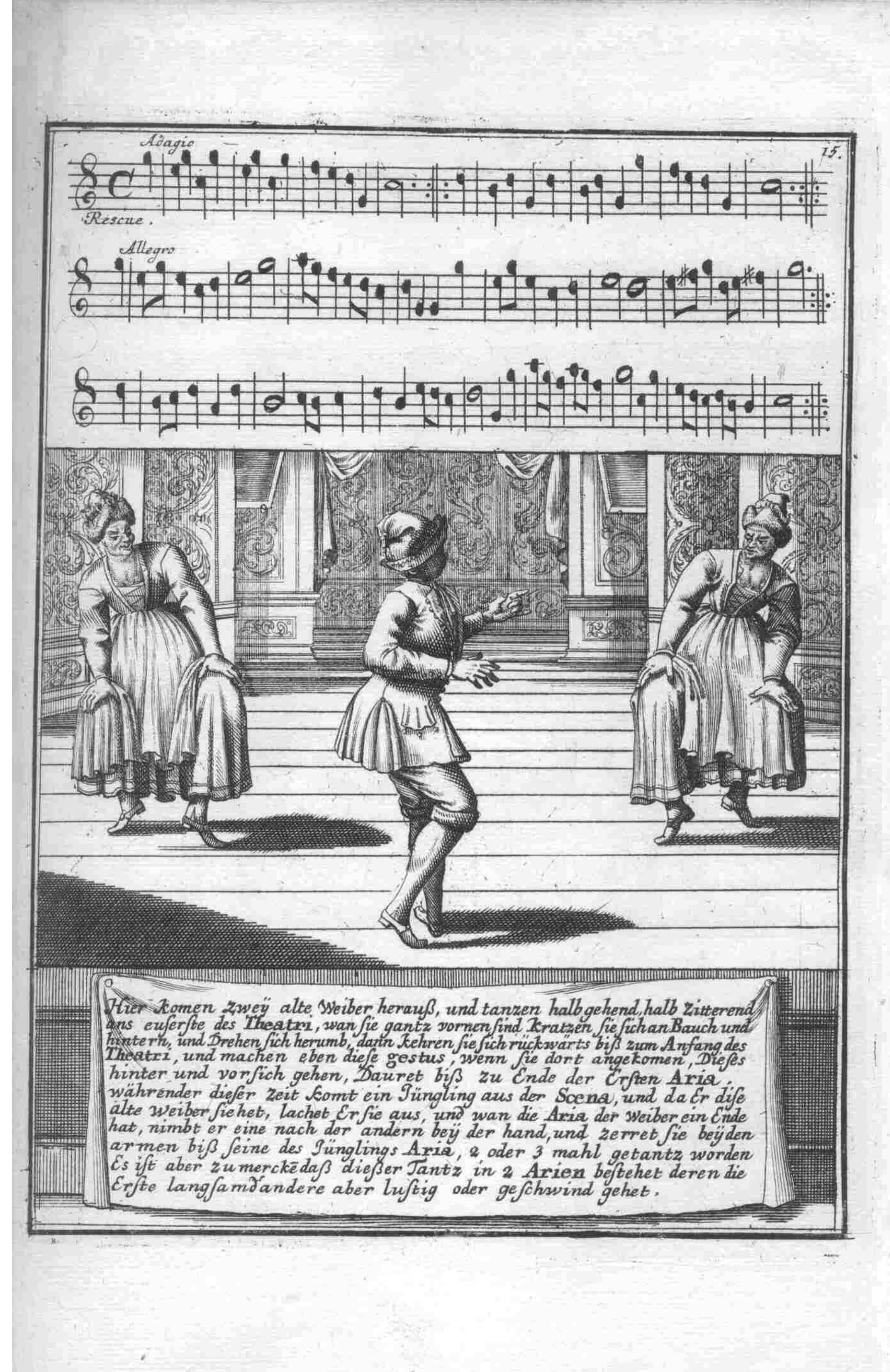
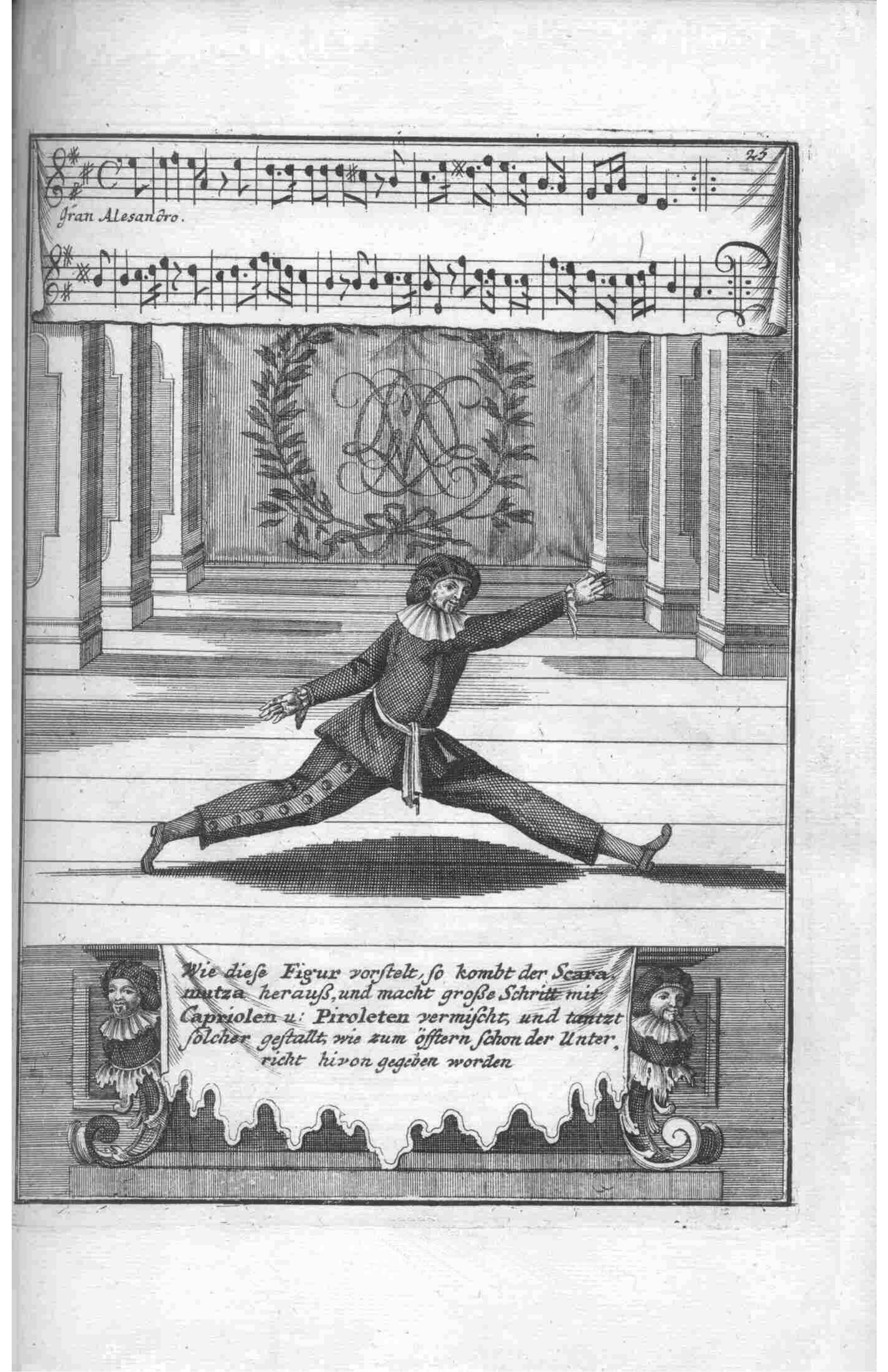
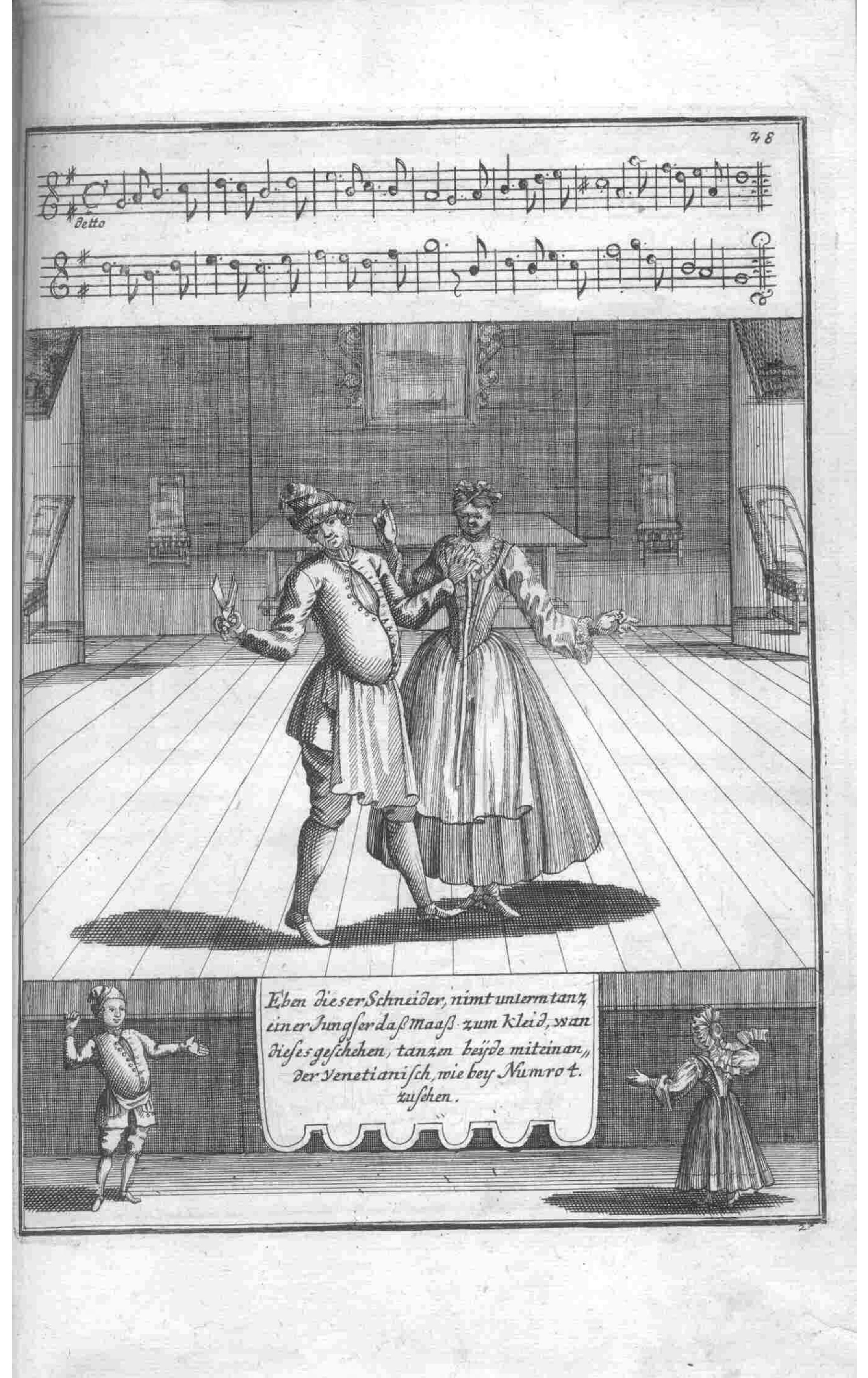
A gentleman and lady occupy the center of a wooden-floored interior stage, framed by a proscenium arch with draped curtains at either side. The man, dressed in fitted breeches, tunic, and ornate jacket with puffed sleeves, stands to the left in three-quarter profile; the woman opposite wears a long, high-waisted gown with full skirt and elaborate headdress. Both are mid-movement, leaning slightly toward each other in an attitude of courtly address. The setting is spare and formal—bare walls, a small window or hanging in the background—which emphasizes the dancers themselves rather than narrative or spectacle. Two smaller figures appear below the stage frame: on the left a cherub or putto, on the right a standing woman in contemporary dress, both apparently observing or commenting on the action above. Musical notation appears at the top in two staves, marked *Ballo*, indicating this is a dance to be learned and performed from the score.
The dancing
The two dancers are approximately equal in height and positioned in open-facing but asymmetrical stance, neither in a closed ballroom hold nor in symmetrical formation. The man's weight appears forward on his right leg, his left arm extended as if in greeting or leading gesture; his posture is upright and his torso faces the woman. The woman, mirroring some of his forward lean, stands with her weight distributed and her arms held with grace at waist height. Both carry themselves with formality and restraint—there is no jumping, flying hair, or collapse of the spine; every line is controlled and architectural. The proportions and anatomical understanding suggest the artist grasped the balletic carriage required, even if specific footwork cannot be resolved from the image.
The dance depicted
This is most likely a *minuet* or a similar courtly paired dance of the early eighteenth century, danced in a ballroom or theatrical setting among the nobility and merchant elite. The German verse beneath describes the dance and the context of its performance. The engraved plate is from Lambranzi's *Nuova e curiosa scuola de' balli theatrali*, a systematic choreographic manual in which each dance was notated above and illustrated below so that dancers could learn steps and sequence from both music and image. The open facing position, upright carriage, and formal interior setting are consistent with the minuet's character as a restrained, processional dance of courtesy; the presence of both figures on stage suggests this was a social dance of courtship or formal greeting rather than a solo or asymmetrical theatrical piece.
How it was made
This is a copper-plate engraving, a technique that allows fine linear detail and repeatable print production, making it ideal for instructional manuals. The artist has used cross-hatching and parallel lines to define form and shadow, building volume through accumulated marks rather than wash or tone. Engraving was the standard medium for dance notation and choreographic instruction in the seventeenth and eighteenth centuries because it produced sharp, reproducible images that could be bound into books and distributed to dancers across Europe. The technique's clarity makes it possible to read posture and arm position precisely; the very regularity of the linework reinforces the formality and discipline of the dance itself.
About this work
Plate 78 from Gregorio Lambranzi's *Nuova e curiosa scuola de' balli theatrali* (Nuremberg, 1716) is an engraved instructional image pairing musical notation with choreographic illustration, showing a gentleman and lady in the opening attitudes of a courtly paired dance. It is one of the era's most comprehensive and influential sources on ballroom and theatrical dance practice, designed to teach dancers in cities far from the master's own studio. The manual was reprinted and adapted across Europe for over a century, making it foundational to the history of minuet and ballet training.
This particular plate exemplifies the book's method: the melody at the top in figured notation, the theatrical stage setting with both dancers shown in decorous contemporary dress, and a vernacular text explaining the dance's character and purpose. The image is not a documentation of a single performance but rather a prescriptive teaching tool—a template for how any dancer of gentility should carry the body, position the feet, and move through space when executing this dance.
How to look at it
Observe the moment of the dance the engraver has chosen to freeze: not mid-leap or turn, but at a moment of greeting or acknowledgment, with both dancers upright and facing each other. This choice is deliberate—it emphasizes the social and courtly character of the dance rather than virtuosity or spectacle. Notice the formality of the setting, the emptiness of the stage, and the equality of the two figures; there is no hierarchy of gaze or positioning that would suggest a performance for an audience rather than a social exchange. The musical notation at the top is not decorative but functional: a period viewer would be able to read the melody and rhythm from the engraved staff, making this a *readable* image in the sense that a musician or trained dancer could learn from it. Finally, attend to the clothing: the woman's headdress and the precise cut of both figures' garments date the image and confirm its period context as early eighteenth-century German or French court dress.
The artist
Gregorio Lambranzi (c. 1650–after 1710) was a Italian choreographer and dance master active in Nuremberg and other German cities in the late seventeenth and early eighteenth centuries. He is known almost entirely through this single printed work, which he likely compiled from his own teaching practice and that of other masters. The *Nuova e curiosa scuola de' balli theatrali* was published first in Nuremberg in 1716, two years after his death, and represents a systematic attempt to notate and preserve both social and theatrical dances for wider circulation. The book's success—it was reprinted and adapted into French and English editions—suggests Lambranzi's reputation as a teacher was already established or posthumously enhanced by the manual's comprehensiveness and clarity.
The period
The early eighteenth century was the age of the *minuet's* dominance in European ballrooms and courts, following the dance's emergence in France in the late seventeenth century. The minuet was the pinnacle of courtly accomplishment: a slow, processional, highly geometric dance that required grace, control, and above all the correct posture and deportment that signaled noble birth or aspiration. At the same time, theatrical dance was becoming increasingly formalized and notated; Raoul-Auger Feuillet's system of choreographic notation, published in 1700, had established a standard shorthand for recording steps and directions, enabling dances to be transmitted in printed form across Europe. Lambranzi's manual appears at the crest of this movement toward codification and democratization of dance knowledge. The book also captures the moment when dance was becoming a subject worthy of serious technical study and written preservation, rather than a purely oral and embodied tradition passed from master to apprentice.
Where it lives
This plate is held in the Library of Congress and is part of the first printed edition of Lambranzi's *Nuova e curiosa scuola de' balli theatrali*, published in Nuremberg in 1716. It is one of approximately 100 plates in the complete manual, each following the same format of musical notation and illustrated dancers. The book was intended as a practical teaching tool for dance masters and pupils across Europe, and its circulation in multiple editions and translations underscores its authority and influence on ballroom and theatrical dance practice throughout the eighteenth century.
Dance in this work
Questions about this work
Is this a real dance or a made-up example?
This is a real courtly dance, likely a minuet or a variant of it, documented in Lambranzi's manual as an actual taught sequence. However, the image is not a record of a specific performance but a prescriptive illustration—a template showing how the dance should be executed. Dancers would use the notation and the image together to learn the steps and carriage required.
What is the music at the top?
The notation at the top is a melodic line in figured bass or similar early eighteenth-century notation, indicating the music to which this dance was performed. The label *Ballo* (dance) marks it as dance music. A musician or trained dancer could read the melody and rhythm from the engraved staff, making the image a complete pedagogical object combining music and movement.
Why are there other figures at the bottom of the plate?
The cherub (putto) and the standing woman at the bottom are likely decorative elements or allegorical references common to the period, emphasizing the courtly and genteel nature of the dance above. Some plates in choreographic manuals include such marginal commentary or observation figures, lending the image a theatrical frame-within-a-frame quality.
Could women actually dance this dance, or is this a manual for men only?
Women absolutely danced these courtly dances; the image shows both a gentleman and a lady as equal participants. The manual was designed for both sexes, and the minuet and similar dances were central to courtly social life for both men and women of the nobility.
More Notation/Choreography artwork