49 works in this view — arrow keys or swipe to move between them.
Dance in Art
Pastoral — Plate 80
Gregorio Lambranzi
- Medium:
- Copper-plate engraving
- Dance:
- Notation/Choreography
- Era:
- 1700s (Enlightenment/Minuet Era)
- Collection:
- Nuova e curiosa scuola de' balli theatrali (1716)
- Source:
- Library of Congress
- Rights:
- Public domain — free to use, share and adapt.
- Recorded as:
- Public Domain
Lambranzi's manual is one of the few surviving sources that combines notation with visual documentation of early 18th-century dance costume, staging, and theatrical context. For dance historians and performers, the pairing of music, image, and text offers rare evidence of how actual steps were executed and how they related to character, costume, and dramatic setting. The work shows that theatrical dance in this period was a fully notated, choreographically complex practice, not improvisation or folk tradition, and that pastoral characters were performed with a deliberate aesthetic of simplification and naturalism.
What you are looking at
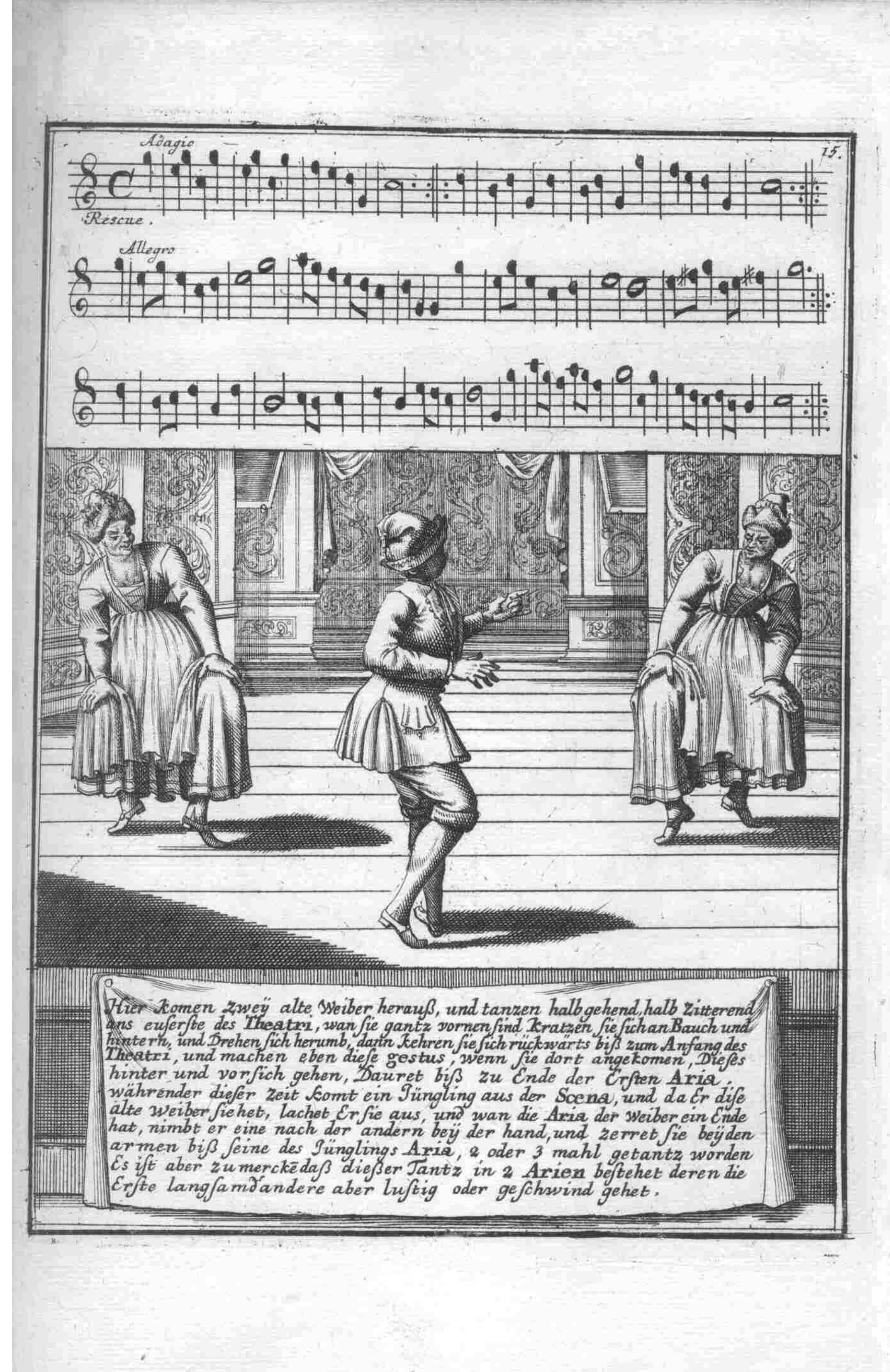
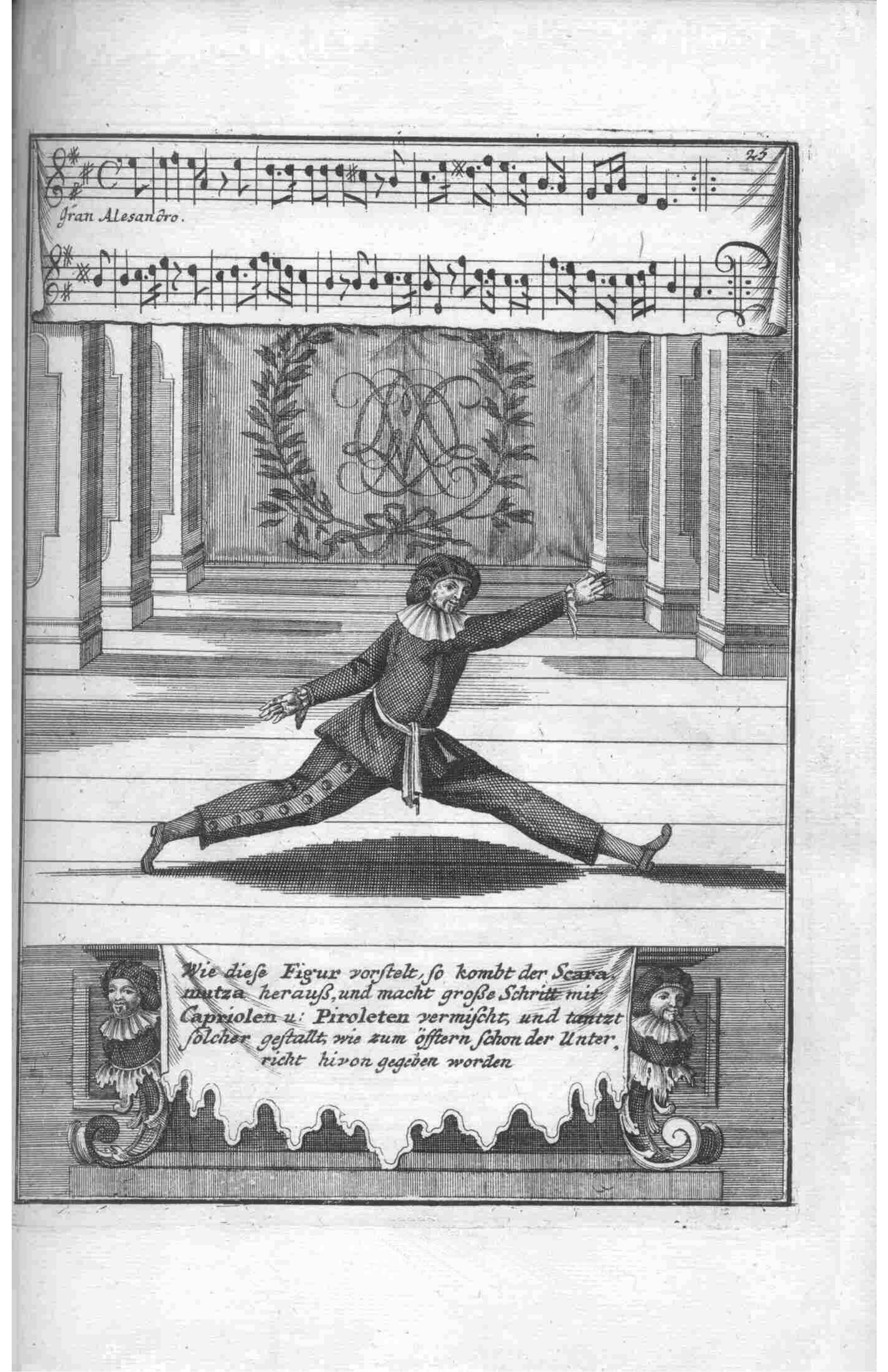
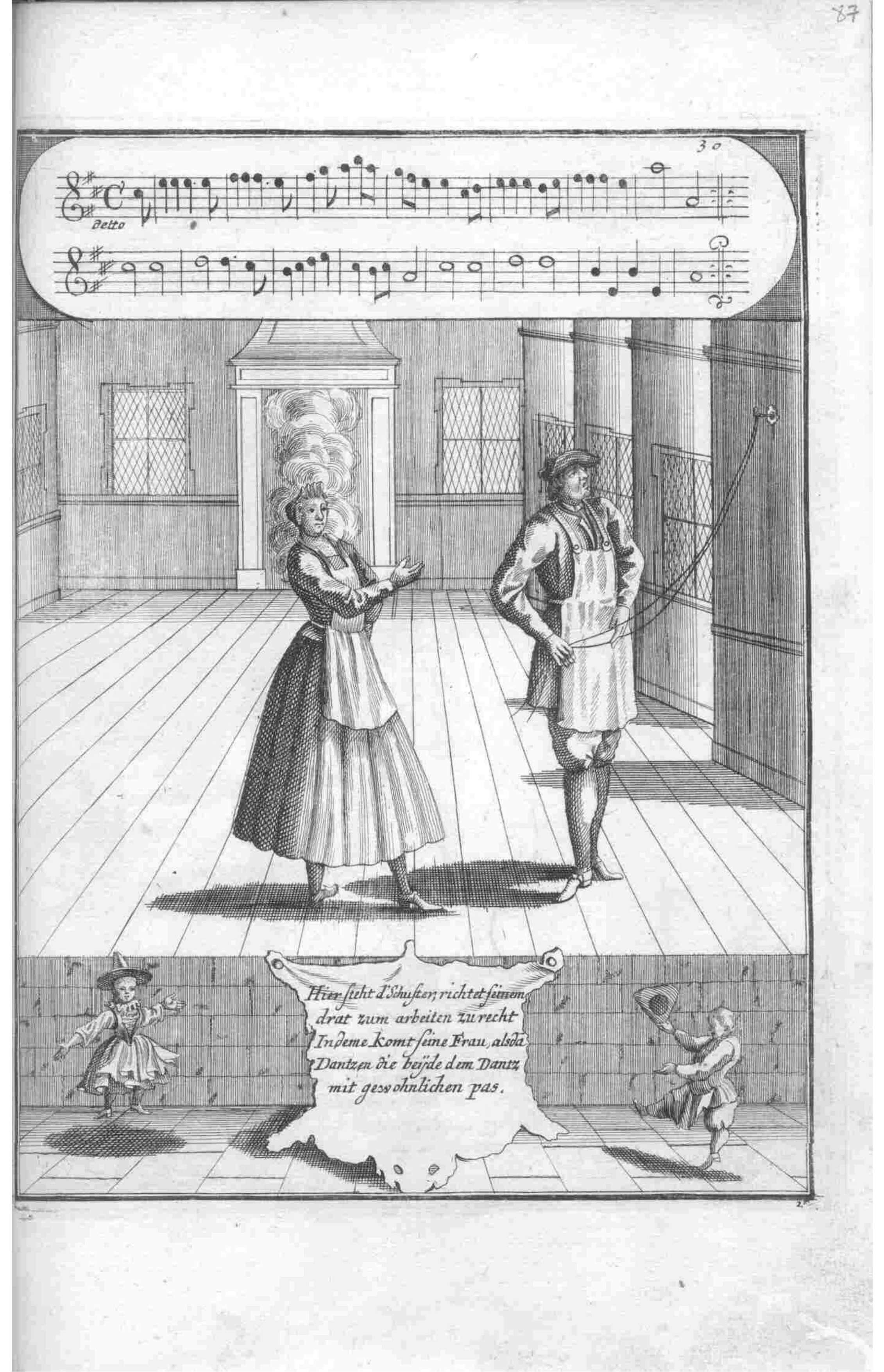
A couple in rustic pastoral costume stand on a wooden stage framed by curtains and classical architecture. The woman wears a full-skirted dark dress with a white apron and an elaborately piled coiffure; the man wears fitted breeches, a white linen shirt, and a dark jacket or doublet. He holds a curved bow or possibly a shepherd's crook. The stage setting includes Corinthian columns and latticed windows, creating a theatrical interior. The floor is rendered in perspective with parallel lines. Above the scene, two staves of musical notation in alto clef provide the melody for their dance. Below, a German verse in a decorative cartouche offers commentary. The engraving is precise and shows careful attention to the textures of fabric, the play of light on the wooden floor, and the formal arrangement of figures within the architectural frame.
The dancing
The couple stand nearly upright and at some distance from each other—not in contact or closed hold. The man's posture is relaxed, one arm at his side and the other holding what appears to be a prop. The woman's arms hang naturally at her sides or rest on her skirt; her weight appears evenly distributed. Neither figure demonstrates the elevated line or turned-out legs characteristic of formal court dance; their stance is grounded and naturalistic. The spacing and neutral positioning suggest they may be about to begin a dance, or this captures a moment of social interaction rather than active movement.
The dance depicted
This plate depicts a pastoral or rustic dance, one of the theatrical genre dances popular in early 18th-century European court and commercial theaters. The notation and the term 'Pastoral' in the title indicate a choreographed theatrical work rather than folk dance. The couple's costume and the shepherd's prop suggest the bucolic subject matter typical of pastoral entertainments. The relaxed posture and absence of formal court technique (turned-out positions, elevated carriage) indicate the deliberate simplification and naturalism expected of pastoral style—a theatrical genre that imitated country life for urban aristocratic audiences. Without access to the full choreography or context within Lambranzi's manual, the specific steps and movement vocabulary cannot be determined from this single moment.
How it was made
This is a copper-plate engraving, a technique that produced fine linear detail through acid-etching and hand-engraving. The medium allowed precise rendering of architecture, drapery, and facial features, and supported the dense cross-hatching used for shadow and volume. Engraving was the standard method for reproducing choreographic manuals and dance treatises in the early modern period because it could be printed repeatedly from a single metal plate, making it economical for commercial publication. The clarity and legibility essential for instructional use—dancers needed to read both image and notation—drove the formal composition and careful spacing of elements within the frame.
About this work
This is Plate 80 from Gregorio Lambranzi's *Nuova e curiosa scuola de' balli theatrali* (1716), one of the most important European sources for early 18th-century theatrical dance. The manual paired notated melodies with engraved illustrations of costumed dancers performing a repertory of choreographed theatrical genres—court dances, comic pieces, national character dances, and pastorals. Lambranzi's work documents the transition from the elite court dance tradition toward commercial theatrical dance as it was performed in European courts and public theaters in the early Enlightenment. This particular plate shows a pastoral couple, representing one of the period's favorite theatrical genres: the stylized imitation of rural or rustic life. The work is foundational to understanding both the visual culture of dance and the notation systems of the period.
How to look at it
Look at the spacing and posture: the couple are neither in formal court alignment nor in active movement. The engraver has chosen a moment of social presentation rather than dynamic action—a pose that establishes character and costume before the dance begins. Note how the elaborate architecture and stage frame elevate the pastoral couple into a theatrical context; this is not a village scene but a staged imitation of one. The notation above confirms that what you are seeing is a specific choreographed work, not a generic scene. The prop (the curved object in the man's hand) is a visual marker of the pastoral genre and would have been recognized immediately by contemporary viewers as a shepherd's attribute.
The artist
Gregorio Lambranzi (fl. 1703–1730) was an Italian dance master and choreographer active in Nuremberg and other German-speaking centers. He composed dances for court, theater, and ballroom and is known primarily through his written and illustrated manual, the *Nuova e curiosa scuola de' balli theatrali*, published in Nuremberg in 1716 (with a second edition in 1728). The manual contained 144 plates and represented one of the most ambitious attempts to document the full range of theatrical dance practice in early 18th-century Europe. Lambranzi's approach—combining Feuillet notation with engraved costume studies and architectural staging—made the manual a commercial and pedagogical success and established it as a standard reference for dance history.
The period
This plate dates to the early 18th century, a period of rapid change in European dance. The formal court dances of Louis XIV's reign—minuet, sarabande, courante—had become standardized and were codified in notation systems (most notably Feuillet's system, published in 1700). Simultaneously, theatrical and commercial dance was expanding beyond the court, and choreographers were developing a wider vocabulary of character dances, comic pieces, and genre scenes. The pastoral was one of the most popular of these theatrical genres, drawing on literary and visual tradition (pastoral poetry, pastoral painting) and offering audiences a stylized, sentimental view of rural life. Lambranzi's manual captures this moment when dance was becoming a fully notated, professional practice and when the range of performance contexts was expanding.
Where it lives
This plate is from a holding of the *Nuova e curiosa scuola de' balli theatrali* (Nuremberg, 1716), an illustrated choreographic manual consisting of 144 copper-plate engravings. The manual is in the collections of the Library of Congress (among other institutions) and is recognized as one of the most important documentary sources for early 18th-century dance. Each plate in the work presents a similar structure: notated music above, a costumed dancer or couple in a theatrical setting in the center, and a German caption below, making the work a unified pedagogical project.
Dance in this work
Questions about this work
Is this depicting a real dance or an invented one?
Both. Lambranzi's manual documents choreographed theatrical dances, most of which were created for performance in courts and commercial theaters. They were notated, specific compositions, not folk dances or social dances. However, many of them drew on or imitated popular social dance forms or national character styles. The pastoral dances in the manual are theatrical inventions in the sense that they are staged imitations of rural life, even though they may reference actual country dances.
What does the notation tell us?
The notation at the top of the plate is a melody in Feuillet notation or a similar system used in the early 18th century. It provides the musical accompaniment for the choreographed steps. To reconstruct the actual steps from notation would require reading Feuillet's system in detail, which is possible for researchers but cannot be done from the image alone. The notation confirms that this is a specific, composed work, not a generic genre scene.
Why are they not moving?
Lambranzi's engravings typically capture dancers in a pose that introduces the character and costume, rather than in mid-movement. This was partly practical—the engraver had to choose a single moment to freeze—and partly pedagogical: the pose establishes who these characters are before the dance begins. The notation provides the choreographic information; the image provides the visual context and costume.
How do we know this is a 'pastoral'?
The title of the plate identifies it as 'Pastoral,' and the visual markers confirm it: the rustic costume, the shepherd's prop, the simplified (non-courtly) posture, and the theatrical staging all point to the pastoral genre. Pastoral was a popular theatrical genre in 18th-century Europe, drawing on literary tradition and offering urban audiences a sentimental view of country life.
More Notation/Choreography artwork