49 works in this view — arrow keys or swipe to move between them.
Dance in Art
Pastoral — Plate 81
Gregorio Lambranzi
- Medium:
- Copper-plate engraving
- Dance:
- Notation/Choreography
- Era:
- 1700s (Enlightenment/Minuet Era)
- Collection:
- Nuova e curiosa scuola de' balli theatrali (1716)
- Source:
- Library of Congress
- Rights:
- Public domain — free to use, share and adapt.
- Recorded as:
- Public Domain
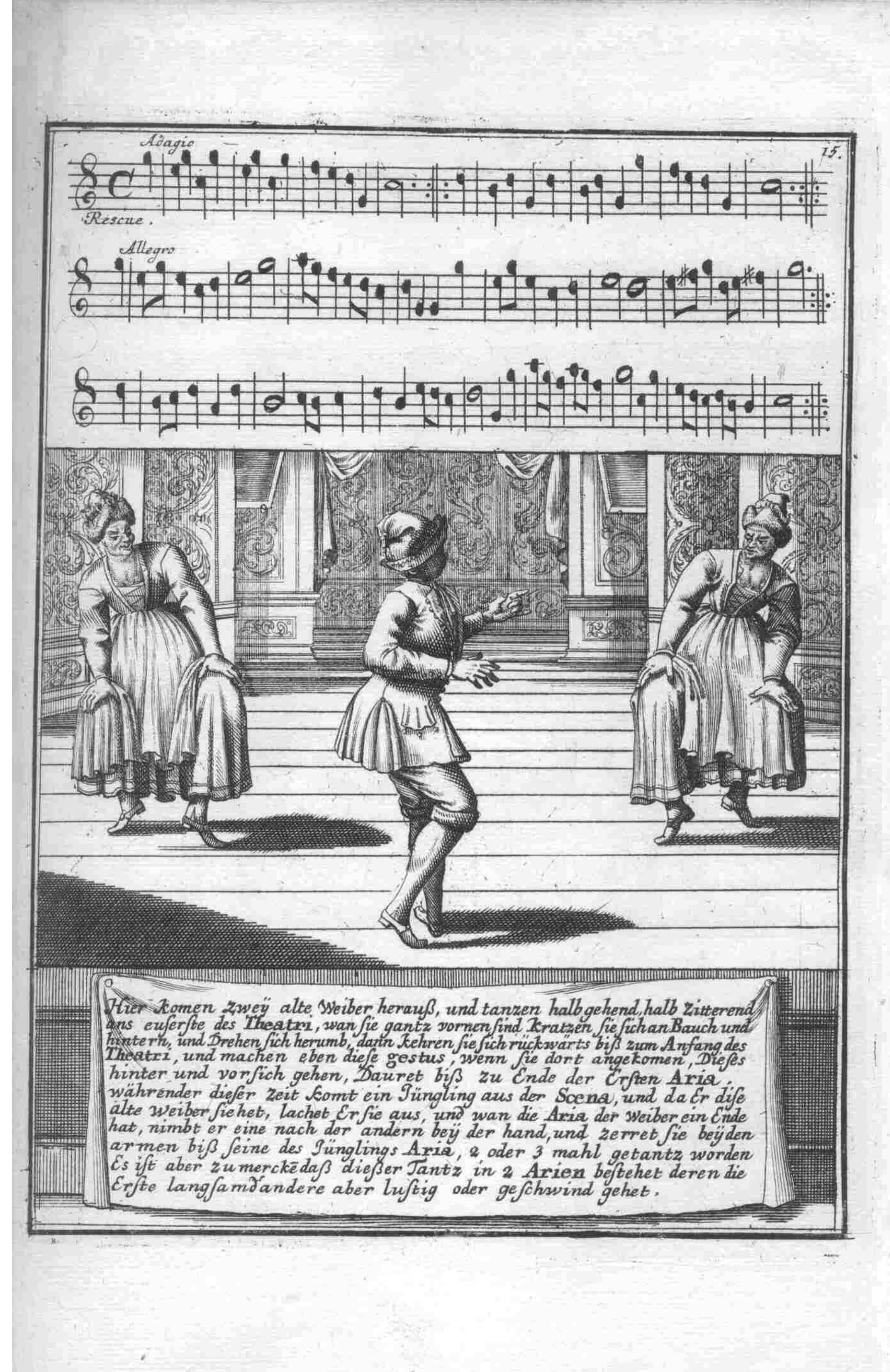
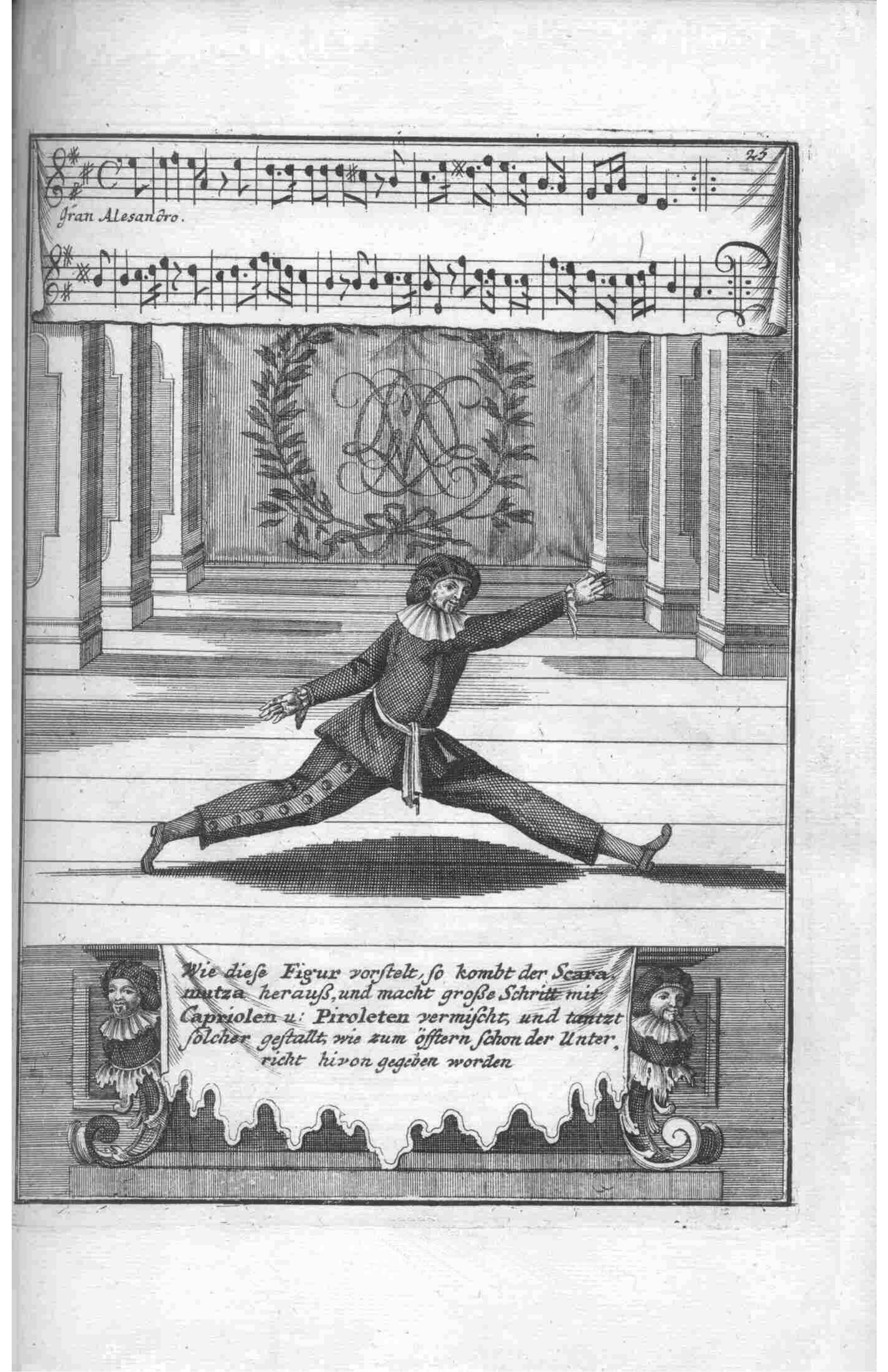
For dance historians and practitioners, Lambranzi's plates are among the few surviving visual records of how Baroque theatrical dances actually looked in motion and in costume. The pairing of music and image reveals the intimate relationship between musical measure and choreographic structure that governed all court and theatrical dance of this era. For engraving specialists and historians of early print culture, these plates demonstrate the technical sophistication and ambition required to document embodied practice in a medium that dealt in fixed lines and static images.
What you are looking at
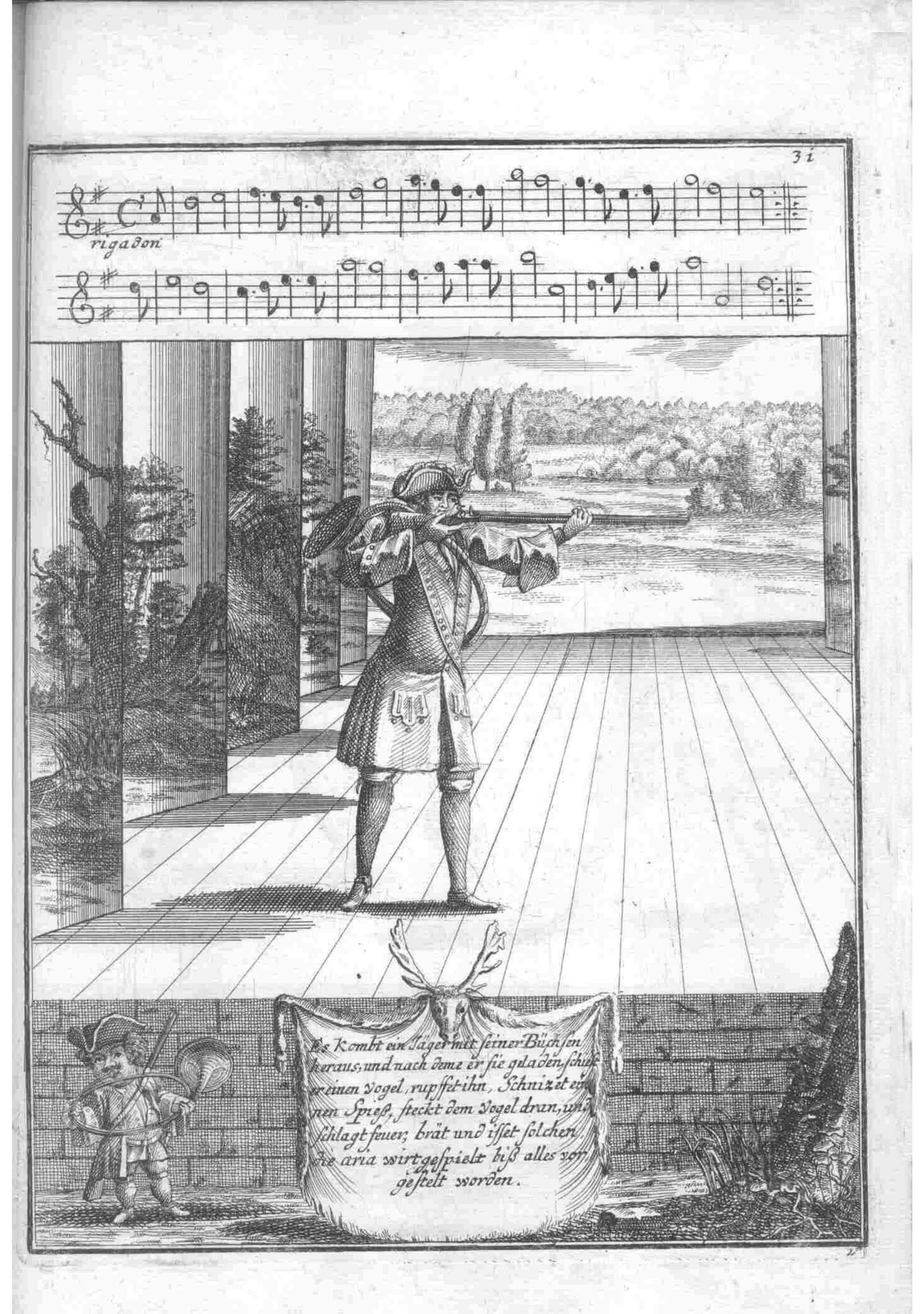
A single male dancer stands on the wooden floor of a stage framed by classical columns, facing stage-right toward an expansive landscape visible beyond the proscenium. The background shows a river, distant trees, and open countryside rendered in careful perspective. The dancer wears a richly decorated coat with ornate embroidery, knee-length breeches, stockings, and shoes—the formal dress of early 18th-century aristocracy. His posture is upright and controlled, one arm raised in an elegant gesture while he appears to hold a long staff or implement across his body. The stage itself is defined by a curtain visible at the edges and the geometry of the floorboards receding toward the back wall. Below the scene, a German verse is inscribed within a decorative cartouche, accompanied by a small putti figure at the lower left. Above the engraving, two lines of musical notation are printed, indicating the melody that accompanied this choreographed figure.
The dancing
The dancer presents a single, isolated figure in a formal upright stance characteristic of court dance. His weight appears centered, with one leg supporting while the other extends slightly. The raised arm creates an open, expansive frame typical of aristocratic gesture. The implement he carries—possibly a sword, staff, or theatrical prop—suggests this is a stylized pastoral or theatrical role rather than pure courtly dance. The positioning and the costume indicate a trained performer demonstrating a specific choreographic moment rather than a spontaneous movement.
The dance depicted
This plate documents theatrical dance from the early 18th-century German court tradition, most likely a minuet or other courtly dance adapted for the stage. Lambranzi's manual was created to teach dancing masters how to compose and execute such theatrical spectacles. The pastoral setting and the soloist's formal bearing suggest this may represent an allegorical or mythological character—a shepherd, hunter, or similar figure from pastoral theater. The pairing of musical notation with choreography was central to early modern dance practice; the notation indicates the precise measure and tempo the dancer was meant to follow.
How it was made
This is a copper-plate engraving, a technique that allowed for precise, repeatable reproduction of both the musical notation and the detailed costume and anatomical features. Engraving was the standard medium for technical manuals in this era, permitting wide distribution among dance masters across European courts and cities. The fineness of the line-work shows the skill required to render both the intricate embroidery of the costume and the carefully measured perspective of the stage architecture. The durability and legibility of engraved plates meant Lambranzi's teaching could reach audiences far beyond a single court.
About this work
This is one of 152 plates from Gregorio Lambranzi's *Nuova e curiosa scuola de' balli theatrali* (Nuremberg, 1716), the most influential and detailed technical manual of Baroque theatrical dance to survive. Each plate pairs a musical score with an engraved figure demonstrating a specific choreographic moment, creating a visual-musical record of how courtly dances were adapted for the stage. Lambranzi's work bridges the gap between notation (which records steps in text or symbols) and the dancing body itself, showing the costumes, postures, and theatrical contexts in which these dances were performed. The manual was used by dancing masters across Germany, Italy, and beyond to train performers and to compose new theatrical spectacles.
How to look at it
Observe the fixed moment Lambranzi has chosen: not a transition, but a held position that demonstrates posture, arm frame, and the coordination of body with the musical measure notated above. The formal columns frame the figure as if in a painting, emphasizing that this is theatrical display rather than social interaction. Note the costume detail—the embroidered coat, the precise cut of the breeches, the stockings and heeled shoes—which together indicate both the dancer's social status and the specific character or role being demonstrated. The distant landscape visible through the stage opening reminds us that these were performances designed for courts and princely theaters, not intimate social gatherings.
The artist
Gregorio Lambranzi (c. 1675–after 1730) was an Italian dancing master and choreographer active in the German-speaking territories. He worked primarily in Nuremberg, where he compiled and illustrated his treatise. While little is known of his own performance career, his systematic approach to documenting theatrical choreography—pairing detailed engravings with musical scores and German-language verse descriptions—established a new standard for dance pedagogy. His work represents the transition from court dance to theatrical spectacle and from oral tradition to printed technical manual.
The period
In the early 18th century, social dance and theatrical dance were beginning to diverge. Minuets, bourées, and other Baroque dances remained central to courtly social life, but dancing masters increasingly created elaborate theatrical versions for court entertainments, carnival spectacles, and opera ballets. The rise of printed dance manuals—including Beauchamp and Feuillet's notation system and works like Lambranzi's—reflected both the growing prestige of dancing as a teachable, systematizable art and the hunger among provincial courts and aspiring gentry for access to fashionable steps and compositions. Lambranzi's decision to document theatrical rather than purely social dance, and to do so in the vernacular German rather than Italian or French, positioned his work for a broad audience of dance masters and theater professionals.
Where it lives
This plate comes from the first (and most authoritative) edition of *Nuova e curiosa scuola de' balli theatrali*, published in Nuremberg in 1716 by the imperial printer. The work survives in numerous copies across European libraries, reflecting its wide use by dancing masters and its value as both a practical manual and a record of Baroque theatrical practice. The Library of Congress holds a copy; this particular engraving is plate 81 of 152.
Dance in this work
Questions about this work
Why is there musical notation at the top of the plate?
The notation shows the exact melody and measure that accompanied this choreographed moment. A dancer using Lambranzi's manual would learn the step and the music together, ensuring that body and music stayed coordinated. This visual-musical pairing was fundamental to all Baroque dance instruction.
What is the setting? Is this a real place?
The setting is a theatrical stage framed by classical columns, with a painted backdrop representing a pastoral landscape. It is not a real place but a convention of court theater, indicating that this is staged spectacle. The landscape suggests this character is a shepherd or pastoral figure, likely from a court ballet or opera entertainment.
Could an amateur learn to dance from this plate alone?
Probably not without additional training. The plate shows a single held moment and the musical timing, but not the steps leading into or out of this position, nor the mechanics of weight transfer. Lambranzi's manual was designed for dancing masters—professionals who could read musical notation and understand movement principles—not for absolute beginners.
Why engrave these at all? Why not just publish written descriptions?
Because the visual record was as important as words. An engraving shows costume, posture, arm frame, and spatial relationship in ways that prose cannot. The printed image could circulate widely, standardizing choreography and costume across different courts and cities.
More Notation/Choreography artwork