49 works in this view — arrow keys or swipe to move between them.
Dance in Art
Comic Character — Plate 82
Gregorio Lambranzi
- Medium:
- Copper-plate engraving
- Dance:
- Notation/Choreography
- Era:
- 1700s (Enlightenment/Minuet Era)
- Collection:
- Nuova e curiosa scuola de' balli theatrali (1716)
- Source:
- Library of Congress
- Rights:
- Public domain — free to use, share and adapt.
- Recorded as:
- Public Domain
As a primary source for early 18th-century stage practice, this plate is one of very few images that shows how comic actors moved, gestured, and used properties (here, the stick) in performance. It demonstrates that theatrical dance was not uniform: while court dances emphasized symmetry and refinement, stage comedy was exaggerated, asymmetrical, and narrative-driven. For historians and practitioners reconstructing period performance, Lambranzi's detailed engravings remain an essential visual record.
What you are looking at
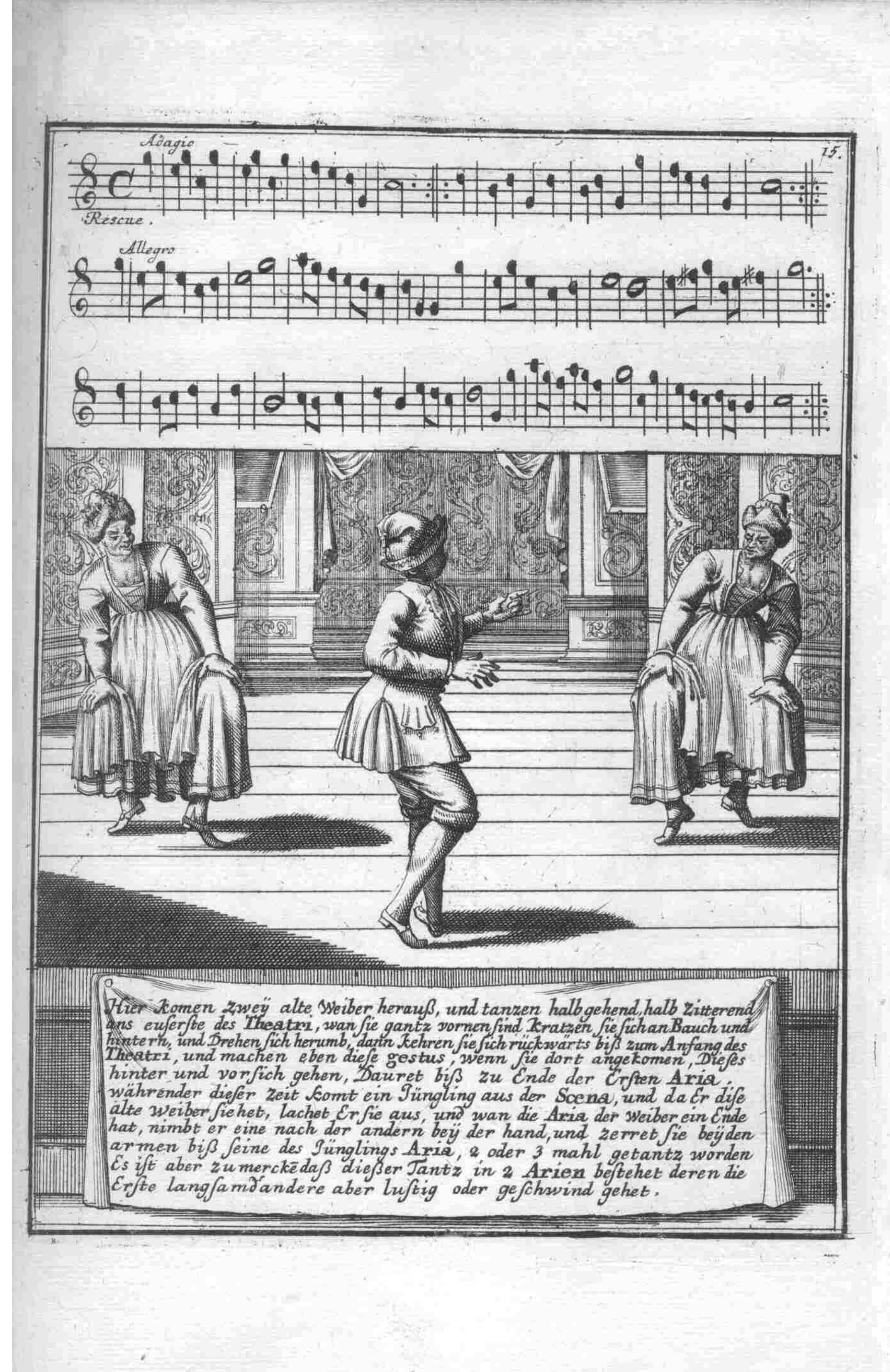
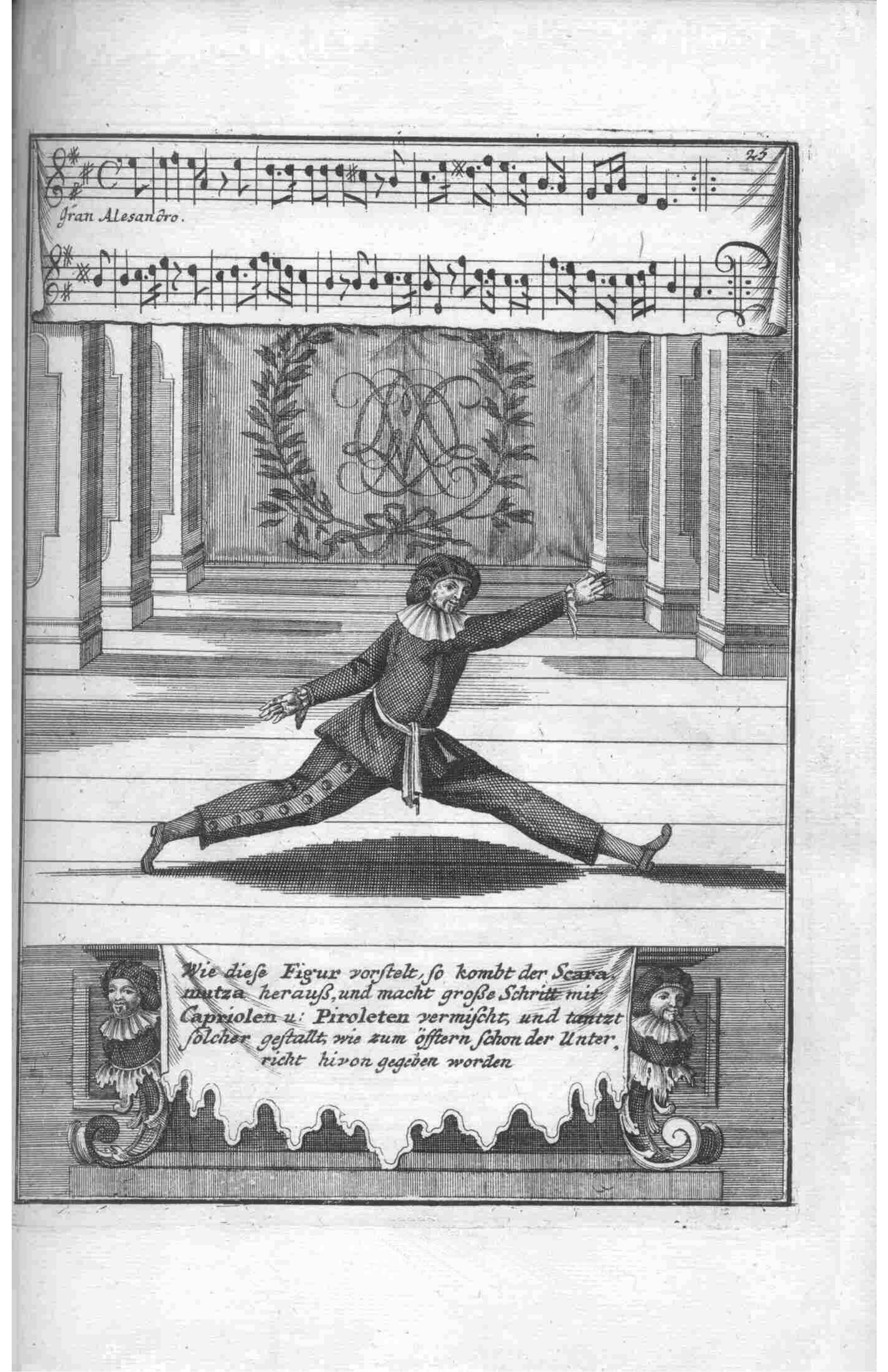
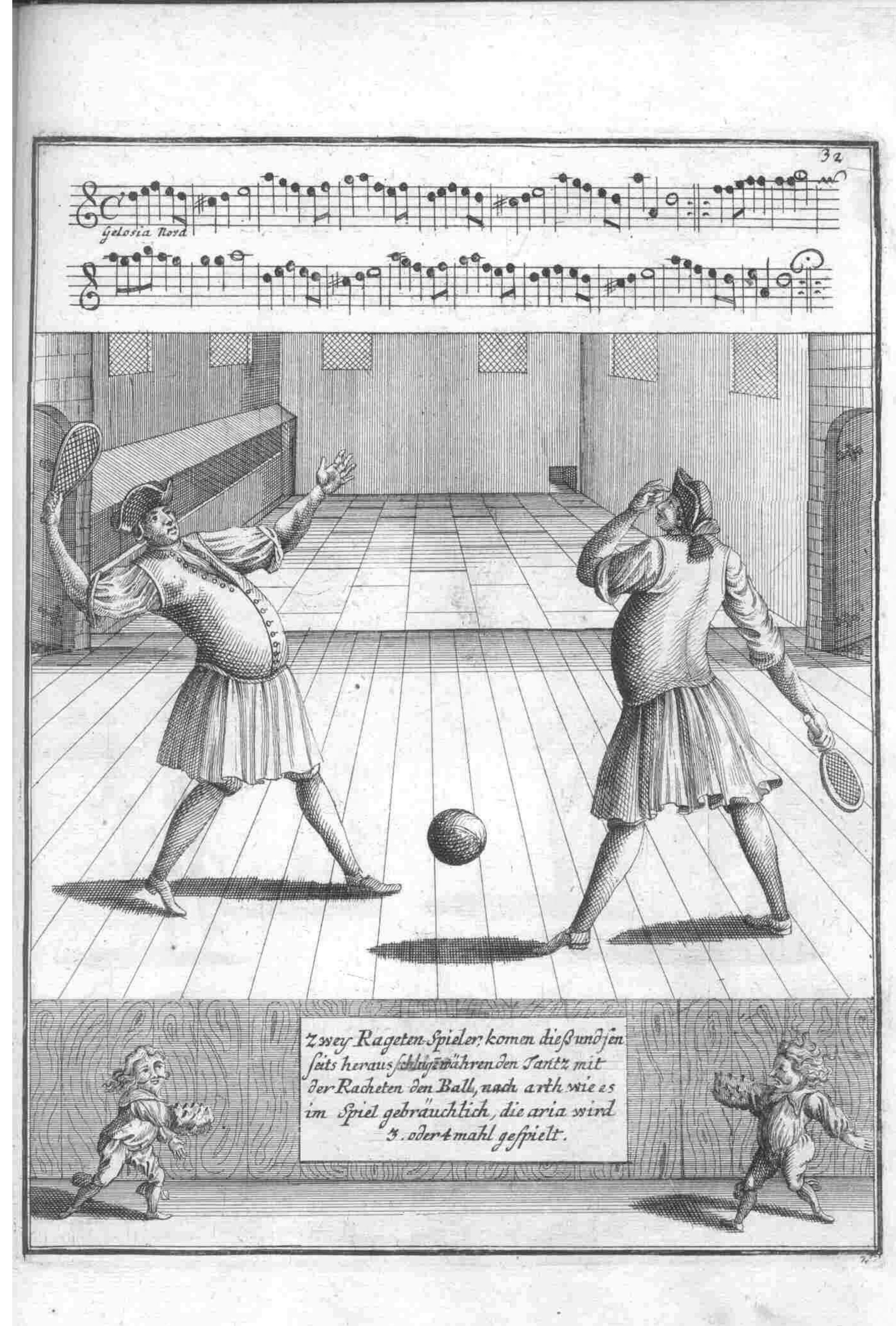
Two figures in early 18th-century theatrical costume occupy a wooden-floored stage enclosed by curtains and a framed doorway. The figure on the left, wearing a plumed headdress and decorated coat with skirts, raises one arm high in an exaggerated gesture while holding a stick or cudgel aloft; the other arm extends outward in a wide, open position. The figure on the right, similarly dressed and plumed, stands in a defensive or reactive posture, one arm raised and bent as if warding off a blow. Between them lies a small ball. The composition captures a moment of comedic struggle or slapstick business. The engraving shows careful attention to the folds of the actors' skirts, the articulation of their limbs in space, and the theatrical staging with its geometric floor and framing architecture. Two putti or cherubs appear below the stage, flanking a German inscription.
The dancing
The left figure is caught mid-action with the raised arm and open frame suggesting physical comedy and exertion. The right figure's bent arm and twisted torso convey reaction to an impending blow. Both stand on turned-out legs in a posture familiar to 18th-century stage movement—neither en pointe nor in a modern natural stance, but rather in the formal, lifted bearing of theatrical dancers and commedia dell'arte performers. The stick held by the left figure anchors the narrative: this is a beating scene, a classic slapstick moment. The distance between them and the ball suggest chasing or struggling over an object.
The dance depicted
This is theatrical comic dance (balletti comici) as performed in the early 18th-century German and Italian stages, likely depicting a scene from commedia dell'arte or another theatrical comedy. The pose and costume place it closer to theatrical dancing and character work than to social dance. The stick identifies this as a beating-comedy scene (bastonata or similar)—a stock moment in comic performance where exaggerated physicality and gesture dominated over courtly refinement. The engraving documents not a named dance form but the physical language of stage comedy that relied on pantomime, gesticulation, and broad movement to convey narrative and humour.
How it was made
This is a copper-plate engraving, one of the most precise reproductive techniques of the period, allowing for intricate detail and wide circulation. The fine parallel lines and cross-hatching create volume and shadow on the figures' garments and skin, while the geometric perspective of the floor tiles and architectural frame grounds the scene convincingly. As an engraving from Lambranzi's 1716 manual, it served as a teaching document: the technique's durability and clarity made it ideal for repeated printing and distribution to dance masters and performers across Europe who could reference the image and inscribed music together.
About this work
This is one of 101 engraved plates from Gregorio Lambranzi's *Nuova e curiosa scuola de' balli theatrali* (Nuremberg, 1716), a foundational illustrated treatise on theatrical dance and performance. Each plate pairs a notated musical score at the top with a staged figure or figures in costume, demonstrating poses, gestures, and choreographic moments for professionals and amateurs. Plate 82 documents a moment of comic stage action—a beating scene with two elaborately dressed performers engaged in slapstick business. The work is one of the era's most influential dance manuals, offering rare visual evidence of how performers moved on the stage in the early 18th century.
Lambranzi's collection bridges the worlds of court ballet, commedia dell'arte, and emerging theatrical spectacle. Unlike the refined court dances of the same period, these plates emphasize character, narrative, and physical comedy. The notation allows reconstruction of the music; the engraving allows us to see what movement was called for. The combination makes the *Scuola* an invaluable document for understanding theatrical dance before the Romantic era.
How to look at it
Notice the wide-armed, open-chested posture of both figures—this is not a closed embrace or precise position but rather a held moment in action, frozen mid-gesture. The raised stick and the other figure's defensive arm establish the narrative instantly: the engraver chose the instant of maximum tension and clarity. Observe that both figures' legs are turned out and their bodies lifted; this is not naturalistic movement but theatrical movement, stylized and formally composed. The geometric floor and architecture act as a stage, framing the action as a performed spectacle. The ball beneath them adds a further layer of comic confusion—a physical obstacle that heightens the chaos of the scene.
The artist
Gregorio Lambranzi (c. 1681–after 1716) was a Nuremberg-based dance master and choreographer. The *Nuova e curiosa scuola de' balli theatrali* is his major surviving work, published in two volumes in 1716. The collection documents dances and theatrical moments that Lambranzi had choreographed or collected from his extensive work in Italian and German theaters. Little is known of his training or early life, but his systematic approach to notating and illustrating dance suggests both practical stage experience and familiarity with the emergent systems of dance notation (Feuillet notation was published in 1700). The *Scuola* positions him as a transitional figure: documenting the older, character-based theatrical dances even as the codified techniques of ballet d'action were beginning to develop.
The period
In 1716, theatrical dance was in transition. The courtly dances of the Baroque—minuet, gavotte, bourrée—coexisted with commedia dell'arte and the emerging ballet d'action on professional stages. Notation systems, newly systematized by Feuillet and others, allowed dances to be recorded and transmitted; Lambranzi's work is one of the first to pair notation with detailed engraved figures. The comic, gestural tradition shown here would gradually be formalized into character dance (a category that persists in ballet training today). Lambranzi was documenting a mode of performance that was beginning to be displaced by the more systematic, narrative ballets that would dominate the 18th century.
Where it lives
This engraving is from *Nuova e curiosa scuola de' balli theatrali* (Nuremberg, 1716), Gregorio Lambranzi's illustrated treatise on theatrical dance. The Library of Congress holds a copy. The work was originally published in two volumes; Lambranzi included 101 plates in total. It is one of the most widely cited sources for early 18th-century stage practice and was reprinted and adapted well into the 19th century.
Dance in this work
Questions about this work
What does the stick mean? Is this a real 'beating' dance?
Yes—the beating scene (bastonata in Italian) was a genuine stage comedy business, part of commedia dell'arte and other theatrical traditions. However, the beating was stylized and exaggerated; it was pantomime and slapstick, not actual violence. The stick, like the poses, was a prop that allowed the performers to create a comic narrative through gesture and physical comedy.
Who would have used this book?
Dance masters, choreographers, and professional performers in German-speaking and Italian theaters. The book served as both a technical manual (the notation tells you the music and rhythm) and an inspiration for choreography. It was expensive to produce and would have been owned by institutions and wealthy practitioners, not casual dancers.
How do we know this shows real movement and not just the artist's imagination?
Lambranzi was a working dance master with decades of theater experience. The consistency of his depictions, the specificity of the poses, and the pairing of notation with figures all suggest he was documenting actual practice. The poses—turned-out legs, lifted torsos, open frames—match descriptions and instructions in other period sources. However, engravings are interpretations; the artist has chosen moments and emphasized certain qualities for clarity.
What is the music at the top?
The notation at the top of each Lambranzi plate gives the melody and rhythm of the music that accompanies the movement. The presence of music notation alongside the figure makes the *Scuola* unique: it is both a dance manual and a music book, allowing reconstruction of both the choreography and its temporal structure. The inscription at the bottom explains the scene in German.
More Notation/Choreography artwork