49 works in this view — arrow keys or swipe to move between them.
Dance in Art
Group — Plate 84
Gregorio Lambranzi
- Medium:
- Copper-plate engraving
- Dance:
- Notation/Choreography
- Era:
- 1700s (Enlightenment/Minuet Era)
- Collection:
- Nuova e curiosa scuola de' balli theatrali (1716)
- Source:
- Library of Congress
- Rights:
- Public domain — free to use, share and adapt.
- Recorded as:
- Public Domain
Lambranzi's manual is one of the few detailed visual records of early 18th-century theatrical dance, capturing not just courtly minuets but the broader vocabulary of stage dancing including comic scenes, group work, and pantomime. This plate specifically shows how narrative and characterization operated in theater dance before the ballet d'action of the late century: through positioning, gesture, and the objects dancers interacted with. For historians studying the transition from court dances to theatrical narrative forms, and for dancers studying period stagecraft, this image is primary evidence.
What you are looking at
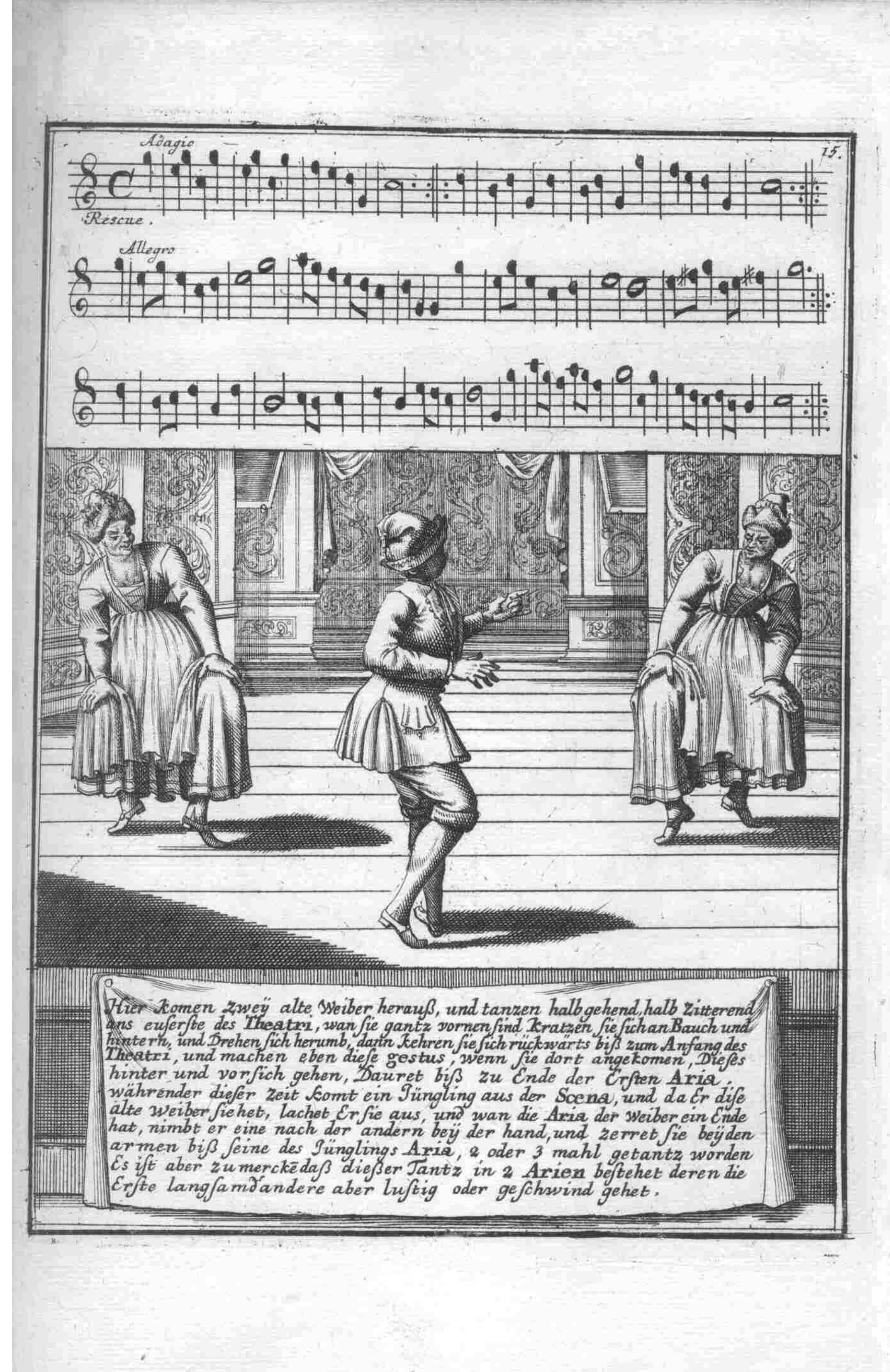
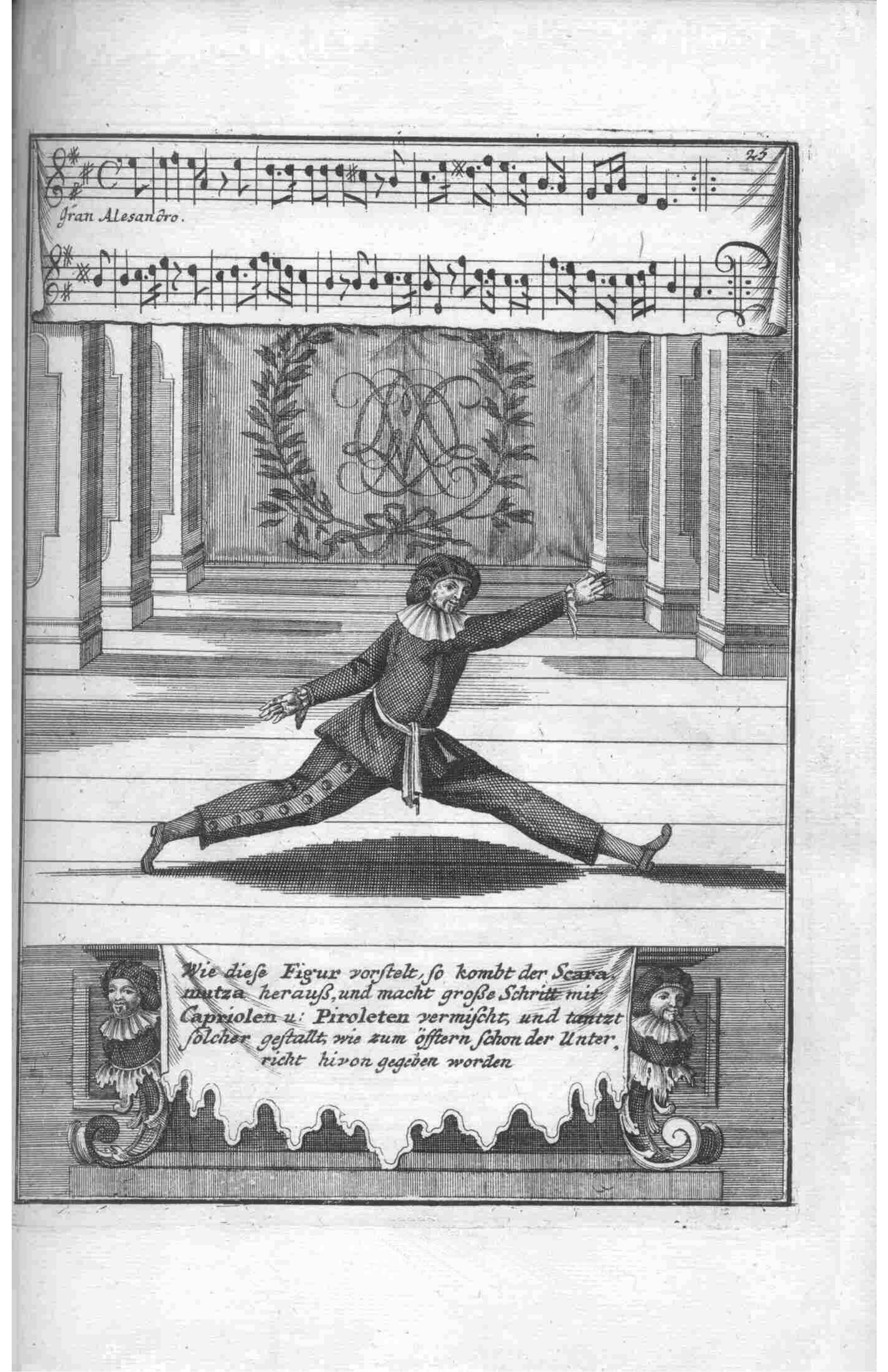
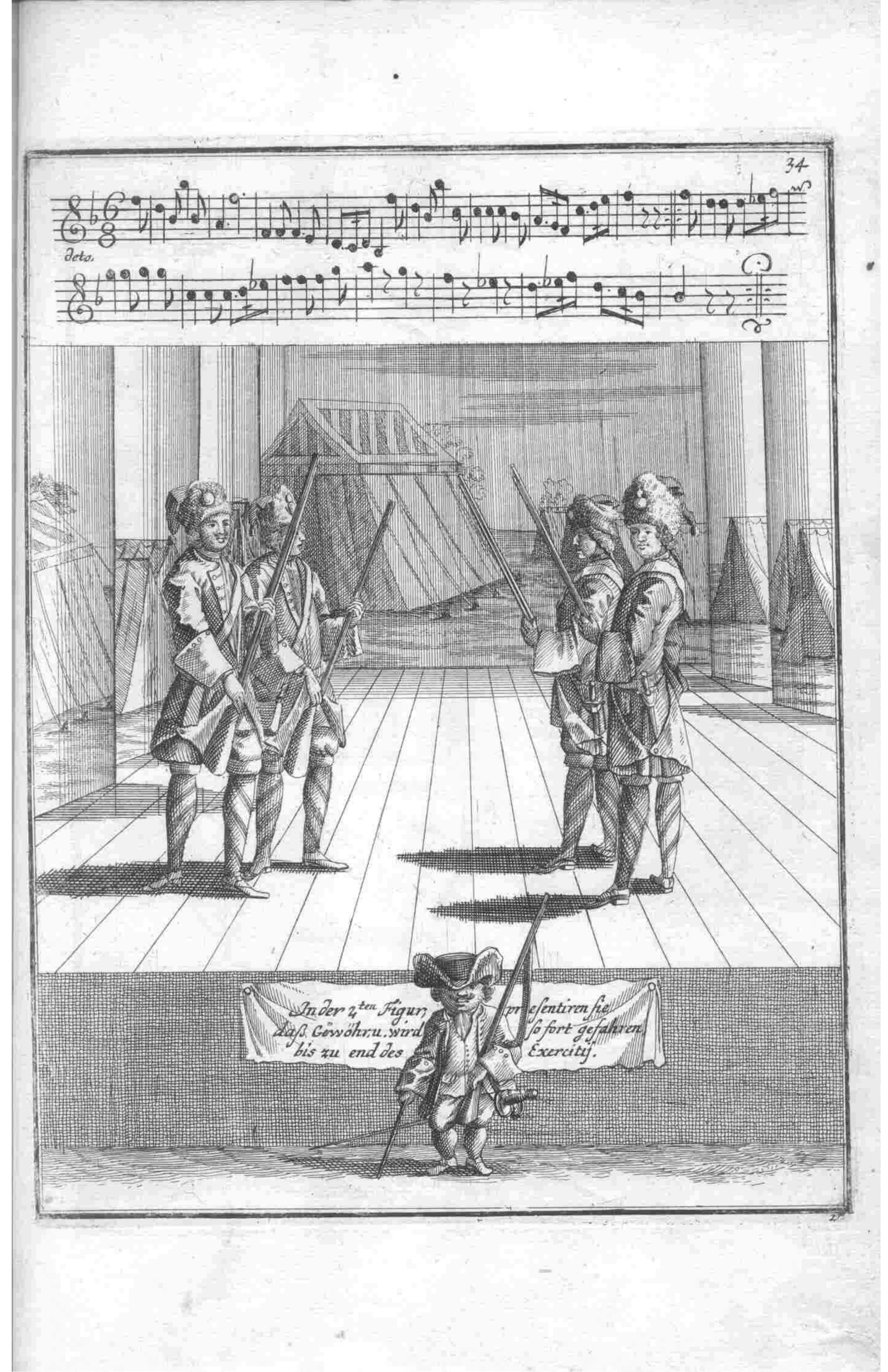
A theatrical interior set within a curtained stage shows four costumed performers arranged in two pairs facing each other across the floor. On the left, two figures in elaborate dress—one in a long coat and periwig—stand with their companion; on the right, two more identically dressed performers mirror their stance. Between them sits a large trunk or treasure chest, rendered in perspective and appearing to be the focal point of their attention. The stage is framed by vertical columns supporting a fabric canopy above; the floor recedes in carefully rendered boards. In the foreground below the stage, a single figure in simple dress and a distinctive tall hat holds a banner with German text, likely providing commentary on the scene. This is Plate 84 from Lambranzi's manual, paired with musical notation at the top of the page.
The dancing
The four dancers stand with upright posture, legs straight, arms and bodies oriented toward the chest in the center. The weight appears to be held evenly on both feet in a neutral stance characteristic of theatrical deportment. The figures do not show dramatic arm extension or elevation; their arms hang relatively naturally or are held at modest heights. Their positioning suggests formal social interaction—perhaps negotiation, competition, or comic business over the trunk—rather than rapid movement or complex footwork. The carefully symmetrical arrangement of two facing pairs creates a tableau rather than dynamic progression.
The dance depicted
This is a theatrical group dance with dramatic or comedic narrative content—Lambranzi notes it as a trio scene with a chest, likely a treasure or comic scene. The formal stance and bilateral symmetry suggest a court or comic ballet rather than a virtuosic or acrobatic work. The emphasis on positioning and gesture over footwork is typical of early 18th-century theatrical dance, which relied heavily on deportment and pantomime to convey character and plot. The German verse below the stage (which the catalogue notes accompanies each plate) would clarify the specific narrative. The dance sits within the tradition of theatrical dancing for court and professional stages in the early Enlightenment, where stories were told through stylized movement, formal placement, and comic business as much as through steps.
How it was made
This is a copper-plate engraving, as stated in the record. The technique allowed for fine linear detail in the costumes, hatching to create tone and shadow on the stage architecture, and clear rendering of multiple figures in space. The precision of engraving made it suitable for instruction: dancers and choreographers could study the exact placement of bodies, the depth staging, and the relationship of figures to one another. Engraving also permitted wide circulation—the manual could be printed in multiple copies, making Lambranzi's choreography available across Europe, which was the explicit purpose of the *Nuova e curiosa scuola*. The pairing of musical notation with the engraved scene was an innovation: readers could see the dance while reading the music, or learn to notate their own steps.
About this work
This engraving documents a moment in a comedic group dance from an early 18th-century theatrical manual. It shows four performers in formal court dress engaged with a trunk—whether they are stealing it, guarding it, or negotiating over it is clarified by the German text below. The scene illustrates how theatrical dance in this period combined formal deportment, symmetrical grouping, and narrative pantomime. As Plate 84 of Gregorio Lambranzi's *Nuova e curiosa scuola de' balli theatrali* (Nuremberg, 1716), it is part of one of the era's most influential dance instruction manuals, which systematically documented both courtly minuets and theatrical and comic scenes for stage dancers. The work demonstrates the role of engraving in dance transmission: by pairing notation with image, Lambranzi created a portable record of choreography that could be learned, shared, and imitated across courts and theaters.
How to look at it
Attend first to the symmetry: the two pairs of dancers create a perfectly balanced composition, which was a hallmark of early 18th-century stagecraft and an aid to learning. Notice how the trunk occupies the visual center and commands the dancers' attention—this tells us the dance is choreographed around an object and a shared focus, not around individual display. Look at the posture: the upright torsos, the controlled arm placement, and the relatively quiet stance emphasize deportment over footwork. Finally, observe how the engraver has rendered the stage space using perspective lines in the floor and the framing columns: this care with spatial representation suggests that the exact placement of the dancers in relation to one another and to the stage was choreographically significant.
The artist
Gregorio Lambranzi (or Lambranzi) was an Italian choreographer and dancing master active in the early 18th century. He is known almost entirely through the *Nuova e curiosa scuola de' balli theatrali*, published in Nuremberg in 1716, which compiled his choreographic system. The manual presented over 100 dances with engravings paired to musical notation, covering court dances, theatrical pieces, and comic scenes. Lambranzi's work is distinguished by its systematic approach to documentation—he sought to create a teachable, reproducible record of choreography at a moment when dance notation systems were still developing. His manual was reprinted multiple times and influenced the spread of both Italian and German dance practices.
The period
This plate dates to 1716, the height of the Enlightenment's fascination with systematizing and documenting knowledge. In dance, this was the era when choreographers began publishing detailed records of steps and dances—Raoul-Auger Feuillet's notation system had been introduced in 1700, and manuals proliferated through the 1710s–1730s. Theatrically, dance was becoming more central to opera and stage spectacle across Europe, especially in Italy and Germany. The scene depicted here—a comic group dance with a prop and narrative element—reflects the period's interest in using dance for character and storytelling on stage, a development that would lead eventually to the coherent ballet narratives of the late 18th century. The formal costumes and staging shown here are typical of professional court theater in Germanic territories during the early Baroque-to-Enlightenment transition.
Where it lives
This is Plate 84 from Gregorio Lambranzi's *Nuova e curiosa scuola de' balli theatrali* (Nuremberg, 1716), held in the Library of Congress. The manual is a bound collection of dance scenes, each pairing a musical composition with an engraved stage scene and accompanying German verse. Individual plates from the manual are sometimes housed separately in collections, but this work is primarily known as part of the integral manual.
Dance in this work
Questions about this work
What is the trunk for? Why do the dancers care about it?
The German text beneath the stage would explain the narrative—whether the trunk contains treasure, whether it is being stolen or guarded, or whether it is the object of a comic dispute. Lambranzi's manuals often included comic scenes and character dances alongside courtly minuets. Without translation of the verse, the exact plot cannot be determined from the image alone, but the formal positioning of four dancers around a central prop suggests choreographed business with dramatic or comic intent.
How would a dancer learn this from the page?
By combining the engraved image with the musical notation at the top. The musical staff shows the length and structure of the piece; the engraving shows the placement and orientation of the dancers at a particular moment. Together with the German text and Lambranzi's broader system of notation, a trained dancer could reconstruct the grouping, deportment, and timing. This manual was designed to be a teachable record, different from purely illustrative prints.
Is this ballet?
No, not in the modern sense. This is theatrical dance—stage dancing for professional or court performers in the early 18th century, before the development of academic ballet technique and vocabulary. The movement vocabulary is likely much closer to court dance (minuets, gavottes) than to the elevated, turned-out style of 19th-century ballet. Lambranzi's dances bridge courtly social dance and early theatrical spectacle.
Why is it a mirror image? Are they dancing the same steps?
The symmetrical positioning was a convention of both court and early theatrical dance—it created visual order and was easier to teach and remember. Whether the two pairs execute identical steps simultaneously or whether they alternate is not entirely clear from a single frozen moment. The symmetry here is primarily compositional and spatial, ensuring that all four dancers have equal prominence and that the stage picture is balanced.
More Notation/Choreography artwork