49 works in this view — arrow keys or swipe to move between them.
Dance in Art
Negri — Dance Plate (plate 11)
Cesare Negri (il Trombone)
- Medium:
- Engraving
- Dance:
- Notation/Choreography
- Era:
- Pre-1700 (Renaissance/Baroque)
- Collection:
- Le Gratie d'Amore (1602)
- Source:
- Library of Congress
- Rights:
- Public domain — free to use, share and adapt.
- Recorded as:
- Public Domain
This image is a primary source document of how Renaissance nobility actually danced and dressed. Negri's treatise is one of the only surviving records precise enough to allow modern reconstruction of sixteenth-century Italian court dances, and his engraved figures establish the visual grammar of courtly movement—the hold, the frame, the deportment—that shaped ballroom dance for the next four centuries. For historians and dancers, this plate is an artifact of codified elegance: a moment when dance moved from folk practice into written instruction for the elite.
What you are looking at
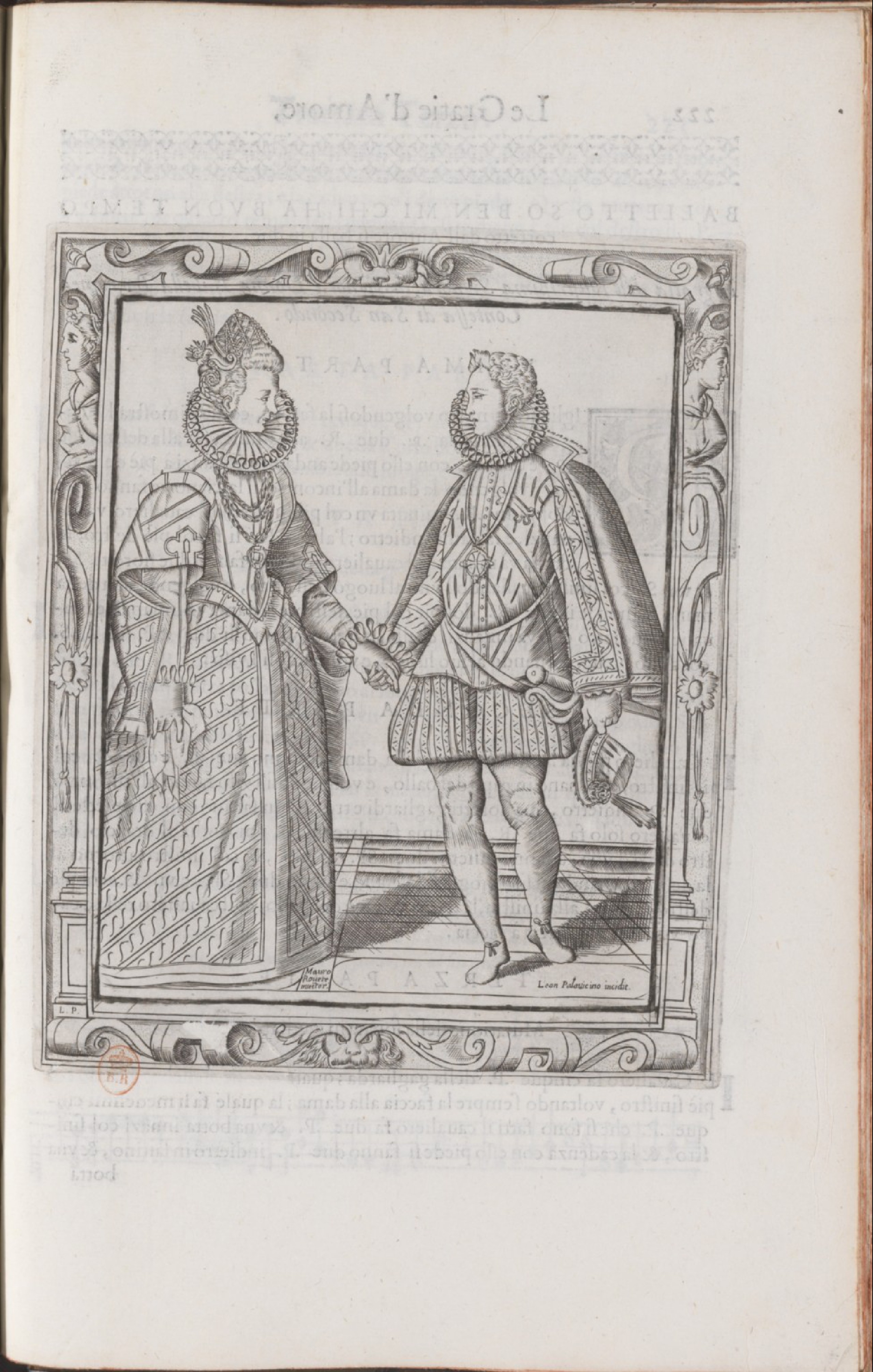
An engraved couple in richly decorated Renaissance court dress stand facing each other in an intimate pose, their hands clasped. The woman wears an ornate gown with a geometrically patterned bodice and full skirt, topped with an elaborate ruff collar and a tall feathered headdress. The man wears a short pleated tunic over hose, a patterned doublet, a cape draped from one shoulder, and matching ruff and feathered headpiece. Both figures are rendered in fine hatching and line work against a plain background, framed within a scrollwork border typical of Renaissance engraved publications. The setting is bare and formal—a simple floor line grounds the figures—suggesting this is a demonstration of courtly pose and dance position rather than a narrative scene. The engraving is clean and precisely executed, with careful attention to the pattern and texture of every garment.
The dancing
The couple stands in a formal, face-to-face orientation with their hands joined at roughly waist height, suggesting a processional or greeting posture rather than an active traveling step. Both figures are upright and still, weight evenly distributed, presenting themselves as statues of courtly decorum. Their bodies are aligned and parallel, not twisted or off-balance; this is a moment of poise and presentation. The man stands slightly taller and occupies the right side of the frame, conventionally the position of authority in Renaissance courtship dances.
The dance depicted
This is a paired figure from Cesare Negri's instructional treatise on court dance. Negri's *Le Gratie d'Amore* (1602/1604) systematically illustrates the steps, postures, and formations of Italian Renaissance and early Baroque court dances—primarily variants of the pavane, galliard, and branle—as practiced in courts across Italy and France. The formal hand-joined position shown here represents either an opening posture or a moment of transition in a courtly dance. Without the accompanying text describing the specific choreography, the image documents the deportment and dress code expected of noble dancers rather than the movement itself. This plate exemplifies Negri's pedagogical method: precise engraved figures presented as models for imitation.
How it was made
This is an engraving, a technique in which an image is cut into a metal plate (usually copper) with a burin, then inked and printed. The fine parallel lines visible throughout—in the hatching of the figures' faces, the geometric patterns of their clothing, and the shading of the border—are characteristic of Renaissance engraving. This technique allowed for sharp detail, fine gradations of tone, and multiple impressions from a single plate, making it ideal for distributing instructional material to courts and dance masters across Europe. The formal border and title cartouche indicate this is a page from a bound publication, not an independent print.
About this work
Cesare Negri was one of the most celebrated dance masters of late-sixteenth-century Milan, and *Le Gratie d'Amore* ('The Graces of Love') is one of the two most comprehensive dance treatises of the Renaissance—the other being Fabrizio Caroso's *Il Ballarino* (1581). Negri's work combines narrative instruction with engraved demonstrations of position and deportment. This plate is one of a series illustrating paired figures suitable for the fashionable dances of the court: the pavane (a grave processional), the galliard (an athletic, jumping dance), and various branles. The couple's precise hand position, formal facing, and immaculate dress establish the standard of courtly comportment against which dancers of the period measured themselves. The engraving circulated among nobility and dance professionals across Europe, standardizing Italian court dance practice during the early 1600s.
How to look at it
Attend first to the couple's hands and the precise distance between them: this is the fundamental information Negri is conveying, the unit of courtly connection. Notice the geometric patterning of the woman's skirt and the man's doublet—Renaissance dance treatises were as concerned with visual and sartorial propriety as with the movement itself. The equal height and formal parallelism of the figures suggests a moment of greeting or processional calm rather than activity; in Negri's world, nobility moved with restraint and dignity, and this stillness was itself a form of grace. The engraved line is steady and unhurried, reinforcing the visual calm that courtly dance was meant to project.
The artist
Cesare Negri (c. 1535–c. 1604), known as 'il Trombone,' was a Milanese dance master and one of the great systematizers of Renaissance court dance. He taught at the courts of Milan, Rome, Florence, and France, and his students included nobility and professional dancers. *Le Gratie d'Amore* (published in Milan, 1602, and reprinted in 1604) represents the culmination of a lifetime spent codifying the steps, music, and social protocols of Italian court dances. Negri dedicated the work to his patrons and presented it as a comprehensive guide to graceful movement. His approach—combining prose instruction with engraved figures—influenced later dance notation systems and established him as a foundational voice in European dance pedagogy.
The period
In the late sixteenth and early seventeenth centuries, court dance in Italy and across Europe was entering a period of formal codification. The pavane and galliard, which had dominated mid-Renaissance dance, were being systematized and refined for performance at court spectacles and in intimate social settings. Around the same time that Negri was publishing in Milan, ballet was developing as a theatrical form in France under Marie de' Medici and the Valois court. The engraved treatise format—exemplified by both Negri's and Caroso's works—became the standard vehicle for transmitting dance knowledge across Europe, creating a shared vocabulary of steps and positions. This was the era in which dance transitioned from unwritten folk practice to authored, publishable, teachable discipline.
Where it lives
This is Plate 11 from *Le Gratie d'Amore*, Cesare Negri's instructional treatise published in Milan in 1602 and reprinted in 1604. The work survives in multiple copies in research libraries across Europe. The copy recorded here is held at the Library of Congress.
Dance in this work
Questions about this work
How do we know what Renaissance dances actually looked like?
Treatises like Negri's *Le Gratie d'Amore* and Caroso's *Il Ballarino* provide the only detailed written descriptions and engraved illustrations we have. Combined with music notation from the period and written accounts by courtiers, these allow modern scholars and dancers to reconstruct Renaissance steps and choreography. Negri's treatise is particularly valuable because it names specific dances (pavane, galliard, branle) and describes the footwork in prose alongside the figures.
What does the formal hand-joined position tell us about Renaissance dance?
It shows that Renaissance court dances were based on processional progression and partner connection rather than the turn-based, closed holds of later ballroom dance. The hand-joined position allowed couples to move forward and backward in formation while maintaining visual decorum. The stillness of this pose also reflects the social function of noble dancing: it was as much about displaying rank, dress, and composure as about demonstrating physical skill.
Why would a dance master publish engraved instruction books?
Engraved treatises allowed dance masters to establish their authority, reach patrons across Europe, and create a permanent, teachable record of their method. For Negri, publication was also a mark of prestige and a way to cement his reputation as the leading dance master of his generation. The engraved figures served as visual models that students and their teachers could study and imitate.
Is this engraving showing an actual dance step, or just a pose?
It is likely a transitional pose or an opening figure—a position that would appear in one or more of the courtly dances Negri describes. The couple is not captured mid-movement, but rather in a static, instructional position. Negri's text would specify which dances used this figure and what came before and after.
More Notation/Choreography artwork