49 works in this view — arrow keys or swipe to move between them.
Dance in Art
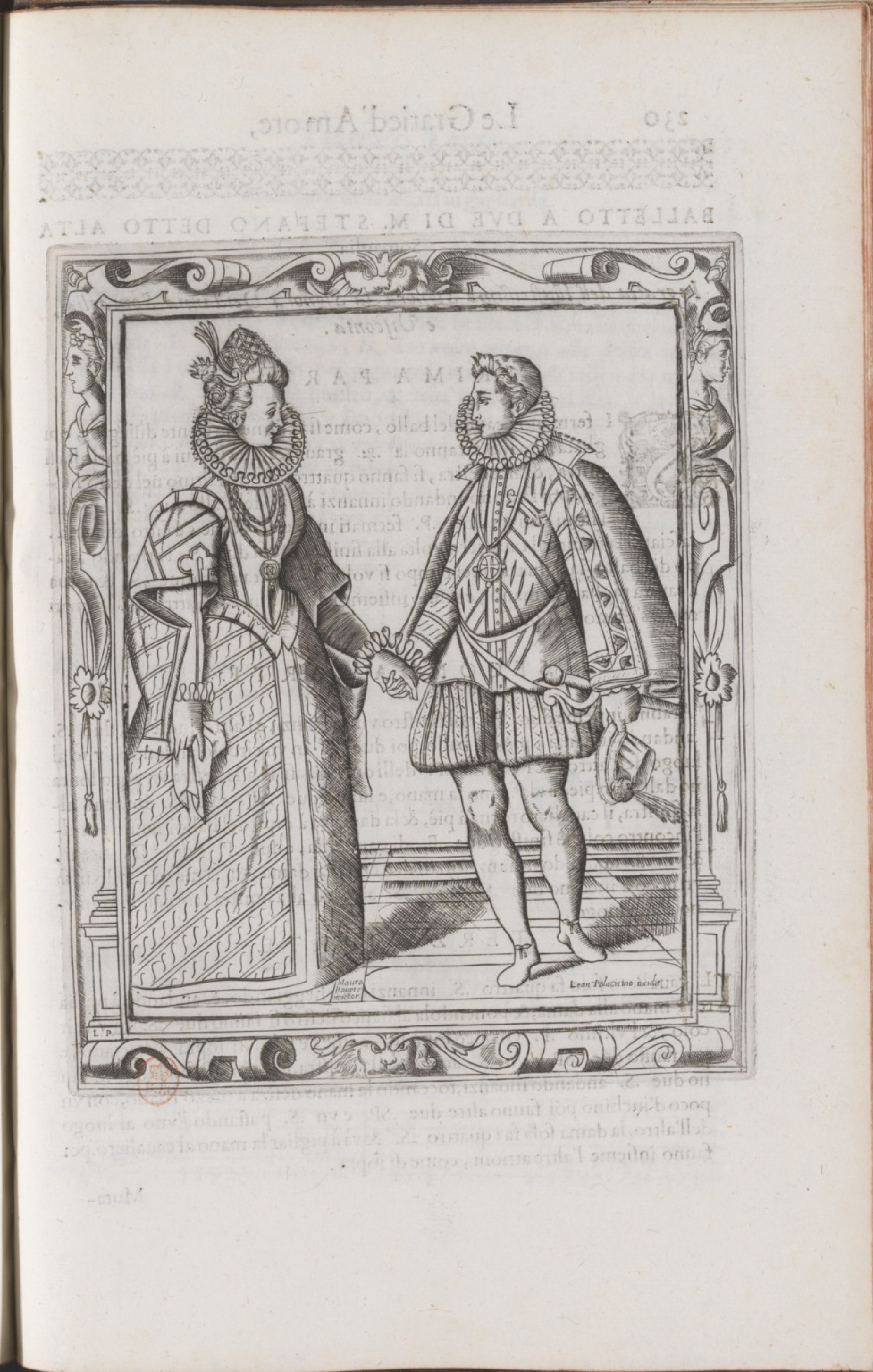
Negri — Dance Plate (plate 13)
Cesare Negri (il Trombone)
- Medium:
- Engraving
- Dance:
- Notation/Choreography
- Era:
- Pre-1700 (Renaissance/Baroque)
- Collection:
- Le Gratie d'Amore (1602)
- Source:
- Library of Congress
- Rights:
- Public domain — free to use, share and adapt.
- Recorded as:
- Public Domain
Negri's *Le Gratie d'Amore* is one of the only surviving visual records of how Renaissance dances were actually constructed and performed, and Negri himself was the most celebrated dance master of his time. This plate documents the foundational stance and gestural language of early modern courtly dancing—the posture, spacing, and decorum that defined a person of quality in Renaissance society.
What you are looking at
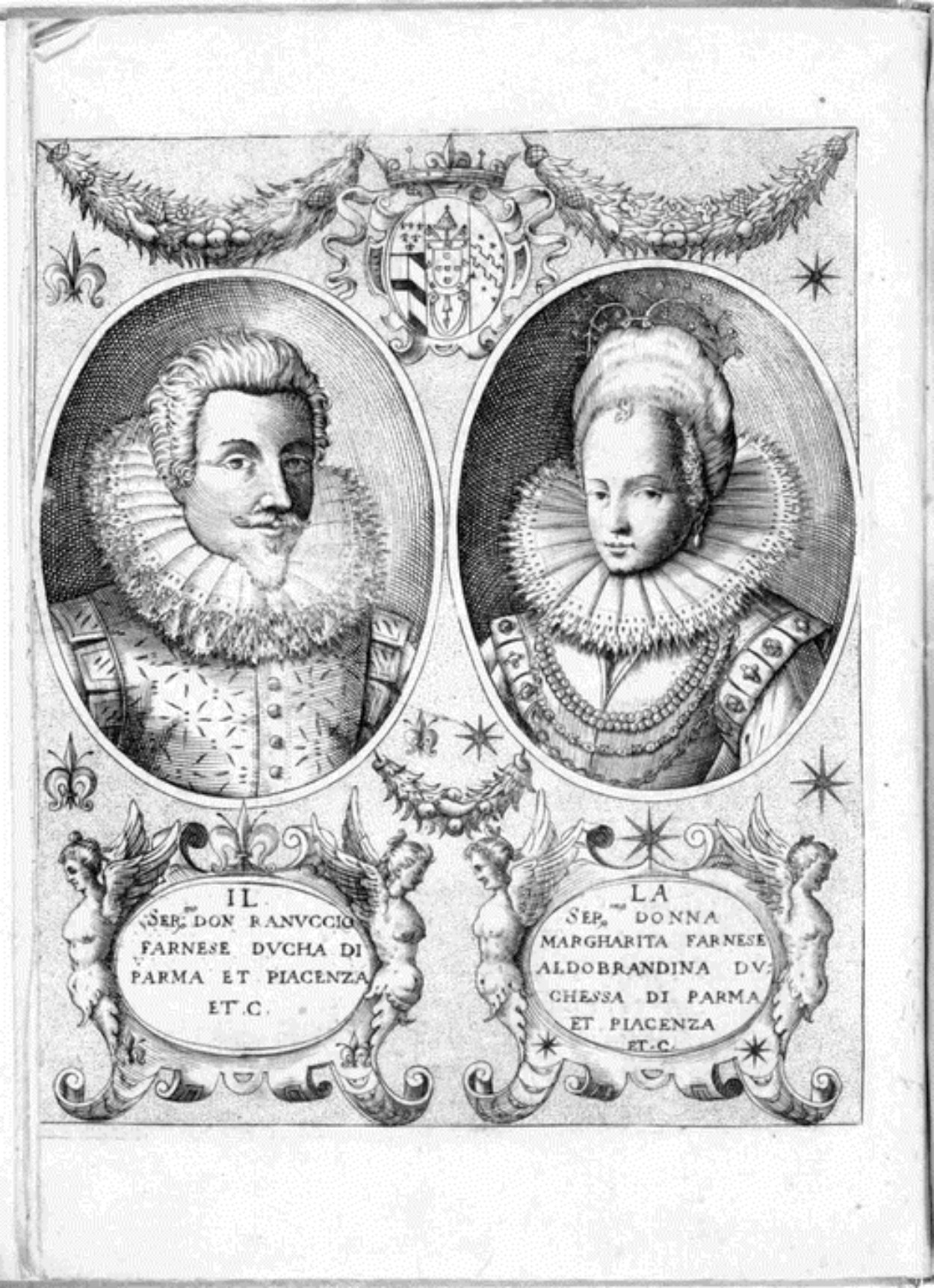
A richly dressed couple stands in a formal interior setting, framed within an ornate Renaissance border of scrollwork and decorative flourishes. The man on the right, wearing a doublet with geometric patterning, short breeches, and a cloak, extends his arm toward the woman on the left in what appears to be a gesture of courtship or invitation to dance. The woman, dressed in an elaborate gown with a heavily patterned bodice and full skirt, wears an ornate ruff collar and has her hair crowned with a feathered headdress. Both figures wear the opulent court dress typical of Milan's ducal courts in the early 1600s. The setting suggests an interior palace or great hall, with architectural elements visible behind them. The engraving is executed with fine linear detail typical of the period, using cross-hatching to create depth and shadow on the fabrics and figures.
The dancing
The man's posture is upright and formal, with his weight on his back leg and his near arm extended in a courtly gesture—neither quite touching the woman nor fully open, suggesting the restrained physicality of court dance. The woman stands en face, her body composed and her hands positioned modestly. Both figures maintain the upright carriage and small foot positions characteristic of Renaissance court dance, with no evidence of the vigorous footwork or turned-out legs that would appear in later balletic codification. The relationship between them is one of formal proximity and mutual acknowledgment rather than physical contact.
The dance depicted
This is a figure study illustrating a dance from Cesare Negri's treatise, most likely a pavane, branle, or similar processional or measured court dance of the early 1600s. Negri was the foremost dance master of Milan and taught throughout the Italian and French courts, and his *Le Gratie d'Amore* is one of the most systematic records of Renaissance court choreography. The plate shows the moment of greeting or the opening stance of a dance, illustrating both the dress code and the deportment required. The gesture and spacing suggest a dance that emphasized grace, restraint, and formal courtesy rather than athletic display—the hallmark of Italian court dancing of this era.
How it was made
This is an engraving, a medium that allowed fine linear detail and was ideal for the reproduction of costume studies and dance notation within treatises. Engraving required that the design be cut into a polished metal plate, allowing multiple impressions to be pulled from a single matrix—crucial for the circulation of Negri's treatise across courts and among aristocratic collectors who wished to learn these fashionable dances. The technique's precision and the care lavished on the decorative border and fabric patterning indicate that this was a prestige publication intended for a wealthy and educated readership, not a practical teaching document for the dance floor.
About this work
This is one of thirteen didactic plates from Cesare Negri's *Le Gratie d'Amore* (Milan, 1602/1604), a foundational text of Renaissance dance. It presents a paired figure in formal court dress, frozen at the moment of opening stance or greeting, illustrating both the choreography and the visual etiquette required of courtly dancers. The engraving serves multiple purposes simultaneously: it is a fashion plate, a notation system, a record of court ritual, and evidence of how the body was expected to move and present itself in the highest aristocratic circles of early modern Italy.
Negri's treatise was among the most influential dance publications of the Renaissance, and his careful, systematic presentation of dances, music, and deportment shaped courtly practice across Europe. This plate belongs in a gallery of dance precisely because it is not a spontaneous snapshot of movement but a prescriptive image—a statement about what grace and nobility should look like when embodied. The couple's stillness is itself a kind of eloquence, holding the opening moment before the choreography unfolds.
How to look at it
Attend to the restraint and formality of the poses. The man's extended arm is not a passionate gesture but a courtly one—controlled, measured, and respectful of distance. Notice the meticulous rendering of fabric and surface—the geometric patterning of the doublet, the texture of the ruff, the weight of the full skirt—which indicates that dress itself was part of the dance's meaning and effect. The ornate border frames the figures as if they were precious objects worthy of study, suggesting that this image was meant not for quick reference but for sustained contemplation and imitation. The stillness of the pose is also significant: Negri's dances were built on walking steps and small movements, and this moment of opening stance shows the dancer's body held in perfect equilibrium—a moment of potential energy before motion.
The artist
Cesare Negri, known as il Trombone, was the principal dance master of Milan from approximately 1554 until the early 1600s. He taught at the Visconti and Sforza courts and traveled throughout Italy and France, making him one of the most influential dance pedagogues of the Renaissance. His two treatises—*Le Gratie d'Amore* (1602) and its expanded version—remain the most comprehensive and systematic records of Renaissance court dance and are unique in combining choreography, music, and visual representation of costume and deportment. Negri's standing and reach ensured that his work circulated among the European nobility and helped standardize courtly dance practice across courts.
The period
In the early 1600s, court dance was at the apex of its prestige and formal elaboration. Dance was not entertainment but a fundamental expression of noble identity—a means by which a courtier demonstrated wit, grace, obedience, and rank. The Renaissance pavane and branle, which Negri taught, were the canonical dances of state occasions and formal gatherings. At the same moment, in Italy and France, the intermezzi and early ballet de cour were beginning to experiment with more narrative and dramatic possibilities, but Negri's focus remained on the measured, processional dances that defined courtly refinement. The publication of his treatise in the early 1600s coincides with the final apotheosis of the purely formal, geometric court dances before the Baroque era introduced greater spectacle and theatrical elaboration.
Where it lives
This engraving is from *Le Gratie d'Amore*, published in Milan in 1602 or 1604 (sources vary on the exact date), held by the Library of Congress. The work survives in multiple copies in major libraries and collections across Europe and North America, reflecting its status as a prestige publication and a foundational reference for dance historians and performers.
Dance in this work
Questions about this work
How do we know what these dances actually looked like?
Negri's treatise combines several forms of documentation: written descriptions of the choreography, musical notation indicating the rhythm and phrasing, and these engraved plates showing the dress and the posture required. The plates do not show the complete dance but rather key positions and moments—here, the opening stance. Dance historians use all of these together to reconstruct the choreography. While we cannot recover the exact sensation of performing these dances, Negri's work is far more detailed and systematic than anything else surviving from the Renaissance.
Was dance really this formal and restrained?
In the formal court setting that Negri taught, yes—at least for the dances associated with state occasions and displays of nobility. The pavane and branle were choreographed, measured, and processional. However, courts also danced livelier dances, and common people danced quite differently. Negri's work documents elite practice, which does not mean it was the only kind of dancing that occurred.
What would learning from Negri's book actually involve?
A wealthy courtier or aspiring dancer would study the written descriptions and listen to the music, then work with a teacher (or a skilled servant) to learn the steps and positions. The engraved plates would serve as visual aids, helping the student understand the correct carriage and dress. The book was a teaching tool but required an experienced practitioner—it was not a self-contained method for a complete beginner.
How did this couple's clothing enable the dance?
The stiffened bodice and full skirt of her gown, the breeches and doublet of his costume, and the ornamental ruffs all constrained the body in specific ways. Large, vigorous movements were impossible; the dances emphasized small, controlled steps, upright posture, and the visual effect of the fabrics in motion rather than athletic display. The clothing itself was part of the choreography.
More Notation/Choreography artwork