49 works in this view — arrow keys or swipe to move between them.
Dance in Art
Negri — Dance Plate (plate 14)
Cesare Negri (il Trombone)
- Medium:
- Engraving
- Dance:
- Notation/Choreography
- Era:
- Pre-1700 (Renaissance/Baroque)
- Collection:
- Le Gratie d'Amore (1602)
- Source:
- Library of Congress
- Rights:
- Public domain — free to use, share and adapt.
- Recorded as:
- Public Domain
Negri's treatise is one of only a handful of comprehensive dance books to survive from the Renaissance, and it is our most detailed source for understanding how court dances were actually performed—the posture, timing, spatial relationships, and social meaning encoded in movement. This particular plate demonstrates the precision with which Negri documented these dances through illustration, making the choreographic and social information legible to dancers and choreographers centuries later.
What you are looking at
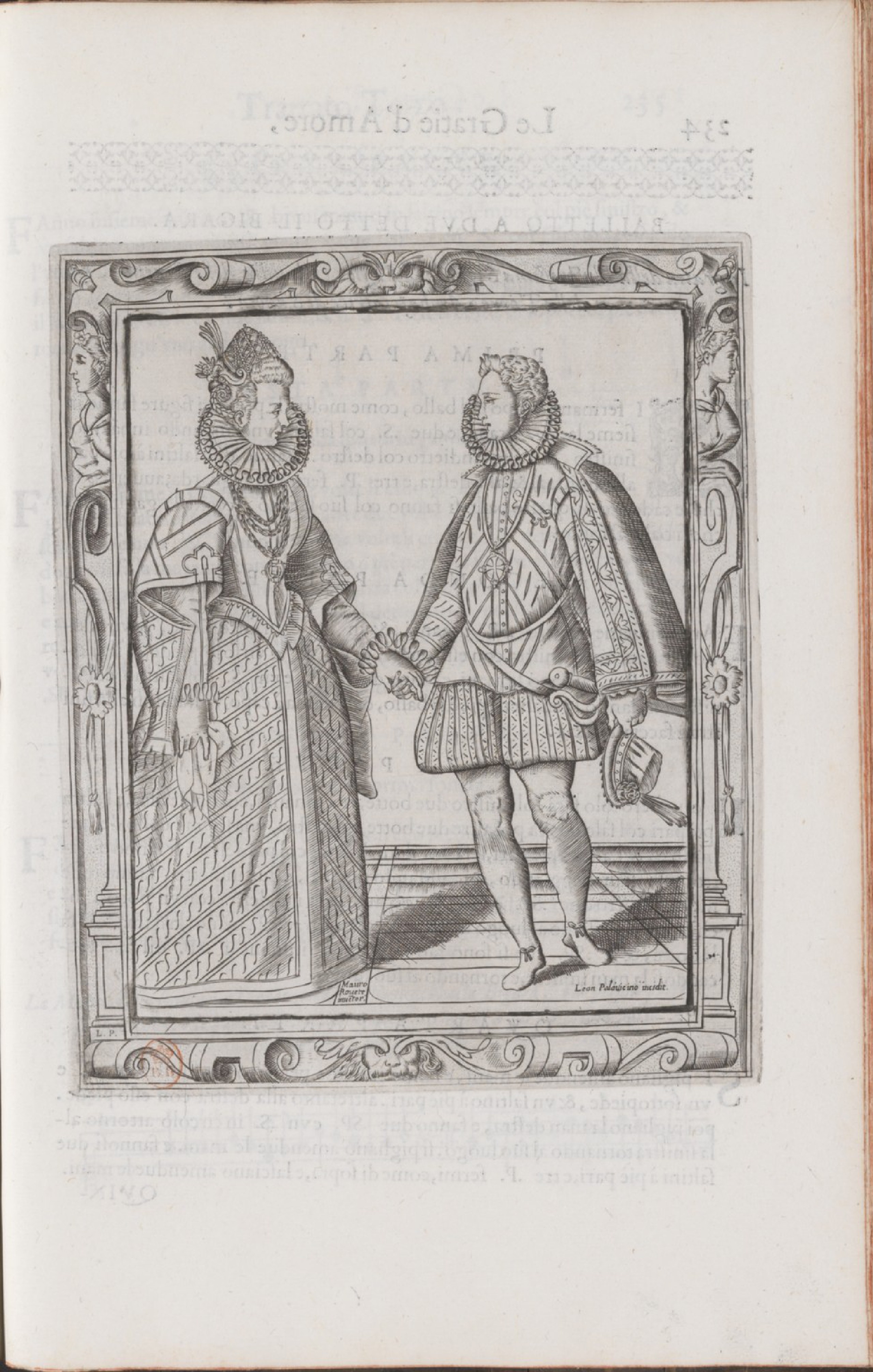
Two figures in elaborate early 17th-century court dress stand facing each other in a formal interior setting, framed by an ornately scrolled border characteristic of Renaissance engraving. The figure on the left wears a richly patterned doublet with diagonal hatching and a full pleated skirt, while the figure on the right is dressed similarly but wears a draped cloak or cape over the shoulders. Both wear elaborate ruffled collars (the high standing collars typical of the period) and jeweled ornaments at the chest. Their hair is styled in the fashion of the early 1600s with curls framing the face. The two figures clasp hands at roughly waist height, their bodies turned toward each other in a pose that suggests the moment of approach or engagement in a formal dance. The setting is minimal—a tiled floor visible beneath their feet—with text faintly visible in the background, indicating this is a didactic plate from a dance treatise. The engraving is rendered in fine parallel lines throughout, creating precise definition of fabric texture and ornamental detail.
The dancing
The two dancers stand in an upright, formal posture with their weight evenly distributed. Their clasped hands at center suggest a moment of connection in a partnered dance, likely at the point of greeting or the opening figure. Both figures maintain an erect carriage with shoulders back, and their facing position with joined hands indicates a symmetric, orderly approach to the movement. The positioning suggests moderate spacing between the bodies rather than a close embrace, consistent with court dance conventions of the period.
The dance depicted
This is a pedagogical illustration from Cesare Negri's *Le Gratie d'Amore*, one of the most influential dance treatises of the late Renaissance. The plate depicts a paired figure from a courtly dance likely in the tradition of the galliard, pavane, or almain—the standard ballroom dances of the Italian and European courts of the 1600s. The moment frozen here is probably the opening salutation or a moment of hand contact between partners, which would have been a standard structural element in these dances. Negri's treatise was known for combining elegant figure illustrations with precise notational description, and this image exemplifies the clarity required to teach these dances to court dancers across Europe.
How it was made
This is a copper-plate engraving, a technique that allowed fine linear detail and precise reproduction. Engraving was the dominant medium for dance instruction books of this period because it could be printed multiple times from the same plate, enabling wide distribution to courts and noble households. The technique's demand for precise, deliberate mark-making is evident in the careful parallel hatching used to model the fabric and the fine scrollwork of the border frame. The engraving's clarity and portability made such treatises essential teaching tools for dance masters who traveled between courts.
About this work
This is a single didactic plate from Cesare Negri's *Le Gratie d'Amore* (Milan, 1602), a foundational Renaissance dance treatise that documented the repertory of Italian court dances at the turn of the 17th century. The plate depicts two costumed figures in the moment of a formal dance encounter, their dress and bearing encoding the social status and courtly refinement expected of the dancers. Negri was the celebrated Milanese dance master whose influence extended across Italy and France; his treatise combines such illustrative plates with detailed choreographic notation, making it one of the most complete records we have of Renaissance dance practice. The work sits at the threshold between medieval courtliness and the emerging Baroque, capturing a moment of formal beauty and controlled elegance that defined elite dance culture of the period.
How to look at it
Attend to the precise moment the artist chose: the joined hands and facing posture suggest not the peak of a virtuosic step but the formal greeting or opening of a dance—the moment of etiquette and order. The symmetry of the two figures and their equal elaboration of dress underscores the social ritual of the dance, where both partners are on display. The extreme detail of the fabric patterns and ornament is not decorative but documentary—Negri's contemporaries needed to see exactly how the courtly body presented itself when dancing. Notice also the minimal setting: there is no architectural background, no onlookers, no narrative—only the two figures and their precise, controlled posture, which suggests that the dance itself, and the refinement it demonstrated, was the entire point.
The artist
Cesare Negri, known as 'il Trombone,' was the principal dance master of the Milanese court and one of the most celebrated teachers of his generation. He trained dancers for the courts of Italy and France and published *Le Gratie d'Amore* in two editions (1602 and 1604) to establish and preserve the courtly dance repertory he had mastered. His treatise is distinguished by the quality of its illustrations and the methodical structure of its notation, reflecting both his status as a court insider and his commitment to codifying dance knowledge for posterity.
The period
The early 1600s were a moment of standardization and documentation in European court dance. The previous generation (Fabrizio Caroso, whose *Il Ballarino* appeared in 1581) had established the basic pedagogical approach of coupling illustration with notation. Negri's treatise, appearing two decades later, refined this method and captured the repertory at a point of refinement and codification. This was also the moment when court dance began to be formalized into the Baroque ballet of Louis XIV's court, where Italian dance masters like Negri had profound influence. The elaborate, jeweled dress depicted here reflects the investment of the nobility in courtly spectacle and the dance master's role in choreographing that display.
Where it lives
This engraving is from the Library of Congress holdings of *Le Gratie d'Amore* (Milan, 1602/1604), Cesare Negri's foundational Renaissance dance treatise. The work is a single plate from a larger illustrated and notated instructional book, and represents one of the primary pedagogical tools by which court dances of the Renaissance were taught and transmitted.
Dance in this work
Questions about this work
Is this two people actually dancing, or posing?
Both. In court dance of this period, the 'pose' and the dance were not distinct. The moment depicted—partners facing each other with joined hands—is an actual structural moment in dances like the pavane or galliard. But it is also a pose, held long enough to be clearly visible and teachable. Negri's plates freeze moments of controlled, formal beauty that dancers needed to be able to hold and repeat.
How do we know what dance this depicts?
The plate would have been accompanied by notation and description in Negri's text (not visible here). The hand position, upright carriage, and spacing between dancers are consistent with the standard court dances of the period—pavane, galliard, allemande, or almain. Without the text, we can identify the genre (Renaissance court dance) from the dress and posture, but not the specific choreography.
Why are they dressed so elaborately?
Court dance was a display of status and wealth. The jeweled ornaments, the expensive fabric, the elaborate tailoring—all of this was essential to the dance's social meaning. Negri's illustrations show dancers as they would have appeared at court, which meant in full formal dress. The dance master's job included choreographing movement that displayed this finery to maximum effect.
Who was Cesare Negri?
Negri was the principal dance master of the Milanese court and one of the most influential teachers of the late Renaissance. He taught dancers across Italy and France and is remembered primarily for his treatise, which is the most complete and carefully illustrated source we have for Renaissance court dance. His work was a bridge between the Italian dance tradition and the Baroque court ballet that developed at Versailles.
More Notation/Choreography artwork