49 works in this view — arrow keys or swipe to move between them.
Dance in Art
Negri — Dance Plate (plate 15)
Cesare Negri (il Trombone)
- Medium:
- Engraving
- Dance:
- Notation/Choreography
- Era:
- Pre-1700 (Renaissance/Baroque)
- Collection:
- Le Gratie d'Amore (1602)
- Source:
- Library of Congress
- Rights:
- Public domain — free to use, share and adapt.
- Recorded as:
- Public Domain
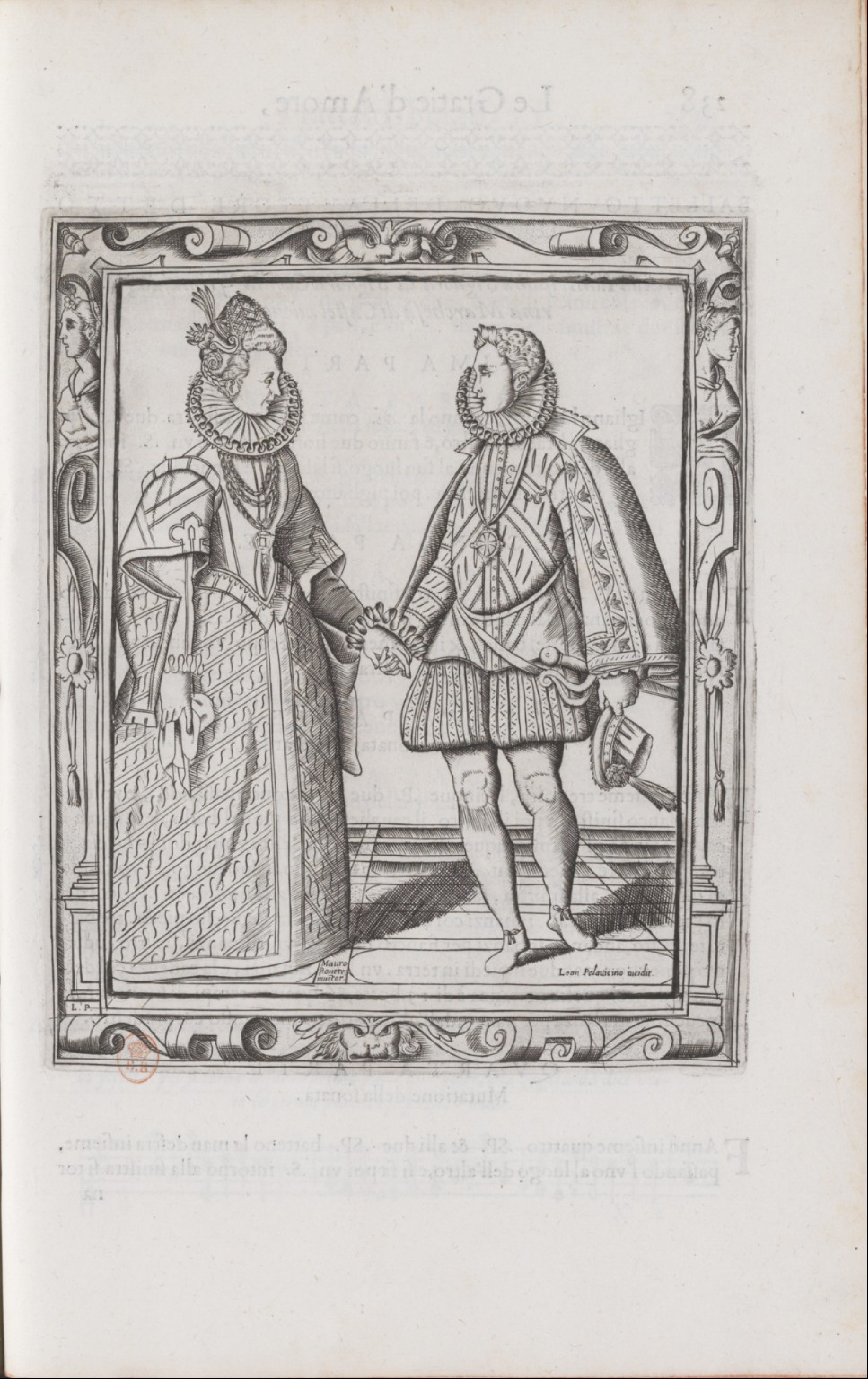
This image documents the precise moment in European dance history when choreography began to be systematically recorded and codified. Negri's treatise was consulted and imitated for the next century, making this couple one of the most influential model figures in Renaissance dance pedagogy—this exact pose and partnering appeared in copies and adaptations across Italy and France.
What you are looking at
A man and woman face each other in formal court dress, their hands joined in greeting or salutation. The woman wears an elaborate gown with a geometric diamond-patterned skirt and a fitted bodice adorned with ornamental details; her neckline is framed by a large ruffled collar typical of Renaissance courtly fashion, and her hair is arranged with jeweled ornaments. The man wears a doublet and hose with a decorative short cape or cloak across one shoulder; he holds what appears to be a small baton or wand in his lowered right hand. Both figures stand on a checkered floor within a framed architectural setting, with scrolled ornamental borders framing the entire composition. The scale and positioning suggest a demonstration or instructional moment rather than an active dance sequence—this is a paired figure in a formal stance, presenting the opening position or attitude for a dance that would have followed in the treatise's verbal descriptions.
The dancing
The man and woman stand nearly upright, separated slightly, with hands connected at approximately waist level in what appears to be a formal greeting hold. Their bodies are presented in three-quarter view facing each other, with weight evenly distributed and posture erect and dignified. The woman's free hand rests against her skirt; the man's baton (likely a symbol of authority or a teaching implement) hangs at his side. Neither figure shows the dynamic extension, bent knees, or rising action characteristic of an active step—this is a posed presentation of position rather than a moment caught mid-movement.
The dance depicted
This plate illustrates a paired dance figure from Cesare Negri's choreographic treatise *Le Gratie d'Amore*, most likely demonstrating an opening position or salutation from a Renaissance court dance such as a pavane, galliard, or branle. The treatise, published in Milan in 1602/1604, was a comprehensive manual for the Milanese dance master's method, combining illustrated couples with detailed written descriptions of steps and figures. The static presentation and formal dress indicate this is instructional rather than theatrical—it shows dancers how to stand and present themselves before executing the choreographed steps described in the accompanying text. The treatise represents the peak of late-Renaissance Italian dance pedagogy, synthesizing court dance practice from across Italy and France.
How it was made
This is an engraving on paper, a medium that allowed precise linear detail and easy reproduction. The fine cross-hatching and careful modulation of line reveal the dress and the figures' forms; the decorative border employs the scrolled Renaissance ornamental vocabulary typical of title pages and frontispieces of the period. Engraving was the standard medium for dance treatises of this era, as it combined legibility with the durability and portability necessary for a treatise intended to circulate among dance masters and nobles across European courts. The uniform gray tone and crisp line work are consistent with high-quality 16th- or early 17th-century engraved illustration.
About this work
This is an instructional plate from Cesare Negri's *Le Gratie d'Amore*, one of the most important dance treatises of the Renaissance. It presents a paired figure—the opening position or salutation between a nobleman and noblewoman—demonstrating the formal comportment and dress expected in late-Renaissance Italian court dance. The work belongs in a dance history collection not for a specific choreographic sequence but as evidence of how the period's elite dances were taught, standardized, and transmitted across courts: through illustrated couples whose gestures and postures could be studied, memorized, and taught. Negri's plates are the visual equivalent of Labanotation, a system for capturing and preserving movement that was essential to court dance culture.
How to look at it
Look at the hand position and the slight tilt of the figures' heads toward each other—Negri is showing not just how to stand but how to regard and address a partner with the formal grace expected at court. The woman's skirt is rendered with meticulous diagonal hatching that suggests the stiffness and weight of the fabric; this was not a flexible garment, and the way it falls tells you something about the constraints on movement. Notice too that both figures are shown in silhouette or near-silhouette against the plain background—this is a deliberate choice to make the outline and posture of the body, rather than facial expression or emotional content, the focus of attention. This is how you teach shape and carriage: through clear, unambiguous outlines.
The artist
Cesare Negri (c. 1535–c. 1604), known as 'il Trombone,' was the most celebrated dance master of late-Renaissance Milan. He taught at the court of William VII, Duke of Mantua, and later served the Gonzaga court; he also traveled to France to teach the French nobility. His *Le Gratie d'Amore* (1602, with a revised edition in 1604) was his magnum opus—a systematically organized manual containing over 140 choreographed dances with accompanying engravings and detailed notation. The treatise synthesized decades of his teaching practice and represented the height of Italian court dance sophistication. Unlike the contemporary French theorists, Negri provided step-by-step visual and written descriptions that allowed readers to reconstruct entire dances.
The period
This plate was created at the very end of the Renaissance, when court dance was at its aesthetic and technical height in Italy but was beginning to give way to the more codified and spectacle-driven ballet that would emerge in France under Louis XIV. The 1600s saw a shift in dance patronage and innovation from the Italian city-states toward France, but Negri's treatise stands as the last great synthesis of Italian Renaissance dance practice. Engraved dance treatises were a tool of elite cultural transmission: they allowed dance masters to preserve their choreography, establish their authority, and teach distant students. Negri's work was one of the last great treatises of this kind; by the mid-17th century, ballet would be codified differently, in written notation rather than illustrative couples.
Where it lives
This plate is from the Library of Congress collection of *Le Gratie d'Amore*, the 1602/1604 Milanese edition by Cesare Negri. The treatise survives in multiple copies and editions, attesting to its circulation and influence among dance masters and nobles.
Dance in this work
Questions about this work
What is that stick or baton the man is holding?
It is likely a teaching implement or wand, a symbol of the dance master's authority. In Renaissance dance instruction, the master often used a small stick to mark time, correct positions, or point out errors. Alternatively, it may represent a weapon or ornament appropriate to a courtier's dress of the period. Either way, it signals his role as the instructor or senior partner in this demonstration.
What dance is this showing?
The specific dance would have been identified in the text accompanying this plate in Negri's treatise, which is not visible in this image. Based on the formal, upright posture and the paired facing position, it is likely an opening figure for a pavane, galliard, branle, or similar Renaissance court dance. The full choreography would unfold through a series of such plates and written descriptions.
Why are both figures shown in such stiff, formal poses?
This is not a snapshot of spontaneous movement but an instructional diagram. Negri needed to show clearly how dancers should stand, how they should hold their bodies, and how they should regard each other. The stillness and formal posture are intentional: they make the body position and alignment legible and reproducible. A reader learning from this image would study it to memorize the exact stance before learning the steps.
How do we know this is from Negri's treatise and not someone else's?
The signature or attribution would typically appear on the plate itself, though it may not be fully legible in this reproduction. The style of engraving, the ornamental border, the dress, and the overall aesthetic are consistent with the known plates from *Le Gratie d'Amore*. The catalogue record attributes it to Negri and identifies it as plate 15 from that work.
More Notation/Choreography artwork