49 works in this view — arrow keys or swipe to move between them.
Dance in Art
Negri — Dance Plate (plate 16)
Cesare Negri (il Trombone)
- Medium:
- Engraving
- Dance:
- Notation/Choreography
- Era:
- Pre-1700 (Renaissance/Baroque)
- Collection:
- Le Gratie d'Amore (1602)
- Source:
- Library of Congress
- Rights:
- Public domain — free to use, share and adapt.
- Recorded as:
- Public Domain
Negri's treatise and its plates are among the most complete surviving records of Renaissance courtly dance technique and the only detailed visual documentation of how late-Renaissance aristocrats actually moved and dressed in the dance. The engraving medium allowed these images to circulate widely and be studied carefully, making them the primary source for reconstructing Renaissance dances today. Without such instructional plates, the lost dances described in written choreographies would remain abstract; with them, dancers can see the posture, spacing, and costume convention that gave those dances their historical form.
What you are looking at
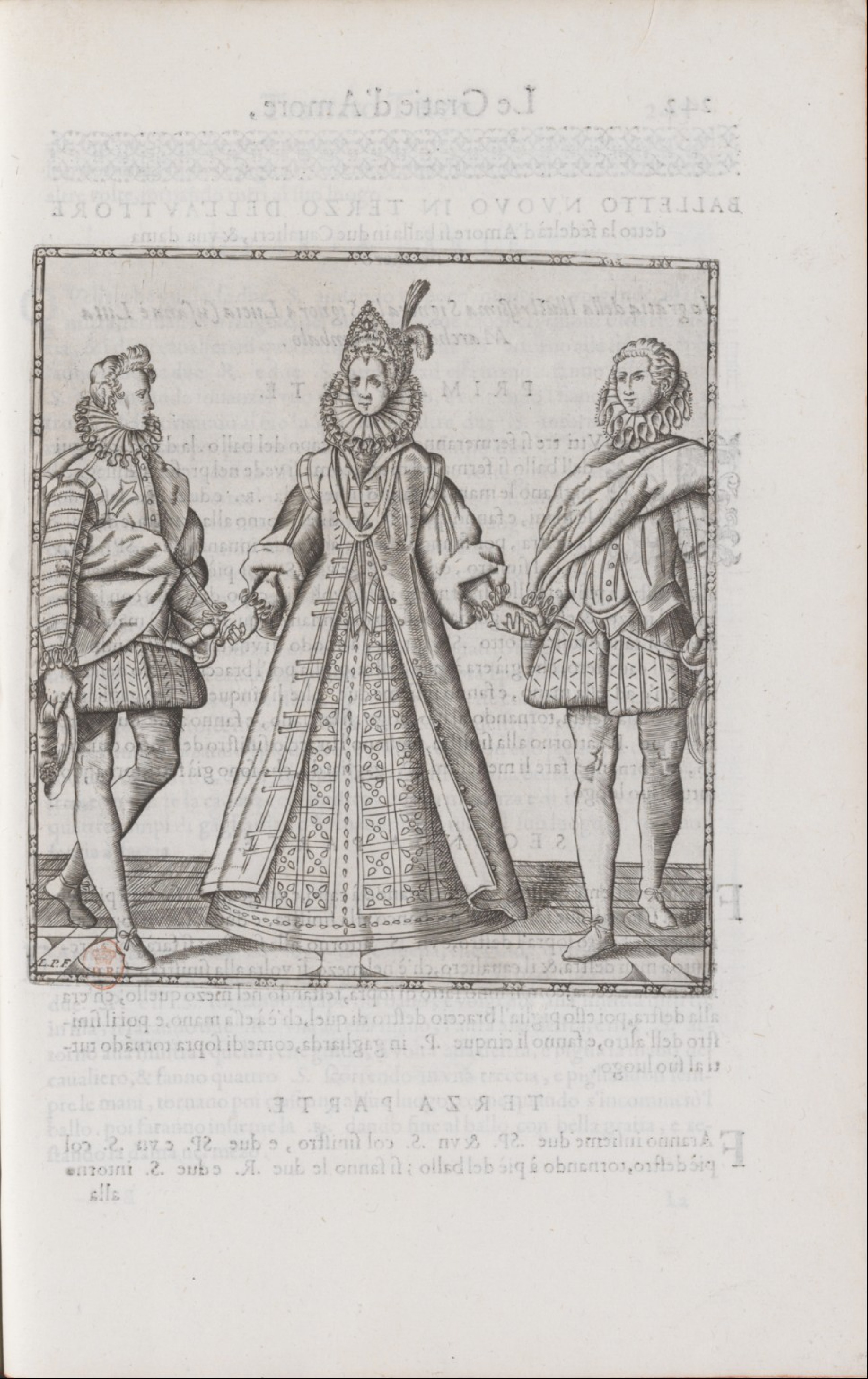
A formal engraved plate from Cesare Negri's dance treatise, depicting three aristocratic figures in elaborate late-Renaissance court dress arranged in a frontal composition. The central figure, a woman, stands between two men in a symmetrical arrangement typical of instructional dance plates. The woman wears an ornately patterned long gown with a dramatic high collar, jeweled necklaces, and an elaborate feathered headdress; her dress is densely decorated with geometric embroidery or brocade patterns. Both men flank her in profile-turned poses, wearing richly decorated short doublets with horizontal ribbed pleating, knee-length hose, and elaborate ruffed collars. The setting is plain and defined by a simple rectangular border frame, allowing the costumes and poses to dominate. The figures stand on a baseline suggesting a stage or dance floor, with no background detail—a standard convention for instructional engravings that prioritize clarity of position and dress.
The dancing
All three figures maintain upright, formal postures with minimal dynamic weight shift—they are positioned rather than captured mid-motion. The woman stands centered with arms at her sides or holding fabric; both men stand in gentle profile with their bodies angled slightly toward the center. The stances suggest a moment of formation or presentation rather than active stepping or turning. Arms and hands appear to follow courtly conventions of formal decorum rather than the vigorous gestures of active dancing. The symmetrical grouping—woman flanked by two men—indicates a standard couple or trio formation for a Renaissance court dance, with the men's posed attentiveness toward the central female figure.
The dance depicted
This plate illustrates a Renaissance couple or trio dance, most likely an allemande, branle, or pavane—the formal postures and static composition are consistent with stately processional dances. The woman's elaborate headdress and jeweled display suggest her status and the formality of the occasion. Negri's *Le Gratie d'Amore* described numerous courtly dances taught to Italian nobility, and the instructional purpose of the plate means it shows the 'set position' or opening formation rather than a moment of dynamic motion. The image documents costume, positioning, and the ritual formality that structured Renaissance court dance, showing dancers who would have learned from Negri's detailed written descriptions accompanying such plates. Without the text this plate supports, the specific dance cannot be definitively named, but the visual evidence confirms this is high-court social dancing, not theatrical spectacle.
How it was made
This is an engraving—a line-based intaglio print created by incising into a metal plate. The technique allows fine detail in the rendering of textile patterns, jewelry, and facial features, visible in the careful cross-hatching that depicts the woman's embroidered gown and the men's doublet pleating. Engraving was the standard medium for instruction books in the Renaissance, permitting multiple impressions of the same plate and wide distribution of visual information. The line work is clean and controlled, with no visible burring or spontaneity—the result is a legible, reproducible technical drawing rather than an expressive artwork. As part of a bound instructional treatise, each plate would be examined closely by students learning dance, making precision and clarity essential to its function.
About this work
This engraving from Cesare Negri's 1602 *Le Gratie d'Amore* is a primary document of late-Renaissance Italian court dance. It shows three aristocratic dancers in their formal court dress, arranged in a symmetrical frontal composition that illustrates the opening position or formation of a stately courtly dance. The plate is not a snapshot of movement but a didactic image: a visual reference for the dancer's body in repose, costume standards, and social positioning, meant to accompany Negri's detailed written choreography. Negri was the preeminent dance master of his generation, teaching across Italy and France, and his treatises were the most influential instructional texts of the Renaissance, used for centuries to teach noble youth the grammar of courtly movement.
The work belongs in a gallery of dance imagery because it is foundational evidence: it shows how Renaissance aristocrats dressed to dance, what formal court dance posture looked like, and how dance knowledge was transmitted through the marriage of image and text. The clarity and authority of the engraving made it reproducible and teachable—a tool of instruction rather than a record of performance. For dancers and historians, it is a window into the aesthetic and social world of Renaissance court culture.
How to look at it
Look first at the dress: every element—the jewels, the feathered headdress, the embroidery patterns, the ruffed collars, the pleated hose—was a careful marker of status, wealth, and fashion awareness. The artist has rendered these with precision because they mattered to the dance and to understanding who danced it. Then attend to posture: note how upright and formal all three figures are, how little weight appears to shift, how the limbs are controlled and quiet. This is not a moment of motion but a moment of formation—the visual analog to Negri's written instruction 'stand thus.' The symmetry of the composition—woman centered, men mirroring on either side—was a fundamental principle of Renaissance dance, where spatial geometry and social hierarchy were expressed through positioning. Finally, observe that this is a teaching tool: the clarity of line, the plain background, the frontal presentation are all designed for reproducibility and study.
The artist
Cesare Negri, called 'il Trombone,' was a celebrated Italian dance master active in the late 16th and early 17th centuries, based principally in Milan. He taught at the courts of Italy and France and published two major dance treatises: *Le Gratie d'Amore* (Milan, 1602) and *Nuove Inventioni di Balli* (Milan, 1604)—the latter sometimes considered an expanded second edition. His treatises combined detailed written choreographies with engraved illustrations of positions, formations, and appropriate court dress, making them the most comprehensive and influential dance instruction manuals of the Renaissance. Negri occupied a position of authority and prestige unusual for a dance master; his treatises were addressed to nobility and framed as repositories of refined courtly knowledge. He is remembered as a systematizer who documented and codified the dances of his era with unprecedented precision.
The period
The early 1600s marked a moment of transition in European court dance: the stately pavanes and almains that had dominated noble dancing in the 16th century were giving way to faster, more rhythmically complex dances like the galliard and eventually the minuet. Negri's treatises captured this moment, documenting both older dances and newer fashions. At the same time, the illustrated dance manual was becoming a standard form—following earlier works by Orchésographie (Thoinot Arbeau, 1589) and anticipating the French court ballet tradition that would flourish under Louis XIV. The engraving technique allowed Renaissance dance manuals to reach a wider audience than any prior dance instruction; they became the foundation for how Renaissance dance was transmitted and eventually reconstructed. In the visual arts, Negri's plates sit at the intersection of courtly portraiture conventions and technical illustration, valuing legibility and costume documentation over expressiveness or narrative.
Where it lives
This engraving is from *Le Gratie d'Amore*, published in Milan in 1602 (or 1604, depending on edition). The work is held at the Library of Congress. It is plate 16 from the treatise—one of dozens of instructional plates that intersperse Negri's written choreographic descriptions and commentary on dance, music, and courtly conduct.
Dance in this work
Questions about this work
Who were these people? Was this a real dance performance?
This is not a record of an actual performance but an instructional diagram, like a figure in a modern dance manual. The figures represent 'a dancer' and 'a partner'—generic roles dressed in the height of fashion to show how one should appear. They embody the ideal rather than document the specific. The choreography this plate supports would have been danced at Italian and French courts by nobility, but this image is didactic, not documentary.
What dance is this showing?
The plate number and the accompanying text in Negri's treatise would specify the dance, but from the image alone we can see this is a formal, stately Renaissance court dance—likely an allemande, pavane, or branle—based on the upright posture, symmetrical formation, and static presentation. The actual choreography would have involved specific steps, turning patterns, and floor paths described in detail in the written text that this plate illustrates.
Why is the woman's dress so elaborate?
The ornate costume—jewels, embroidery, feathered headdress—displays both the expense of court dress and the woman's status as a participant in elite dance. In Renaissance court culture, dress and dance were inseparable markers of rank and refinement. The artist has rendered every detail clearly because costume was part of what a student of dance needed to learn and emulate.
How do we know this is by Negri?
The plate is identified as part of Negri's *Le Gratie d'Amore* in the catalogue record and is consistent with the style and purpose of his treatises. Negri's own signature or mark may appear on the plate itself, though the catalogue record does not state this. The treatise was widely circulated and is well-documented in the history of dance instruction.
More Notation/Choreography artwork