49 works in this view — arrow keys or swipe to move between them.
Dance in Art
Negri — Dance Plate (plate 17)
Cesare Negri (il Trombone)
- Medium:
- Engraving
- Dance:
- Notation/Choreography
- Era:
- Pre-1700 (Renaissance/Baroque)
- Collection:
- Le Gratie d'Amore (1602)
- Source:
- Library of Congress
- Rights:
- Public domain — free to use, share and adapt.
- Recorded as:
- Public Domain
Negri's *Gratie d'Amore* is one of the most important surviving sources for Renaissance court dance practice, and this plate is among the first visual documents to show dancers in the act of a choreographed partnership. For historians of dance and courtly culture, the image provides concrete evidence of body position, costume, and the formal aesthetic principles that governed movement in Renaissance courts—information available nowhere else. For artists and dancers today, it demonstrates how dance was documented and valorized as an art form worthy of the same careful illustration and reproduction as other courtly disciplines.
What you are looking at
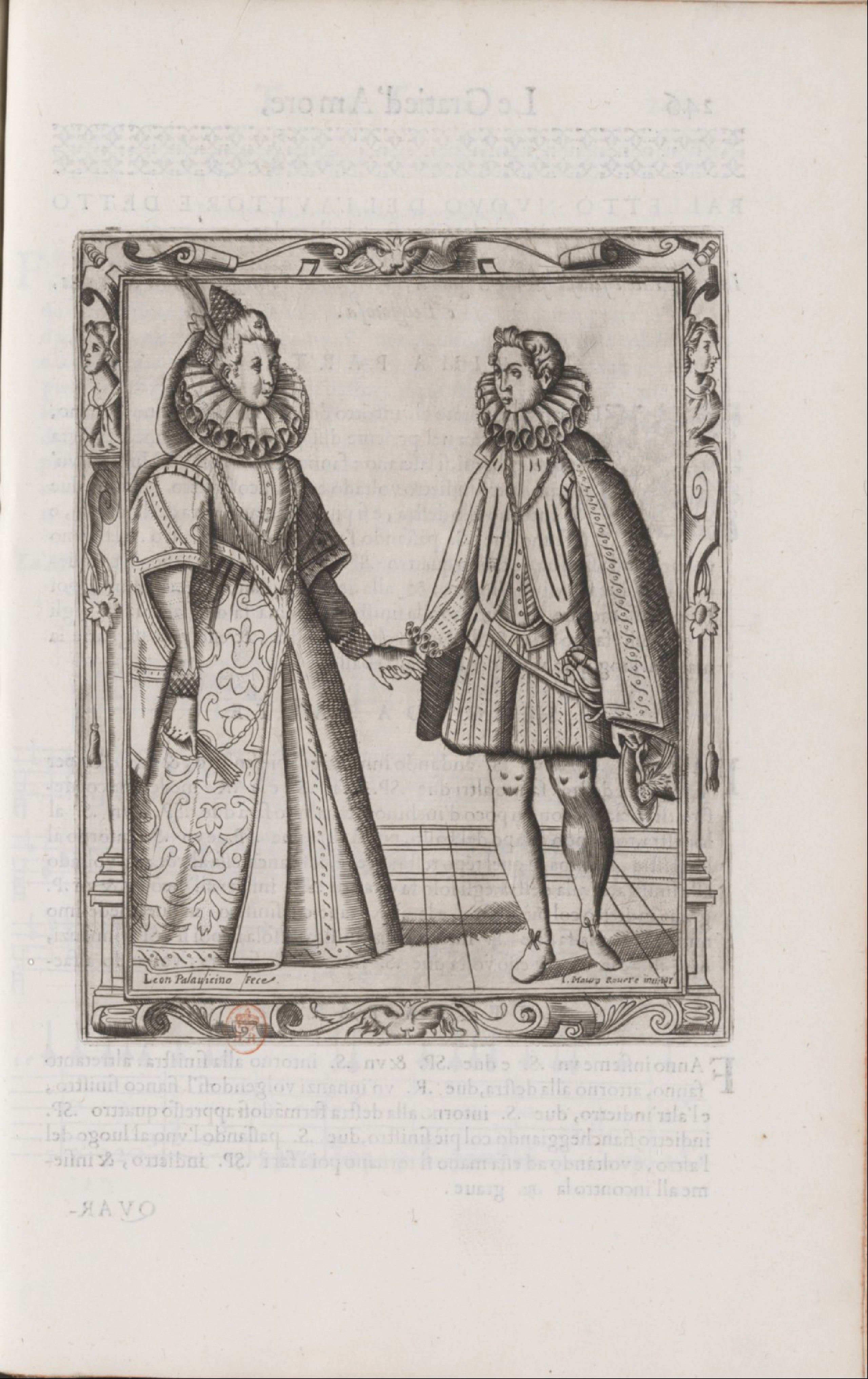
An engraved plate from Negri's dance treatise presents two aristocratic figures in an interior setting defined by a classical architectural frame. On the left stands a woman in an elaborate gown with voluminous skirts decorated with scrolling floral embroidery; her bodice is tightly corseted, and she wears the characteristic wide ruffled collar (millstone ruff) of late Renaissance court dress. Her hair is gathered up, and her posture is upright and formal. To her right stands a younger figure in doublet and hose, wearing a shorter garment with similar ruffled collar detail, his legs exposed below the knee in the style of male court dress of the period. The two figures face each other at a slight angle, and their hands are linked or nearly touching at chest height, suggesting a moment within a choreographed sequence. The background is plain, allowing the ornate borders—decorated with scrollwork, shells, and foliate designs—to frame the scene with Renaissance elegance. The engraving style is crisp and precise, with careful hatching to create depth and texture in the fabrics.
The dancing
Both figures maintain an upright, dignified carriage characteristic of court dance. The woman's weight appears centered, her torso formal and still; the man assumes a similar posture. Their arm position suggests a hand-hold at chest level, palms likely facing inward in the style of Renaissance courtly contact. There is no visible footwork detail, but the positioning and angle of their bodies indicates a moment of connection within what would have been a patterned, processional sequence rather than rapid movement. The relative scale and positioning suggest this is a paired couple figure documented for teaching or reference.
The dance depicted
This is one of Negri's choreographic notation plates illustrating a paired figure from a court dance of the late Renaissance. The dress, posture, and hand-hold are consistent with the basse danse, almain, or galliard—the primary court dances of the period—though Negri's treatise encompasses multiple forms. The image functions as a visual aid to the written instructions that accompanied it in the text, showing dancers (most likely nobility or their courtiers, trained in the humanistic discipline of dancing) how to hold and relate to their partner at a specific moment in the choreography. The formal, restrained gesture and the frontal orientation toward the audience indicate this is a position designed for display and elegance rather than virtuosity.
How it was made
This is an engraving—a intaglio print in which fine lines are cut into a metal plate, inked, and printed onto paper. The technique produces crisp, reproducible detail and was the standard medium for illustrating technical and instructional treatises in the early seventeenth century. Engraving allowed Negri's choreographic documentation to circulate beyond the immediate court and to be copied, making it a durable pedagogical tool. The ornamental border and careful attention to costume detail are characteristic of prestigious printed books of the period, indicating this was a luxury publication intended for an elite, literate audience of courtiers and dance masters.
About this work
This is a dance instruction plate from Cesare Negri's *Le Gratie d'Amore* (*The Graces of Love*), published in Milan in 1602 as one of the earliest systematic notations of Italian Renaissance court choreography. Negri was a celebrated dance master who taught at multiple courts and compiled his knowledge into this lavishly illustrated treatise, combining written description, visual plates, and choreographic instruction. The plate presents a paired couple in a formal court dance, their dress and posture documenting not only how the dance was performed but also the courtly ideal of refined movement and social grace that dancing embodied. Such treatises were instruments of cultural transmission, spreading courtly practices across regions and preserving them for future generations.
How to look at it
Attend to the precise formal posture and the restrained gesture: this is not a moment of exuberance or rapid movement, but rather a choreographed position held for display and counted according to musical measures. The linked or near-touching hands at chest height are the signature of Renaissance court dance partnership, and the frontal facing of both figures toward the viewer suggests this is a frame in which the couple would be observed from an audience perspective. The ornate borders and careful costume rendering indicate that this is a document designed to be studied and referenced, not a casual observation—the kind of visual instruction a student of dancing would consult before learning the figure from a master.
The artist
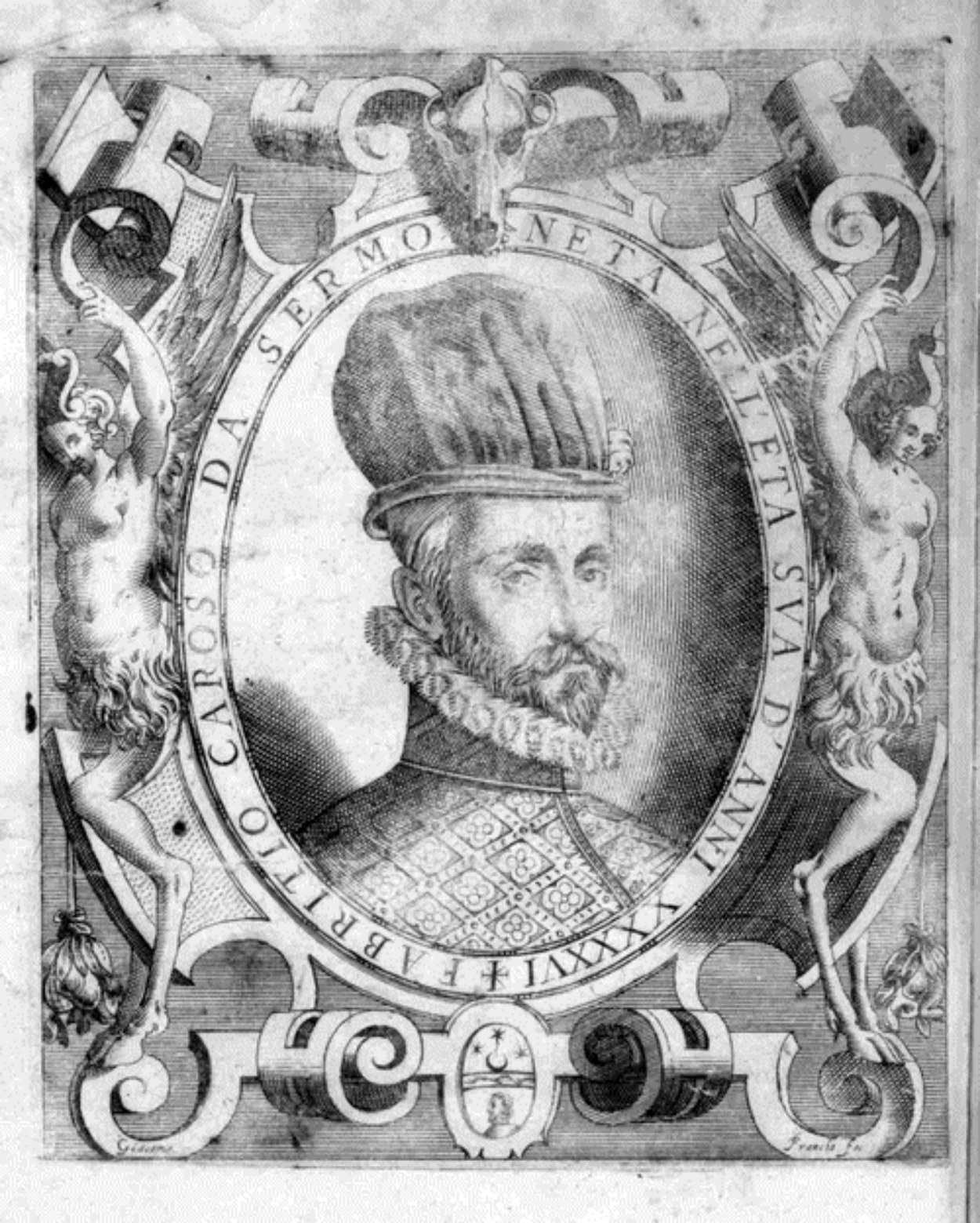
Cesare Negri (c. 1535–c. 1604), called 'il Trombone,' was an influential dance master and theorist based primarily in Milan. He is known to have taught at the courts of Turin, Mantua, and France, and his treatise *Le Gratie d'Amore* is one of the most comprehensive records of late Renaissance Italian dance practice. Unlike Fabrizio Caroso (whose *Il Ballarino* preceded Negri's work), Negri emphasized geometrical precision and elaborate court figures. His treatise combines dance instruction with music, etiquette, and courtly philosophy, reflecting the Renaissance ideal of dance as part of a complete humanistic education. The engraved illustrations were produced by skilled craftsmen and have become the visual foundation for modern reconstructions of Renaissance choreography.
The period
In the late sixteenth and early seventeenth centuries, social dancing was a required accomplishment for nobility and a visible marker of courtly refinement. The Italian Renaissance courts, particularly Milan, were centers of choreographic innovation, where dance was formalized into teachable sequences and performed at court events, weddings, and celebrations. The printing of illustrated dance treatises—beginning with Caroso and culminating in Negri—coincided with the broader humanistic impulse to document, systematize, and preserve knowledge. This was also the period in which dance was beginning to be recognized as a distinct art form worthy of written and visual analysis, laying groundwork for the later development of ballet in France.
Where it lives
This engraving is from *Le Gratie d'Amore*, published by Cesare Negri in Milan in 1602 (with a second edition in 1604). The work was held by the Library of Congress and is now digitized as part of their collection of early printed books. The treatise was reprinted and translated multiple times and was widely distributed among educated European audiences, making it one of the most influential documents of Renaissance dance practice.
Dance in this work
Questions about this work
What dance is being shown here?
The plate illustrates a paired figure from a court dance of the late Renaissance—most likely a basse danse, almain, or galliard, though Negri's treatise covers multiple forms. The specific dance would be identified by consulting the accompanying written instructions in the treatise, which are not visible in this image alone. What matters is that this is a moment within a choreographed sequence, frozen for teaching and reference.
How was this engraving made?
An artist drew the design on a metal plate (usually copper), and an engraver cut fine lines into the surface using a burin tool. The plate was then inked and pressed onto paper to create a print. This process was labor-intensive and required skilled craftsmen, making it expensive—the cost indicates this was a prestige publication for an elite audience.
Who would have used this book?
Dance masters, nobility, and courtiers learning or teaching court dances. The treatise was an instruction manual and a status symbol, documenting the refined movements expected of anyone participating in courtly life. Its circulation in print meant these standards and practices could spread beyond a single court.
Why do the figures look so formal?
Renaissance court dance prioritized elegance, geometry, and restraint. Movement was meant to display grace and noble bearing, not athleticism or emotional expression. The formal posture and linked hands are hallmarks of the style, and this image documents the aesthetic ideal of the period.
More Notation/Choreography artwork