49 works in this view — arrow keys or swipe to move between them.
Dance in Art
Negri — Dance Plate (plate 18)
Cesare Negri (il Trombone)
- Medium:
- Engraving
- Dance:
- Notation/Choreography
- Era:
- Pre-1700 (Renaissance/Baroque)
- Collection:
- Le Gratie d'Amore (1602)
- Source:
- Library of Congress
- Rights:
- Public domain — free to use, share and adapt.
- Recorded as:
- Public Domain
Negri's *Le Gratie d'Amore* is one of only two comprehensive dance treatises to survive from the Renaissance, and one of the first to combine notation with engraved figures. This plate is a primary source for understanding not only the steps of Renaissance dance but the visual grammar of courtly presentation—how the body was supposed to look, how partners related to one another, and how dress and movement worked together to signal status and accomplishment. For a dancer or historian, this image bridges the gap between abstract notation and embodied practice: it shows what the notation was meant to produce.
What you are looking at
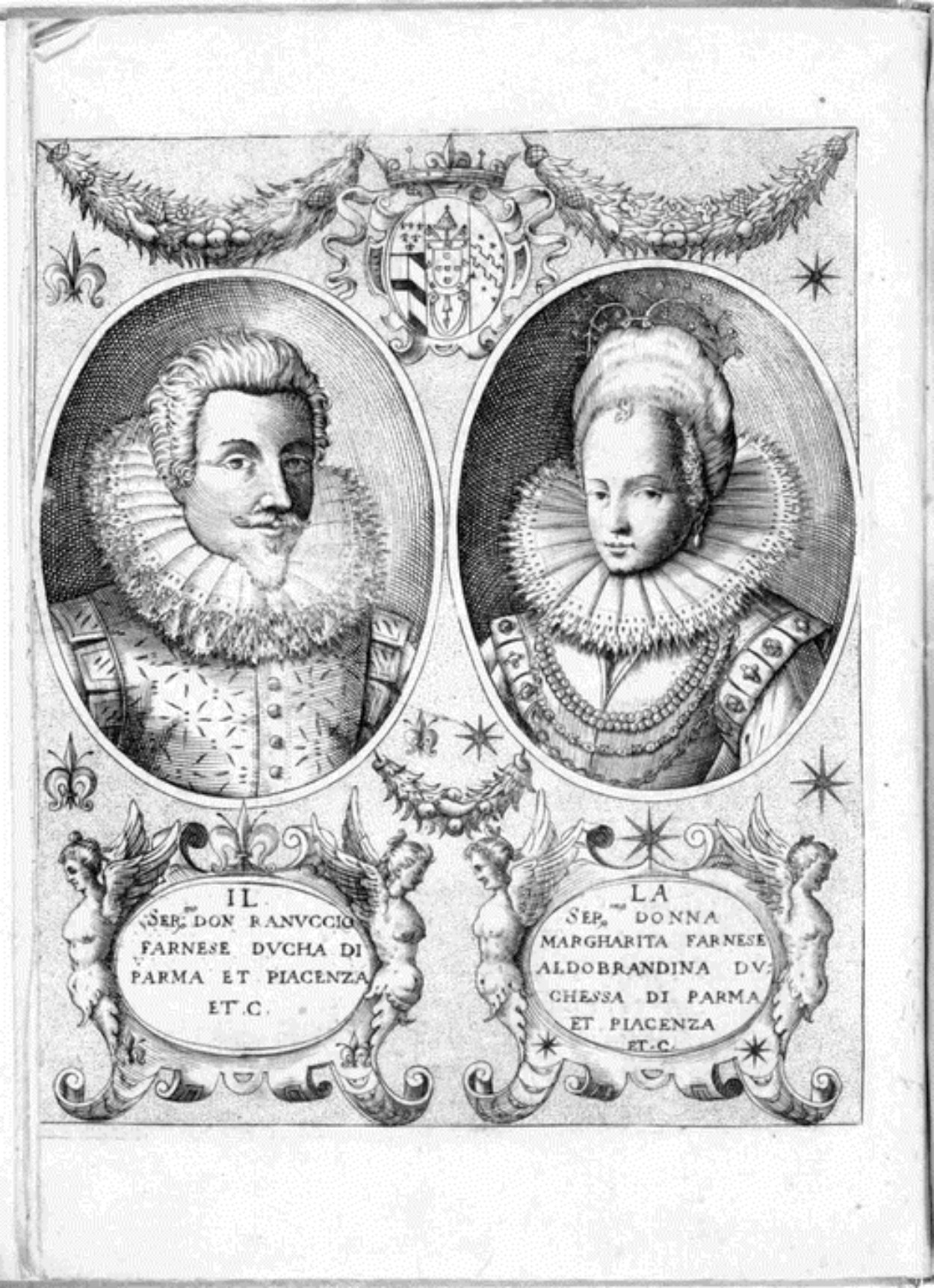
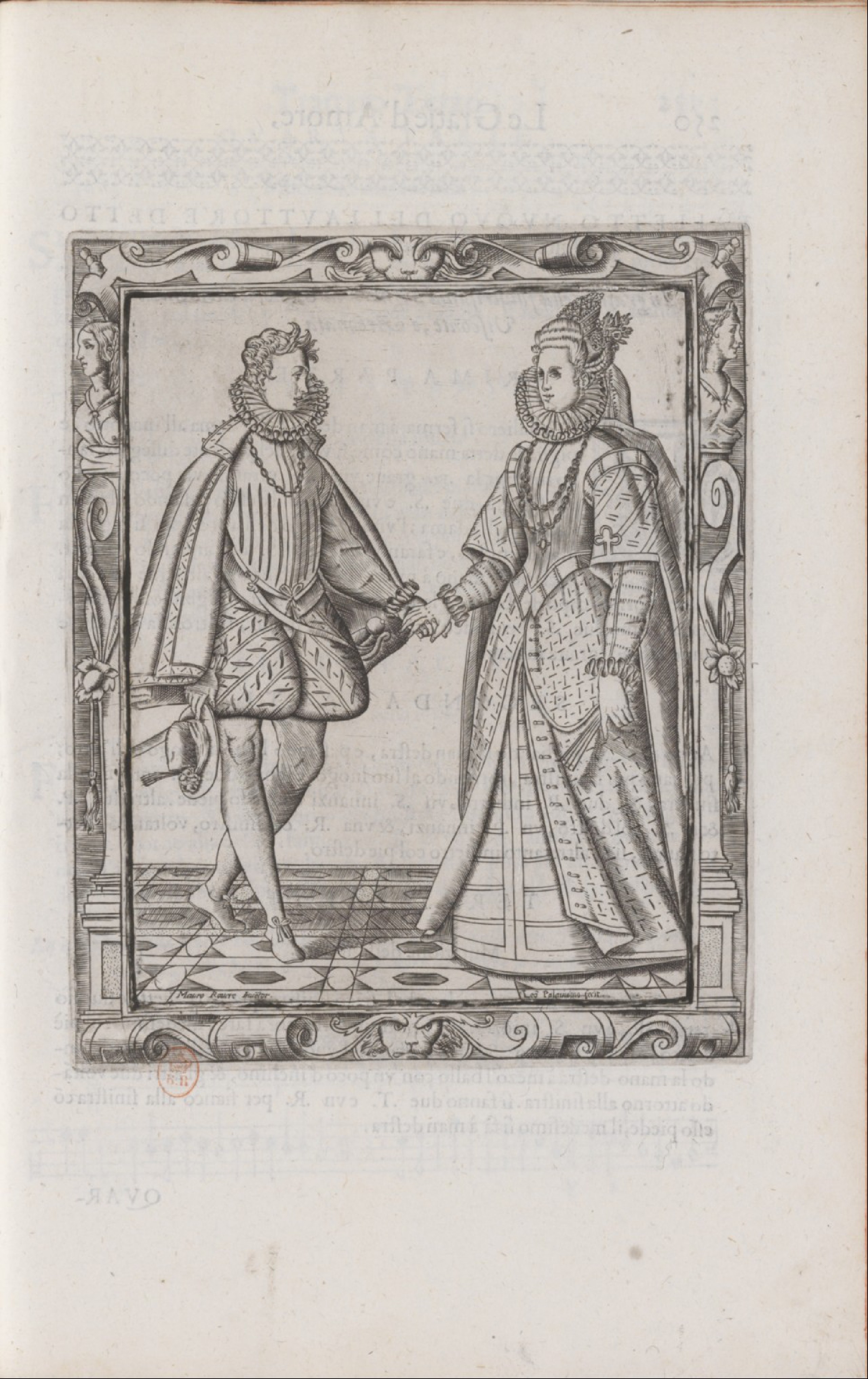
An engraved courtly couple stand face-to-face in a formal architectural setting with an elaborate scrollwork border. Both figures wear the ornate dress of late Renaissance Italian nobility: the man on the left sports a feathered cap, a short cape draped from his shoulders, and a pleated doublet with close-fitting hose and shoes; the woman on the right wears an elaborate headdress with upright plumes, a high-necked bodice with geometric quilting, a heavily patterned skirt with complex folds, and a long formal mantle. They hold hands between them in a pose that suggests formal greeting or the opening of a paired dance. The floor beneath them is rendered in perspective with a grid pattern. The border frames them as if presenting them for study—the kind of didactic arrangement typical of dance instruction manuals where single figures or couples are shown as models for imitation.
The dancing
The two figures stand upright with equal weight distributed, turned slightly toward each other in mirror symmetry. Their joined hands form the focal point of the composition, positioned at waist height in what appears to be a formal hand-hold rather than an embrace. Neither figure leans toward the other; both maintain an erect, dignified posture characteristic of courtly decorum. The man's left leg is slightly bent at the knee, suggesting a momentary pause in movement rather than an active step. The woman's stance is more contained within her voluminous skirts. The gesture is courteous and measured—no indication of vigorous movement, but rather the formal presentation of two partners acknowledging one another before or during a dance.
The dance depicted
This plate appears to document one of the Italian court dances that Negri taught and notated—most likely a pavane, allemande, or other stately processional or paired dance common to 1590s–1610s Milan and French court circles. The hand-hold, upright posture, and the formal presentation style are consistent with Renaissance dances that emphasised measured steps, symmetry, and courtly decorum. Negri's *Le Gratie d'Amore* included detailed choreographic notation alongside these paired-figure engravings, allowing dancers to study both the dress and deportment expected of accomplished courtiers. The image shows not a moment of dynamic movement but a posed convention—the dancers as they would stand to begin or to present themselves within the formal structure of the dance.
How it was made
This is an engraving, a printmaking technique that uses a burin to incise lines into a metal plate, which is then inked and pressed onto paper. Engraving allowed for fine detail and sharp definition—evident here in the intricate patterning of the woman's quilted bodice, the feathering of the man's cap, and the elaborate scrollwork of the border. The technique was labour-intensive but produced impressions suitable for circulation among elites and for illustration in books; this image appears in *Le Gratie d'Amore*, a major printed dance treatise. The clarity of line and precision of anatomical rendering would have made such plates invaluable for distant students seeking to understand the dress, posture, and formal presentation expected in courtly dance practice.
About this work
This is one of a series of instructional paired-figure engravings from Cesare Negri's *Le Gratie d'Amore* (Milan, 1602/1604), a comprehensive dance treatise by the most celebrated Italian dance master of the late Renaissance. Negri, known as 'il Trombone,' taught at courts across Italy and France, and his book synthesised decades of professional practice into a written and illustrated system. Each plate in the series presents a couple—or sometimes an individual—in formal court dress, often paired with detailed choreographic notation explaining the steps they would execute. This particular image shows a man and woman of noble bearing in the act of formal greeting or partnership, the moment before or within a measure of stately courtly dance. The engraving's precision and the careful attention to textile detail—embroidery, quilting, and patterned silk—emphasise that court dance was inseparable from display, status, and the cultivation of elite bodily decorum.
How to look at it
Observe the hands: they are the anchor of the composition and the interface between the two dancers. Note how neither figure crowds the other, and how the formal distance between them reflects Renaissance ideas about courteous reserve. Look at the feet and legs to see how weight is distributed—the slight bend in the man's knee suggests a pause in a sequence of measured steps rather than a static pose. The border is not merely decorative: it frames these figures as exemplary, worthy of study and imitation. The engraving's precision allows you to read the elaborate textile work and jewellery that would have been part of the actual costume, reminding you that Renaissance dance was always a visual spectacle, not merely a kinetic one. This is a teaching image: it shows you how to stand and how to hold your partner's hand.
The artist
Cesare Negri (c. 1535–after 1604), called 'il Trombone' (the trombone), was the foremost dance master and choreographer of late Renaissance Italy. Active primarily in Milan from the 1560s onward, he taught nobility, trained professional dancers, and choreographed entertainment for the Sforza and Spanish courts. His *Le Gratie d'Amore* (1602, with a revised edition in 1604) was the culmination of a lifetime of practice and represented the most systematic attempt yet made to codify Renaissance dance technique, style, and repertoire. Negri worked with skilled engravers to produce the detailed costume plates and invented a notation system (precursor to more modern systems) to record the sequences of steps and patterns. His approach—combining visual instruction with written rule and mathematical clarity—established a model for dance documentation that influenced subsequent choreographers.
The period
In the 1590s and early 1600s, Italian and French courts were reaching the height of their investment in court dancing as an art form and a marker of nobility. Dance was understood as one of the essential arts of courtship and statecraft, alongside music, poetry, and rhetoric. The Renaissance had valorised measured, symmetrical movement over the vigorous, acrobatic styles of the medieval period; by Negri's time, pavanes and galliards were the dominant forms, each with its own rules for step, timing, and deportment. The rise of the printed book—including Orchésographie by Thoinot Arbeau (1588) and Negri's own works—reflects a new cultural moment in which elite dance practices were being codified and circulated beyond the court itself. The careful engraving of dress in these plates also coincides with a broader Renaissance interest in the material culture of nobility: what one wore, how one stood, and how one moved were all legible signs of rank and cultivation.
Where it lives
This engraving is from *Le Gratie d'Amore* (Milan, 1602/1604), one of only two comprehensive Renaissance dance treatises to survive. The work is housed in the Library of Congress and other major collections. Within the treatise, such paired-figure plates serve as visual complements to the choreographic notation that explains the specific steps, tempos, and patterns each couple would execute.
Dance in this work
Questions about this work
What dance are these two people doing?
The image does not identify the specific dance, but the posture, hand-hold, and formal presentation are consistent with the stately Renaissance dances Negri taught—pavanes, allemandes, or courtly processional dances. The purpose of the plate is to show the correct posture and deportment before or within such a dance, not to capture a moment of visible action. The accompanying text and notation in Negri's treatise would have specified the exact steps.
Why are they dressed so elaborately?
Renaissance court dance was inseparable from display and status. What you wore—the quality and cost of your fabrics, the intricacy of your embroidery and quilting, your jewellery and feathers—signalled your rank and your cultivation. Negri's engravings emphasise dress because it was part of the art form itself. A skilled dancer had to look the part.
Who was Cesare Negri?
Negri (c. 1535–after 1604) was the most celebrated Italian dance master of the late Renaissance. He taught at courts across Italy and France, choreographed entertainments for nobility, and trained professional dancers. His *Le Gratie d'Amore* was his life's work: a comprehensive, illustrated, and notated guide to Renaissance dance technique and style.
Is this an engraving or an etching?
This is an engraving. The technique uses a burin (a sharp tool) to incise lines directly into a copper or steel plate; the plate is then inked and printed. Etching, by contrast, uses acid to bite lines into a waxed plate. Engraving allowed for finer detail and was better suited to the intricate textile work visible in these costume plates.
More Notation/Choreography artwork