49 works in this view — arrow keys or swipe to move between them.
Dance in Art
Negri — Dance Plate (plate 19)
Cesare Negri (il Trombone)
- Medium:
- Engraving
- Dance:
- Notation/Choreography
- Era:
- Pre-1700 (Renaissance/Baroque)
- Collection:
- Le Gratie d'Amore (1602)
- Source:
- Library of Congress
- Rights:
- Public domain — free to use, share and adapt.
- Recorded as:
- Public Domain
Negri's *Le Gratie d'Amore* is one of the two most important surviving sources for Renaissance court dance; his plates are among the only detailed visual records of how these dances looked in performance dress and spatial arrangement. For historians and dancers, this image is invaluable evidence of Renaissance posture, fashion, and the formal conventions that governed courtly movement.
What you are looking at
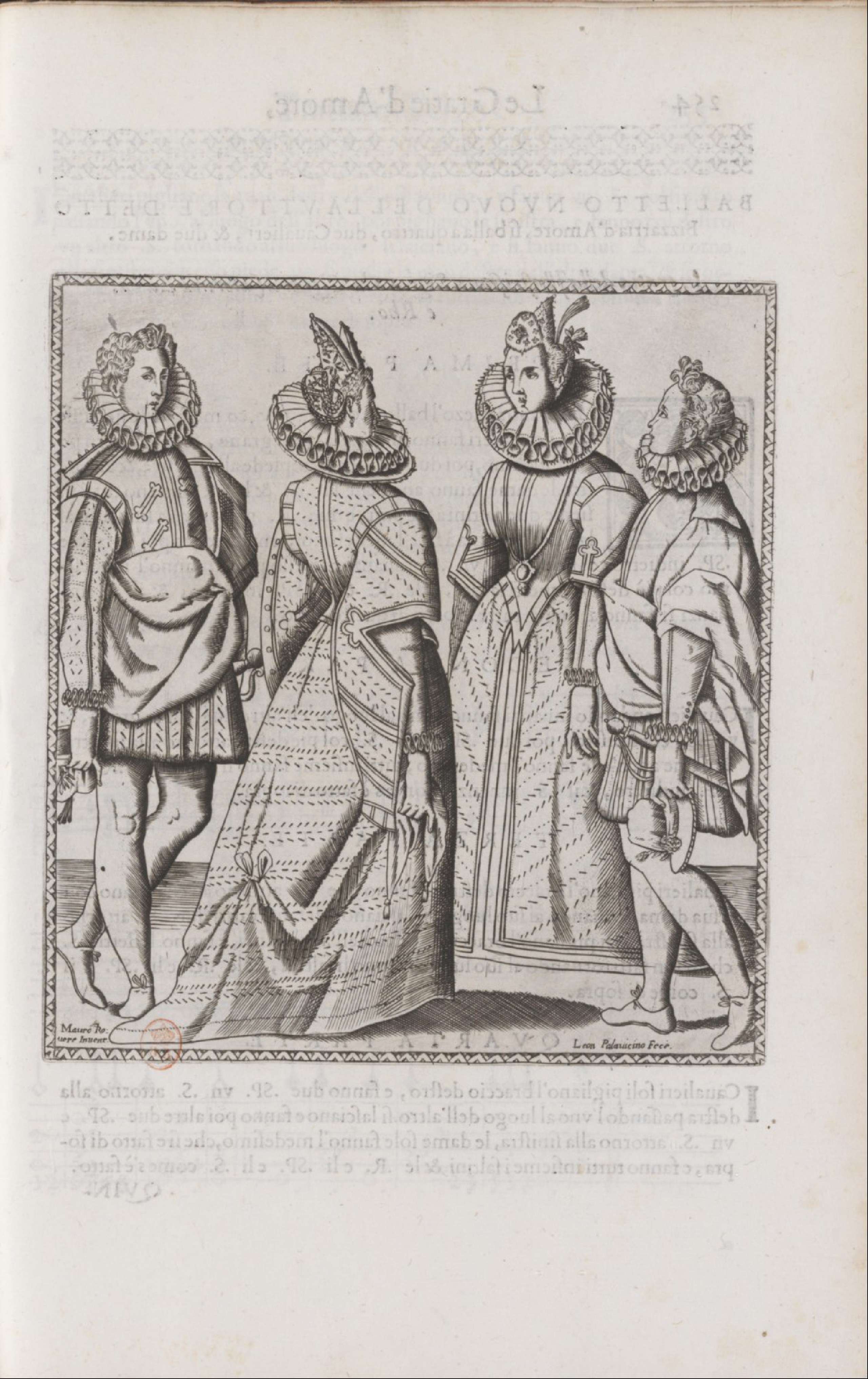
Four figures in elaborate Renaissance court dress stand in a formal line against a plain background, framed by a decorative border. From left to right: a man in a slashed doublet and short hose; a woman in a long patterned gown with puffed sleeves; a woman in a richly embroidered gown with geometric patterns; and a smaller figure (possibly a page or younger dancer) in fitted hose and doublet. All wear the wide, stiffened collars characteristic of late 16th-century fashion. The engraving's fine cross-hatching creates volume and texture in the fabrics—the women's skirts have considerable weight and drape, while the men's legs are defined by careful line work. The figures stand in relatively static poses, with hands positioned at the sides or resting on the body; their heads are turned slightly toward the viewer or toward their neighbors, suggesting they are paired or grouped for a specific choreographed moment. There is no narrative or dynamic action; instead, the image presents a formal tableau, the kind used in dance manuals to teach position and deportment.
The dancing
The figures occupy a shallow space and do not interact through contact or interlocking holds. Their postures are upright and dignified, with weight distributed evenly on both legs—characteristic of the standing positions from which Renaissance dances began. The men show the turned-out leg alignment typical of court dancing, while the women's voluminous skirts conceal the footwork. Arm positions are modest and constrained, with hands held near the body rather than raised or extended. The lack of dynamic tension or mid-movement capture suggests these are demonstration poses: the starting point or a discrete position within a choreographed sequence, not a moment of turning or traveling.
The dance depicted
This is a choreographic notation plate from Cesare Negri's *Le Gratie d'Amore*, one of the most influential dance manuals of the late Renaissance. Negri was a celebrated Milanese dance master whose treatise documented the court dances of northern Italy and the French court in the early 1600s. The plate shows paired dancers—most likely a galliard, pavane, or almain figure, all social dances of the period that required formal dress and intricate footwork. Negri's plates are primarily documentary: they present the dancers in costume and show the spatial relationship between partners, while the actual steps and movements are described in accompanying text. The formal presentation, the courtly dress, and the careful positioning of four figures suggest a group dance or the demonstration of a paired figure that could be performed in sequence.
How it was made
This is an engraving, a printmaking technique that uses a metal plate (typically copper) incised with a burin to hold ink. The fine parallel lines and cross-hatching visible throughout the composition—especially in the rendering of fabric, flesh, and shadow—are characteristic of engraving's precision and capacity for tonal gradation. Engraving was the dominant reproductive medium for printed books in the 16th and 17th centuries and allowed images to be distributed widely. As part of *Le Gratie d'Amore*, a substantial printed treatise, this plate would have circulated among European courts and dancing masters, making it one of the most accessible records of Renaissance dance practice. The technique's clarity and detail made it ideal for instructional works: readers could study the exact placement of feet, the hang of garments, and the relative positioning of dancers.
About this work
This engraving from Cesare Negri's *Le Gratie d'Amore* (Milan, 1602) is a choreographic diagram presenting four dancers in Renaissance court dress as a formal tableau. It is one of many plates in Negri's treatise that documented the social dances of the Italian and French courts at the turn of the 17th century. The image combines visual description with didactic intent: it shows dancers in their finery and demonstrates the spatial and postural conventions of courtly dance, while accompanying text would have specified the steps and musical accompaniment.
Negri's work represents the high point of printed dance notation in the Renaissance. Unlike modern notation systems, Negri relied on prose description paired with engraved figures to convey choreography. This plate exemplifies that method: the careful rendering of posture, dress, and spatial relationship gives a reader (or fellow dancing master) enough information to reconstruct and teach the dance. The engraving's circulation in printed form means it reached a far wider audience than manuscript would have allowed, making it instrumental in standardizing court dance practice across Europe.
How to look at it
The figures in this plate are presented in a moment of stillness or pause, not mid-step. Look at the weight and balance: all four dancers stand with a relatively neutral, erect posture, the kind from which a dance phrase would begin or where partners would meet. The engraver has emphasized the clothing—the intricate patterns on the women's gowns, the slashing on the men's doublets—which tells us these are dancers of rank and wealth. Notice how the figures are arranged: the two central figures are taller and more prominent, while the outer figures (especially the figure on the right) are smaller, suggesting either a spatial recession or a hierarchy of importance. This is not a snapshot of movement, but a formal presentation of dancers in their roles and relationships.
The artist
Cesare Negri (c. 1535–c. 1604), known as *il Trombone*, was the most celebrated dancing master of late-Renaissance Italy. Based in Milan, he taught nobility and courtiers across Italy and France, and his treatise *Le Gratie d'Amore* (published in two editions, 1602 and 1604) remains the most comprehensive record of Italian court dance from the period. Negri's approach combined detailed prose description of steps with engraved figures showing the dancers in costume and formation. His work built on earlier treatises by Domenico da Piacenza and Fabrizio Caroso, but was more systematic and widely circulated. Negri's reputation extended across Europe; his dances were copied and adapted, and his manual became a standard reference for dancing masters into the 17th century.
The period
In the early 1600s, when Negri published *Le Gratie d'Amore*, court dance was at its formal and technical height. The pavane and galliard dominated courtly practice, with the pavane serving as a stately processional and the galliard as its virtuosic, jumping counterpart. These dances were central to courtship, diplomacy, and the display of status in the Italian and French courts. Printing had recently made dance notation accessible beyond individual court circles: Caroso's *Il Ballarino* (1581) was among the first printed dance manuals, and Negri's work followed a generation later, refining and expanding the tradition. At the same time, the Renaissance courtly ideal—the *sprezzatura* or cultivated ease that Castiglione had described—was beginning to give way to the more theatrical and virtuosic dance that would characterize the emerging ballet de cour in France. Negri's treatise captured this moment of transition, documenting social dances that were still the foundation of courtly practice while acknowledging the growing importance of choreographed spectacle.
Where it lives
This engraving is from *Le Gratie d'Amore*, a printed treatise published by Cesare Negri in Milan in 1602 (a second, expanded edition appeared in 1604). The work survives in multiple copies in libraries and museums across Europe and North America, making it one of the most accessible primary sources for Renaissance dance. The Library of Congress holds a copy, from which this image is drawn.
Dance in this work
Questions about this work
What dance is this showing?
The specific dance cannot be determined from the engraving alone; Negri's system relies on the accompanying text to identify the dance type and describe the steps. Based on the formal dress and four-figure grouping, this could be a pavane, galliard, or group figure from a bransle or contradanse. The plate serves as a visual reference for the spatial arrangement and postures, while the written description would specify the footwork and music.
How did dancers learn from this book?
Negri's treatise combined images with detailed prose descriptions of steps, counts, and musical accompaniment. A dancer or dancing master would read the text for a given dance, then refer to the engraved plate to understand the positioning and dress of the performers. The book was intended for educated courtiers and professional dancing masters, not beginners; it assumed familiarity with basic Renaissance dance technique.
Why are the figures so stiff and formal?
The formal posture reflects the actual aesthetic of Renaissance court dance: dancers were trained to maintain an upright, dignified carriage, with restrained arm movements and turned-out legs. Virtuosity lay in the footwork and jumps (especially in the galliard), not in expansive gestures. The engraving captures the ideal of courtly deportment: ease, control, and elegance.
Who was Cesare Negri?
Negri (c. 1535–c. 1604) was a celebrated Milanese dancing master who taught Italian and French nobility. His treatise *Le Gratie d'Amore* is the most comprehensive surviving record of Italian court dance from the late 16th and early 17th centuries. He was renowned for his technical knowledge and the precision of his choreography.
More Notation/Choreography artwork