49 works in this view — arrow keys or swipe to move between them.
Dance in Art
Negri — Dance Plate (plate 20)
Cesare Negri (il Trombone)
- Medium:
- Engraving
- Dance:
- Notation/Choreography
- Era:
- Pre-1700 (Renaissance/Baroque)
- Collection:
- Le Gratie d'Amore (1602)
- Source:
- Library of Congress
- Rights:
- Public domain — free to use, share and adapt.
- Recorded as:
- Public Domain
Negri's *Le Gratie d'Amore* is one of only three major printed dance manuals of the Renaissance period and represents the fullest visual documentation of court dance from this era. This plate is a primary source for understanding both the choreography and the aesthetic ideals of Renaissance courtly movement—the upright carriage, the controlled arm positions, the separation of dancers into individual poses, and the integration of dance with display of costume and status.
What you are looking at
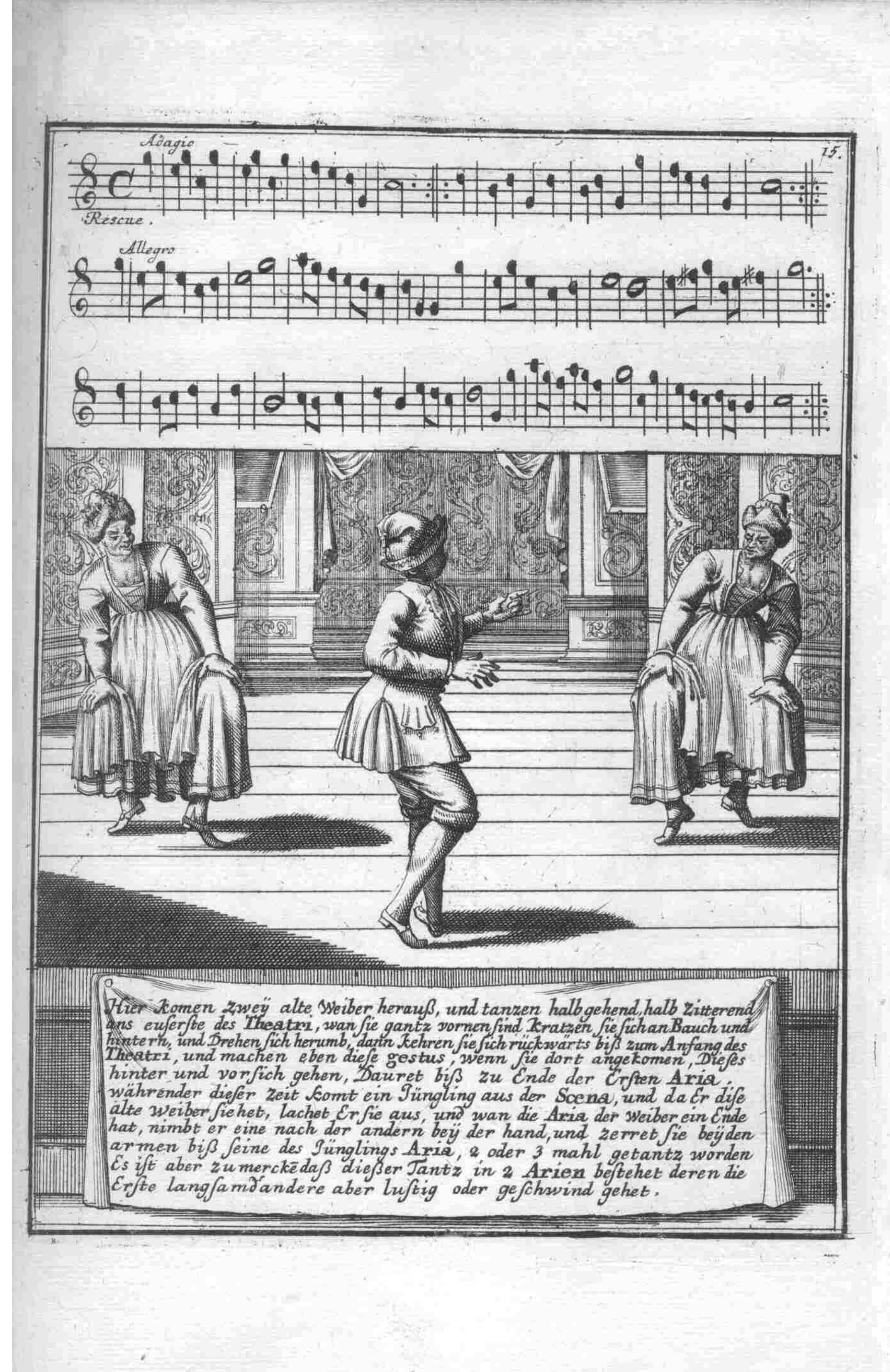
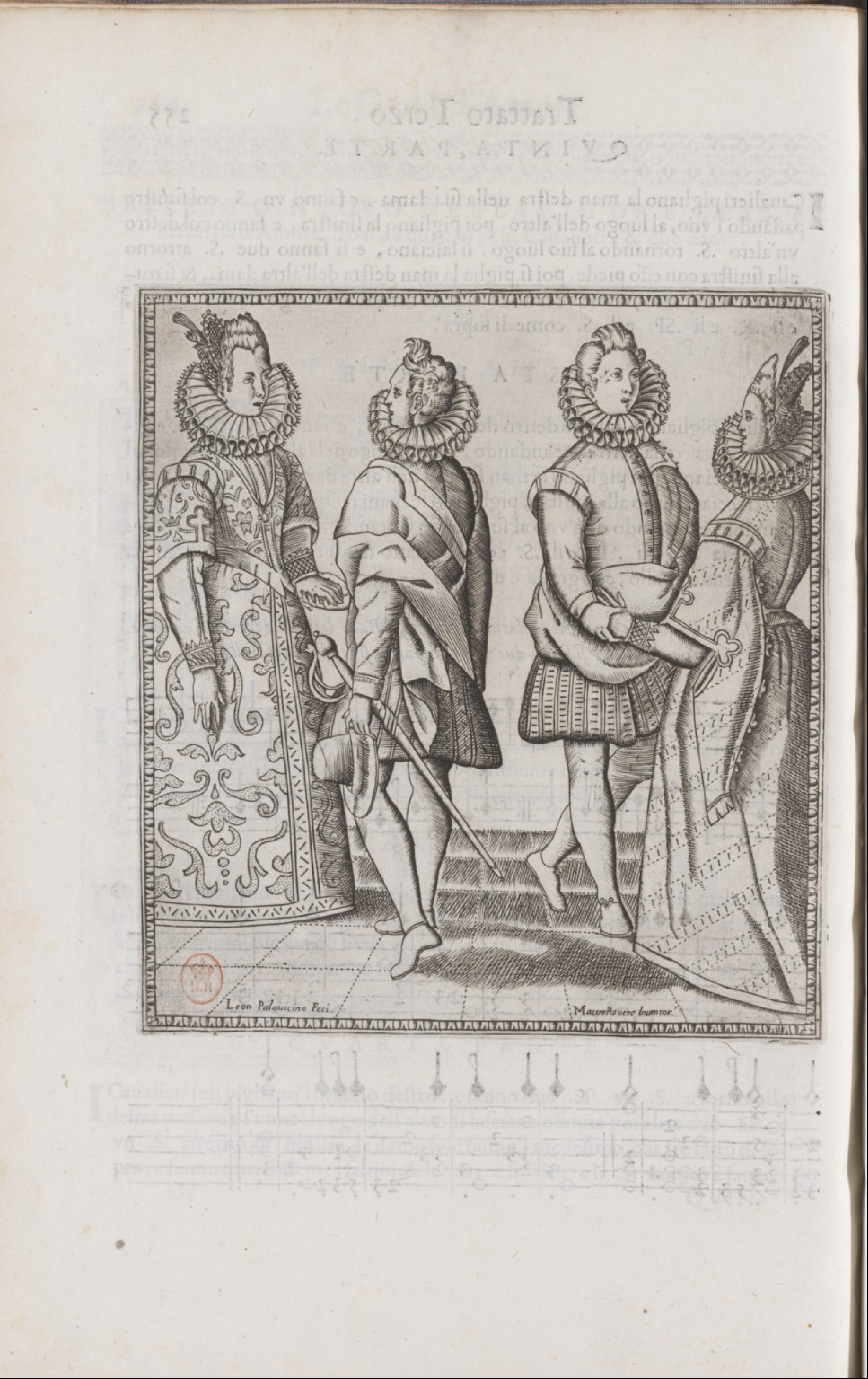
This engraving presents four figures in Renaissance court dress arranged in a shallow interior space defined by a decorative border. At left stands a woman in an elaborately patterned long gown with a high ruff collar and feathered headdress, her posture formal and frontal. To her right, a man in hose and a doublet with diagonal cross-hatching turns away, his body angled and weight shifted. At center-right, another woman in a pleated skirt and high ruff faces forward with arms positioned at her sides, her stance upright and composed. A fourth figure at far right—partially visible—wears a flowing garment and elaborate headdress. The figures occupy a continuous ground plane rendered in light cross-hatching; no architectural setting is suggested beyond the framing border. The composition emphasizes the display of costume and the formal arrangement of bodies rather than narrative action or spatial depth.
The dancing
The four figures are arranged in a linear procession across the frame, each isolated in individual posture rather than engaged in mutual contact or partnered hold. The woman at left extends her arms slightly away from her body; the man beside her has turned his torso with one arm crossing his front, suggesting a moment of turning or traversal; the woman at center maintains an erect frame with arms at her sides. None of the figures touch or face each other directly. The weight in each figure appears grounded and vertical rather than committed to traveling motion. The positioning suggests a series of individual poses or 'postures' as they might be demonstrated in sequence rather than a continuous coupled dance.
The dance depicted
This is a didactic illustration from Cesare Negri's *Le Gratie d'Amore*, a major Renaissance dance manual, and shows the type of courtly couple dances that Negri taught and documented. The figures likely represent a specific dance figure or sequence—possibly from an *allemande*, *pavane*, or *galliard*—as described in the accompanying text. The engraving serves as a visual notation of the body positions and arm carriage expected in formal court dance. The static, frontal presentation of individual dancers rather than the capture of a single moment in a traveling dance suggests this is instructional, meant to show students the correct deportment, costume, and positioning for the dances of the Italian and European courts. The use of four figures allows Negri to show both male and female variations and the relative positioning of dancers within a figure.
How it was made
The work is an engraving—lines cut into a metal plate, likely copper, and then printed. The fine parallel hatching lines visible throughout create tone and volume, particularly in the garments and the ground plane. Engraving allowed for crisp, precise detail ideal for rendering the intricate patterns of Renaissance embroidery, the texture of fabrics, and the articulation of human anatomy. This technique was expensive and labor-intensive, making it suitable for a high-status publication like Negri's treatise, which was aimed at court nobles and professional dancers across Italian and French courts. The engraving's portability and reproducibility meant these images could circulate widely and serve as models for dancers across Europe.
About this work
This engraving is one of a series of instructional plates from Cesare Negri's *Le Gratie d'Amore* (Milan, 1602/1604), a foundational treatise on late Renaissance court dance. It captures the formal, vertically composed aesthetic of courtly movement at the turn of the 17th century, displaying the body positions, arm carriage, and costume conventions that defined elite European dance of the period. The work sits at the intersection of dance notation, courtly fashion, and printmaking: it is simultaneously a technical manual for dancers, a display of aristocratic dress, and a record of how the body was meant to move in formal social space.
For dance history, this engraving is invaluable as a window into embodied practice. Unlike written descriptions alone, it shows the actual positioning of the spine, the placement of arms, the angle of the head, and the relationship between dancers and ground. Negri's plates are among the most detailed and influential visual records of Renaissance dance and were widely imitated and republished throughout the 17th century.
How to look at it
Observe the vertical alignment of each figure: none leans forward or shifts weight dramatically; all are contained and upright. Notice the isolation of the four dancers—they do not hold each other or form a unified group, but rather stand as individual demonstrations of posture and arm position. The engraver has frozen each body in a discrete pose rather than capturing a moment of traveling motion or turning. This reflects the Renaissance dance manual's pedagogical method: to show the student the correct placement of the body, the angle of the arms, the position of the head, and the relationship between elegant dress and proper carriage. The slight turn of the man's torso and the forward-facing positions of the women may indicate the sequence of a figure or a moment where partners face each other before traversing; the text accompanying the plate in the original treatise would specify the choreography.
The artist
Cesare Negri (c. 1535–after 1604), known as 'il Trombone,' was one of the most celebrated dance masters of the late Renaissance. He worked in Milan, serving the ducal court, and traveled extensively to teach at courts throughout Italy and France. *Le Gratie d'Amore*, published in Milan in 1602 with a reissue in 1604, was his major written work and included approximately 50 engravings showing the steps, figures, and positions of courtly dances. Negri's approach synthesized the earlier geometric and philosophical dance theory of Domenico da Piacenza with the more naturalistic and varied style of dance that had developed by the late 16th century. His work was widely influential and was reprinted and adapted throughout the 17th century.
The period
This engraving dates to the early 17th century, at a moment when the dance manuals of the late Renaissance were being synthesized and printed for wider circulation. The *pavane* and *galliard* had dominated elite European dance through the 16th century; by the time Negri published his work, newer dances like the *volta* and *corrente* were emerging, though the older dances remained foundational to court training. The three major printed Renaissance dance manuals—Domenico da Piacenza's *De arte saltandi et choreas ducendi* (c. 1455, printed 1728), Fabrizio Caroso's *Il Ballarino* (1581), and Negri's *Le Gratie d'Amore* (1602)—represent a progression from geometric and highly formalized movement to a style that, while still formal and heavily costumed, allowed for greater dynamism and variety in the body. Negri's work represents the culmination of this tradition before it was absorbed into the emerging ballet de cour and the theatrical dances of the 17th century.
Where it lives
This engraving is part of the illustrated edition of Cesare Negri's *Le Gratie d'Amore* (Milan, 1602/1604), held by the Library of Congress. The treatise was a major printed manual circulated among European courts and served as both a teaching text and a record of performance practice.
Dance in this work
Questions about this work
What dance is being shown?
The specific dance is identified by the accompanying text in Negri's treatise; from the image alone, we can see the formal positioning and arm carriage typical of late Renaissance courtly dances such as the pavane, galliard, or allemande. The four-figure arrangement and frontal positioning suggest this is a didactic plate meant to show step-by-step positioning rather than a moment from a single continuous movement.
How do we know how Renaissance dances were performed?
Printed dance manuals like Negri's *Le Gratie d'Amore* are primary sources for Renaissance dance. They combine written choreographic notation with visual illustrations showing body position, arm placement, and costume. Negri's work is one of only three major surviving printed manuals from the Renaissance and is invaluable for reconstructing the steps, figures, and aesthetic ideals of the period.
Why are the dancers not touching or dancing together?
This engraving is pedagogical—it demonstrates the correct body position and posture for male and female dancers rather than showing a moment of coupled or group dance. The text in the original treatise would describe the choreographic figures and how dancers move between the positions shown here. Engravings that showed only movement would be difficult to read; static poses allow the student to study the exact placement of the arms, spine, and head.
What can we learn from the clothing?
The elaborate costumes—the embroidered gowns, high ruffs, feathered headdresses, and patterned hose—are integral to the dance. Renaissance court dance was a display of status, wealth, and grace; the movement had to complement and showcase the costume. The upright carriage, controlled arm positions, and vertical alignment visible in these figures are designed to display the garments and the wearer's body to best effect.
More Notation/Choreography artwork