49 works in this view — arrow keys or swipe to move between them.
Dance in Art
Acrobatic — Plate 90
Gregorio Lambranzi
- Medium:
- Copper-plate engraving
- Dance:
- Notation/Choreography
- Era:
- 1700s (Enlightenment/Minuet Era)
- Collection:
- Nuova e curiosa scuola de' balli theatrali (1716)
- Source:
- Library of Congress
- Rights:
- Public domain — free to use, share and adapt.
- Recorded as:
- Public Domain
This image documents a form of physical performance—apparatus-based acrobatics—that existed as a recognized theatrical genre in the 18th century but is often absent from histories of dance that focus exclusively on ballroom or ballet traditions. Lambranzi's inclusion of it signals that 'dance' in this period encompassed a much wider range of skilled movement, and that acrobatic display and balance work were legitimate theatrical arts worthy of notation and preservation. For anyone studying the history of circus, acrobatics, or theatrical spectacle, this is a primary source.
What you are looking at
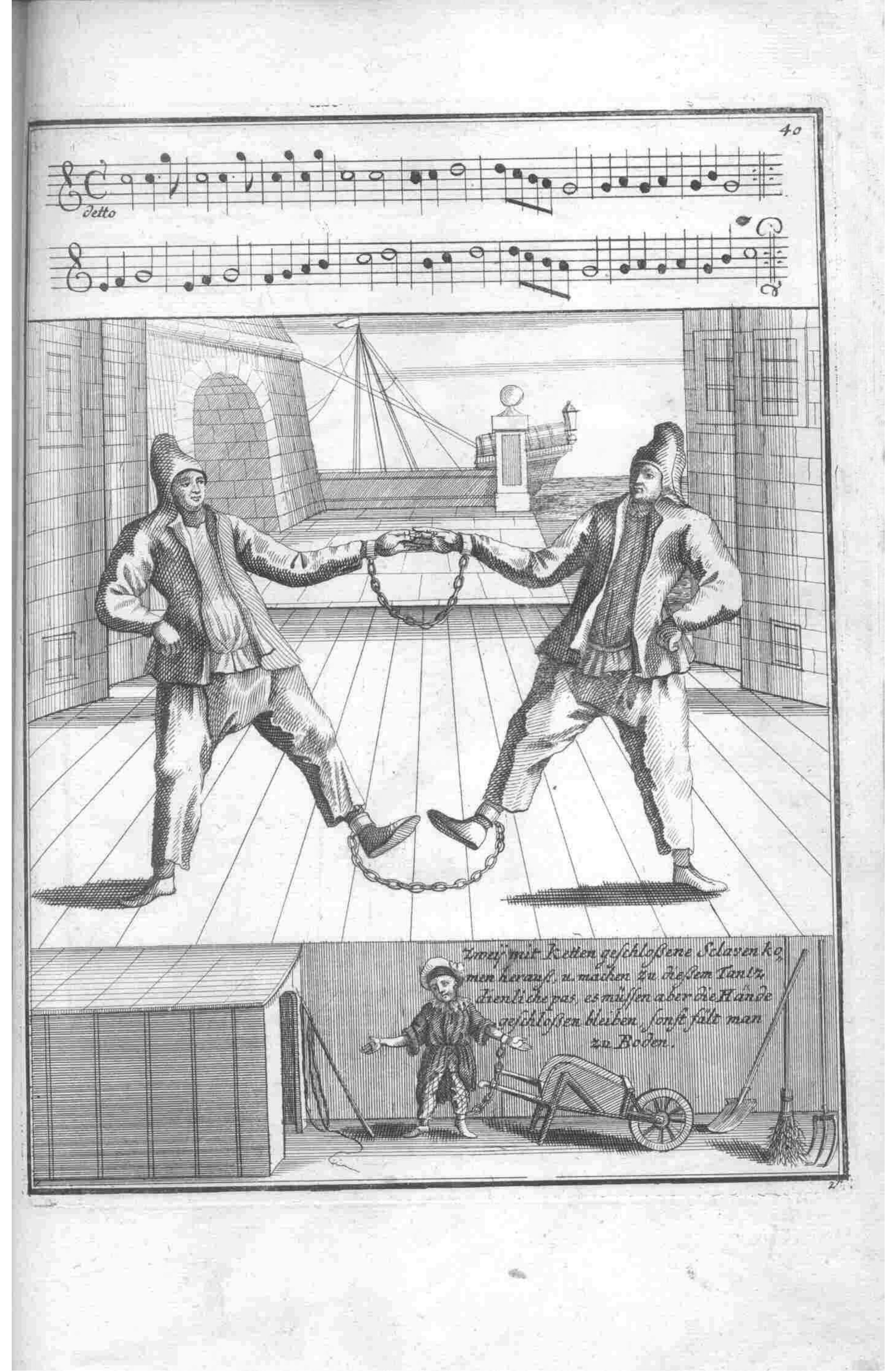
Two male acrobats in matching period costume—quilted doublets, breeches, and caps—face each other on the wooden deck of a ship, visible through an open-sided stage structure. Between them hangs a chain from which a wooden chair is suspended. The acrobat on the left leans backward at a steep angle, one leg extended, holding the chain; the acrobat on the right mirrors the pose in the opposite direction. The composition is perfectly symmetrical, the two bodies forming an X. Behind them, a three-masted sailing vessel sits at anchor on calm water. The stage frame suggests a theatrical performance space rather than shipboard action: the scene is a constructed demonstration of balance and strength. A smaller scene below shows a man in similar dress attending to wheeled equipment on the ship's lower deck, possibly preparing apparatus or attending to maintenance.
The dancing
Both acrobats display identical inverted or deeply arched postures, leaning away from the suspended chair while gripping the supporting chain. Their legs are extended; their torsos are dramatically hyperextended, creating extreme backbends. The symmetry is intentional—a mirror image designed to display balanced strength and control. The hold on the chain appears to be the primary point of contact, with the body's weight distributed through the arms. This is not a partnered hold in the ballroom sense but a shared engagement with apparatus: two bodies demonstrating solo acrobatic skill in tandem.
The dance depicted
This is acrobatic performance of the chair-balance or suspended apparatus type, likely performed by male acrobats as a carnival, fair, or theatrical spectacle rather than as a social or balletic form. The image depicts what was known in 18th-century Europe as an 'acrobatic act' or 'trick': the ability to control and balance the body while suspended or while supporting weight through the arms. The symmetrical presentation suggests this was performed as a paired exhibition—two skilled bodies demonstrating matching feats of strength and flexibility. This type of performance sat outside the ballet and social dance traditions but was a recognized theatrical spectacle.
How it was made
This is a copper-plate engraving, a relief or intaglio process that allowed precise linear detail and wide circulation through printing. Lambranzi's technique emphasizes anatomy and spatial clarity: the human figures are rendered with anatomical attention to musculature and joint articulation, while the architectural and maritime details (the stage frame, the ship, the wooden deck) are rendered in linear perspective. The engraving allowed for mass production and distribution of dance and acrobatic notation across Europe, making it a pedagogical tool as much as a record. The precision of line and the orderly composition reflect the Enlightenment-era drive to document, systematize, and disseminate knowledge of movement.
About this work
This plate from Gregorio Lambranzi's *Nuova e curiosa scuola de' balli theatrali* documents an 18th-century acrobatic exhibition: two male performers suspended by or gripping a chain in a perfectly symmetrical, hyperextended pose aboard or within a theatrical representation of a ship. Lambranzi's work is one of the era's most comprehensive records of theatrical movement—not only ballroom and courtly dance but also acrobatic spectacle, comic business, and physical virtuosity. This plate represents the broader category of 'curious' or 'curious school' performance: skilled physical acts presented for theatrical audiences. The pairing of musical notation at the top with the visual demonstration below indicates that even acrobatic performance was understood as part of a choreographed theatrical whole, set to music and executed with deliberate form.
How to look at it
Attend to the symmetry: the artist has frozen a moment of perfect balance, with both bodies mirroring each other. This is not a snapshot of fleeting movement but a demonstration of sustained control—a held position designed to display strength and flexibility. The chain is central; without it, the pose would be impossible. Notice how the engraver has used line to convey the extreme arch of the back and the extension of the legs, emphasizing the physical demand of the feat. The theatrical framing—the stage structure, the ship, the musical notation above—reminds us that this was not a test of strength in isolation but a performance, a 'curious' show set to music and staged for an audience.
The artist
Gregorio Lambranzi was an 18th-century Italian dancer, choreographer, and movement notator active in Nuremberg. His *Nuova e curiosa scuola de' balli theatrali* (New and Curious School of Theatrical Dances), published in Nuremberg in 1716, is one of the most comprehensive illustrated dance manuals of the Baroque period. The work documents not only the formal dances of the ballroom and court but also comic, acrobatic, and spectacular forms of movement. Lambranzi's approach was systematic and pedagogical: each plate pairs musical notation with a visual demonstration of a specific movement or performance type, suggesting that the work was intended as both a record and a teaching tool. His inclusion of acrobatic acts, animal impersonations, and theatrical business alongside minuets and other court dances reflects an expansive understanding of 'dance' as a comprehensive theatrical art.
The period
In early 18th-century Europe, the period of Lambranzi's work, theatrical performance was undergoing systematization and documentation. The rise of the professional court ballet and the ballroom dances of the nobility created a demand for notation systems and instructional manuals. Simultaneously, fair performance, carnival spectacle, and acrobatic display remained popular public entertainments. Lambranzi's work sits at the intersection: it documents the refined ballroom dances of the nobility while also preserving the 'curious' or spectacular forms of theatrical movement that were performed at fairs, in street spectacles, and in theatrical productions. The maritime setting of this plate may reference the world of navigation and exploration that fascinated 18th-century audiences, or it may simply provide an exotic or novel staging for the acrobatic display. Engraving technology allowed such illustrated manuals to circulate across Europe, making them key documents in the professionalization and standardization of movement practice.
Where it lives
This is plate 90 from the first edition of Gregorio Lambranzi's *Nuova e curiosa scuola de' balli theatrali*, published in Nuremberg in 1716. The work is a comprehensive illustrated manual of theatrical dances and acrobatic performances, with each plate pairing musical notation (at the top) with a visual demonstration and often a German verse or caption beneath. This particular copy is held by the Library of Congress.
Dance in this work
Questions about this work
Was acrobatics considered 'dance' in the 18th century?
Lambranzi's inclusion of acrobatic performance in a work titled *School of Theatrical Dances* suggests that yes, acrobatics and apparatus work were understood as part of the broader category of theatrical movement and performance. The pairing with musical notation indicates that acrobatic acts were choreographed and performed to music as part of theatrical productions. However, acrobatics was distinct from the ballroom and courtly dances that dominated formal dance instruction—it was a 'curious' or spectacular form, often associated with fairs, street performance, and theatrical spectacle rather than the nobility.
What does the musical notation at the top tell us?
The two staves of musical notation indicate that this acrobatic act was performed to music. This was typical of theatrical performance in the period: even apparently 'non-dance' movements like acrobatic stunts were rhythmically structured and executed to a musical accompaniment. The notation suggests that performers needed both musical literacy and movement skill, and that timing and rhythm were integral to the performance.
Why is the setting a ship?
The maritime setting may reflect 18th-century fascination with exploration and seafaring, or it may simply provide a novel or visually interesting theatrical backdrop. Lambranzi's collection includes many different staging scenarios—comic, mythological, exotic—suggesting that the 'curious school' of theatrical performance drew on a wide range of themes and settings to create spectacular entertainment.
Who would have performed this act?
Professional acrobats and theatrical performers, likely trained from childhood. The extreme physical skill required—the sustained hyperextension, the balance, the control—indicates specialized training. These performers would have worked in court theaters, fair venues, and public spectacles, often as part of traveling companies or established theatrical troupes.
More Notation/Choreography artwork