49 works in this view — arrow keys or swipe to move between them.
Dance in Art
Group — Plate 91
Gregorio Lambranzi
- Medium:
- Copper-plate engraving
- Dance:
- Notation/Choreography
- Era:
- 1700s (Enlightenment/Minuet Era)
- Collection:
- Nuova e curiosa scuola de' balli theatrali (1716)
- Source:
- Library of Congress
- Rights:
- Public domain — free to use, share and adapt.
- Recorded as:
- Public Domain
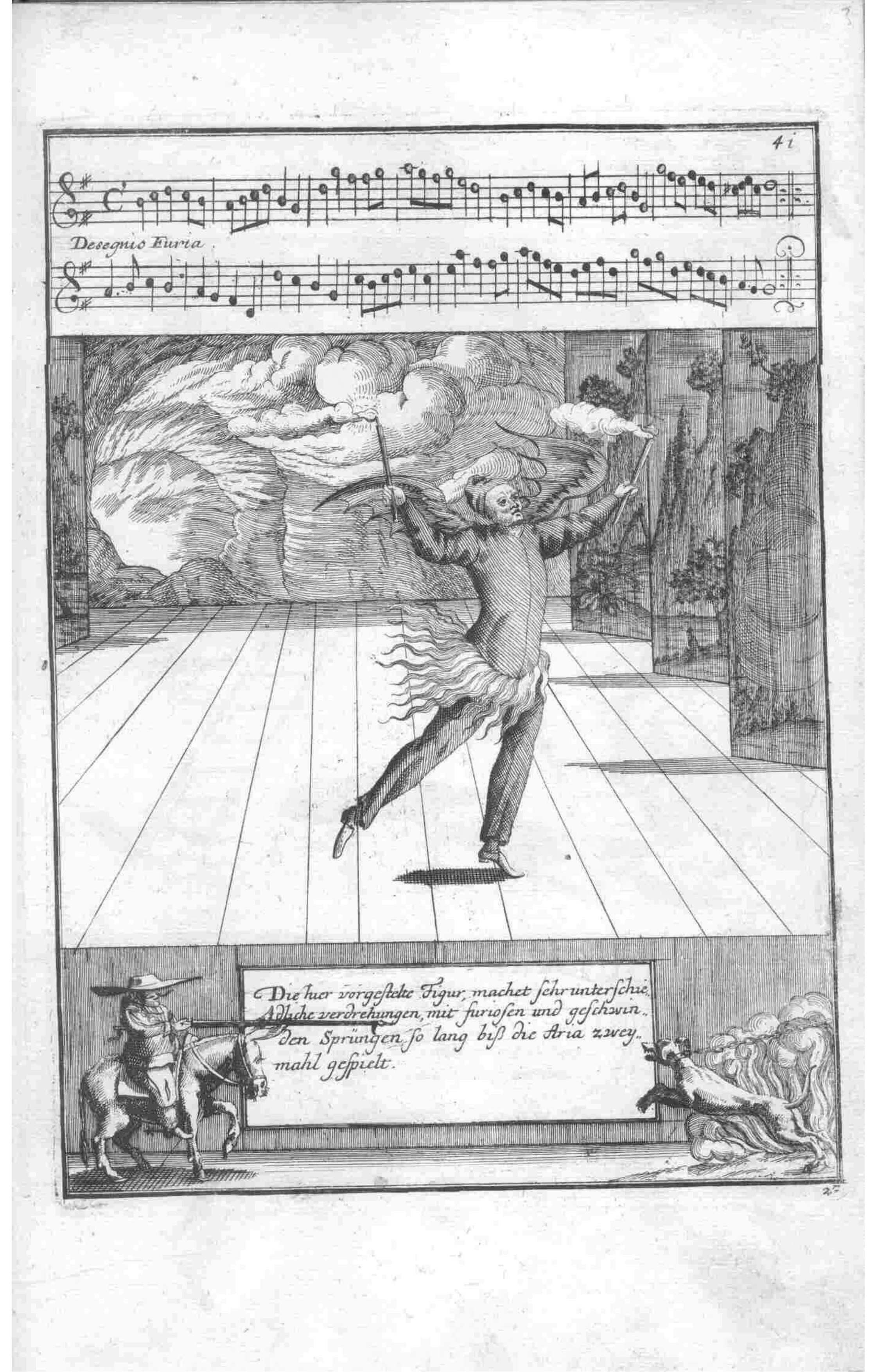
Lambranzi's *Scuola* is one of the earliest dance manuals to illustrate theatrical and character dances alongside court dances, and one of the very few to combine music notation with anatomically convincing figure drawings. This plate proves that early 18th-century stage dancers possessed jump technique, spatial control, and the ability to embody fantastical roles—a reminder that theatrical dance was not merely ballet, and that acrobatic character work was a valued professional skill centuries before it acquired a name.
What you are looking at
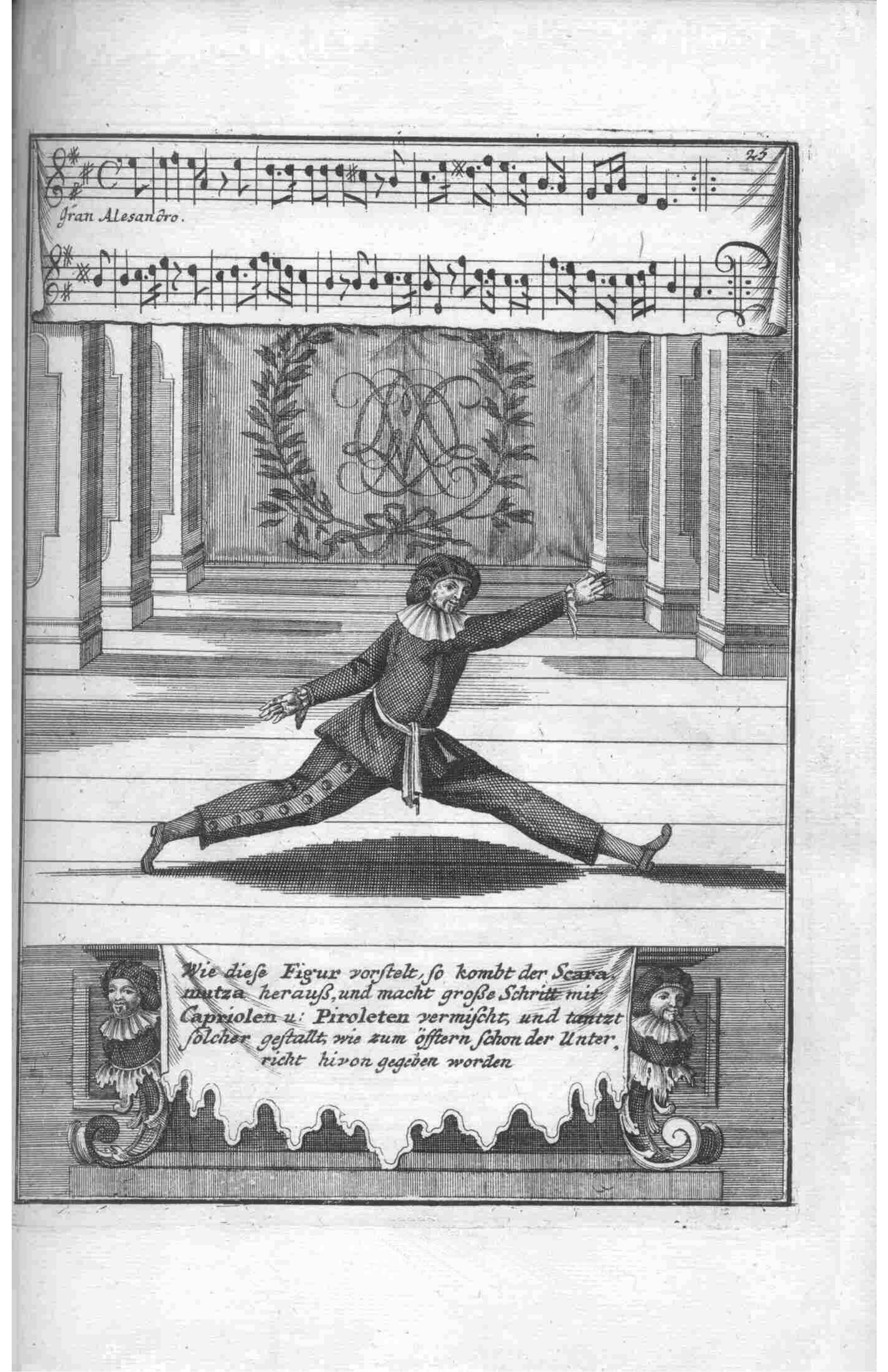
A demonic or satyr-like figure dominates the stage, seen in profile mid-leap with one leg extended horizontally behind and the other bent beneath. The creature has a grotesque face, bare muscled torso, and what appears to be serpentine or scaled lower body. Its arms are raised in an expressive gesture, one pointing forward. The figure wears a flowing, billowing cape or cloak that catches in the air, creating dramatic movement across the composition. The setting is a wooden-floored stage with draped curtains visible on either side; trees or architectural elements suggest a landscape backdrop. In the lower margin, two small figures flank a cartouche: a rider on horseback to the left and an onlooker to the right, establishing scale and theatrical context. The engraving shows the moment of highest energy—the apex of a jump or leap—with the body fully articulated in space.
The dancing
A single theatrical figure in an airborne position: torso twisted, supporting leg bent, free leg extended straight back in arabesque, arms lifted and spread for balance and expression. The posture suggests trained control despite the grotesque form—the weight is clearly managed through the supporting leg, the torso is lifted and opened to the audience, and the extended limb is pointed. The body reads as a dancer's body; the proportions and the articulation of joints show understanding of how movement works. The cape adds visual extension and emphasizes the direction and speed of the leap.
The dance depicted
This is theatrical dance from the early 18th century German-speaking stage, almost certainly a comic or burlesque character role—a demon, wild man, satyr, or similar figure from commedia dell'arte or theatrical spectacle. The pose is a controlled jump or leap, likely from a danced scene involving magical transformation or supernatural appearance. The style appears derived from ballet vocabulary (the arabesque line, the turned-out support) but applied to a grotesque, energetic character part. Lambranzi's treatise documented dances performed in and around Nuremberg; such fantastic figures were standard in the musical theatre and intermezzi of the period. The inscription below (in German, 'Dessemo Buria' in the notation above) likely names the character or dance.
How it was made
Copper-plate engraving, a technique that allowed fine detail, consistent reproducibility, and relatively affordable circulation compared to painting. The crisp parallel lines (hatching and cross-hatching) build tone and model form—visible in the musculature of the figure, the drapery folds, and the floor recession. The engraving preserves notational detail above (musical score in staff notation) and narrative detail below (the framing figures and German text), making this both a dance instruction and a theatrical document. The technique was ideal for illustrated manuals: multiple impressions could be distributed to dance masters across Europe.
About this work
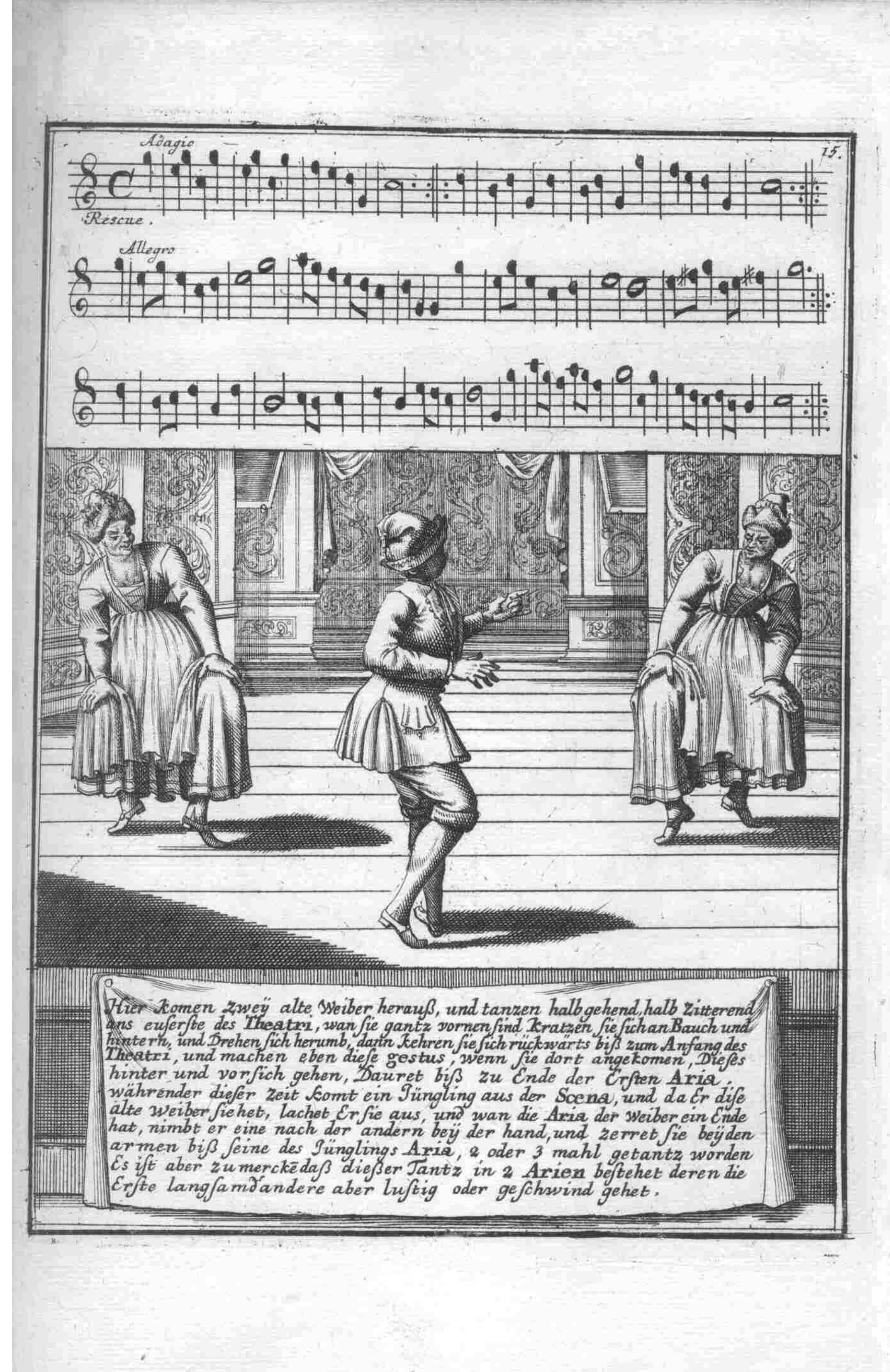
This is Plate 91 from Gregorio Lambranzi's *Nuova e curiosa scuola de' balli theatrali* (Nuremberg, 1716), one of the most important dance manuals of the early 18th century. Each plate pairs a musical score with a costumed figure performing a specific choreography in a theatrical setting. This particular sheet documents a comic or demonic character performing a spectacular leap, likely from the pantomime or spoken-word theatre that dominated German and Italian stages of the period. The engraving is both a record of theatrical practice and a teaching text—the notation and the image together constitute instructions for recreating the dance.
The work belongs in a dance history because it is evidence of what theatrical bodies did and looked like in the early 1700s, before ballet became the dominant language of theatrical dance. The grotesque character, the energetic leap, and the flowing costume show that dance was not solely the refined, vertical vocabulary of the court minuet; professional theatres employed trained dancers in a wider range of styles and character roles. Lambranzi's plates survive in only a few copies and have become foundational sources for historians of baroque theatre and commedia dell'arte.
How to look at it
Attend to the moment chosen: the apex of the leap, when the dancer is fully airborne and the body is most dramatically extended. The artist has frozen the movement at the point of maximum visual and kinetic interest—not the preparation or the landing, but the instant when shape and effort are most legible. Notice how the musculature is rendered: the supporting leg is articulate and tensed, the free leg is pointed, the torso is lifted and twisted to face the audience. The cape extends the line and echoes the direction of motion. The small figures in the margin (a rider and an onlooker) establish this as theatrical spectacle—a performance watched, not a private lesson. The musical notation above the figure suggests that the leap happened at a specific moment in the score, coordinating dance and music.
The artist
Gregorio Lambranzi (fl. 1716) was an Italian dance master and choreographer active in Nuremberg. He is known almost exclusively through his *Nuova e curiosa scuola de' balli theatrali*, a two-volume treatise illustrated with around 120 copper-plate engravings. The plates document court dances (minuets, bourées, sarabandes) as well as theatrical and character dances, many of them clearly from commedia dell'arte or German Singspiel. The identity of the engraver(s) is not established. Lambranzi's treatise was reprinted and translated into French in the 18th century and has become a primary source for understanding both dance technique and theatrical practice in the German-speaking territories of the early baroque.
The period
In 1716, theatrical dance in Germany and Italy was dominated by spectacle, pantomime, and character work, often with music and narrative elements drawn from commedia dell'arte or court entertainments. Court ballet (the codified vocabulary we now call 'baroque ballet') existed and was taught, but professional theatres staged a much wider range of movement styles. This was before the strict separation between ballet (vertical, turned-out, lifted) and other forms; trained dancers were expected to jump, tumble, embody comic or grotesque characters, and adapt their bodies to narrative and musical requirement. Lambranzi's compilation captures that eclecticism. The engraving technique itself was at its height as a medium for instruction and dissemination; printed dance manuals and illustrated books were proliferating across Europe in the early 18th century.
Where it lives
This plate is from Lambranzi's *Nuova e curiosa scuola de' balli theatrali*, a two-volume treatise published in Nuremberg in 1716. The Library of Congress holds copies of the work. Each plate in the treatise functions as both a visual record and an instructional diagram, pairing notation, image, and often a written caption to convey the choreography to a reader who would then have to reconstruct the dance from these elements.
Dance in this work
Questions about this work
What is this figure supposed to be?
The grotesque features—the face, the scaled or serpentine lower body—suggest a supernatural or commedia dell'arte character: a demon, devil, wild man, or satyr. Such roles were common in German and Italian theatrical spectacles of the early 18th century. The engraving does not name the specific character, but the inscription 'Dessemo Buria' may be a character name or a title for the dance.
Was this really how people danced in 1716?
Yes, at least in theatrical contexts. This shows a trained dancer performing an energetic leap—evidence that stage dancers of the period had jump technique and could embody character roles, not just dance courtly patterns. The pose reads as anatomically possible and skillfully executed. Whether this exact figure was danced exactly as shown is unknowable, but the engraving was intended as instruction, so it represents a real, teachable movement.
Why does the music appear above the figure?
Lambranzi was documenting dances that were performed to specific music. The staff notation establishes the musical context and rhythm for the choreography. A dance master using the manual would need both the visual image and the score to understand the full performance: what the body did, and when and how fast it did it.
How was this image made and distributed?
Copper-plate engraving allowed fine detail and multiple impressions. Copies of the *Scuola* were printed and could be owned by dance masters, musicians, and educated patrons. Unlike a painting, an engraved plate could be used repeatedly, making the work reproducible and shareable—a key reason why dance manuals used engraving rather than relying on single hand-drawn copies.
More Notation/Choreography artwork