49 works in this view — arrow keys or swipe to move between them.
Dance in Art
Negri — Dance Plate (plate 21)
Cesare Negri (il Trombone)
- Medium:
- Engraving
- Dance:
- Notation/Choreography
- Era:
- Pre-1700 (Renaissance/Baroque)
- Collection:
- Le Gratie d'Amore (1602)
- Source:
- Library of Congress
- Rights:
- Public domain — free to use, share and adapt.
- Recorded as:
- Public Domain
Negri's plates are among the only visual evidence of how Renaissance court dances were actually performed—the hand holds, the posture, the relationship between partners. For dancers and historians, they represent a rare moment when a master chose to document his own teaching through images rather than words alone, creating a bridge between written choreographic notation and embodied practice. The *Gratie d'Amore* was copied and imitated for centuries and influenced how dance was taught across Europe.
What you are looking at
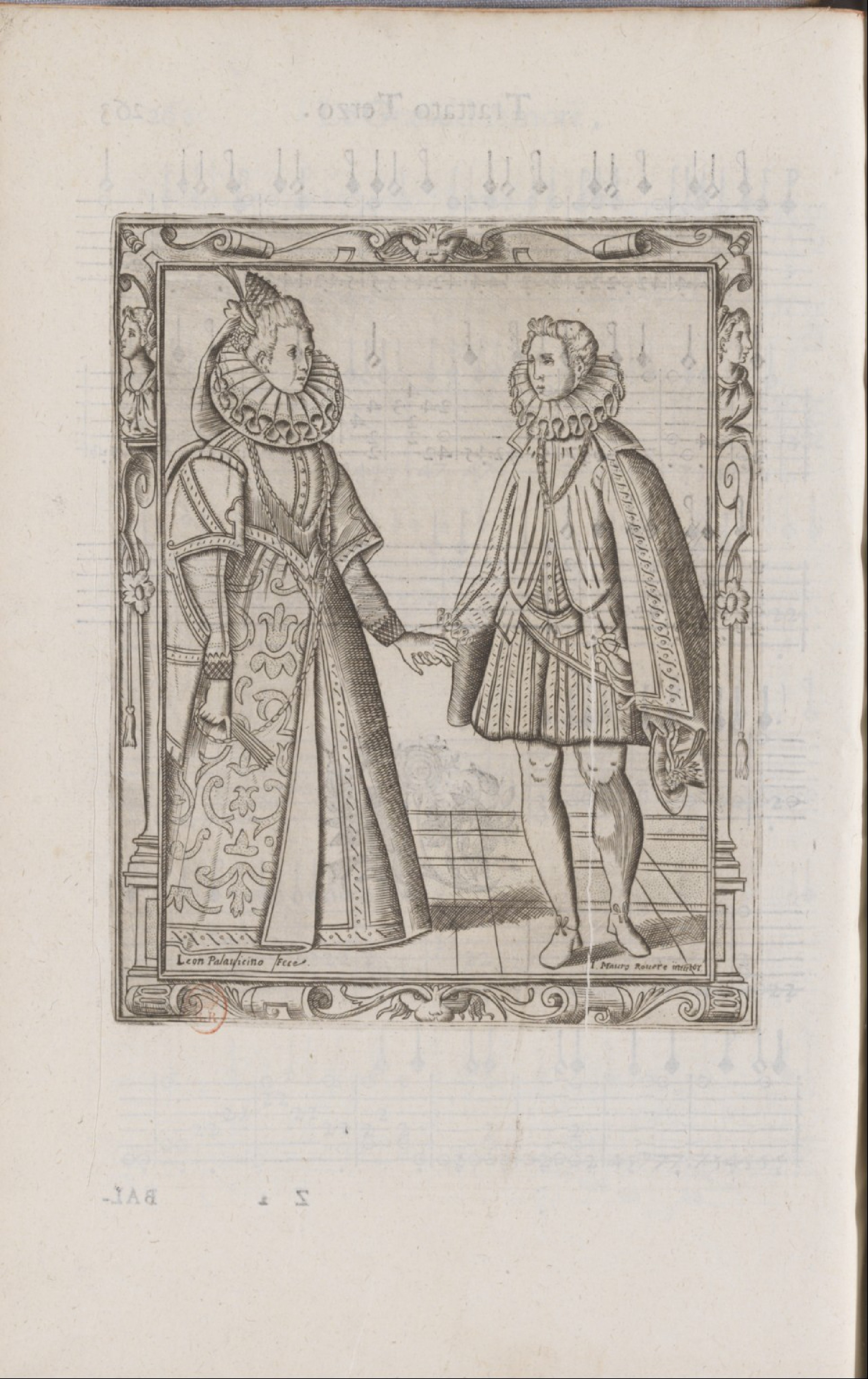
An engraved plate showing a richly dressed couple in a formal court setting, facing each other with hands joined in greeting or dance position. The woman on the left wears an elaborate gown with ornate patterning, a high ruff collar with radiating pleats, and an elaborate headdress; her long skirt falls to the floor with a train visible behind her. The man on the right is dressed in a doublet with puffed sleeves, close-fitting breeches, and a similar high ruff collar, holding what appears to be a feathered hat or plume. Both figures are poised in a moment of formal interaction—the touching of hands suggests either the opening gesture of a dance or a courtly salutation. The background is plain, and an ornamental border of scrollwork and classical motifs frames the entire composition. The artist's signature appears in the lower left.
The dancing
The couple stands in an upright, formal posture characteristic of court dancing, with their bodies angled slightly toward each other and hands meeting between them at approximately waist height. The woman's weight appears centered and her frame open; the man holds a relaxed, elegant stance. Both figures maintain the elongated, dignified carriage expected of Renaissance nobility. The precise hand position—neither in a tight grip nor fully extended—suggests either the opening position of a dance or the formal greeting that preceded it. The composition emphasizes symmetry and mutual respect between the partners.
The dance depicted
This is a document of Italian Renaissance court dance, one of a series of instructional plates from Cesare Negri's *Le Gratie d'Amore*, a foundational treatise on courtly dance. The couple is posed in what appears to be the opening or a key moment of one of the dances Negri taught and described in his text. The high ruffs, the formal hand position, and the enclosed setting are all markers of late 16th-century Italian court dance, including dances like the pavane, galliard, or volta that were central to courtly social life. Negri's plates function as both artistic portraits and instructional diagrams, freezing a moment of movement that readers would then practice from his written descriptions.
How it was made
This is an engraving, a printmaking technique that allowed Negri's treatise to be widely distributed across courts and noble households in Italy and beyond. The medium's precision and reproducibility made it ideal for instructional material: each copy could convey the exact proportions, costume details, and spatial relationships of the dance. The fine linear work in the background and the careful rendering of fabrics and ornament show the skill required to translate the three-dimensional body into a legible two-dimensional instruction. Engravings of this kind were far more accessible and economical than paintings, making Negri's knowledge portable.
About this work
This plate is one of twenty-one instructional dance figures from Cesare Negri's *Le Gratie d'Amore* (Milan, 1602), a landmark manual of Italian Renaissance court dance. Negri was the most celebrated dance master of his time, teaching nobility and royalty across Italy and France, and his treatise codified the techniques and social protocols of courtly dancing at the threshold of the modern era. The plate shows not a frozen narrative moment but a pedagogical diagram—a couple posed in the opening gesture of a specific dance, rendered with the elegance and precision required to communicate to aristocratic readers who would recognize themselves in the dress and bearing shown. It belongs here because it is one of the earliest systematic visual records of how European court dance actually looked in motion, combining portraiture, technical instruction, and social aspiration in a single image.
How to look at it
Notice first the hand position: the couple's fingers meet but do not clasp, a formal and respectful connection that governed Renaissance courtship and dance. Watch the posture—neither figure leans toward the other, and both maintain the upright alignment that was considered virtuous and noble. The ornament on the woman's dress is not decorative excess but a badge of wealth and status; the precision with which the engraver rendered it tells you something about the artwork's audience—these were people who recognized fine fabrics and wore them. Finally, observe the moment chosen: not a leap or a turn, but a greeting or opening, suggesting that Negri considered the social ritual of the dance as important as its physical virtuosity.
The artist
Cesare Negri (c. 1535–after 1604), called 'il Trombone' for reasons now lost, was the preeminent dance master of late Renaissance Italy. He taught at the Milanese court of the Gonzagas and traveled to France to instruct nobility, including members of the royal household. His *Le Gratie d'Amore* (1602), revised and reissued with additional material in 1604 as *Nuove Invenzioni di Balli*, was the most comprehensive and most influential dance treatise of the period. Unlike his predecessor Fabrizio Caroso, whose *Il Ballarino* (1581) focused primarily on written choreography, Negri gave equal weight to image and text, making his work a hybrid between art book and instructional manual. His legacy shaped ballroom dancing across Europe for the next two centuries.
The period
The early 17th century was the height of the Renaissance court dance in Italy, a moment when dance was recognized as an essential accomplishment of nobility and a key form of courtly sociability. The elaborate ruffs and doublets shown here date to the 1590s–1600s, the peak of Spanish-influenced court fashion. Negri's work appeared at a transitional moment: the stately pavane and galliard he documented were giving way to faster, more virtuosic dances like the volta and coranto, yet they remained the foundation of courtly education. In the world of printmaking, the early 17th century saw engravings become the dominant mode for distributing knowledge, outpacing manuscript circulation. Negri's choice to publish his dances as engravings was both artistic and strategic—it gave his method permanence and reach.
Where it lives
This engraving comes from the first edition of *Le Gratie d'Amore*, published in Milan in 1602 by Negri himself with engraving and printing by Leone Pacifico and other Milan-based craftsmen. It is one of twenty-one instructional plates in the treatise, each showing a couple or group in a specific dance figure. Copies survive in major libraries across Europe and North America; this example is held by the Library of Congress.
Dance in this work
Questions about this work
What dance are these two doing?
The plate does not identify which of Negri's dances is shown, and the moment frozen here—the hand touch—appears in multiple dances. Readers of Negri's text would have cross-referenced the plate with the written choreography to understand the full sequence of steps and turns. The formality and hand position suggest a pavane, galliard, or volta, the most prestigious court dances of the period.
Why are they not touching more closely?
Renaissance court dance maintained formal distance between partners, especially in the presence of others at court. Close embrace was not part of the aesthetic and would have been considered improper. The light hand touch shown here was the standard greeting and opening position, and partners might hold hands more firmly during certain movements like the volta, but formality governed most of the dance.
How do we know this is instructional and not just a portrait?
Negri published this plate as one of a series within his treatise, paired with written descriptions of the steps and music. The pose is generic and repeated across his plates—it represents a type of figure or moment rather than a unique person or event. The engraving's precision and its placement in a teaching manual confirm its instructional purpose.
Who was Cesare Negri and why is he important?
Negri was the most celebrated dance master of the late Renaissance, teaching nobility across Italy and France. His *Le Gratie d'Amore* was the most comprehensive printed guide to court dancing of its time, and his methods influenced dance instruction for over a century. He is important because he codified Renaissance dance at the moment of its greatest refinement and made that knowledge portable through print.
More Notation/Choreography artwork